The Hmar Tribe: Heritage, Cultural Resilience, and the Quest for Development in Modern India
Tucked away amidst the rugged, mist-clad hills of Northeast India Hmar Tribe lives an indigenous community whose history weaves together ancient oral epics, intricate textile artistry, egalitarian community values, and an enduring struggle for political and cultural self-determination. They are the Hmar—a recognized Scheduled Tribe in India, ethnically belonging to the greater Zo (Chin-Kuki-Mizo) family.
Thank you for reading this post, don't forget to subscribe!Spread across the contiguous hill regions of Manipur, Mizoram, Assam, Meghalaya, and Tripura, the Hmars have inhabited the Indo-Burma frontier for centuries. Yet, while their artistic traditions, folk songs, and democratic village ethos reflect deep cultural roots, their contemporary experience is defined by the complex realities of modern India: the lingering fractures of colonial boundary demarcation, educational triumphs set against economic isolation, ethnic tensions, and the urgent push to preserve ancestral customs within a hyper-connected digital world.
1. Historical Origins and the Legend of Sinlung
To understand the Hmar soul, one must look toward a fabled cradle named Sinlung.
Unlike communities whose pasts are preserved in stone tablets or monarchical chronicles, the early memory of the Hmar people lives in chanted oral poetry (Hla), proverbs, and genealogies recited across generations. According to tribal lore, their ancestors originated from a region called Sinlung—a name that resonates through traditional songs:
“Kei khaw lam thluai a, Sinlung lam thluai a;
Sinlung veng thim khati laia, ram an sawn nuam naw e.”
Historians, anthropologists, and tribal scholars propose varying theories regarding Sinlung’s geographical location:
The “Cave” or “Enclosure” Hypothesis: The word Sinlung literally breaks into Sin (close, cover, or enclose) and Lung (stone or cave). Early colonial ethnographers suggested ancestors sheltered in stone caves or fortified valleys to escape oppressive conquerors.
The Chinese Borderlands Theory: Many Hmar historians connect Sinlung to regions in southwestern China—specifically Sichuan or Yunnan—suggesting their ancestors migrated southward across the Chindwin and Irrawaddy river basins in Myanmar during imperial conflicts, eventually settling in the Chin Hills before moving westward into modern Northeast India.
From the Chin Hills, migrating Hmar clans advanced across the hills of modern Mizoram, the southern hills of Manipur (notably the area now designated as Pherzawl district), and the lush river valleys of Cachar and Dima Hasao in Assam. By the 18th and 19th centuries, the Hmars had established fortified hill settlements throughout these ridgelines, defending their sovereignty against neighboring principalities and early British survey expeditions.
2. Social Fabric, Clan Organization, and Village Democracy
Traditional Hmar society was organized not as a centralized kingdom, but as a federation of self-governing village communities. At its foundation were distinct clans—such as Lawnglai, Lungtau, Khawbung, Zote, Biete, Ngurte, Thiek, Darngawn, Hrangkhawl, and others—each tracing its lineage to a common patrilineal ancestor.
The Lal (Chief) and the Village Council
Every ancestral Hmar village was governed by a hereditary or selected chief known as the Lal, assisted by a council of elders called the Siehmang Upas. While the chief held administrative and territorial authority, he did not rule as an absolute autocrat:
Democratic Checks: If a chief ruled with cruelty or violated customary law (Dan), villagers reserved the right to migrate (insawn) to another chiefdom, effectively stripping the oppressive chief of his tribute and defensive numbers.
The Siehmang Upas: Councilors debated land allocations, settled interpersonal disputes, and negotiated peace pacts (remna) with external tribes.
The Thiempu (Priest/Healer): Before the arrival of Christianity, the village priest conducted propitiatory rites to appease forest spirits (ramhuai) and cure illnesses.
The Buonzawl: The Traditional Youth Dormitory
Central to ancient Hmar education and communal solidarity was the Buonzawl—the bachelor dormitory. Similar to the Morung of the Nagas or the Zawlbuk of the Mizos, the Buonzawl served as an indigenous civic academy:
[ Elders & Warriors ]
        │
   (Imparts History, Folk Hymns, Warfare & Customary Law)
        ▼
   [ The Buonzawl ]
        │
   (Youth Mobilization & Civic Duty)
        ▼
[ Village Defense, Firefighting, Community Farming & Funerals ]
Young men slept in the Buonzawl once they reached adolescence. Here, elders taught them wrestling, hunting techniques, customary law, oral genealogy, and musical instruments. If an elderly widow needed firewood, or if a fire broke out in the dry season, the Buonzawl youths were the first to respond. This institution instilled a lifelong code of conduct: Tlawmngaina—an untranslatable ethic of altruism, humility, valor, and putting the welfare of others before oneself.
3. Cultural Heritage: Festivals, Dances, and Handloom Arts
The artistic expressions of the Hmar people reflect an agrarian hill community deeply attuned to the cycles of the earth.
The Major Festivals
Farming by Jhum (shifting slash-and-burn cultivation) dictated the ritual calendar:
Sikpui Ruoi (Winter Harvest Festival): The premier cultural festival of the Hmar community. Historically celebrated during a year of peace and bumper harvest, Sikpui Ruoi is marked by communal singing, grand feasts, and the performance of sacred dances. The festival rekindles connections with ancestral roots, emphasizing friendship, thanksgiving, and reconciliation.
Butukhuonglawm: A celebration marking the completion of field weeding, bringing together young men and women for music and community meals.
Chawnglaizawn: Celebrated during moments of triumph, hunting milestones, or agricultural prosperity, characterized by dynamic drumbeats and pipe melodies.
Traditional Dances and Folk Music
Dance among the Hmars is a collective, rhythmic celebration rather than an individual exhibition. Key dance forms include:
Dar Lam: The dance of the gongs, where brass gongs (Darkhuang) provide a steady tempo as dancers move in circular formations.
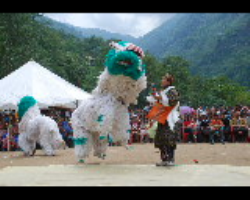
Chawnglaizawn Dance: Performed with colorful handwoven shawls draped over shoulders, moving to the beat of wooden drums (Khuong) and mithun horn trumpets.
Handlooms and Textiles: The Language of Puan
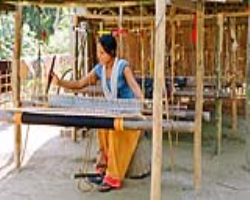
The women of the Hmar community are master weavers, converting local cotton and yarns into complex textiles using traditional loin looms and waist-frame fly-shuttles. A Hmar woman’s skill on the loom was historically considered a core mark of refinement and domestic leadership.
Textile Name Visual Characteristics Cultural Significance & Usage Textile Name Visual Characteristics Cultural Significance & Usage Hmaram White base, stark black borders, fine multicolored horizontal stripes One of the oldest ancestral weaves; worn by women during festivals and ceremonies. Thangsuo Puan Bold black, red, and white geometric bands An elite cloth reserved historically for men who achieved hunting or warrior honors (Thangsuo). Puandum Deep black ground punctuated by red, green, and yellow bands Worn during formal mourning, weddings, and key community milestones; carries deep emotional weight. Each pattern, thread count, and motif reflects hours of back-strap loom work. Today, young Hmar designers are translating these traditional patterns into contemporary jackets, scarves, and bags, seeking sustainable livelihoods while preserving indigenous intellectual property.
4. The Watershed Transition: Missionary Contact and Christianity
No analysis of modern Hmar society is complete without examining the transformational impact of Christian missionaries in the early 20th century.
In 1910, a Welsh Presbyterian missionary named Watkin Roberts arrived in Senvawn, a prominent Hmar village in southern Manipur, carrying copies of the Gospel of John translated into the Lushai/Mizo dialect. The arrival of the Christian gospel—locally remembered as Chanchintha lut—fundamentally transformed Hmar society within two generations:
Eradication of Headhunting & Inter-Clan Warfare: Ancient feuds between disparate hill clans gave way to an overarching, shared Christian brotherhood.
Literacy and Roman Script: Christian missionaries, working closely with native pioneers like H.K. Dohnuna and Rochunga Pudaite, introduced the Roman alphabet to transcribe the oral Hmar language. The Hmar Bible, published through the monumental translation efforts of Rochunga Pudaite, standardized the written language and ignited widespread literacy.
Dissolution of Animist Taboos: Ancient animal sacrifices (Inthawina) to avert forest spirits ceased, diverting household wealth toward children’s education and sanitation.
Decline of the Buonzawl: While schools, church youth fellowships (Thangthar Pawl), and Sunday schools replaced the Buonzawl’s instructional role, the sudden departure of traditional dormitories led to the erosion of some ancestral woodcraft, hunting lore, and oral chants.
Today, virtually the entire Hmar population practices Christianity, largely within Presbyterian, Baptist, and Independent Church denominations. The church serves as the central hub of community life, organizing welfare drives, relief for displacement victims, musical training, and social gatherings.
5. Human Development: Education, Health, and Rural Economy
When viewed through human development metrics, the Hmar tribe presents an intriguing paradox common to many hill communities in Northeast India: high educational attainment juxtaposed with severe infrastructural and economic underdevelopment.
Educational Attainment
Due to the early establishment of mission schools, the Hmars boast literacy rates consistently above the national average—often exceeding 80–85% in both rural and semi-urban pockets. Fluency in English and tribal vernaculars has enabled young Hmars to gain admission into India’s premier central universities (Delhi University, JNU, NEHU) and secure competitive placements in civil services, corporate sectors, academia, and defense forces.
The Struggles of Rural Healthcare
In stark contrast to literacy levels, primary healthcare in ancestral Hmar hill tracts remains precarious:
The Remoteness Penalty: In districts like Pherzawl (Manipur) or rural pockets of Dima Hasao (Assam), reaching a functional Community Health Centre (CHC) or district hospital can require an 8-to-12-hour journey over unpaved, mud-slicked mountain roads.
Maternal Health: Expectant mothers often lack access to emergency obstetric care, requiring communities to carry emergency patients on makeshift bamboo stretchers (zawn) across swollen rivers during monsoon washouts.
Manpower Deficits: Government healthcare centers frequently suffer from chronic shortages of doctors, technicians, and essential medications due to the isolation of postings.
Agriculture and the Economic Conundrum
The bulk of rural Hmar households remain dependent on subsistence agriculture:
Jhum vs. Settled Cultivation: While environmental agencies advocate for settled terrace farming, the steep terrain of the Hmar hills makes terrace preparation labor-intensive and costly. Shifting cultivation remains widespread, though shortened fallow cycles have diminished crop yields.
Cash Crops and Horticultural Potential: The Hmar hills yield high-quality organic ginger, king chili (Bhut Jolokia), turmeric, pineapples, and oranges. However, due to the lack of cold-storage units, food-processing plants, and fair supply chains, farmers often fall prey to exploitative middlemen or watch bumper crops rot at farm gates when landslides block national highways.
6. Political Fragmentation and the Struggle for Autonomous Governance
The defining socio-political tragedy of the Hmar tribe stems from the geopolitical borders drawn during British colonial administration and formalized post-Indian independence.
Territorial Division
Rather than inhabiting a single consolidated administrative district, the Hmar population was partitioned across three distinct state boundaries:
Manipur: Predominantly in the southwestern hills (Pherzawl District, Churachandpur District, and Jiribam).
Assam: Primarily in the Dima Hasao hill district and the Cachar plains.
Mizoram: Concentrated in the northern border villages (Sakawrdai, Vaitin, Sinlung Hills area).
This division reduced the Hmars to a demographic minority within each respective state framework. Cut off from one another by state borders, their political leverage was diluted, making comprehensive socio-economic development and infrastructure allocation an ongoing struggle.
The Quest for Autonomy
To safeguard their land tenure, language, and cultural survival, Hmar leadership has launched several political campaigns since India’s independence:
[ 1980s: Rise of Insurgency ]
  └─ Formation of Hmar People's Convention (HPC)
  └─ Armed struggle demanding autonomy under the Sixth Schedule

[ 1994: The HPC-Mizoram Accord ]
  └─ Signing of peace agreement
  └─ Creation of Sinlung Hills Development Council (SHDC)

[ 2018: Upgradation to SHAC ]
  └─ Reconstitution into Sinlung Hills Autonomous Council (SHAC)
  └─ Dedicated administrative budget, though full Sixth Schedule parity remains pending
The Sinlung Hills Autonomous Council (SHAC) in Mizoram: Following an armed insurgency spearheaded by the Hmar People’s Convention (HPC) in the late 1980s and early 1990s, peace accords were signed with the Mizoram state government. This led first to the Sinlung Hills Development Council in 1994, and subsequently to the elevated Sinlung Hills Autonomous Council (SHAC) in 2018. While this council oversees cultural affairs and local development works, community leaders continue to seek full constitutional protection under the Sixth Schedule of the Indian Constitution.
The Autonomous District Council Struggle in Assam: In Assam’s Dima Hasao, Hmars navigate power-sharing arrangements alongside the Dimasa and other indigenous tribes. In the Cachar plains, organizations like the Hmar Inpui continually lobby for the creation of an autonomous regional council to protect their lands from encroachments.
The Administrative Void in Manipur: In Manipur, the Hmars long campaigned for their own administrative unit, culminating in the formal bifurcation of Churachandpur district to create Pherzawl District in December 2016. However, infrastructure delivery to this new district headquarters remains an uphill battle, compounded by ongoing ethnic unrest in the state.
7. The Human Cost of Conflict: Displacement and Ethnic Polarization
Living in the ethnically complex borderlands of Northeast India has exposed the Hmar community to cycles of violent ethnic conflict and forced displacement.
The Dimasa-Hmar Clashes (2003)
In the early 2000s, escalating territorial and insurgent frictions in the North Cachar Hills (now Dima Hasao) of Assam erupted into violent clashes between Dimasa and Hmar groups. Scores of villages on both sides were razed, leading to human casualties and driving thousands of Hmar families into relief camps in neighboring Cachar and Mizoram. It took years of inter-tribal peace summits and civil-society dialogues to rebuild basic neighborly relations.
The Manipur Crisis and Its Repercussions
More recently, the widespread ethnic violence that erupted in Manipur in May 2023 between the Meitei community of the Imphal Valley and the Kuki-Zo hill tribes (of which the Hmars are an integral branch) has upended the community’s stability:
Physical Displacement: Hundreds of Hmar families residing in the peripheral valleys, Jiribam, and Imphal were forced to flee their homes, schools, and workplaces, seeking refuge in Mizoram, Assam, and deep within the southern hill sanctuaries.
Disruption of Education: An entire generation of college and school students saw their academic pipelines severed overnight, forcing student unions to improvise remote classrooms and seek emergency admissions in other Indian states.
Deepened Alienation: The crisis has intensified calls among the Hmar, Paite, Thadou, Vaiphei, and allied tribes for a Separate Administrative Unit (Union Territory with legislature) under the Indian Constitution, arguing that living alongside majoritarian valley governance is no longer viable.
8. Preserving Identity in the Digital Age: Youth, Diaspora, and Revitalization
Amid political displacement and modern urbanization, the Hmar tribe is witnessing a grassroots cultural renaissance driven largely by educated youth, digital technology, and community-led initiatives.
The Diaspora and the “Virtual Village”
Today, thousands of young Hmars reside in metropolitan centers like Delhi, Bengaluru, Mumbai, Shillong, and Guwahati, working in IT, aviation, hospitality, and civil administration. To combat the risk of linguistic assimilation, the community has built a vibrant digital ecosystem:
Online Lexicons and Literature: Digital portals such as Virthli and various community social channels provide daily news, traditional essays, and language resources to diaspora members worldwide.
Weaving Economics and Sustainable Fashion
Young Hmar fashion entrepreneurs are reviving traditional loin-loom weaving through ethical, direct-to-consumer models:
By establishing weaver collectives in rural Manipur and Assam, these initiatives pay fair wages to village artisans.
Traditional motifs—like the chevron patterns of the Thangsuo or the disciplined stripes of the Hmaram—are being woven into contemporary jackets, table runners, and laptop sleeves, introducing tribal artistry to national and international markets.
The Role of Apex Bodies
Organizations like the Hmar Inpui (Supreme Customary Council), the Hmar Women’s Association (HWA), and the Hmar Students’ Association (HSA)—one of the oldest tribal student unions in Northeast India, founded in 1939—play a stabilizing civic role:
Conflict Resolution: Mediating community differences and providing neutral, non-violent advocacy during times of regional tension.
Humanitarian Aid: Organizing food supply corridors, medical camps, and refugee shelter logistics during seasonal floods or communal unrest.
Cultural Archiving: Documenting customary laws, folklore, and medicinal plant knowledge before the remaining elders pass away.
The Road Ahead for the Hmar Tribe
The journey of the Hmar community captures the broader indigenous narrative of modern India: the challenge of holding onto a distinct cultural identity while striving for economic and political parity within a large, diverse democracy.
To secure a just and stable future for the Hmar people, focused policy interventions are needed:
Infrastructure Connectivity: Building reliable all-weather roads and digital telecom infrastructure in remote hill districts like Pherzawl and the Sinlung Hills to end geographical isolation.
Decentralized Democratic Autonomy: Strengthening local governance institutions—such as the Sinlung Hills Autonomous Council in Mizoram and granting constitutional self-governance guarantees to Hmar-inhabited pockets in Assam and Manipur.
Agro-Horticultural Value Addition: Establishing cold-storage hubs and ginger/turmeric processing units to turn subsistence hill farming into a sustainable commercial engine.
Cultural Preservation and Intellectual Property: Securing Geographical Indication (GI) tags for authentic Hmar handloom textiles (Puan) and funding bilingual tribal education programs to protect their ancestral language.
The Hmar people have repeatedly shown an ability to adapt—transitioning from ancient forest migrations and the code of the Buonzawl to academic halls and digital communities. Their history demonstrates that indigenous traditions and modern progress need not stand in opposition; when given peace, self-respect, and constitutional support, tribal cultures can enrich the broader mosaic of the nation.