


Myanmareritage, Culture, and Modern Struggles of the Hrangkhwal Tribe
Northeast India is an extraordinary mosaic of cultures, languages, and ethnic traditions. Among the mist-covered valleys of Tripura and the rugged terrain of Assam’s Dima Hasao district lives a small, fiercely resilient Indigenous community: the Hrangkhwal (often spelled Hrangkhol or Hrangkhawl).
Thank you for reading this post, don't forget to subscribe!As part of the broader Tibeto-Burman linguistic and ethnic continuum, the Hrangkhwals have maintained a rich oral literature, an intricate social structure, vibrant folk dances, and sacred seasonal rituals. Yet, like many small tribal communities across modern India, they face urgent questions of identity, socioeconomic marginalization, language endangerment, and the delicate balance between ecological heritage and modern developmental imperatives.
Who Are the Hrangkhwal? Demographics and Geographical Footprint
-
Tripura: The community has notable concentrations in the Dhalai and Khowai districts, residing within villages like Kamalacherra, Ambassa, and adjoining hilly tracts. Under Tripura’s state administration and the Tripura Tribal Areas Autonomous District Council (TTAADC), they are classified under the Scheduled Tribe framework.
-
Assam: In Assam, their primary ancestral home is nestled within the Dima Hasao district (formerly North Cachar Hills).
-
Mizoram and Manipur: Smaller, dispersed populations live along neighbouring border belts, tracing kinship lineages back through shared migratory routes.
Because of their small population—estimated at roughly 18,000 to 25,000 individuals across India—the Hrangkhwals are frequently overshadowed by larger ethnic blocs such as the Tripuris, Dimasas, and Mizos. This demographic scale makes the preservation of their unique social fabric and material culture especially urgent.
Historical Roots and Oral Genealogies
Unlike communities with ancient written epics, the historiography of the Hrangkhwal relies primarily on rich oral genealogies passed down by elders through memory and song.
Colonial-era ethnographers classified the Hrangkhwal among the “Old Kuki” groups who moved westward into the hills of Cachar and the Princely State of Hill Tipperah earlier than the “New Kuki” (Thadou-speaking) groups. Local lore connects their ancient origins to legendary ancestral caves or subterranean settlements, often referred to conceptually alongside regional traditions of Sinlung or Khul.
Throughout their history, the Hrangkhwals navigated shifts in regional alliances. In Tripura, they entered into customary allegiances with the Manikya kings, offering forest defence and tribute while maintaining village autonomy. In Assam, their settlements operated as self-reliant hill communes navigating interactions with the Dimasa Kachari Kingdom and later British frontier administrations.
Kinship, Governance, and Social Organisation
The Hrangkhwal social system balances strict clan cohesion with collective community support.
Clan Dynamics and Lineage
The community is organized patrilineally into exogamous sub-clans. Kinship rules dictate clan exogamy, meaning marriage within the same immediate clan is traditionally forbidden to preserve social equilibrium and prevent domestic taboos.
Major life milestones—birth, naming ceremonies, coming of age, and death—demand the presence of clan kin:
-
Birth and Confinement: Traditional practices observe a period of post-natal seclusion for the mother and child, with ritual purifications ensuring spiritual protection against hostile forest energies.
-
Matrimonial Traditions: Marriage alliances involve traditional negotiations led by family elders. Customary bride wealth (Man) serves not as a commercial transaction, but as a symbolic gesture of respect honoring the bride’s household, cementing peace between families, and establishing mutual responsibilities.
Traditional Village Governance
Hrangkhwal villages were historically governed by a village headman, supported by a council of elders (Karbari or equivalent village head depending on the district). The council mediated disputes over land boundaries, interpersonal conflicts, and seasonal hunting areas. Decisions prioritized consensus and community harmony over punitive retribution.
Communal Labor: The Cooperative Workgroup
Central to traditional Hrangkhwal social life is the communal labor collective (comparable to the Lawm found in related hill communities). Unmarried youth and young adults work collectively across village agricultural plots. Rather than relying on wage labor, the village clears, burns, weeds, and harvests jhum fields together, rotating through households in turn. This system weaves economic production directly into youth camaraderie and social bonding.
Cultural Tapestry: Language, Attire, and Material Craft
The Hrangkhwal Language
Because it developed within oral traditions, it historically lacked an Indigenous writing script. In recent decades, missionary education and cultural societies have used the Latin script for literacy efforts and primers. However, Tezpur University’s Centre for Endangered Languages has identified Hrangkhwal as a vulnerable language due to the shrinking number of fluent mother-tongue speakers.
Textile production remains an expressive hallmark of Hrangkhwal cultural identity. Weaving is carried out predominantly by women using traditional waist-looms (backstrap tension looms).
-
Patterns and Dyes: Woven shawls (Puan) and wraparounds feature bold geometric configurations, contrasting stripes, and motifs inspired by regional fauna, river bends, and jungle flora.
-
Natural Pigments: Traditionally, yarn was dyed using vegetable matter, wild madder, and crushed leaves before commercial thread entered regional bazaars.
-
Status and Symbolism: Certain woven textiles are reserved for festive rites or gifted to village elders and newlyweds as heirlooms.
Bamboo and Wood Engineering
Living in biodiverse forest ecosystems, the Hrangkhwal developed advanced bamboo-craft technologies:
-
Stilt Architecture (Tong-Ghar): Houses are elevated on sturdy timber or bamboo pilings to guard against damp ground, torrential monsoon runoff, and wild animals. Split bamboo forms flexible, breathable flooring and walls, capped by thick thatched wild grass roofs.
-
Baskets and Traps: Elaborate carrying baskets (Doko-style conical carriers), storage granaries, and riverine fish traps reflect sophisticated ecological engineering using bamboo cane.
Spiritual Universe, Rites, and Festivals
The cosmological view of the Hrangkhwal blends deep-rooted animistic traditions with spiritual layers adopted over the past century through contact with Hinduism and Christianity.
Traditional Hrangkhwal Cosmology│┌────────────────────────────┼────────────────────────────┐▼ ▼ ▼Pathian / Supreme Creator Forest Spirits & Deities Ancestral Reverence(Universal Sovereign) (Sacred Groves & Waterways) (Rites of the Hearth)
The Indigenous Pantheon
Before widespread missionary encounters in the twentieth century, the Hrangkhwal worldview held that the cosmos was filled with spirits (Hrai or Dawi) residing in natural elements—tall trees, boulder formations, water bodies, and mountain gaps. At the apex stood a supreme creator god (Pathian), while village priests performed animal sacrifices and herb rituals to placate local forest forces, avert sickness, and ensure bountiful crops.
Key Festivals
Festivals structure the agricultural calendar, moving with the rhythms of clearing, sowing, and harvesting crops.
-
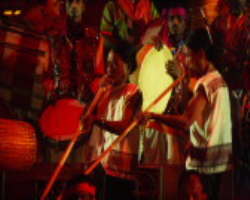
Rualsafak: The major post-harvest thanksgiving celebration. After rice, millet, and sesame are harvested from jhum clearings, villages gather for shared communal feasts. Men beat large hollow wooden drums (Khuang) and blow traditional wind horns, while women and men dance in circular formations. Songs narrate heroic journeys, historical migrations, and prayers for village prosperity.
-
Parsem Kut: A vibrant spring festival welcoming the flowering season. Emphasising fellowship, community reconciliation, and thanksgiving, young villagers dress in full traditional attire, exchange prepared foods, and perform folk dances.
Economic Foundations: Jhum Cultivation and Livelihoods
For generations, the Hrangkhwal economy was defined by subsistence shifting cultivation (Jhum), foraging, and small-scale domestic animal husbandry.
-
Clearing and Slashing (December–February): Hillside plots are selectively cleared of undergrowth, leaving large tree trunks to prevent soil erosion.
-
Controlled Firing (March–April): Dried biomass is burnt under careful supervision. The resulting ash layer provides essential nutrients for thin hill soils.
-
Multi-Crop Sowing (April–May): Seeds of upland paddy, maize, squash, tubers, ginger, and chilies are sown together using simple dibbling sticks.
-
Harvesting (August–November): Crops ripen successively, providing diverse nutrition over several months and buffering families against single-crop failure.
Shifting Realities and Modern Livelihood Strains
Traditional jhum systems were historically sustainable when long fallow cycles (15 to 20 years) allowed secondary forests to regenerate completely. Over recent decades, however, population growth, land alienation, and forest conservation borders have compressed fallow cycles down to 3 to 5 years.
This drop leads to soil exhaustion, declining crop yields, and heavier labour demands for weeding. As a result, younger Hrangkhwals are increasingly transitioning away from subsistence jhum to settled horticulture (rubber, betel nut, and banana plantations), manual day labour, or migration to urban centres.
Comparative View: Hrangkhwal and Regional Tribal Neighbors
To better understand where the Hrangkhwal fit within Northeast India’s ethnic tapestry, this comparison highlights their traditions alongside neighboring communities:
| Cultural Dimension | Hrangkhwal Tribe | Tripuri (Debbarma) | Dimasa Community |
| Primary Region | Tripura (Dhalai/Khowai) & Assam (Dima Hasao) | Tripura plains and rolling hills | Assam (Dima Hasao, Karbi Anglong, Cachar) |
| Language Lineage | Sino-Tibetan (Kuki-Chin sub-branch) | Sino-Tibetan (Bodo-Garo / Kokborok sub-branch) | Sino-Tibetan (Bodo-Garo sub-branch) |
| Traditional Economy | Jhum cultivation, forest foraging, weaving | Settled wet-rice farming, mixed agroforestry | Valley terrace farming, jhum cultivation |
| Prominent Festival | Rualsafak, Parsem Kut | Garia Puja, Kharchi Puja | Bushu Dima |
| Social Organization | Exogamous patrilineal clans; village elder council | Patrilineal clans; historically royal administrative tiers | Double-descent clan system (Sengphong & Jaddi) |
Human Development and Challenges in Modern India
Despite India’s broader economic growth, small hill tribes like the Hrangkhwal face structural disadvantages that affect day-to-day well-being.
Educational Infrastructure and Mother-Tongue Learning
While basic literacy rates have improved over the past two decades thanks to government and mission schooling, educational outcomes remain uneven:
-
The Mother-Tongue Divide: In government schools, instruction is delivered in Bengali, Assamese, English, or Kokborok. Hrangkhwal children encounter formal education in a non-native language, creating early learning barriers and driving up dropout rates during the middle-school transition.
-
Higher Education Access: Pursuing higher education or vocational skills requires youth to leave their hill villages for cities like Agartala, Silchar, or Guwahati. The associated costs for room and board place high financial strain on farming families.
Healthcare, Nutrition, and Infrastructure
Villages tucked away in remote hill areas face persistent infrastructure gaps:
-
Medical Desertification: Primary Health Centers (PHCs) often lack doctors, diagnostic equipment, or reliable electricity. Reaching an emergency obstetric center or treating acute illnesses during the monsoon can require traveling over unpaved, flood-prone roads.
-
Maternal and Child Nutrition: Chronic iron-deficiency anemia and stunting remain persistent public health concerns, exacerbated by shifts away from wild-foraged foods toward refined market staples.
Land Rights and Forest Entitlements
The enforcement of the Scheduled Tribes and Other Traditional Forest Dwellers (Recognition of Forest Rights) Act (FRA), 2006 remains uneven. Hill forest lands often sit in administrative overlap between Forest Department reserves, Autonomous District Councils, and customary holdings. Without clear, formal title deeds, families face tenure insecurity that limits their access to institutional farm credit and government agricultural subsidies.
Cultural Attrition and Linguistic Endangerment
With fewer than 25,000 total speakers, the Hrangkhwal language faces mounting pressure. As young people migrate toward commercial centers for employment, dominant regional languages often replace the native tongue in everyday settings. Without institutional codification, school curricula, or state broadcast media, their oral traditions risk fading across generations.
The Path Forward: Conservation, Autonomy, and Policy Priorities
Ensuring a secure future for the Hrangkhwal requires balanced, targeted policy interventions that respect Indigenous autonomy while expanding economic opportunity.
1. Linguistic Documentation and Mother-Tongue Early Education
-
Foundational Learning Primers: Working in partnership with tribal cultural councils, state education boards should develop early-childhood learning materials that blend Latin-script Hrangkhwal primers with bilingual state-language bridges.
-
Oral History Archives: State universities and tribal research centers should document elders’ folk songs, healing traditions, and village histories in accessible digital repositories.
2. Sustainable Agroforestry and Value-Chain Development
-
Shifting away from pure subsistence jhum does not require clearcutting hills for mono-crop plantations. Agroforestry models that blend native tree cover with organic cash crops (such as king chili, ginger, black pepper, and high-altitude turmeric) can protect hill slopes while generating dependable household income.
-
Forming Tribal Farmer Producer Organizations (FPOs) can help local growers bypass predatory middlemen and market forest produce directly.
3. Enhancing Local Governance Under Sixth Schedule Frameworks
-
Administrative bodies such as the Tripura Tribal Areas Autonomous District Council (TTAADC) and the North Cachar Hills Autonomous Council (NCHAC) must guarantee institutional voice and development funding for numerically small tribes, preventing political monopolization by larger regional voting blocs.
-
Village councils should receive dedicated rural development allocations to build local solar microgrids, all-weather link roads, and solar-refrigerated village dispensaries.
4. Supporting Handloom Heritage
-
The intricate handloom traditions of Hrangkhwal weavers can be integrated with ethical handloom cooperatives, access to credit, and national design platforms. Direct producer-to-consumer partnerships can turn traditional textile artistry into a sustainable livelihood for rural women without losing touch with customary designs.
The Hrangkhwal people are guardians of an ecological philosophy, social resilience, and textile heritage that have sustained life across the hills of Northeast India for generations. Recognizing their distinct identity within national tribal development policies is essential to building an inclusive, pluralistic society where numerically vulnerable communities can thrive on their own terms.