


Guardians of the Hidden Valley: Inside the Culture, Faith, and Modern Struggles of the Khamba Tribe
Along the high, mist-shrouded gorges where the Tsangpo river loops violently southward to become the Siang in northern Arunachal Pradesh lies a land veiled in both sacred myth and geographical isolation. Here, tucked deep inside the Upper Siang district along the Yang Sang Chu river valley, lives one of India’s most resilient yet least known indigenous border communities: the Khamba tribe.
Thank you for reading this post, don't forget to subscribe!Living in high-altitude hamlets near the Indo-Tibetan frontier—such as Tashigong, Mankota, Yortong, Nyukong, and Lango—the Khamba number merely between 1,000 and 2,000 souls. In official anthropological records and public discourse, they are often overshadowed by larger regional tribes like the Adi or their close cultural kin, the Memba. Yet, the Khamba represent a vital thread in India’s multi-ethnic tapestry. They are custodians of the sacred Beyul Pemako—a hidden land of refuge blessed by Guru Padmasambhava—maintaining a delicate equilibrium between Tibetan Mahayana Buddhism, ancient animist sensibilities, and an agrarian subsistence life balanced on the razor edge of ecological change and border geopolitics.
Understanding the Khamba is not merely an academic exercise in Himalayan ethnography; it is an intimate look at the human stakes of modern tribal development in India. How does a micro-minority preserve its linguistic identity, oral memory, and mountain autonomy when highways, hydroelectric mega-projects, digital transitions, and climate shifts arrive all at once?
The Landscape of Beyul: Homeland of the Khamba
To understand the worldview of the Khamba, one must first understand their terrain. The Yang Sang Chu valley—often referred to locally as the Yongyap valley—is steep, rugged, and characterized by dense temperate-to-alpine forests, thundering glacial rivers, and near-perpetual cloud cover.

In Tibetan Buddhist sacred geography, this pocket of Upper Siang is venerated as a hidden paradise (Beyul), a sanctified sanctuary consecrated in the 8th century by Guru Rinpoche (Padmasambhava) to shelter the faithful during epochs of chaos and spiritual degeneration. For centuries, the Khamba have lived not as mere extractors of mountain resources, but as consecrated stewards of a sacred topography. Every mountain peak is home to a protective deity; every pristine tributary of the Yang Sang Chu is an artery of life that demands reverence. The villages sit perched on mountain shelves high above treacherous ravines. Settlements are deliberately planned around community life and mutual defense against the brutal elements. The architecture reflects an intimate adaptation to the Eastern Himalayan climate:
-
Raised Platforms: Houses are elevated off the damp, sloping ground on wooden stilts, keeping grain and living quarters dry from torrential monsoons.
-
Organic Materials
: Walls are carefully crafted with split bamboo, timber frames, and thatched or wooden-shingle roofs engineered to shed heavy snow and rain. -
The Central Hearth: The focal point of every Khamba home is the traditional oven and hearth (chulha), functioning simultaneously as a cooking fire, water purifier, space heater, and gathering place for cross-generational storytelling during sub-zero winters.
Historical Roots and Ethnological Identity
Oral traditions among Khamba elders trace their ancestral lineage across the trans-Himalayan plateau, indicating migration routes southward through high mountain passes into the verdant valleys of the Siang prior to modern international cartography. Anthropologically, the Khamba belong to the wider Bodhic ethnic umbrella of the Eastern Himalayas, closely affiliated with the neighboring Memba of the Mechuka and Tuting valleys.
However, calling them a mere sub-group erases critical distinctions:
While the community maintains distinct linguistic features and ancestral pride, they have coexisted for generations alongside Adi and Mishmi populations. Historically, this contact generated complex networks of barter trade, where salt, Tibetan wool, iron implements, and medicinal mountain herbs were exchanged across mountain paths for lowland cane, raw cotton, and riverine goods.
Spiritual Fabric: Where Tantric Buddhism Meets Living Animism
The religious life of the Khamba is often cataloged simply as “Mahayana Buddhism” or “Lamaism.” In reality, their lived spirituality is a syncretic worldview where formal Vajrayana teachings exist hand-in-hand with an older, earth-centric animism. Each Khamba village features a local Buddhist monastery or prayer house (Gompa), with revered centers such as the Devekota Gompa in Mankota standing as pilgrimage sites for both locals and discerning travelers. Monks (Lamas) are community anchors—not merely spiritual leaders, but arbitrators of dispute, keepers of genealogical calendars, healers, and schoolteachers of ethical conduct. The people adhere earnestly to fundamental Buddhist scriptures like the Tripitaka and daily observances of ethical conduct (Panchasheel and Ashtasheel).
Yet underneath the soft drone of copper prayer wheels and fluttering prayer flags (lungta), the forest remains populated with territorial spirits, river demons, and protective clan ancestors. When a Khamba villager clears a terrace for terrace cultivation or hunts deep in the oak forest, prayers are whispered to appease the forest guardian. Spiritual harmony is not achieved by defeating nature, but by maintaining an unwritten contract of respect between humans, wild beings, and unseen spirits.
Sacred Dances and Ritual Pantomime
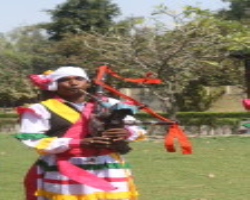
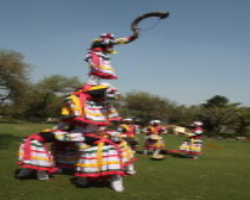
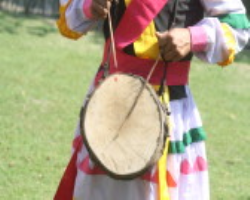
During celebrations such as Drubachuk and Trinda Chichuk, this syncretism takes theatrical shape in sacred masked dances (pantomimes). The air fills with the deep, resonance of brass horns (dungchen), cymbals (rolmo), and handheld drums (damaru).
A central cultural performance is Guru Chenji, a ritual dance-drama where performers don hand-carved wooden masks to enact the deeds of nine historic Buddhist preceptors. With deliberate, sweeping footwork and vibrant brocade robes, the dancers ritually banish malignant energies, restore cosmic equilibrium, and offer collective petitions for bumper harvests, the fertility of livestock, and protection against disease for both humans and wildlife.
Social Structure, Craft, and the Material Culture of Resilience
Khamba society is organized along egalitarian clan lines, devoid of the rigid caste hierarchies characteristic of mainland India. Community cohesion is reinforced by collective labor institutions: when a villager builds a timber house or clears a mountain slope, neighbors pitch in without cash wages, rewarded with communal meals, butter tea, and locally brewed millet beer (chhaang).
The Gendered Architecture of Craftsmanship
Material culture among the Khamba is defined by utility, aesthetic dignity, and zero waste:
-
Textiles and the Tension Loom: Khamba women are weavers of high repute. Using backstrap tension looms (often termed Indonesian or loin looms), they produce durable, dense fabrics using local fibers and wool. The Khamba carpet-weaving tradition features intricate geometric borders and stylized dragon motifs (Druk) inherited from Himalayan iconography, reflecting their historic lineage.
-
Bamboo and Cane Artistry: The men possess mastery over raw cane and bamboo. Because the subtropical slopes around the Yang Sang Chu are rich in versatile bamboo varieties, everything from conical load-carrying baskets (solung/kho) to rain hats, winnowing trays, mats, and animal traps is hand-split, woven, and fire-cured.
-
Village Blacksmiths: Blacksmiths maintain a revered position. Using open-air bellows and stone-anvil forges, they fashion the iron tools critical for mountain survival: broad daos (machetes used for clearing brush, butchery, and carpentry), sickles, adzes, and hoes.
Agrarian Lifeways
The economic life of the Khamba remains deeply tied to subsistence agriculture. Due to the steep topography, agriculture demands extraordinary physical stamina:
-
Terrace and Sloping Fields: The community cultivates hill slopes and river shelves, balancing slash-and-burn shifting agriculture (Jhum) with permanent terrace cultivation.
-
Crop Diversity: Maize and paddy serve as staple dietary crops. They are supplemented by resilient cold-climate grains like barley, buckwheat, finger millets, Job’s tears (Coix lacryma-jobi), and an assortment of tubers and seasonal leafy vegetables.
-
Pastoral Rearing: Khamba families rear cows, domestic pigs, and the magnificent semi-wild bovine known across Northeast India as the Mithun (Bos frontalis). The Mithun is not a draft animal; it serves as a measure of household wealth, traditional currency for bridal exchange, and ritual currency in major community rites.
The Crisis of Silence: Language and Orality Under Threat
The Khamba language (ISO 639-3 code: kbg) belongs to the Bodish sub-group of the Tibeto-Burman language family. It is currently classified by linguists as an endangered language.
In local primary schools, teachers often resort to using Khamba orally to bridge comprehension for young children, but the medium of official instruction is English and Hindi. Across Arunachal Pradesh, the rise of Arunachali Hindi as a common lingua franca has accelerated language attrition among indigenous youth. While initiatives like the Scheme for Protection and Preservation of Endangered Languages (SPPEL) under the Central Institute of Indian Languages (CIIL) have documented Khamba phonology, grammar, and bilingual glossaries, the daily living domain of the language is shrinking to the domestic sphere. When an elder passes away in Tashigong or Mankota, an entire repository of botanical knowledge, ecological terms, and oral folk epics risks vanishing forever.
The Modern Paradox: Development, Borders, and Dilemmas
The story of the Khamba is emblematic of the dilemmas faced by borderland indigenous communities throughout modern India. Located in a frontier zone that borders Tibet, the Yang Sang Chu valley is no longer an untouched, forgotten periphery. It is situated directly within national security planning, infrastructure pushes, and industrial modernization.
1. The Isolation Penalty: Healthcare and Education
For decades, the fundamental struggle for the Khamba has been simple physical isolation. Reaching villages in the Singa Circle frequently required days of arduous trekking over hanging wire-and-cane suspension bridges, through landslide-prone cliffs, and along jungle footpaths.
This geographic isolation extracts an immense human toll:
-
Emergency Healthcare: Pregnant women experiencing obstetric complications or villagers with severe medical conditions have historically had to be carried on bamboo stretchers over mountainous terrain to reaching primary health centers in Tuting or Yingkiong. In adverse weather, life or death often depends on whether state emergency helicopter sorties can clear dense cloud banks.
-
Brain Drain and Youth Outmigration: Without secondary schools or technical training centers in their immediate valley, children must leave home at tender ages for boarding schools in Pasighat, Itanagar, or Shillong. While education brings upward mobility, it also severs day-to-day cultural transmission. Many educated Khamba youth do not return to settle in their ancestral villages, choosing public sector employment, armed forces service, or urban gig economies in mainland Indian cities instead.
2. The Ecological and Spiritual Threat: Hydroelectric Development
The Siang river basin is internationally recognized as one of the world’s most ecologically sensitive water towers. In the national drive for green energy and strategic water management along cross-border rivers, multiple large-scale hydroelectric projects have been proposed throughout Upper Siang.
For the Khamba, this development paradigm presents an existential threat. Hydroelectric dams do not merely submerge agricultural plots or displace villages; they threaten to inundate the sacred geography of Beyul Pemako. In recent years, local Buddhist monks, community elders, and indigenous activists have registered public objections against coercive clearances and environmental damage. The Siang is not an unpopulated hydraulic resource to its indigenous custodians; it is a living life-giver. To dam it without free, prior, and informed consent is, in their eyes, an act of spiritual and cultural erasure.
3. Border Infrastructure and the Double-Edged Sword
The Government of India’s push under border development schemes—such as the Vibrant Villages Programme—is transforming the Upper Siang frontier. New all-weather motorable roads, tactical bridges, border outposts, and fiber-optic communication towers are penetrating valleys that were foot-path territories just a decade ago.
The benefits are undeniable:
-
Road access drastically lowers the price of life-saving goods, cooking gas, and medical supplies.
-
Digital connectivity integrates rural classrooms with nationwide educational resources.
-
Border connectivity allows local farmers to transport high-value organic produce—such as large cardamom, mountain honey, and temperate fruits—to wider regional markets.
Yet, road development brings disruption in its wake. Unscientific road blasting destabilizes fragile Himalayan mountain folds, triggering massive monsoonal landslides that wipe out traditional terrace fields and pollute pristine trout streams. Furthermore, improved access brings cultural exposure to commodified consumerism, fracturing communal labor networks and traditional self-sufficiency.
The Path Forward: What Sustainable Human Development Must Look Like
If India is to preserve its distinct tribal identities while ensuring constitutional guarantees of equitable development, the policy approach toward minuscule frontier communities like the Khamba must evolve past paternalistic welfare or unexamined industrialization. A community of 1,500 people cannot afford even a 10% displacement rate; an impact that would be a minor statistical footnote in a mega-city represents demographic decimation for the Khamba.
1. Mother-Tongue Literacy and Educational Hybridity
Under the framework of the National Education Policy (NEP), regional educational councils in Arunachal Pradesh must collaborate with Khamba elders, monks, and university-trained indigenous scholars to introduce Khamba-language primers in primary education. Documenting folk epics, ecological taxonomies, and traditional craftsmanship into illustrated children’s literature ensures the language survives not just in the archives of research institutes, but on the tongues of the coming generation.
2. Regulated Cultural and Sacred Tourism
The Yang Sang Chu valley holds world-class potential for low-impact, high-value spiritual trekking, cultural pilgrimage, and ecological tourism. By training Khamba youth as heritage guides, establishing community-run homestays in Mankota and Tashigong, and showcasing authentic carpet-weaving traditions, young people can build sustainable local livelihoods. Tourism revenues can be funneled directly into village development councils (Kebang/panchayats) rather than outside tour monopolies, keeping wealth within the indigenous ecosystem.
3. Tailored Borderland Infrastructure
Development should not be equated with destructive mega-structures. Instead of ecologically destabilizing high-impact dams, policy planners must prioritize:
-
Decentralized micro-hydel and solar-storage systems that supply year-round, clean power to remote villages without submerging forests.
-
Climate-resilient, bio-engineered rural link roads that honor traditional drainage pathways and use vegetative slope stabilization.
-
Telemedicine hubs staffed by trained local nurses, connected via satellite broadband to tertiary medical centers in Dibrugarh and Guwahati.
4. Legal Protections and Recognition of Customary Land Rights
The constitutional protections granted to Arunachal Pradesh through the Sixth Schedule framework and the Bengal Eastern Frontier Regulation (Inner Line Permit system) must remain inviolable. The Khamba’s customary stewardship over village territories, community forests (Jhum lands), and sacred groves (Deo-bhumi) must be given statutory sanctity. Major infrastructure initiatives must adhere strictly to environmental impact assessments that evaluate not only soil and fauna, but also cultural and spiritual geography.
Reflections: The Quiet Dignity of Survival
Standing on a bluff in Mankota at dusk, one looks out over the Yang Sang Chu snaking through deep green chasms. The air carries the sharp scent of pine smoke, roasting corn, and wet moss. In the village monastery, a single bronze butter lamp flickers against dark lacquered wood, while the rhythmic, low chanting of a monk blends seamlessly with the rushing river hundreds of meters below.
This is a world that has sustained human souls for centuries without depleting the soil, drying up springs, or reducing life to transactional consumerism. The Khamba tribe does not need urban pity, nor do they need romanticization as pristine museum relics frozen in time. They are living, breathing citizens of modern India who deserve modern healthcare, high-speed connectivity, educational opportunity, and economic dignity.
The fundamental question facing India’s tribal policy is whether we can build a nation where modernization does not demand the sacrifice of indigenous culture. Can a young Khamba girl learn coding and global history while taking pride in the intricate dragon motifs woven on her mother’s loom?
The survival of the Khamba community is not merely their own concern. When a distinct language ceases to be spoken, humanity loses an irreplaceable window into nature. When a mountain people are displaced from their ancestral forests, the world loses centuries of accumulated ecological wisdom. In the mist-wrapped valleys of the Upper Siang, the Khamba continue to chant their prayers for the well-being of all sentient beings. It is high time the rest of the world pauses, listens, and stands beside them to ensure their sacred valley remains whole.