


The Unsung Sentinels of the Forest: Life, Culture, and Everyday Struggles of the Naikda (Talavia) Tribe
The morning Naikda (Talavia) Tribe mist clings low across the undulating foothills of the Aravallis and the dense tracts of Panchmahal and Dahod. Long before the sun cuts through the canopy of teak and mahua, an elderly man named Somabhai ties a worn cotton cloth around his waist, picks up a curved sickle, and steps barefoot onto the cool, dewy earth. Somabhai belongs to the Naikda community—specifically the Talavia section of Gujarat. His relationship with the forest is not academic or recreational; it is woven into his pulse, his myths, and his daily fight for bread.
Across India’s tribal heartlands, hundreds of indigenous communities have preserved an ancient equilibrium between ecology and human existence. Yet, while names like the Bhils, Santhals, or Gonds frequently feature in historical discourse, the Naikda—frequently identified alongside their sub-group, the Talavia—remain largely in the shadows of popular consciousness. Designated as a Scheduled Tribe across Gujarat, Rajasthan, and parts of Maharashtra and Madhya Pradesh, and categorized in specific pockets as a Particularly Vulnerable Tribal Group (PVTG), the Naikda carry a saga of quiet endurance, forest rebellion, rich oral literature, and structural neglect.
This in-depth exploration journeys into the heart of the Naikda (Talavia) universe: their origin myths, social codes, kinship structures, intimate botanical knowledge, spiritual world, and the modern socio-economic trials that threaten to erode their heritage.
Who Are the Naikda and Talavia? Etymology, Identity, and Nomenclature
The terminology surrounding tribal identities in Western India is layered with history, geography, and administrative classifications. To grasp the essence of this community, one must unpack the names by which they are known, self-identify, and are registered in state gazetteers.
The Origin of the Name “Naikda”
The word Naikda (also spelled Naikada, Nayaka, or Naika) traces its linguistic roots to the Sanskrit term Nāyaka, meaning “leader,” “captain,” or “chief.” In the medieval and early modern eras, members of these forest communities frequently served as military scouts, hill fort sentinels, and foot-soldiers under local Rajput chieftains and Maratha rulers. Their unrivaled mastery over rugged terrains, agility in hill warfare, and archery made them natural frontier guardians. Over centuries, colonial ethnographers and local plains communities transitioned the respectful term Nayaka into Naikda, with the diminutive suffix -da commonly found in Gujarati and Rajasthani dialects.
The “Talavia” Distinction
The designation Talavia holds deep local significance, particularly across central and southern Gujarat (districts like Panchmahal, Vadodara, Chhota Udepur, Bharuch, and Surat):
-
Geographical and Labor Connection: The name Talavia is historically linked to Talav (the Gujarati and Hindi word for pond, reservoir, or lake). Ethnographic accounts suggest that early colonial settlement schemes and princely states engaged these clans extensively in earthworks, building water embankments, excavating village reservoirs, and clearing lakeside thickets.
-
Settlement Pattern: The Talavia are generally viewed as the settled, agricultural, or plains-dwelling counterpart of the more interior, hill-dwelling forest Naikda. Over generations, while the forest-dwelling Naikda remained dependent on hunting, shifting cultivation, and minor forest produce, the Talavia transitioned into settled agrarian labor, sharecropping, and tenant farming around rural water bodies.
-
Internal Stratification: Within the community, lines of endogamy and exogamy exist. While modern administrative records often group Naikda, Nayaka, and Talavia under a unified Scheduled Tribe schedule, the people preserve nuanced internal identities. A Talavia may proudly claim a heritage of valley agriculture and pond-keeping, yet acknowledge blood kinship with the upland Naikda.

Geographical Distribution and Ecology: The Living Landscapes of the Naikda
The habitat of the Naikda is not merely a setting; it is the primary architect of their social customs, economy, and spiritual worldview.
Living amidst these transitional belts between dense forests and agricultural plains, the Naikda have historically served as a human bridge between the deep wilderness and settled agrarian villages. Their settlements, known locally as Falias or Padas, are rarely dense clusters. Instead, they feature dispersed homesteads situated on elevated mounds or hillocks, allowing each family immediate visual oversight of their small clearing, livestock pen, and surrounding trees.
The Chronicle of Resistance: The Naikda Forest Uprisings of the 19th Century
Popular colonial narratives often characterized the Naikda as “wild,” “lawless,” and “untamable forest folk.” In truth, this framing stemmed from British frustration at their refusal to submit to colonial forest enclosures, revenue extraction, and forced disarmament. The Naikda resistance during the mid-19th century remains one of the most remarkable chapters of subaltern anti-colonial struggle in Western India.
The Spark of Rebellion (1858–1868)
Following the upheaval of 1857 across North India, unrest simmered in the tribal tracts of Gujarat. In the late 1860s, the Naikda of the Panchmahal hills rose in armed revolt against British authority, extortionate money-lenders (sahukars), and oppressive forest revenue laws.
Rupa and Joria: The Messianic Leadership
The rebellion took on a powerful socio-religious and political character under two leaders: Rupa Naik and Joria Nayak:
-
Spiritual Revitalization: Joria Nayak claimed divine revelations, declaring that the old order was ending and that the supreme deities had anointed him to establish a righteous forest kingdom (Dharma Raj). He performed purificatory rites, urged the Naikda to cast off intoxicating habits, and promised that bullets fired by British soldiers would turn to water through divine intervention.
-
Reclaiming Forest Sovereignty: In 1868, Naikda warriors, armed primarily with bows, arrows, and country swords, launched coordinated assaults on colonial police outposts, revenue offices, and trading hubs at Rajpipla, Jambughoda, and Sankheda.
-
The Colonial Crackdown: The British responded with overwhelming military force. Regiments equipped with modern firearms marched into the Panchmahal hills, burning tribal hamlets, cutting off mountain passes, and hunting down the insurgent bands. Joria and Rupa were captured, tried, and executed.
Although brutally crushed, the memory of this uprising is preserved in community ballads (Aakhyans and oral epics), sung around campfires during moonlit winter nights, reminding younger generations that their ancestors died fighting for freedom and their sacred forests.
Kinship, Clan Systems, and Social Architecture
The Naikda (Talavia) community maintains a disciplined social fabric rooted in equality, mutual aid, and strict exogamic lineage laws. Unlike classical caste society, their social structure avoids rigid, vertical hierarchies, emphasizing clan brotherhood and communal consensus instead.
The Exogamous Atak (Clan) System
The Naikda are organized into numerous patrilineal clans called Ataks or Kuls. Members of the same Atak consider themselves direct descendants of a common ancestor, viewing one another as brothers and sisters. As a result, marrying within the same Atak is strictly taboo:
-
Totemic Origins: Many Ataks are named after sacred plants, animals, or topographical markers (e.g., Mor for peacock, Kansara after wild grains, Vad after the banyan tree). A clan holds reverence for its totem and avoids harming or cutting it.
-
Patrilineal Descent with Matrilocal Flexibility: Lineage traces through the father, but the mother’s brother (Mama) plays an indispensable ceremonial role in rites of passage, particularly during wedding negotiations and funeral offerings.
[ COMMUNITY COUNCIL: THE PANCH ]│┌─────────────┴─────────────┐▼ ▼[ PATEL / TADVI ] [ BHAGAT / PUJARO ](Civil Headman: (Spiritual Shaman:Land, disputes, Healing, rituals,marital disputes) ancestral peace)│ │└─────────────┬─────────────┘│[ COMMUNITY VOICE ](Consensus via Clan Elders)
Traditional Governance: The Council of Elders
Internal harmony is sustained by an autonomous council of elders known as the Panch:
-
The Patel or Tadvi: The hereditary yet consensus-driven village headman. The Patel commands deep moral authority, arbitrating disputes over land boundaries, livestock theft, family partitions, and marital discord.
-
The Bhagat or Pujaro: The spiritual elder and healer. While the Patel manages civil and social friction, the Bhagat manages the metaphysical universe, curing illnesses attributed to malevolent spirits and presiding over agrarian festivals.
-
Restorative Justice: The Naikda legal philosophy prioritizes restitution over punitive revenge. If a wrong is committed, the offender is typically fined in grain, livestock, or a community feast (Dand), restoring communal harmony rather than casting the individual out into social exile.
Sacred Ecology: Worldview, Spirits, and Deities
For the Talavia and forest Naikda, the cosmos is neither secular nor abstract. Every ridge, natural spring, termite mound, and grove hosts an unseen vitality. Nature is not a resource to be dominated; it is an extended kin network that demands reverence, reciprocity, and ritual care.
The Divine Pantheon
[ SUPREME HEAVEN ]│[ BHAGWAN / SURYA ](The Sun / Life-Giver)│┌──────────────────────┼──────────────────────┐▼ ▼ ▼[ BABA DEV ] [ KALI MATA ] [ HIRYADEO ](Lord of Hills, (Goddess of Life, (Protector ofForests & Boundary) Protection, Sickness) Crops & Herds)│ │ │└──────────────────────┼──────────────────────┘│[ PITRUDEV / KHATRI ](Ancestral Spirit World)
-
Baba Dev (The Hill Deity): Revered across the Western Ghats and Aravalli foothills, Baba Dev is the supreme guardian of hills, wild beasts, and forest resources. Sanctuaries to Baba Dev are rarely walled temples; they are open-air sacred groves marked by terracotta horses, uncarved stones coated in vermilion (Sindoor), and fluttering white or red flags.
-
Khatri and Pitrudev (Ancestral Spirits): Ancestor worship is central to Naikda spiritual life. The dead do not depart to a disconnected heaven; they linger near the homestead, safeguarding crops and monitoring moral conduct. Wooden or stone pillars known as Khatris, carved with representations of horse-riders, warriors, or domestic symbols, are erected to honor deceased elders.
-
Hirya Dev and Gam Dev: Hirya Dev oversees standing crops and pasturelands, while Gam Dev guards the perimeter of the village, turning away wandering spirits, epidemics, and ill-intentioned outsiders.
-
The Sacred Mahua (Madhuca longifolia): To call the Mahua tree a plant is an understatement; it is the lifeblood of the community. Its fallen flowers provide sustenance, wild molasses, and distilled brew (Mahuwa no Daru); its seeds yield oil for cooking and lamps; its timber is used in making ploughs; and its presence is vital for sealing weddings, contracts, and ancestral libations.
Ritual Life and Seasonal Festivals
-
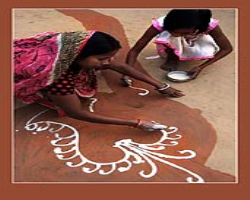
Pithora Ceremonies: While historically associated with neighboring Rathwas and Bhilalas, many Naikda families living along the border zones participate in or venerate the ritual art of Pithora. Painted on the inner walls of mud homes, these sacred murals depict the wedding procession of Lord Pithora, surrounded by horses, wild tigers, birds, and farming tools, serving as a drawn prayer for abundance.
-
Diwaso: Celebrated in the monsoon month of Ashadha, Diwaso is an intimate community festival centered on ancestral placation, the well-being of draft oxen, and protection against monsoon water-borne diseases. Women prepare delicacies from coarse grains, and families offer clay dolls and miniature ploughs to ancestral shrines.
-
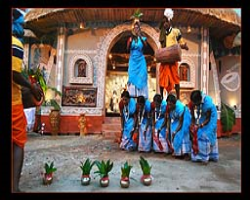
Holi (The Great Vernal Gathering): Holi is the zenith of the cultural calendar. For the Naikda, Holi is not simply the festival of colors; it marks renewal, the end of winter harvesting, the gathering of forest honey, and the season of courtship. Drums crafted from hollowed teak trunks and goat hide (Dhol and Mandal) boom across the valleys for days. Youth dance in swirling, hypnotic circles, re-enacting historic hunts and legendary warrior deeds.
The Rhythms of Daily Life: Material Culture, Dwellings, and Cuisine
Step inside a Naikda village, and you find a sustainable, low-carbon lifestyle shaped by deep environmental ingenuity.
Vernacular Architecture: The Kudaba Home
Naikda homes reflect their surrounding landscape:
-
Walls: Constructed from interwoven wild bamboo reeds or stalks of wild sorghum, plastered with a thick paste of red clay, fine river silt, and cow dung. This composite wall breathes during the sweltering dry summers, keeping the interior cool, while providing warmth during cold winter nights.
-
Roofing: Sloped gables built from teak rafters and covered with hand-turned earthenware tiles (Naliya). The pitch of the roof allows monsoon downpours to drain quickly without washing away the mud walls.
-
Courtyard and Storage: Every home features an open front yard (Angan) swept spotless at dawn. Inside, woven wicker bins (Kothi) sealed with dung paste store wild seeds, dried mahua flowers, pulses, and maize, protecting them from moisture, insects, and rodents.
Foodways: Resilience on the Plate
The traditional diet of the Naikda (Talavia) is an agrarian, forest-foraged system built around coarse grains, uncultivated greens, and wild tubers:
-
Millet and Maize: Rotla—thick, hand-patted flatbreads made from pearl millet (Bajra), finger millet (Ragi or Bavto), and yellow maize—are the daily staple. Eaten alongside crushed raw onions, garlic-chili paste (Chutney), and forest greens, they fuel intense physical labor.
-
Wild Uncultivated Foods (Jungle Bhaji): During the monsoons, Naikda women forage dozens of wild leafy vegetables from field edges and stream beds, including Kuda, Chanch, Dodi, and tender shoots of bamboo (Vans na Killa). These wild greens provide essential micronutrients, vitamins, and antioxidants.
-
Mahua Preparations: Dried mahua blossoms are boiled with gram flour or crushed and roasted with parched grains to create a quick, high-energy travel meal. During seasons of scarcity or drought, the mahua tree has saved the community from starvation time and again.
The Darker Horizon: Systemic Struggles and Socio-Economic Realities
While the cultural heritage of the Naikda (Talavia) is rich and resilient, their daily reality is shaped by structural marginalization. Despite decades of developmental schemes, affirmative action programs, and five-year plans, the Naikda remain among the most impoverished groups in the subcontinent.
The Naikda have transitioned over the past century from semi-nomadic foresters to marginal farmers and landless laborers. The core problems are structural:
-
Fragmented Landholdings: The average family owns tiny, uneven patches of rocky, rain-fed land. Soil erosion on steep slopes strips essential nutrients, leaving yields insufficient to feed a household year-round.
-
Lack of Irrigation: Despite major river valley projects in Gujarat and Maharashtra, the benefits of canal irrigation rarely reach the elevated, undulating tribal uplands. Farming remains at the mercy of unpredictable monsoon rains.
-
Tenuous Land Titles: Many families who have cultivated forest clearings for generations still struggle to obtain formal, clear titles under the Forest Rights Act (FRA), leaving them vulnerable to eviction or harassment by local authorities.
2. The Cycle of Seasonal Distress Migration
When the monsoon harvest winds down by November, silence falls across hundreds of Naikda hamlets. Men, women, and older children pack their few belongings into plastic sacks and board crowded trucks:
-
The Brick Kilns and Sugarcane Fields: Thousands of Talavia families migrate toward the industrialized belts of Ahmedabad, Surat, Vadodara, or the sugarcane-cutting areas of South Gujarat and Western Maharashtra.
-
Exploitative Labor Conditions: Families live in temporary plastic-sheet lean-tos directly on the scorching clay grounds of brick kilns or by dusty roadsides. They work 14- to 16-hour days under grueling physical conditions.
-
The Intermediary Trap: Labor agents (Mukaddams or Dalals) advance cash loans during the monsoon lean months to pay for food or medical emergencies. In exchange, the tribal worker pledges their labor for the upcoming dry season, working for subsistence pay to clear an artificially inflated debt.
3. Chronic Debt and Informal Usury
Commercial banks and rural credit cooperatives often feel distant, bureaucratic, and unapproachable to an illiterate or semi-literate Naikda farmer lacking titled collateral. As a result, the informal village moneylender fills the void. Charging exorbitant interest rates (frequently ranging from 36% to 60% annually), these creditors keep households trapped across generations, absorbing any small surplus the family produces.
4. Educational Hurdles and Cultural Disconnect
While literacy rates have climbed over the past two decades, educational outcomes in these belts remain fragile:
-
The Language Divide: At home and within the village, Naikda children speak their native dialect—a rich blend of Gujarati, Bhili, and Khandeshi roots. When entering primary school, they are immersed in formal standard Gujarati or Hindi text. Without bilingual bridge education, children quickly fall behind, lose confidence, and drop out.
-
Disrupted Schooling via Migration: When parents migrate for six to seven months every year, children either accompany them to work sites—losing all continuity in their studies—or are left behind with elderly grandparents who struggle to support their homework and regular attendance.
5. Health, Malnutrition, and Genetic Vulnerability
The health profile of the Naikda reflects their daily deprivations:
-
Maternal and Child Malnutrition: High rates of anemia among women and chronic stunting among children remain common across the Panchmahal, Dahod, and Chhota Udepur belts.
-
Sickle Cell Anemia: Similar to many indigenous groups across Central India, the sickle cell trait has a notable genetic prevalence among the Naikda. When paired with inadequate clean water, poverty, and malaria, sickle cell crises trigger severe pain, organ strain, and early mortality.
-
Remoteness of Care: Primary Health Centers (PHCs) are often located miles away across hilly terrain. Vacancies for medical specialists, erratic medicine supplies, and transportation costs mean acute illnesses are frequently left to village herbalists until conditions turn critical.
A Comparative Glimpse: How the Talavia and Forest Naikda Adapt
The split between the settled Talavia and the interior Naikda illustrates how an indigenous group navigates different degrees of ecological and modern exposure.
| Dimension | Interior / Forest-Dwelling Naikda | Settled / Plains Talavia |
| Primary Livelihood | Gathering minor forest produce (MFP), mahua, honey, gum; rain-fed subsistence farming | Small-scale agriculture, sharecropping, masonry, wage labor in semi-urban hubs |
| Material Culture | Mud and bamboo homes (Kudaba), earthenware domestic utensils, hand-hewn wood implements | Mud-brick or semi-masonry brick houses, metal utensils, occasional modern appliances |
| Language & Dialect | Deep archaic tribal dialect with heavy Bhili and ancestral lexical roots | Dialect influenced heavily by regional rural Gujarati and Marathi |
| Interaction with Markets | Weekly tribal markets (Haats); barter persists for specific wild roots and seeds | Daily interface with local grain markets, urban bazaars, and industrial supply lines |
| Ritual Life | Centered on sacred groves, mountain spires, unhewn boundary stones, shamanistic healing | Syncretic blend: traditional ancestor worship alongside popular local folk shrines |
Forest Rights, Legal Battles, and the Path Forward
The survival of the Naikda (Talavia) as a distinct cultural group does not require freezing them in time as museum relics. It requires securing their land rights, restoring their dignity, expanding their educational options, and honoring their heritage.
[ STRATEGIC PRIORITIES FOR NAIKDA EMPOWERMENT ]│┌───────────────────────────┼───────────────────────────┐▼ ▼ ▼[ LAND TITLES ] [ LOCALIZED HUBS ] [ CULTURAL PRIDE ]Full implementation Value-addition for Mother-tongue primaryof Forest Rights forest produce (mahua, schooling; digital archivesAct (FRA) community honey); watershed & of oral epics, herbal lore,and individual claims drip irrigation systems and ancestral songs
Strengthening the Forest Rights Act (2006)
The historic Scheduled Tribes and Other Traditional Forest Dwellers (Recognition of Forest Rights) Act, commonly known as the FRA, offers a legal framework to correct historic injustices. For the Naikda:
-
Individual Forest Rights (IFR): Expediting the verification and granting of clear, unencumbered land titles for plots cultivated before the cutoff date is essential to secure livelihood stability.
-
Community Forest Rights (CFR): Giving local Panchayats and Gram Sabhas legal ownership over community forests allows the Naikda to harvest, process, and sell minor forest produce directly, bypassing predatory middlemen.
Revitalizing Agriculture and Water Management
Since the tribal uplands receive heavy monsoon rains that wash down the slopes, small-scale decentralized water harvesting is far more effective than massive dam projects:
-
Constructing check dams, contour trenches, and percolation tanks across the hillsides can recharge the water table.
-
Introducing micro-drip irrigation and promoting drought-resilient millets (Ragi, Bavto, Kodra) can transform rain-dependent patches into year-round productive farms.
Transforming Forest Produce into Sustainable Value Chains
The Naikda gather high-value forest products—mahua flowers, neem seeds, timru leaves, gum, and medicinal herbs. Currently, these are sold raw to regional traders at rock-bottom prices. By establishing tribal-owned processing centers, self-help groups (SHGs) can dry, package, and market certified organic forest products directly to urban consumers, ensuring profits stay inside the community.
Culturally Rooted Education
Education must build on tribal knowledge rather than erase it:
-
Bilingual Pedagogy: Developing primers in local dialects for early childhood schooling bridges the gap between home life and standard state curricula.
-
Respecting Herbal and Ecological Knowledge: Naikda elders carry deep botanical expertise, identifying hundreds of forest plants, their healing properties, and their ecological roles. Schools that include community elders as living resources validate tribal identity instead of treating indigenous youth as empty vessels.
Why the Naikda (Talavia) Voice Matters Today
In a world wrestling with climate change, topsoil erosion, water shortages, and ecological grief, communities like the Naikda (Talavia) offer vital wisdom. Their traditional lifeway treats humanity as a humble partner within a wider living world, not its owner.
When Somabhai climbs the hillock behind his home to leave an offering of wild grain for the birds and forest spirits before picking up his sickle, he demonstrates an environmental awareness that modern society is only beginning to relearn. The story of the Naikda is not merely one of hardship; it is a testament to cultural endurance. By standing with them—demanding legal justice, economic fairness, and cultural dignity—we help ensure that their songs, stories, and sacred groves endure for generations to come.