
Comprehensive Ethnographic and Socioeconomic Study of the Singson Tribe: Origins, Lineage, Livelihoods, and Contemporary Realities
1. Introduction and Definitional Framework
The Singson (historically documented in colonial archives as Shingson, Singngon, or Vungson) are a prominent ancestral clan belonging to the Thadou-Kuki branch of the larger Zo/Kuki-Chin ethnic continuum. Inhabiting the sub-Himalayan hills, ridges, and river valleys across Northeast India (primarily Manipur, Assam, and Nagaland) and northwestern Myanmar (Chin State and the Sagaing Region), the Singson represent a vital component of the region’s upland tribal tapestry.
Thank you for reading this post, don't forget to subscribe!In classic ethnographic categorisation—dating back to colonial records by British political officers such as C. A. Soppitt, J. Shakespear, and William Shaw—the distinction between a “tribe” and a “clan” was often blurred. British administrative classifications frequently termed individual ruling lineages as distinct tribes based on localized chieftainships.
In contemporary anthropological and constitutional terms, however, the Singson constitute an influential, patrilineal clan (Phung) integrated within the recognized Scheduled Tribe (ST) frameworks of India (predominantly classified under the Thadou or Any Kuki Tribes designations).
This treatise provides an in-depth socio-anthropological, historical, and economic analysis of the Singson community. It traces their genealogical origins from mythical antiquity through modern migrations, delineates their political and kinship structures, examines their primary modes of subsistence and agrarian transitions, interrogates the complex intersection of customary law and modern gender parity, highlights escalating ecological vulnerabilities, and analyses the community’s socio-political strategies of resilience amid intense contemporary upheavals in Northeast India.
2. Mythological Antiquity and Historical Migration Routes
The Myth of Khul (Cave of Origin)
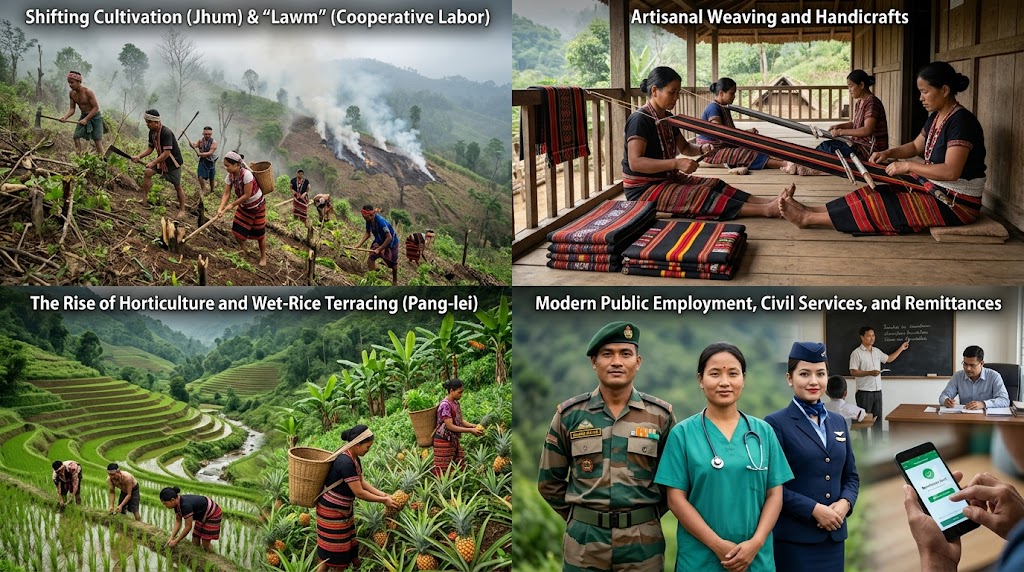
Like their cognate brethren across the Zo/Kuki-Chin-Mizo spectrum, the primordial memory of the Singson traces human emergence to an ancestral subterranean cavern or earth-womb known as Khul (or Sinlung in related dialects). According to oral epics (Mual-thu and Lapi):
- The progenitors of humanity dwelt in darkness beneath the earth, seeking an exit to the upper terrestrial realm.
- The exit was blocked by a primordial subterranean monster, often personified as a giant serpent or mythological ox (Chong-meng or Chongthol).
- A mythic culture hero and ancestor outwitted and slew the beast, rolling aside the massive stone barrier (Song-pi) to lead the lineage out into the sunlight of the rolling hills.
Anthropologists and linguists analyse the Khul myth not as literal speleology, but as a deep structural metaphor encoding memory of a fortified valley settlement, a walled defensive redoubt, or a catastrophic natural bottleneck traversed during early migrations across Central Asia and the Tibetan plateau.
Tibeto-Burman Migration Corridors
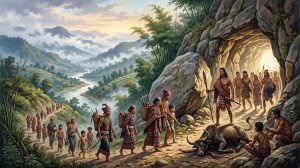
Linguistic and historical scholarship places the ancestors of the Singson firmly within the southward expansion of Sino-Tibetan / Tibeto-Burman language speakers. Historical linguistics and oral genealogies reconstruct their physical trajectory along four major phases:
- The River Valleys of Southwestern China and Tibet: Proto-Kuki-Chin speakers migrated southward along the major river conduits (the Yangtze, Mekong, and Salween corridors) escaping imperial expansions and inter-tribal pressures.
- The Chindwin and Irrawaddy Basins (Myanmar): By the 1st millennium CE, ancestors of the clan established settled agrarian footholds in the fertile plains of the Chindwin and Kabaw valleys in upper Burma.
- The Chin Hills Ascent: Pressured by expanding Shan principalities and Bamar kingdoms around the 13th to 15th centuries, the communities retreated into the heavily forested mountain ranges of the Chin Hills, developing robust upland warfare tactics and terraced shifting cultivation.
- Entry into Northeast India: From the 16th century onward, wave-like migrations pushed northward and westward across the Indo-Burma frontier into the Lushai Hills, the Naga Hills, the Cachar plains of Assam, and the southern and northern hill tracts of the princely state of Manipur.
Throughout this extensive dispersal, the Singson lineage established independent villages led by their hereditary chiefs, retaining their unique clan nomenclature while preserving linguistic mutual intelligibility within the Thadou-Kuki dialect cluster.
3. Patrilineal Lineage, Kinship Systems, and Traditional Governance
Primogeniture and the Kinship Hierarchy
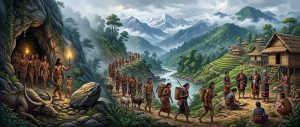
The social architecture of the Singson is strictly patrilineal, governed by an unyielding system of agnatic primogeniture (Mi Upa system). In traditional customary jurisprudence:
- The Eldest Son (Upa): Inherits the ancestral status, the hereditary chieftainship (if born of a ruling house), the family homestead, weapons of honour, and the responsibility to care for aged parents and maintain the family ancestral altar.
- The Younger Brothers (Naopa): While respected, younger siblings historically held secondary rank within village councils. When land within a village became scarce, younger brothers were expected to assemble allied households, venture out into unoccupied forested tracts, and carve out a new satellite village where the founder could claim chieftainship in his own right.
Marriages traditionally adhered to clan exogamy combined with asymmetric cross-cousin marriage preferences (specifically matrilateral cross-cousin marriage, or marrying the mother’s brother’s daughter—MBD), reinforcing alliances between distinct clans while maintaining the purity of the male agnatic bloodline.
Village Chieftainship (Haosa) and Traditional Administration
The core political unit of the Singson for centuries was the semi-autonomous village republic, governed under an aristocratic chieftainship system. Traditional governance revolved around three fundamental pillars:
The Village Chief (Haosa) Absolute custodian of land, peace, and justice |
|
Council of Elders (Semang-Pachong)
|
Customary Functionaries
|
- The Chief (Haosa): Unlike egalitarian tribal groups where power was vested in village assemblies, the Haosa held title over all village land. All residents cultivated land under his authority. The chief levied traditional tithes, including Changseo (a basket of paddy from every household’s harvest) and Salam (tribute from game hunted within village forests).
- The Advisory Council (Semang-Pachong): A curated assembly of village elders, lineage representatives, and tacticians who advised the chief, arbitrated interpersonal disputes, negotiated peace pacts, and levied customary fines (Phit).
- The Priestly Functionary (Thi-mpu): In pre-Christian animist religion (Doi worship), the Thi-mpu acted as intermediary between the villagers and forest spirits (Gam-doi), performing ritual animal sacrifices (pigs, mithuns, fowls) to diagnose illness, secure bountiful harvests, and appease ancestral spirits (Thilha).
4. Historical Milestones and Colonial Encounters
The Anglo-Kuki War (1917–1919)
The watershed historical confrontation between the British Empire and the Kuki-Chin clans, including the Singson, occurred during the Anglo-Kuki War of 1917–1919 (historically termed the “Kuki Rising”). When the British colonial administration attempted to forcibly conscript hill men for the Indigenous Labour Corps to serve in France during World War I, the hereditary chiefs convened supreme war conclaves, circulated the Thingkho Le Malcha (a ceremonial signal of burning wood and dried chilli symbolising war and defiance), and openly revolted.
The Singson chiefs and fighters participated in this guerrilla war across the dense hill terrains:
- Utilising indigenous stockades, subterranean pitfall traps, and bamboo caltrops.
- Deploying leather cannons (Pompai) and indigenous flintlock firearms.
- Engaging in tactical scorched-earth manoeuvres that held off colonial British and Assam Rifles columns for nearly two years.
The Dawn of Christianity and Mass Literacy
In the immediate aftermath of the Anglo-Kuki War, Western Christian missionaries—primarily American Baptists and British Presbyterians—expanded their mission stations into the hill regions.
The introduction of Christianity provoked a profound societal transformation:
- Eradication of Animist Sacrifices: Village altars were dismantled, and conversion replaced the Thi-mpu with ordained local pastors and evangelists.
- Linguistic Standardisation: Missionaries introduced the Latin alphabet to transcribe the Thadou-Kuki language, translating the New Testament and standardizing educational primers.
- Breakdown of Chiefly Religious Authority: While the political and landholding power of the Haosa remained legally intact, the spiritual dominance of the chieftainship was permanently separated from secular village administration.
5. Demographic Patterns and Statistical Context
Because official state census operations in India record demographic figures by officially recognised Scheduled Tribe (ST) labels rather than sub-clan surnames, demographic metrics for the Singson must be contextualised within the broader Thadou and Any Kuki Tribes categories:
Key Demographic and Socioeconomic Indicators
(Compiled from the Census of India and regional social evaluations)
| Metric / Parameter | Demographic Data & Statistical Estimates |
| Thadou Language Speakers (India-wide) | 313,308 (Census of India, 2011) |
| Additional Speakers under the “Kuki” Category | 83,924 (Census of India, 2011) |
| Geographic Concentrations | Manipur: Kangpokpi, Churachandpur, Tengnoupal, Chandel. Assam: Dima Hasao, Karbi Anglong, Cachar. Myanmar: Chin State, Kabaw Valley, Sagaing. Nagaland: Peren, Kohima, Dimapur. |
| Estimated Singson Clan Population | ~25,000 – 35,000 individuals across India and Myanmar (Community Register Estimates) |
| Overall Literacy Rate | ~75.0% – 82.5% in hill districts (Substantially above the national ST average of 59.0%) |
| Sex Ratio | 985 – 1,010 females per 1,000 males across major hill village clusters |
| Religious Affiliation | >98% Christianity (Baptist, Presbyterian, Seventh-day Adventist, Catholic, Evangelical) |
| Primary Economic Base | Agriculture (~60–65% agrarian labor force), Services/Govt (~20%), Trade/Handloom (~15%) |
6. Livelihoods, Economic Transformations, and Occupational Mobility
Shifting Cultivation (Jhum / Poum-lei)
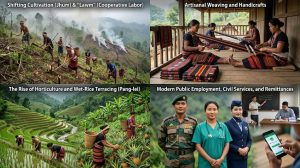
For centuries, shifting agriculture served as the socio-ecological heartbeat of Singson villages. Organized communal labor—governed by the traditional cooperative labor group known as Lawm—cleared designated forested hillsides through slashed-and-burned methods.
Within this agrarian paradigm, biodiversity was maintained by polyculture: farmers sowed up to 15–20 distinct crops simultaneously, ensuring harvest security even if the primary mountain paddy failed due to erratic weather.
Slashing of forest tracts [January - February] -> Controlled burning & clearing field ash [March - April] -> Sowing mixed crops (paddy, millet, corn) [May - June] -> Weeding cycles (Intense manual labor) [July - September] -> Harvesting crops & winter storage [October - November] -> Fallow period begins (Land rests 3-5 years) [December - January]
The Rise of Horticulture and Wet-Rice Terracing
Increasing demographic pressure and soil degradation have accelerated transitions away from traditional shifting cultivation:
- Terrace Cultivation: Wherever perennial stream valleys permit, farmers carve out irrigated steps (Pang-lei) for wet paddy production.
- Commercial Cash Crops: Extensive tracts in hill districts have been converted into orchards yielding ginger, organic turmeric, king chili (U-morok or Bhut Jolokia), pineapples, passion fruit, and rubber plantations.
- Artisanal Weaving and Handicrafts: Women operate loin-looms producing iconic tribal textiles (Puan), notably the prized black, red, and yellow-banded Saipikhup shawl. These fabrics are marketed through tribal handicraft emporiums across Northeast India.
Modern Public Employment and Remittances
High literacy and fluency in the English language have propelled significant out-migration into modern organized services. Members of the community are prominently represented in:
- The Armed and Paramilitary Forces: Long traditions of enlistment in the Assam Rifles, the Indian Army’s Naga and Kuki contingents, and the Central Reserve Police Force (CRPF).
- Civil Services and Education: Employment in central and state secretariats, public school faculties, university professorships, and regional banking.
- The Metropolitan Healthcare and Service Industry: A substantial diaspora of educated youth works in corporate healthcare (particularly specialized nursing), aviation, and hospitality sectors across Delhi, Bengaluru, Mumbai, and Hyderabad, channeling vital remittances back to ancestral villages.
7. Environmental Crises and Ecological Vulnerabilities
The traditional ecosystems inhabited by the Singson face unprecedented ecological and environmental shocks:
Major Ecological Pressures |
||
Collapsed Jhum Cycles |
Acute Water Table Depletion |
Climate Shocks & Mudslides |
Fallow intervals dropped from 10–15 years down to 3–5 years; severe top-soil erosion and nutrient depletion. |
Deforestation on ridges dries mountain springs (Tuikhur); acute water scarcity during dry winter months. |
Unpredictable monsoons; flash floods and severe slope destabilization sever vital mountain transport highways. |
Collapsing Fallow Cycles and Soil Exhaustion
The historic resilience of Jhum cultivation depended on a 10 to 15-year fallow period that allowed secondary forests to regenerate and restore soil nitrogen. Rising population density and modern spatial restrictions have compressed this cycle to 3 to 5 years. As a result:
- The land never returns to full arboreal cover; vegetative regeneration is arrested at the stage of invasive scrub and bamboo (Melocanna baccifera).
- Heavy monsoon rainfalls wash away fragile mountain topsoils, triggering sharp drops in per-acre agricultural yields and driving rural debt cycles.
Ridge-Top Deforestation and Spring Depletion (Tuikhur)
Singson villages are traditionally constructed along defensible mountain ridges and high crests rather than in malaria-prone valleys. These settlements rely entirely on gravity-fed mountain aquifers and natural springs (Tuikhur):
- Extensive logging, forest clearing for infrastructure, and commercial firewood harvesting have stripped recharge zones across the ridges.
- Numerous perennial mountain springs have turned seasonal, causing acute water shortages during the dry months from January to April. Women and youth are forced to trek miles down steep ravines to haul water.
Infrastructure Fragility and Natural Hazards
The young, seismically active geological strata of the Indo-Burma range make the habitat highly vulnerable to climate events:
- Cloudbursts and shifting rainfall regimes trigger catastrophic landslides, periodically cutting off critical road networks such as National Highway 2 and National Highway 37.
- Remote villages are regularly stranded without access to emergency medical services, electricity grids, or supply lines for basic necessities.
8. Status of Women: Gender Roles in the Household and Workplace
Structural Status of Singson Women |
|
Domestic & Private |
Public & Economic |
• Total domestic authority
|
• High agricultural labor
|
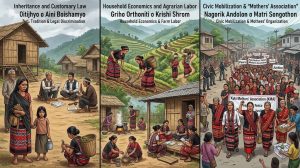
Inheritance and Customary Law
Traditional customary law strictly bars women from inheriting immovable family property (ancestral land or the family homestead).
- Assets pass exclusively through male primogeniture. If a man dies leaving only daughters, his property reverts to his nearest agnatic male relative (brothers or uncles), rather than his daughters or widow.
- While modern legal reforms exist at the national level, customary personal laws are fiercely protected in tribal hill tracts, leaving women vulnerable during property disputes or marital dissolutions.
Household Economics and Agrarian Labor
At the domestic level, women exercise substantial practical authority:
- Women manage daily household expenditures, child-rearing, food conservation, and domestic livestock.
- In agrarian labor, their contribution equals or exceeds that of men: women undertake the strenuous tasks of weeding (Phaat-lei), seed preservation, and crop harvesting, alongside domestic water collection and firewood foraging.
- Women dominate informal rural financial systems through neighborhood micro-lending networks and cooperative revolving funds (Marup).
Civic Mobilization and the “Mothers’ Association”
While traditional village governance councils (Semang-Pachong) remain strictly male, women have created alternative spheres of public authority:
- Church Women’s Fellowships (Numi Pawl): Operate social welfare campaigns, missionary funding drives, and youth counseling programs.
- The Kuki Mothers’ Association (KMA): A powerful civic and human rights collective that serves as a moral force during times of conflict. The association engages in front-line peace mediation, blocks inter-communal violence, provides humanitarian relief, and conducts anti-substance-abuse patrols across hill townships.
9. Educational Infrastructure, Achievements, and Systemic Bottlenecks
Education has served as the single most powerful catalyst for socio-economic mobility within the Singson community over the past century:
  Primary Schooling                 Higher Secondary                  Tertiary Aspirations
┌─────────────────────┐           ┌─────────────────────┐           ┌─────────────────────┐
│ Church-run mission  │ ────────> │ High English        │ ────────> │ Mass out-migration  │
│ schools in villages │           │ literacy, gender    │           │ to national hubs    │
│ (Basic literacy)    │           │ parity in enroll-   │           │ (Shillong, Delhi,   │
│                     │           │ ment                │           │ Guwahati, Bengaluru)│
└─────────────────────┘           └─────────────────────┘           └─────────────────────┘
Educational Achievements and Gender Parity
Unlike many patriarchal societies that limit female schooling, the Singson and broader Thadou-Kuki families prioritize equal educational investment:
- Parity in Primary/Secondary Ranks: Female enrollment rates in primary and secondary schools consistently match or exceed those of male students.
- English-Medium Foundations: Early literacy initiatives run by Christian churches fostered English-medium education, giving local youth an advantage in national civil services, academia, and the corporate service sector.
- Family Sacrifice: Agrarian households routinely liquidate livestock, land leases, or cash crop yields to finance their children’s university studies in regional and national metropolises.
Structural Bottlenecks in the Hill Regions
Despite community commitment to education, the physical delivery system suffers from acute systemic deficits:
- Infrastructure Gaps in Remote Regions: Village state-run schools frequently suffer from teacher absenteeism, dilapidated classrooms, and poor science and computer laboratory facilities.
- Digital and Power Disconnect: The rugged terrain and lack of reliable high-speed broadband infrastructure hamper modern digital education, leaving rural students at a disadvantage during competitive national examinations.
- Conflict-Driven Disruptions: Waves of regional instability and inter-ethnic friction regularly force schools and colleges to suspend classes for months at a time, displacing families and disrupting academic paths.
10. Social Standing, Contemporary Conflicts, and Survival Strategies
The Inter-Ethnic Geopolitics of Northeast India
The Singson reside in a volatile geopolitical landscape where borders, ancestral homelands, and resource claims intersect:
- The Naga-Kuki Clashes (1990s): During the devastating inter-tribal clashes of the early to mid-1990s, hundreds of remote Kuki and Naga villages were destroyed, displacing tens of thousands of families into internal refugee camps and fundamentally restructuring settlement patterns along ethnic fault lines.
- Manipur Valley-Hill Friction and the Post-2023 Crisis: The contemporary socio-political crisis in Manipur has led to sharp demographic and spatial segregation between the valley-dwelling Meitei and the upland Kuki-Zo populations.
- Singson villages across bordering districts (Kangpokpi, Churachandpur, Tengnoupal) have absorbed heavy burdens: internally displaced persons (IDPs), localized skirmishes, economic blockades, and prolonged internet blackouts that strain rural stability.
Crisis Management Network |
||
Apex Tribal Councils (e.g., Kuki Inpi) |
Church Organizations & Relief Committees |
Clan Welfare Unions (Singson Phungpi) |
Intertribal political representation, peace distribution, and defense of lands. |
Humanitarian relief, IDP shelter, food stipends, and lineage trauma counseling. |
Emergency aid, family tracking, education conflict mediation. |
Modern Survival and Adaptive Strategies
To weather external pressures, the Singson clan relies on several key community institutions:
- Clan Welfare Organizations (Singson Welfare Unions): Formally structured kinship unions organize the diaspora and rural villagers into a united network. They maintain emergency disaster funds, publish genealogical directories, fund educational stipends for underprivileged students, and settle civil disputes through traditional mediation.
- The Kuki Inpi (Apex Customary Body): The Singson operate under the political umbrella of the Kuki Inpi, the traditional supreme governing council. This body articulates indigenous territorial rights, negotiates peace declarations with neighboring tribal councils, and represents community interests before state and central governments.
- Church-Driven Welfare Systems: The church network functions as an institutional safety net when state services break down. Church associations construct refugee relief camps, run community kitchens, organize health and medical clinics, and facilitate rehabilitation for displaced families.
- Resilience of Customary Land Holding: While the traditional Haosa (chieftainship) system faces modern administrative and democratic challenges, it has kept village lands intact against external purchase. Because village territory remains communally held under the chief’s stewardship, tribal lands cannot be sold or transferred to non-tribal entities, safeguarding the ancestral land base through volatile political cycles.
11. Conclusion
The Singson community embodies the historical resilience and complex cultural evolution of Northeast India’s upland peoples. From their mythological emergence from Khul and their long migrations across the Indo-Burma mountain corridors, they built a coherent society anchored by patrilineal primogeniture, autonomous village chieftainships, and cooperative agricultural traditions.
Throughout the 20th and 21st centuries, the community has navigated dramatic cultural transformations: adopting Christianity, securing widespread literacy, and shifting from self-sufficient Jhum cultivation into modern market and professional economies. At the same time, severe ecological pressures—such as soil erosion, depleted aquifers, and recurring natural hazards—continue to challenge their traditional agrarian lifeways. While customary law preserves clan coherence and communal land security, it continues to face structural questions regarding gender equity and inheritance rights.
Amid shifting regional geopolitics and modern identity struggles, the Singson preserve their identity through traditional kinship networks, clan welfare organizations, and church institutions. Through these community systems, they maintain cultural continuity, protect their ancestral traditions, and adapt to the challenges of modern Northeast India.
