
Introduction : Abujh Marias Tribe
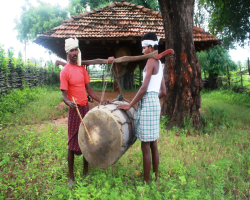
The Abujh Marias Tribe Culture in India, or Hill Marias, are one of India’s most mysterious and unique Particularly Vulnerable Tribal Groups PVTGs, living in the remote Abujhmarh hills in what is today Chhattisgarh state. The tribal community whose name itself comes from “Abujh” and that also means “rustic” in the local language of Gondi, and “marh” meaning mountain, have kept its culture intact despite centuries of remoteness.
Their unique life style linked with way of forest is the repository of deep traditional indigenous knowledge systems, social practices and sustainable living system that they have developed over thousands of years in arguably one of the most inaccessible landscape in India.
Geographical Distribution and Demographic Profile
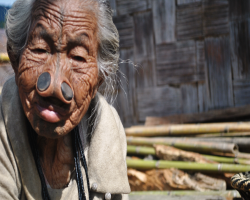
The Abujh Marla society resides in the deep and dense forest area of Narayanpur district’s approx 1500 square miles which falls under blocks like Orchha, Narayanpur, Podi Uproda and Korba and is known as Abujhmarseder segment. This 2,200 to 3,160 feet high plateau has been declared a prohibited zone and one of the most difficult tribal territories in India by the state government. The Abujh Marias are of Proto-Australoid racial stock and their language is the Madi dialect of Gondi, a Dravidian language
Social Organization and Kinship Systems
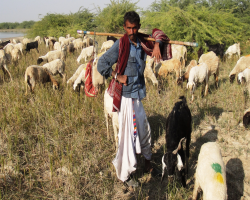
The Abujh Maria’s social life world is extremely elaborate, the complex nature of which reflects their cosmological orientation and celestial beliefs. The community is endogamous having a well developed system of exogamous phratries known locally as divisions which comprises several clans or groups, called “kattas”. Each katta serves as a unilinear descent group and claims descent from certain clan deities, “pen,” who are thought to own certain territories located in both the celestial and terrestrial spheres.
The main organizing principle of katta is the bhaiband relationships where members of same pen but from different kattas are considered consanguineal kin in a clan used for marriage (through them as representatives) and marriage within these groups is strictly prohibited. In marriage, the only possible arrmangement is with akomama relations (mother’s brothers), which results in a complex network of cross-cousin wife exchange and clan exogamy that serve to maintain social separateness while promoting interclan cooperation.
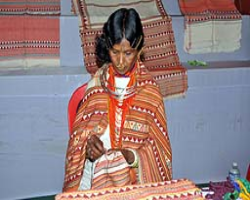
Abujh Marias Traditional Abujh Maria are organized by a strongly hierarchical system of government, each pargana having an headman (Pargana Manjhi) and every village its Patel or Manjhi in charge of settling disputes and preserving custom laws.
That system of indigenous social control remains largely in place, despite the best efforts by administrations ie governance from outside to meddle with/modify it in any significant way: this is good evidence of how strong the community dedication to traditional authority systems remain.
The forms of marriage include negotiated marriage (ful kochna), the most favoured, cross cousin, junior levirate (aeohundi), sororate (koyeyari) and widow re-marriage. Although divorcees are allowed, but it is discouraged in the community and marriages are normally scheduled on market days to allow more people from the community to participate.
Economic Practices and Subsistence Patterns
They are mainly ‘penda’ cultivators, which is slash-and-burn or shifting hill cultivation that constitutes their major force of livelihood. This is a form of primitive agriculture where forest patches are felled, the vegetation is burnt and the land is cultivated for up to four consecutive years before being left uncultivated for an extended regeneration phase. The underlying cosmology to their farming practices is the belief that all land in the Abujhmarh hills belongs to pen deities of the celestial world who have apportioned and divided territories among various kattas, setting up divine tenure systems that determine cultivation rights.
The Abujh Marias grow small grained rice, especially “korsa” and supplement their diet by hunting for small game using traditional bow and arrows, fishing in the local streams, and extensive forest produce collection including mahua flowers & seeds, tamarind, amla (Phyllanthus emblica), karanj (Pongamia pinnata) seed among various other NTFPs.
In addition to slash and burn agriculture, the community engages in an early form of settled cultivation in some places, indicating adaptive potential within traditional ecological knowledge systems.
Economy The economic life of Abujh Marias is largely semi-nomadic and the village sites shift with the wearing down of penda slopes; thus a village site lasts five to ten years depending on how many cultivation points at manageable supervision distance are available., where they often attend weekly markets (hat bazar) in.
adjacent towns, where they sell rice, forest products such as tendu leaves, and buy essentials, although these encounters with the outside world are still restricted and closely monitored.
Religious Beliefs and Ceremonial Life
Abujh Marias religious belief is centred on animism and their deities are pen (clan deities), ancestor spirits, hill and forest spirits as well as water spirits. “[E]ach clan has its own heaven” (pen), god and associations among these celestial are analogous to those establishing social structure on earth.
Their chief festival is Kaksar, celebrated in the month of June immediately preceding the rains, at which all clan-deities, Tallur Muttey and other deities as well as Danteswari Mata (the divine guardian of Bastar) are worshipped together. Kaksar has been considered as a harvest festival and new eating ceremony of crops however; its basic aim is to bend before clan gods before proceeding to work for agriculture after monsoon showers.
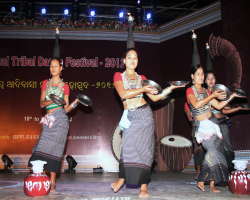
The Kokasar dance culture of the Kaksar is a unique cultural institution where young boys and girls who are yet unmarried take part in dance performances to effect mate selection, with getting married taking place by aggregating social approval.
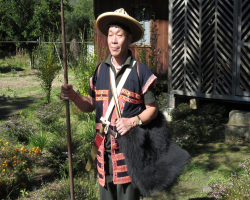
In clothes, the male folks wear a special kind of dress and pagadi on the head (known as Bandiyodi), while the girls hold iron rods utilizing which they strike small bells fixed in wooden plaques tied around their ankles while dancing. The musical ensemble of the two percussion (mandar and timki) and a wind instrument (bansuri), gives the occasion an ethereal ambience with both, religious as well as social impact.
Chamars and other non-tribal Cultivators are looked upon as high caste food collectors, although the status of these communities extends no further south than Khalsa; but in a historical point of view their recognition by the Abujh Maria mind suffices to differentiate them from those races which have not yet arrived at that stage where anxiety for virgin produce is paramount to everything else.
Material Culture and Traditional Craftsmanship
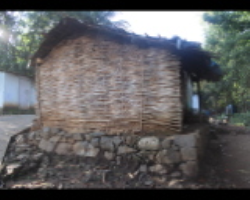
Abujh Marias’ material culture testify to their deep rootedness in forest ecology as well as their aesthetics of isolation. Traditional dwellings are rectangular in shape with thatched roof sloping on all sides and a verandah at the front, made mainly from locally available material such as bamboo, wood and thatch.
Even today men’s dress is as minimal as the groom wears only a simple loin cloth and in case of women, it varies from half-dressed to almost non-clothed due to influence of outsiders. But immodest is the body dress of the natives who artistically deck themselves with beads, grass, cane, iron and fibre from head to foot both men and women do this.
Rings of iron necklaces come with cultural status, people exhibiting as many as twenty rounds of the masjeng measured in rings; some women will have up to fourteen holes on top parts of their ears vis a vis multiple decorative studs and rings.
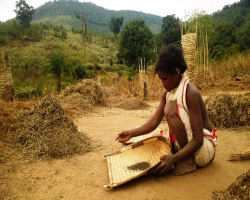
Another significant factor of the Abujh Maria identity (through their women) are ‘tattoos’, or godana, which are so styled sacred jewelry for life, `worn’ on any part of the body with intricate designs/styles that adorn traditional motifs/designs all over a woman. The people are skilled at bamboo weaving and basketry to produce usable functional.
articles comprising baskets,winnowing fans (supas) and other containers used in their daily activities of life maintenance. These crafts use conventional methods with capital intensive technology such as selection of bamboo, splitting, cleaning and special patterns of twisting to weave in design that conforms practical envisage saving luxury.
The Ghotul System: Indigenous Educational Institution
The most characteristic social institution of the Abujh-Maria is Ghotul, a traditional youth dormitory, which is an autonomous organization for unmarried youths in terms of education and social life. The mythological Lingo was the Zenith God (Gond God) and he built first Ghotul, so its a sacred area of their social and religious life.
he Ghotul is a men’s social institution, but it also functions as a community center: unmarried women (motiyaris) and men (cheliks) sleep in the same room of the ghotul under the direct or indirect control of elected leaders, called siredar for boys and belosa for girls.
Here at this college, children learn these valuable life skills; the importance of cleaning oneself and ones cloths, discipline, hard labour work ethic, traditional dances,songs&folk stories &values,cultural values and social acceptability.
Ghotul is an institution for passing on cultural norms, skills or knowledge from exposition to association. Boys act as acolytes at local feasts and girls become bridesmaids at village weddings, and both join in various village activities, becoming a part of the larger community. The institution also provides a regulated space for courtship and partner selection, although the rules of engagement in romantic relationships are highly idiosyncratic to each Abujh Maria community.
The Ghotul has been referred to as a “republic of children” by famous British anthropologist Verrier Elwin [full citation needed] who had lived with them for years; the concept brought into light the idea that democracy, equal status and community service is inculcated in tribal children through this practice. At the night events, storytelling and riddle-solving are undertaken, as well as planning for expeditions, along with singing and dancing to promote social bonding and maintaining living cultural heritage.
Death Rituals and Megalithic Traditions
The Abujh Marias have detailed ceremonies associated with death, which in broad terms express their beliefs about what happens to the deceased in the afterlife, how the spirits of the dead will continue to affect those still alive and that there is a continuing relationship between those who are living and those who have died.
They dispose of their dead by burial, though the goods and valuables of the departed are laid under stone slabs or memorials known as “mengrahal” (menhirs) that mark a place where someone was buried.
These huge structures presumably had a variety of functions, such as to indicate the site of burials and to show bounds upon which the deceased’s carvings or illustrations would be drawn representing his deeds in life, his lineage and his victory over enemies. The inscriptions on necropolis stones, which commonly depict animals, birds, human forms and symbols of the soul’s passage to heaven upon an elephant or other symbolical transport, also served as surrogates for personal biographies and cultural history.
Stubenvoll Funeral DLR Last rite-cremation Bride’s head facing East and feet to west, exposed to Sun -because 1000s yr ago Abujh Marias worship the sun god and they believe by keeping the position of the dead as such means continuous worshipping of SunGod.
Relatives perform purification rituals with water, turmeric and other sacred substances at the end of the funeral. On specific death days (notably the tenth day or “daswa din), grandiose rites include raising a sama tree pole Terminalia elliptica), closely related to their Anga pen (clan god). These practices illustrate
the complex ideas of theology which underlie Abujh Maria cosmology; the material and spiritual worlds are to be in continuous interaction, ritual performance and sacred geography being the medium.
Contemporary Challenges and Cultural Preservation
As a PVTG, the Abujh Marias are dealing with multiple issues affecting their identity and existence in their traditional landscapes. Their centuries of isolation, which have led to the survival of unique cultural practices, has also left them with extremely low levels of literacy 48.62% (district average in 2011), much worse within core Abujh Maria domains) and little access to healthcare or modern administrative mechanisms.
Abujhmarh being a restricted area helps the community from quick incursion of outsiders, but at the same time it also locks them out of government benefits, educational facilities and other economic activities accessible to other tribes.
Shifting cultivation, which is central to the agrarian economy of the Garo, today comes under pressure from forest conservation policies that perceive it as environmentally harmful and so are causing tensions between traditional ecological practices and modern conservation discourses.
The pressures of modernization, Naxalite movements in the area and increasing contacts with national society are further threats to their cultural identity. And young people increasingly have dreams of education, wealth and prosperity that are often at odds with traditional ways of living, leading in turn to a faster breakdown of culture – along with the disappearance of indigenous systems of knowledge that took thousands of years to develop. The very recent inclusion of Abujh Marias in the ST list (in 2013) is a case in point to show how their marginalization did not just necessarily mean historical, administrative ignorance but even now trees them with entitlements such as affirmative action benefits and targeted welfare schemes like the PM JANMAN.
The implementation of development aid, though effective, continues to be problematic with the community’s isolation and language barrier as well as generations of seclusion from outsiders creating a natural distrust toward them.
Conclusion: Preserving Indigenous Heritage in Modern India
Living Abujh Marias are witness to human cultural diversity and amazing community ability to preserve their identities despite isolation and adversity. Members of the indigenous tribal community had a complex social organization that evolved around clan deities, sophisticated agricultural practices in harsh terrains as well unique institutions such as Ghotul and rich ceremonial life demonstrates their complexity and uniqueness Walknel’s findings reveal about resilient nature of the native cultures. The traditional ecological knowledge in their penda cultivation system, medicinal plants usage and forest resource management is of high significance for present environmental conservation purposes. India is on a development trajectory and the task is to forge ways that honor abujh Maria autonomy and cultural rights but at the same time provide avenues for good health, education, jobs or occupation that contribute to well-being without undermining cultural underpinnings. As outside pressures grow and the pace of social change quickens, documenting their language, oral traditions, crafts, and ritual practices has been an increasingly urgent priority. In the end, the story of the Abujh Marias reveals deep and in many ways fundamental questions about cultural pluralism, indigenous rights, democracy all of which have an ongoing impact on development; And these issues are fundamental to a country known for its profound diversity and most urgent demand policies that respect both constitutional commitments to tribal welfare as well as self-determination and preservation of cultural continuity.
