
Hengna Tribe: Guardians of the Hills, Cultural Integrity, and the Struggle for Recognition in Modern India
Introduction: Unveiling an Overlooked Heritage of Hengna tribe
The tribal mosaic of India represents one of the most culturally resilient, ecologically attuned, and socio-politically complex tapestries in human civilisation. Across hills, forested valleys, riverine deltas, and arid plateaus, indigenous communities have sustained lifeways that balance survival with spiritual reverence for their surrounding ecology. Among the varied indigenous populations of Northeast India and adjacent central-eastern hilly tracts, the Hengna emerge as an extraordinary, yet often misunderstood or overlooked, community.
While dominant historical narratives frequently group localised clan networks and minor indigenous settlements under broad, homogenous umbrella terms—often subsuming them into larger neighboring ethno-linguistic conglomerates like the Kuki-Chin-Mizo, Naga, or ancient Austroasiatic and Tibeto-Burman frontiers—the Hengna maintain a distinct ethos. Their identity is defined by ancestral lineage, unique linguistic idioms, intricate customary tenure systems, and a profound philosophical bond with their natural habitats.
Understanding the Hengna requires looking beyond standard ethnographic categories. It demands an examination of human resilience: how a distinct, localized tribal entity navigates marginalization, negotiates community survival amidst political turmoil, and maintains oral history across generations of modernization.
- Jhum Agro-forestry • Patrilineal Exogamy • Genealogical Chants • Recognition / Forest Rights
- Ridge-top Settlement • Village Chief (Lal/Haosa) • Folk Epics & Ballads • Healthcare & Education Access
- Sacred Groves & Water • Restitution-based Justice • Woven Symbolic Art • Market Disruption & Migration
Origins, Migration, and the Geography of the Hengna
Ancestral Roots and Oral Genealogies
The history of the Hengna is preserved not in written state archives or colonial gazetteers, but in living memory. Like many highland communities of the Indo-Myanmar frontier and the surrounding sub-Himalayan ranges, their historical discourse is passed down through chhar-in (genealogical chants) and epic narrative cycles performed by village elders.
According to widespread community memory, the ancestors of the Hengna trace their journey through high mountain passes, ancient river gorges, and dense subtropical broadleaf forests. Clan elders speak of a mythical ancestral cradle—a subterranean opening, cave, or protective rock shelter often invoked as Chhinlung or Khur in allied linguistic groups, but rendered in Hengna oral songs as a localized ancestral enclosure. This metaphor speaks to a historical period of acute vulnerability, where clan ancestors coalesced inside defensible geological formations to escape warring factions, slave raids, or catastrophic ecological shifts.
When the ancestors emerged, they organized along distinct clan and sub-clan lines. Migration was not erratic; it was dictated by:
- Soil fertility and topography: The search for stable ridgelines safe from flash floods and valley miasmas.
- Security and mutual defense: High-altitude promontories offering defensive sightlines against rival clans and external imperial expeditions.
- Spiritual omens: Divination rituals based on bird migrations, water sources, and ancestral dreams.
Geographical Distribution and Topography
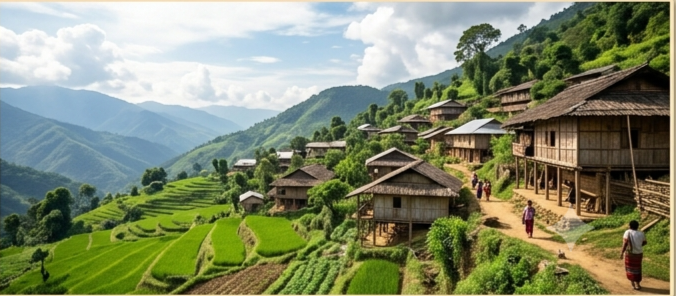
Geographically, the Hengna inhabit rugged, dissected terrain characterised by rolling hills, steep forested scarps, and narrow river valleys. Their traditional lands sit within biodiversity hotspots where mist-shrouded elevations transition into deciduous forests.
Settlement architecture mirrors this topography:
- Hilltop Clusters: Villages are established along high ridges to preserve arable slope land below and maximize natural drainage during intense monsoon downpours.
- Proximity to Sacred Waterways: While homesteads cling to ridge summits, village perimeters encompass perennial gravity-fed springs (tuisik) protected by strict taboos against deforestation.
- Buffer Zones: Concentric rings of communal forest, swidden agricultural fields (jhum), and perimeter hunting grounds historically delineated Hengna village boundaries from neighbouring ethnic groups.
This physical setting fostered an inward-looking self-reliance. Cut off from alluvial plains and major trade arteries, the Hengna refined an economy and material culture reliant entirely on local biomass—bamboo varieties, hardwoods, wild creepers, mountain rice, and forest wildlife.
Social Architecture: Kinship, Clans, and Customary Governance
Clan Structure and the Philosophy of Descent
The socio-political organisation of the Hengna is anchored in patrilineal descent, structured clan hierarchies, and exogamous marriage norms. Society is segmented into primary descent groups (phratries), which divide into localised patrilineages.
- Lineage Solidarity: A person’s identity is bound to their ancestral lineage. Lineage provides land access, mutual defense, and shared liability in customary justice.
- Exogamous Prohibitions: Marriages within the same immediate patrilineal clan line are strictly prohibited (thianglo), seen as cosmological violations that could bring poor harvests or familial sickness.
- Bridge-Building Alliances: Inter-clan marriages function as socio-political treaties, creating bonds of mutual assistance across different village settlements through reciprocal gift-giving and bride-wealth exchange (man).
The Chieftaincy and the Council of Elders
Governance among the Hengna operates as a blend of hereditary leadership and gerontocratic counsel. At the center of traditional governance stands the village chief, traditionally titled Haosa or Lal, assisted by an informal council of elders known as the Upas.
The chief’s power was traditionally counterbalanced by customary boundaries. While the chief owned the village lands in trust for the community, he could not arbitrarily dispossess a clan of its worked plots. Generosity was a prerequisite of authority: a chief who failed to host community feasts, assist the destitute, or protect village interests faced quiet rebellion, migration of his subjects to rival villages, or deposition by the elder council.
Customary Jurisprudence: Restitution Over Retribution
Unlike codified modern legal frameworks based on punitive confinement, Hengna customary law prioritizes restoration of communal harmony and tangible restitution.
- The Principle of Restitution: Crimes such as theft, boundary encroachment, or physical altercations are settled through fines payable to the aggrieved party and the village council, typically in the form of livestock (mithuns, pigs), handwoven shawls, or earthen jars of fermented rice beverage.
- Social Reintegration: Once a fine is paid and a reconciliation feast shared, the offender is re-integrated into the social fabric. Stigmatization is actively discouraged to preserve internal cohesion.
- Oaths and Ordeals: In cases lacking clear physical evidence, justice relies on solemn ancestral oaths invoked over sacred natural items (tiger teeth, river rocks, or iron). The deep fear of spiritual retribution ensures that false testimonies remain rare.
Traditional Economy, Agriculture, and Ecological Wisdom
The Dynamics of the Jhum Cultivation Cycle
The traditional Hengna economy centres on shifting cultivation, known regionally as jhum, supplemented by foraging, hunting, small-scale animal husbandry, and cottage crafts. Jhum is not merely a farming technique; it is a spiritual, seasonal, and social rhythm that governs community life.
The process begins in early winter with the selection of a forested hillside, decided collectively by the Haosa and the Upas to ensure equitable distribution across households.
- Controlled Slashing and Burning: Vegetation is cleared, leaving the root systems intact to anchor the thin, highly erodible topsoil. Once thoroughly dried, the slash is burned in a controlled fire, creating an ash bed rich in potash, phosphorus, and trace minerals that neutralises acidic forest soils.
- Polyculture and Food Security: The Hengna plant up to twenty distinct crops in the same plot. Upland hill paddy serves as the staple, intercropped with fox-tail millets, maize, sweet potatoes, yams, pumpkins, perilla seeds, ginger, and indigenous bird’s-eye chilies. This high agrobiodiversity mimics natural forest ecosystems, minimizes pest outbreaks, and guarantees balanced nutrition even if unpredictable weather damages the rice crop.
- The Fallow Cycle: Traditionally, plots were cultivated for one or two seasons and then left fallow for ten to fifteen years. During this period, pioneer bamboo and broadleaf trees restored organic nitrogen to the soil. As modern population pressures and state territorial restrictions have compressed these fallow periods down to three to five years, this ecological balance has come under acute stress.
Agro-Ecological Calendar of the Hengna
 Ethnobotany, Foraging, and the Sacred Forest
The Hengna view the forest not as an untamed wilderness, but as an inhabited landscape governed by invisible spirits (dawi / chhung-leng). Survival has always depended on deep ethnobotanical knowledge:
- Wild Edibles and Famine Buffers: During pre-harvest hunger periods, the forest provides wild yams (Dioscorea spp.), tender bamboo shoots, wild banana blossoms, wood fungi, and wild leafy greens. These foods supply micronutrients absent from commercial monoculture diets.
- Phytotherapy: Traditional healers rely on indigenous pharmacopeia: bark extracts to treat malaria-induced fevers, crushed leaves for coagulating deep lacerations, and boiled roots for gastrointestinal parasites.
- Sacred Groves: Villages historically maintained demarcated patches of old-growth forest, strictly protected from wood-cutting. These sacred groves served as animal refuges, preserved vital microclimates, and sheltered the spiritual entities protecting community water aquifers.
Cultural Formations: Oral Literature, Textiles, and Rituals
The Sonic World of Orality
Without written scriptures, Hengna literature lives as performance. Every cultural transition—birth, marriage, harvest, sickness, death—is marked by specific metric recitations and poetic forms.
- Epic Ballads: Elders recite long verse narratives that commemorate legendary warriors, historical migrations across forgotten rivers, and star-crossed lovers. These songs use an archaic, metaphorical vocabulary distinct from everyday speech.
- Work Songs: During the arduous weeding and harvesting phases on steep hill slopes, collective call-and-response chants synchronize labor, maintain group energy, and ease physical fatigue.
- Lamentations: Funeral dirges (huan-hla) trace the departing soul’s path across the physical realm into the ancestral village of the dead, offering precise geographical directions to prevent the spirit from losing its way and wandering restlessly near the living.
Textiles as Visual Language
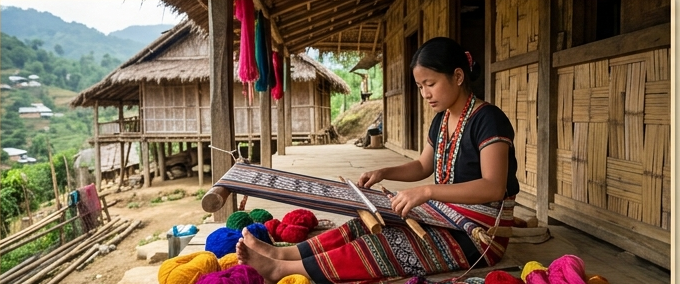
Weaving is a central medium of artistic, cultural, and socio-political expression among Hengna women, practiced on traditional portable backstrap tension looms (loin looms).
- Clan Signifiers: The motifs, color bands, and geometric configurations woven into traditional shawls (puan) indicate the wearer’s clan affiliation, social standing, and genealogical status.
- Ritual Regalia: Specific textiles were traditionally reserved for those who achieved prestige through the Feast of Merit or demonstrated exceptional valor. Wearing these designs without customary authorization was believed to invite supernatural misfortune.
- Sustainable Metallurgy and Dyeing: Raw cotton and nettle fibers were historically hand-spun and colored with plant-based dyes derived from wild madder (Rubia cordifolia), turmeric roots, indigo, and tannin-rich tree barks. These natural mordants created earthy colors designed to withstand heavy monsoon conditions.
Human Development Realities: The Modern Predicament
Despite their rich cultural legacy, the contemporary human development indicators for the Hengna reveal persistent vulnerabilities. The transition from autonomous, subsistence-based village polities to integration within modern market systems and bureaucratic state frameworks has introduced significant structural challenges.
- Infrastructure Deficits and Spatial Isolation
Spatial isolation remains a significant hurdle to equitable development for Hengna settlements:
- All-Weather Connectivity: Many villages are linked to regional administrative headquarters only by unpaved paths cut into fragile shale and sandstone slopes. During the monsoon season (June to September), frequent landslides sever road access for weeks at a time.
- Market Disconnect: Farmers are forced to sell high-value organic produce—such as ginger, chilies, and oranges—to middle-tier trading cartels at low farm-gate prices, as they lack cold-storage facilities and dependable transport to regional economic hubs.
- Digital and Electrical Deserts: While rural electrification schemes have brought lines to many ridgelines, power supply remains intermittent. Patchy telecommunications connectivity cuts Hengna youth off from digital educational resources, competitive examination materials, and remote economic opportunities.
- Public Health, Nutrition, and Primary Care
The physical isolation of Hengna settlements directly affects healthcare access and public health outcomes:
- Maternal and Child Mortality: Institutional delivery rates in remote Hengna settlements trail state and national averages. Pregnant women facing obstetric emergencies often have to be carried down mountain trails on bamboo stretchers to reach Primary Health Centres (PHCs).
- Nutritional Transitions: While wild foods once provided a balanced diet, the degradation of forest reserves alongside reliance on subsidized polished rice through the Public Distribution System (PDS) has spurred a “double burden” of malnutrition: childhood stunting and micronutrient deficiencies (chronic anemia) alongside rising metabolic disorders among older adults.
- Endemic Diseases: Low-lying farming valleys harbor seasonal malaria, vector-borne illnesses, and waterborne gastrointestinal infections, which are often compounded by a lack of clean drinking water systems in high-ridge villages during summer dry spells.
- Education and Linguistic Estrangement
Education is essential for social mobility, yet the formal educational system presents systemic challenges for Hengna children:
- The Medium-of-Instruction Barrier: Most government and low-cost private schools operate in regional state languages, Hindi, or English. Hengna children, who grow up speaking their native tongue at home, are often thrust into alien linguistic environments without bilingual transition programs, driving up early primary drop-out rates.
- Institutional Neglect: Remote schools struggle with high teacher absenteeism, crumbling physical infrastructure, a lack of separate sanitation facilities for girls, and absent science laboratories.
- Brain Drain and Cultural Erosion: Educated young people are frequently forced to migrate to urban centers (such as Guwahati, Shillong, Delhi, or Bengaluru) for higher education and employment. This outmigration deprives villages of dynamic young leaders and fragments the transmission of oral customs, weaving, and indigenous environmental knowledge.
Socio-Political Struggles: Recognition, Land Rights, and Modernity
The challenges facing the modern Hengna stem from historical administrative policies and contemporary development pressures. Their ongoing struggle centers on political voice, territorial security, and cultural survival.
The Struggle for Distinct Constitutional Recognition
A core grievance among the Hengna is the quest for distinct administrative and constitutional recognition.
- The Trap of Homogenization: During colonial and post-independence administrative mappings, smaller tribal groups were often categorized under broader Scheduled Tribe (ST) designations to simplify governance. As a result, the Hengna are frequently treated as a sub-clan of larger neighboring ethnic groups.
- Unequal Resource Allocation: Subsumption into larger ethnic blocs leaves the Hengna politically marginalized. Dominant groups typically secure the lion’s share of autonomous district council funding, legislative representation, and public sector employment quotas, leaving micro-minority tribes without an effective voice in regional decision-making.
- Demands for Affirmative Action: Hengna community leaders, student bodies, and welfare associations continue to lobby state and central governments for distinct enumerations in the Census, targeted developmental packages, and explicit recognition under the Scheduled Castes and Scheduled Tribes Orders.
Land Rights and the Forest Rights Act (FRA, 2006)
The relationship between the Hengna and their ancestral lands faces unprecedented legal and environmental pressure:
- Customary Tenure vs. Eminent Domain: The Hengna rely on unwritten, community-sanctioned customary tenure. However, modern state agencies often classify uncultivated jhum fallows, clan hunting reserves, and sacred groves as “Unclassed State Forests” or “Wastelands.” This classification leaves them vulnerable to unilateral acquisition for highway construction, extractive projects, or commercial plantations.
- Implementation Gaps of the FRA: The Scheduled Tribes and Other Traditional Forest Dwellers (Recognition of Forest Rights) Act, 2006 was designed to correct historical injustices against forest-dwelling communities. Yet, in much of Northeast India, implementation remains stalled due to jurisdictional conflicts between Sixth Schedule Autonomous Councils, state forest departments, and traditional village authorities. Consequently, Hengna farmers struggle to secure formal Community Forest Rights (CFR) titles to protect their lands from state-backed commercial incursions.
- The Monoculture Threat: To discourage shifting cultivation, regional development programs often push commercial monocultures like rubber, oil palm, and commercial teak. While promising short-term cash yields, these plantations deplete local groundwater reserves, strip soil nutrients, and eliminate the rich biodiversity that underpins traditional Hengna food security.
Comparative Analysis: Traditional Life vs. Modern Realities
To understand how rapidly life is changing for the Hengna, it helps to examine their socio-economic and cultural shifts across different spheres:
| Dimension of Life | Traditional Ancestral Paradigm | Contemporary Modern Reality | Critical Challenges / Systemic Stress |
| Agricultural Base | Multi-crop subsistence jhum; long fallows (10–15 yrs); diverse indigenous seeds. | Shortened fallows (3–5 yrs); rising cash monocultures (ginger, broom-grass, rubber). | Severe soil nutrient loss, lower yields, erosion of indigenous seed banks. |
| Land Ownership | Communal land held in trust by the Haosa; usufruct rights distributed by clan needs. | Gradual privatization; boundary demarcations; state eminent domain pressures. | Emerging landlessness, wealth divides, disputes over unregistered lands. |
| Governance | Autonomous village council; Haosa and Upas; customary restitutive justice. | Overlap of statutory Gram Panchayats / District Councils with traditional chiefs. | Jurisdictional confusion; erosion of traditional elder council legitimacy. |
| Knowledge Transfer | Oral epics, evening fireside storytelling, youth learning in community dormitories. | Formal textbook schooling in non-native languages; commercial digital entertainment. | Rapid loss of native dialects, ethnobotanical expertise, and oral folklore. |
| Healthcare | Local healing traditions; bone-setters; wild herbal treatments; propitiatory rituals. | Mix of under-resourced public health centers, private clinics, and local remedies. | High out-of-pocket costs in medical emergencies; late-stage diagnoses. |
| Youth Aspirations | Mastery of forest skills, agricultural self-reliance, weaving, community standing. | Pursuit of formal credentials, public sector jobs, and urban private-sector work. | High urban un/underemployment, identity crises, village demographic decline. |
Preserving Identity: Modern Revival and Cultural Renaissance
In response to rapid socioeconomic disruption and cultural dilution, younger Hengna generations, community leaders, and women’s cooperatives are taking active steps to document and revitalize.
- Recording Oral Epics • Fair-Trade Collectives • Revival of Harvest Dances
- Native Lexicons • Natural Dye Restoration • Traditional Sports
- Social Media Archives • Economic Autonomy • Inter-Tribal Dialogues
- Language and Oral History Documentation
Recognizing that losing a language means losing an entire worldview, educated Hengna youth are working with cultural researchers to build community-driven documentation projects:
- Audio-Visual Archiving: Activists are recording village elders reciting ancestral chants, traditional healing invocations, and clan genealogies to preserve these oral forms beyond the living memory of current custodians.
- Orthography Development: Community scholars are collaborating to adapt Latin scripts to their native phonetic systems. They are developing basic primers, dictionaries, and folk storybooks to introduce children to the written form of their mother tongue.
- Revival of Traditional Textiles and Women’s Cooperatives
Weaving remains a living link to ancestral identity, and Hengna women are organizing to turn this heritage into sustainable livelihoods:
- Loom Collectives: Weaving cooperatives allow artisans to bypass predatory middlemen, buy organic yarn collectively, and sell directly through regional tribal expos and ethical online platforms.
- Reviving Natural Dyes: Sustainable fashion initiatives are encouraging a return to native plant-based dyes like wild indigo and madder. This preserves cultural knowledge while opening up opportunities in the global slow-fashion market.
- Cultural Festivals as Spaces of Unity
Harvest festivals and traditional gatherings are being reimagined to strengthen community ties and build cultural pride:
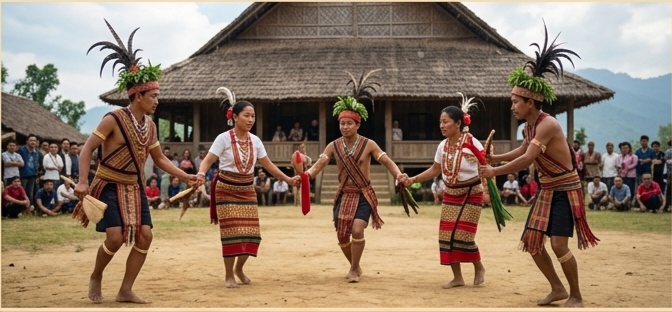
- Public Celebrations: Events that were once celebrated only within isolated mountain settlements are now held in regional centers, featuring traditional bamboo dances, musical performances with indigenous instruments, and sporting events like traditional wrestling.
- Inter-Generational Dialogue: These festivals create a space where urbanized youth can reconnect with rural elders, learn traditional arts, and take pride in their distinct identity within the broader Indian collective.
Policy Frameworks: A Roadmap for Sustainable Development
Supporting communities like the Hengna requires a balanced approach—one that respects traditional autonomy and ecological wisdom while ensuring equitable access to modern healthcare, education, and economic infrastructure.
- Governance and Legal Empowerment
- Accurate Enumeration and Targeted Development: State administrations must conduct comprehensive ethnographic and socio-economic surveys to recognize smaller communities like the Hengna as distinct groups, ensuring they receive targeted affirmative action, developmental grants, and appropriate legislative representation.
- Accelerating Forest Rights Claims: State governments should launch dedicated drives to settle Community Forest Rights (CFR) claims under the Forest Rights Act (2006). This provides communities with the legal security needed to protect their ancestral lands from ecological degradation and land alienation.
- Integrating Customary and Statutory Law: Rather than dismissing traditional systems, regional planning bodies should work alongside traditional councils (Haosa and Upas). Involving clan elders builds greater community trust, participation, and accountability in rural development initiatives.
- Culturally Responsive Education and Healthcare
- Mother-Tongue Early Education: Early childhood learning programs should incorporate local languages, oral histories, and cultural references, pairing native primers with state curricula to ease children into the formal schooling system.
- Decentralized Mobile Healthcare: Given the rugged terrain and poor road connections, state health departments should deploy regular mobile medical units, train local community health workers (ASHAs) in maternal care, and maintain life-saving medicines and antivenoms at local sub-centres.
- Combining Herbal and Modern Medicine: Public health initiatives should recognize and work with traditional herbalists, creating a collaborative model that values local knowledge while introducing modern diagnostics and emergency care.
- Ecological Livelihoods and Agrarian Innovation
- Strengthening Sustainable Jhum: Rather than trying to eliminate shifting cultivation with forced cash-crop monocultures, agricultural agencies should support traditional agro-forestry. Providing non-invasive green fertilizers, improving soil terracing, and introducing participatory breeding for high-altitude rice varieties can improve yields without disrupting the local ecosystem.
- Decentralized Post-Harvest Infrastructure: Installing solar-powered cold-storage units and village-level processing facilities (for drying ginger, packaging chilies, or milling grains) allows farmers to retain more economic value locally and reduce post-harvest waste.
- Community-Led Ecotourism: Developing ethical, community-managed ecotourism and homestay cooperatives offers a promising avenue for local enterprise. This approach lets travelers experience indigenous ecology and cultural traditions firsthand while ensuring that revenues go directly to the village.
Conclusion: Honoring the Past, Navigating the Future
The story of the Hengna reflects the broader experience of India’s indigenous communities. It is a story of balance: living in step with ecological systems, keeping communal values alive in village councils, and finding strength in shared memory and song.
Yet it also highlights the urgent need to address systemic inequalities. The challenges facing the modern Hengna—administrative invisibility, territorial insecurity, economic marginalization, and linguistic erosion—are not inevitable results of progress. They are the consequence of centralized development models that have long overlooked the needs of smaller indigenous groups.
Recognizing the distinct identity, customary rights, and deep ecological knowledge of the Hengna is not just about historical justice. It is an opportunity to learn from a culture that has practiced sustainable living, communal solidarity, and restorative justice for centuries.
Ensuring that the Hengna thrive in the twenty-first century requires more than symbolic cultural celebrations. It calls for meaningful legal protection of their ancestral lands, access to quality health and educational systems, and direct representation in regional governance. Only then can the Hengna preserve their rich heritage while building a self-determined future as equal partners in India’s ongoing democratic journey.
