
The Karbi Tribe: Heritage, Cultural Resilience, and the Struggle for Self-Determination in Modern Northeast India
Origins, Geography, and Demographic Footprint
Understanding the Karbi journey begins with their geographic heartland and migration narratives.
Geographical Distribution: From the Hills to the Plains
The Karbi population is predominantly concentrated in the autonomous hill districts of Assam:
-
Karbi Anglong (East and West Karbi Anglong districts)
-
Dima Hasao (formerly North Cachar Hills)
-
Adjoining foothill pockets in the Kamrup Metropolitan, Morigaon, Nagaon, Golaghat, and Sonitpur districts
-
Scattered communities in neighbouring states, including Meghalaya (Ri-Bhoi district), Arunachal Pradesh, and Nagaland
Geographically, their domain bridges the Brahmaputra Valley and the Meghalaya plateau. This topography historically protected the Karbis from large-scale imperial conquests while exposing them to continuous cross-cultural contact with neighbouring Ahom, Kachari, Khasi, and Jaintia kingdoms.
Ethno-Historical Roots and Oral Genesis
Linguistically classified under the Kuki-Chin-Naga or intermediate Tibeto-Burman sub-family, the Karbis preserve their ancient migration history not in stone monuments, but through oral epics called Mosera Kharik. According to living folklore, their ancestors migrated through eastern river corridors, traversing the Patkai range and the Brahmaputra basin before settling across the hills of central Assam.
During the medieval era, the Karbis navigated complex relationships with the Dimasa Kachari kingdom and the Jaintia rulers. These interactions often pushed Karbi clans deeper into the safety of the hilly forests, shaping their self-reliant, forest-based economy and communal village organization.
Social Architecture: Kinship, Clans, and Egalitarian Village Rule
The Karbi social structure is anchored in a well-defined kinship framework that balances patrilineal descent with collective mutual aid.
                         ARLENG (Karbi Society)
                                    |
     +--------------+---------------+--------------+--------------+
     |              |               |              |              |
  INGHI          INGTI          TERON          TERANG         TIMUNG
(Kur / Clan)   (Kur / Clan)   (Kur / Clan)   (Kur / Clan)   (Kur / Clan)
     |              |               |              |              |
 Sub-clans      Sub-clans       Sub-clans      Sub-clans      Sub-clans
 (Kursopo)      (Kursopo)       (Kursopo)      (Kursopo)      (Kursopo)
The Five Exogamous Clans (Kur)
Karbi society is strictly organized into five principal exogamous clans, known as Kur:
-
Inghi
-
Ingti
-
Teron
-
Terang
-
Timung
Each Kur is further divided into numerous sub-clans (Kursopo). Clan exogamy remains an unbreakable social law: individuals belonging to the same Kur consider each other blood siblings and cannot intermarry. Lineage follows patrilineal descent; children adopt their father’s clan name, and ancestral property is traditionally inherited through the male line.
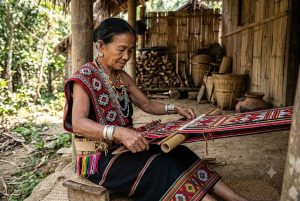
Despite this patrilineal framework, Karbi women exercise substantial social agency, mobility, and dignity. They are the sole custodians of textile arts, manage household granaries, play indispensable ceremonial roles, and remain free from practices such as dowry or purdah.
Traditional Governance: The Mei and Village Council System
Long before modern statutory panchayats or bureaucratic administrative systems reached Assam’s interior, the Karbis operated through a decentralized, participatory democracy:
-
The Sarthe (Village Headman): Each Karbi settlement is governed by an elder chosen through community consensus. Villages are traditionally named after their current headman (e.g., Sarthe Rong).
-
The Mei (Village Council): The council consists of adult household heads who assemble at the headman’s courtyard. The Mei functions as an open deliberative body handling land demarcation, civil disputes, community ceremonies, and restorative justice. Ostracization or ritual fines (Dand) replace punitive incarceration, focusing entirely on community reconciliation.
-
The Longri Mei: A higher council that presides over regional clusters of villages to resolve inter-village disputes, maintain boundary peace, and coordinate collective defense.
The Jirsong: The Traditional Youth Dormitory
One of the most remarkable institutions of indigenous Karbi sociopolitical education is the Jirsong (or Rongkthe). Similar to the Ghotul of central India or the Morung of the Nagas, the Jirsong was a communal youth hall where young men and women lived, worked, and trained together.
Led by elected youth leaders (Seng-bhalang and Kharbhi), the Jirsong functioned as an agrarian labour cooperative. If an elderly widow, an infirm villager, or an impoverished family needed their fields tilled or harvested, the Jirsong mobilised en masse to finish the labour without charging wages. Within this space, oral histories, ballads, architectural crafts, weaving techniques, and social ethics were transferred directly across generations.
Spiritual Universe: Indigenous Faith, Ancestor Worship, and Sacred Ecologies
The indigenous metaphysical outlook of the Karbis is known as Hemphu-Mukrang, an animist and polytheistic worldview where spiritual forces permeate natural phenomena.
The Pantheon and Natural Guardians
-
Hemphu: Revered as the supreme creator and protector of humanity.
-
Mukrang: The secondary divine architect associated with moral order and community health.
-
Rasinja: The deity of prosperity, wealth, and household blessing.
-
Arnam Kethe: The great household and regional spirit invoked during major community welfare rituals.
Beyond the major deities, Karbi theology recognizes local forest spirits, mountain protectors, and river deities (Than). Trees, hilltops, and water sources are treated not as exploitable real estate, but as inhabited spaces requiring sacred reciprocity. Before felling timber or clearing a forest plot for farming, prayers and offerings are made to placate the dwelling deities.
       HEMPHU-MUKRANG BELIEF SYSTEM
       ============================
       [Hemphu]    -> Supreme Creator & Sustainer
       [Mukrang]   -> Guardian of Virtue & World Order
       [Rasinja]   -> Deity of Household Harmony & Harvest
       [Arnam Kethe] -> Great Spirits of Village Welfare
            |
       Pervades Sacred Spaces:
       - Forest groves (Than)
       - Riparian corridors
       - Ridge crests & Ancestral soils
The Grand Mortuary Ritual: Chomangkan
Nowhere is the Karbi spiritual cosmology more profound than in Chomangkan, the four-day, four-night grand death ceremony. For the Karbis, physical death is merely a transition; the spirit (Karhi) wanders between realms until the community performs Chomangkan to guide it peacefully to Chomi Arong (the ancestral spirit realm).
Key features of Chomangkan include:
-
The Charhepi (Ritual Dirge Singer): A designated female ritualist who recites the Kacharhe—a day-long oral chant tracing the lineage of the deceased, offering directions across cosmic paths, and preparing the soul to meet its forebears.
-
The Jambili Athon: The sacred woodcarving of the Karbi people, displayed prominently during Chomangkan.
-
Banjar: Tall, carved bamboo poles decorated with white shavings, erected at the ritual grounds to signify clan pride and spatial sacredness.
-
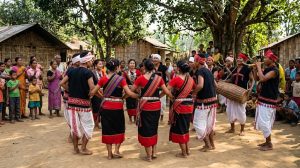
Kan Nimso Kerung: A formal, dignified ritual dance performed by youth holding umbrellas and shields, maintaining steady steps to the resonant rhythm of the Cheng (traditional drum).
Living Material Culture: Weaving, Regalia, and Festive Life
The aesthetic identity of the Karbis is deeply tied to back-strap loom weaving, natural dyes, and agro-festivals aligned with seasonal cycles.
The Symbolic Grammar of Textiles
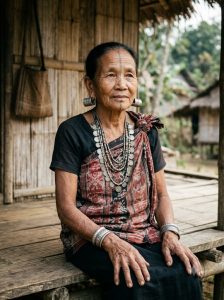
Weaving is an essential art form among Karbi women, passed down from mother to daughter. Using cotton, eri silk, and natural plant dyes, Karbi weavers produce iconic textiles:
| Textile Name | User Group | Description & Cultural Significance |
| Pini | Women | A black waist cloth wrapped securely around the hips, featuring intricate geometric threadwork along its borders. |
| Pekok | Women | A patterned upper-body cloth draped diagonally across the chest and tied firmly over the shoulder. |
| Vamkok | Women | A wide, patterned waist binder used to hold the Pini firmly in place during daily chores and agricultural field labor. |
| Choi | Men | A sleeveless, embroidered vest featuring long fringes and bold red, black, and white striped patterns. |
| Rikong | Men | A simple traditional white cotton loincloth designed for physical labor and warm climates. |
| Poho | Men | An elegant white turban worn with pride during public deliberations, councils, and ceremonial events. |
The Jambili Athon: Masterwork of Woodcraft
The Jambili Athon is the definitive artistic and cultural emblem of the Karbi tribe. Carved from the sacred wood of the Bengvoi tree, it consists of a central pillar ending in a four-branched framework. Each branch is adorned with carved birds representing different clans, topped by the Vo-Rukve (the racket-tailed drongo), symbolizing communal vigilance, unity, and protection. It represents the Karbi cosmic tree of life and is treated with deep reverence.
Festivals of Soil, Seasons, and Solidarity
Karbi festive celebrations correspond to the agrarian calendar, thanking natural forces and reaffirming communal bonds:
-
Rongker: Held in January or April at the start of the agricultural year. It is a village-wide purification ritual where livestock and crops are offered to village deities to ward off illnesses, drive away crop pests, and ensure good rains. During Rongker, strangers are barred from entering the village to preserve sacred tranquillity.
-
Karbi Youth Festival (KYF): Founded in 1974 at Diphu (Taralangso), the KYF has grown into one of Northeast India’s largest and longest-running indigenous cultural festivals. It brings together hundreds of thousands of youth each February to revive endangered folk games, traditional music, choral epics, handloom arts, and modern creative expressions.
Traditional Subsistence: Forest Ecology and Jhum Agriculture
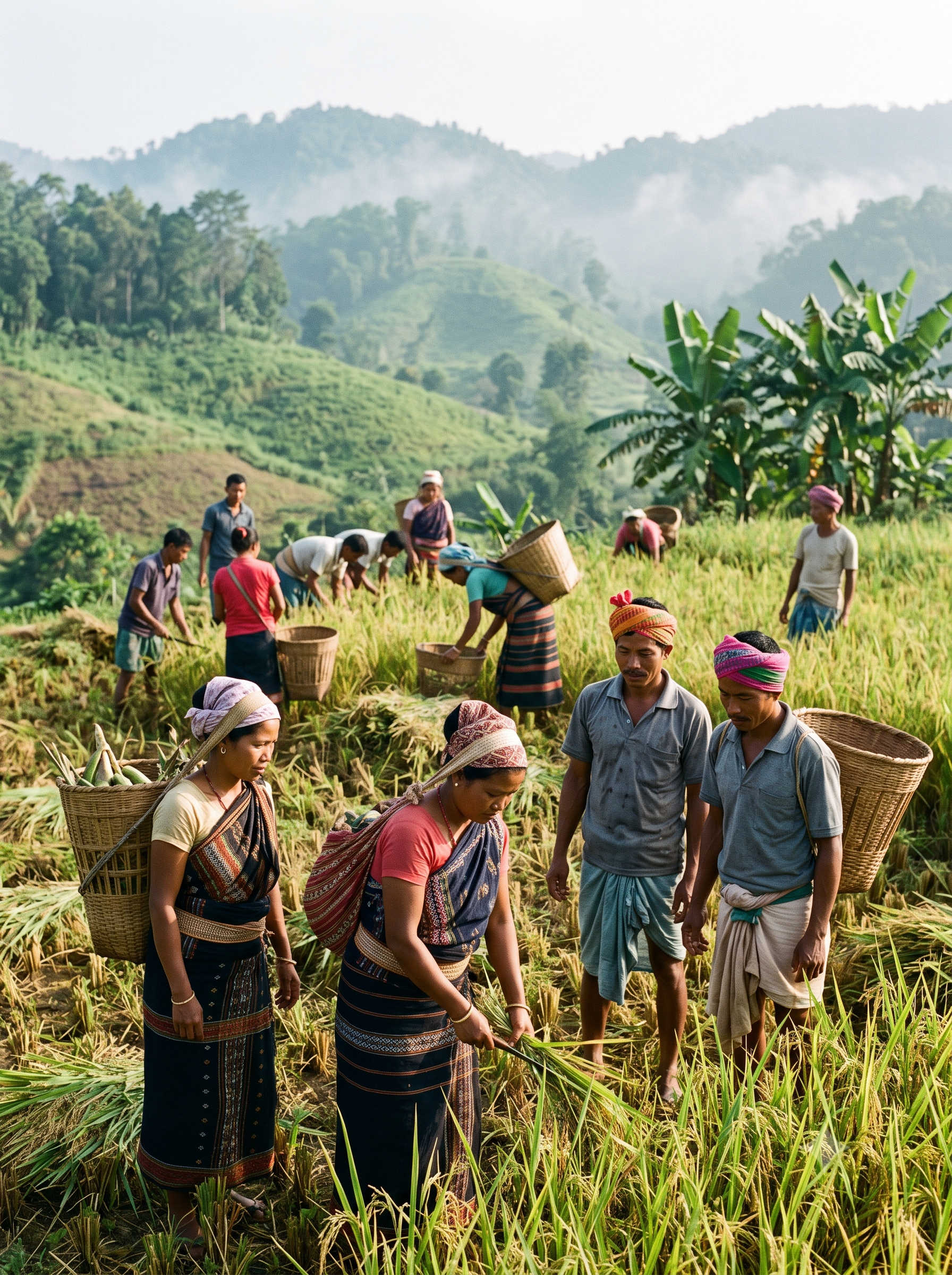
The traditional economic life of the Karbi people centers on subsistence farming, forest collection, and shifting cultivation (Jhum or Rikong-Ahye).
The Dynamics of Jhum Farming
For generations, shifting cultivation on steep hill slopes shaped Karbi survival. Contrary to colonial and early modern characterizations of Jhum as environmentally destructive, traditional Karbi farming operated on extended 10-to-15-year fallow rotations:
-
Biodiversity Conservation: A single Jhum swidden contained a polyculture of dry paddy, maize, chillies, ginger, sesame, pumpkins, yams, and cotton, buffering the family against total crop failure.
-
Soil Regeneration: Land was cleared by hand, left to dry, and burned before the monsoon rains. The ash fertilized the thin mountain soil without synthetic chemical additives.
-
Communal Labor Sharing (Langhe): When a household cleared a hillside, relatives and neighbors worked the land together through reciprocated labor arrangements, minimizing socio-economic stratification.
The Gathering Economy and Medicinal Plant Wisdom
Beyond farming, the Karbis maintain extensive ethnobotanical knowledge:
-
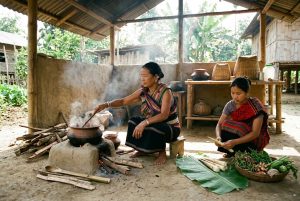
Forests supply wild bamboo shoots (Hen-up), leafy herbs (Hanserang), roots, and medicinal barks.
-
Ethnomedicinal healers (Beh) treat bone fractures, malaria, digestive disorders, and venomous bites using localized flora.
-
Bamboo forms the structural core of everyday life—used for raised stilt houses (Hem-Tap), storage baskets (Khorang), fishing traps, and drinking vessels.
The Political Journey: Autonomy, Sixth Schedule, and Self-Determination
The Karbi experience in modern India is deeply tied to their ongoing struggle for constitutional autonomy, land security, and political self-determination.
The Sixth Schedule and the Karbi Anglong Autonomous Council (KAAC)
Under the Constitution of India, the indigenous hill communities of Assam received special protective administration under the Sixth Schedule, enacted to safeguard tribal customs, land tenure, and local governance.
                       CONSTITUTIONAL AUTONOMY TIMELINE
                       ================================
   1951: Mikir Hills District Council established under Sixth Schedule.
   1970: Re-christened Mikir Hills District; autonomous powers expanded.
   1976: Renamed Karbi Anglong District, restoring indigenous identity.
   1995: Memorandum of Understanding signs over deeper administrative devolution.
   2021: Karbi Anglong Peace Accord signed with major armed groups.
In 1951, the Mikir Hills District Council was carved out to grant self-governance to the hill populations. Over the decades, it evolved into the Karbi Anglong Autonomous Council (KAAC). Headquartered in Diphu, the KAAC holds legislative authority over local subjects such as land allocation, primary education, forests, rural roads, and municipal taxes.
The Movement for an Autonomous State (Article 244A)
Despite the Sixth Schedule, many Karbis felt administrative power remained concentrated in the state capital of Guwahati. Throughout the 1980s and 1990s, political organizations such as the Autonomous State Demand Committee (ASDC) and the Karbi Students Association (KSA) led mass democratic movements demanding the operationalization of Article 244A of the Indian Constitution.
Article 244A allows for the creation of an autonomous sub-state within Assam, comprising Karbi Anglong and Dima Hasao, with its own legislature and council of ministers. This demand remains a major political aspiration for the Karbi intelligentsia, who view full constitutional autonomy as the only way to safeguard their demographic and territorial future.
The Decades of Armed Insurgency and the 2021 Peace Accord
Frustrations over socio-economic backwardness, administrative bottlenecks, and demographic pressures fueled armed resistance groups in the late 1990s and 2000s, including:
-
The Karbi National Volunteers (KNV)
-
The Karbi People’s Force (KPF)
-
The United People’s Democratic Solidarity (UPDS)
-
The Karbi Longri N.C. Hills Liberation Front (KLNLF)
These decades of insurgency brought severe development stagnation, security crackdowns, and tragic ethnic clashes with non-Karbi communities (such as the Dimasas, Kukis, and Hindi-speaking settlers).
A major breakthrough occurred in September 2021, when the Central Government, the Government of Assam, and all active Karbi armed factions signed the historic Karbi Anglong Peace Accord. The accord promised:
-
Complete cessation of hostilities and the surrender of over 1,000 armed cadres.
-
A special development package of ₹1,000 crore dedicated to Karbi Anglong and West Karbi Anglong.
-
Greater devolution of legislative powers to the KAAC.
-
Targeted reservations to protect Karbi and indigenous tribal land ownership.
Modern Human Development Realities: Disparities and Challenges
While the political landscape has stabilized, human development indicators across Karbi Anglong reflect persistent challenges that demand urgent policy focus.
1. Literacy, Education, and Language Endangerment
Literacy rates across Karbi Anglong have risen over recent decades, reaching roughly 68–73% in urban pockets like Diphu, Bokajan, and Hamren. However, significant disparities remain in remote hill hamlets:
-
Mother-Tongue Education: For decades, Karbi children were instructed exclusively in Assamese or English, creating learning hurdles for rural students whose primary language is Karbi.
-
Institutional Infrastructure: Rural schools face teacher shortages, lack functional science laboratories, and experience high dropout rates at the secondary level.
-
Linguistic Vitality: The Karbi language is rich in oral literature, but its transition into formal academic curricula, modern digital formats, and technical publications remains gradual. While it is written primarily in the Roman and Assamese scripts, ongoing debates over an official script have slowed text standardization.
2. Rural Healthcare Access and Nutritional Deficits
Healthcare delivery in the interior hills faces severe logistical barriers:
-
Geographical Isolation: During monsoons, mountain landslides and flooded rivers sever road links, cutting off remote villages from Primary Health Centres (PHCs).
-
Maternal and Child Health: Institutional delivery rates in remote hill tracts lag behind Assam’s state average. Maternal anemia, infant malnutrition, and water-borne diseases remain prevalent where piped drinking water and sanitation are scarce.
-
Vector-Borne Diseases: The dense forests of Karbi Anglong are endemic for malaria and Japanese encephalitis, requiring continuous vector-control interventions.
+--------------------------------------------------------------------------+
|                  CORE HUMAN DEVELOPMENT CHALLENGES                       |
+--------------------------+-----------------------------------------------+
| Domain                   | Key Issues in Remote Karbi Anglong            |
+--------------------------+-----------------------------------------------+
| Education                | Medium-of-instruction gaps; high rural dropouts|
| Healthcare               | Landslide cutoffs; high maternal anemia rates |
| Infrastructure           | Fragile power grids; poor all-weather roads   |
| Economic Mobility        | Reliance on raw-commodity sales; low industry |
+--------------------------+-----------------------------------------------+
3. Agrarian Transitions and Environmental Pressures
The Karbi agrarian economy is at a critical crossroads:
-
Fallow Cycle Compression: Rising population pressures and forest reservation policies have compressed the traditional Jhum fallow cycle from 15 years down to 3–5 years. This shortened window leaves hillsides insufficient time to regenerate natural topsoil, leading to reduced crop yields and soil erosion.
-
Cash Crop Transition: To survive economically, many Karbi farmers have converted ancestral shifting plots into monoculture rubber, ginger, broom grass, and black pepper plantations. While this transition boosts immediate cash income, it exposes smallholders to volatile market prices and reduces subsistence food security.
-
Extractive Deforestation and Mining: Illegal timber felling, uncontrolled stone quarrying, and coal mining in the borders adjoining Kaziranga National Park and neighboring states have damaged fragile watersheds and provoked human-wildlife conflict.
The Modern Identity Struggle: Indigenous Rights and Urbanization
The modern Karbi experience is shaped by the complex balance between preserving cultural heritage and navigating rapid integration into modern Indian society.
Demographic Influx and Land Alienation
The foremost existential concern for the Karbi community is the preservation of tribal land rights. Despite legal protections under Clause 3 of the Sixth Schedule restricting the transfer of tribal land to non-tribal individuals:
-
Large areas of valley lands and commercial centers (such as Diphu, Bokajan, and Howraghat) have seen demographic shifts due to migration from neighboring plains and cross-border regions.
-
Legal loopholes, long-term leasing arrangements, and fraudulent land registrations have caused land alienation among impoverished Karbi farmers.
-
The demand to strictly enforce Rule 18 of the Assam Land and Revenue Regulation 1886—evicting illegal encroachers from tribal belts and blocks—remains a rallying cry for Karbi student bodies.
The Conundrum of Religious Transition
The religious landscape of Karbi Anglong has changed significantly over the past century:
-
The arrival of Christian missionaries in the late 19th and 20th centuries established modern schools, hospitals, and written literature, drawing a sizable portion of the Karbi population to Christianity.
-
At the same time, Hindu reform movements have integrated other segments into mainstream neo-Vaishnavite traditions.
-
This transition has sparked an introspective cultural movement among traditionalists. The Karbi Cultural Society (KCS) works actively to ensure that converted Karbis do not abandon their ancestral clan rituals, funeral practices, oral epics, or traditional attires, emphasizing that cultural identity transcends sectarian lines.
Voices of Revival: Youth Mobilization, Literature, and Sustainable Horizons
Amid these complex pressures, a vibrant resurgence led by young people, community activists, and cultural scholars is charting a forward-looking path for the Karbi people.
                           PILLARS OF KARBI REVIVAL
                                      |
         +----------------------------+----------------------------+
         |                            |                            |
  CULTURAL PRESERVATION       AGRO-ECOLOGICAL VALUE        DIGITAL PRESERVATION
  - Karbi Cultural Society    - Organic ginger & turmeric  - Archiving oral epics
  - Karbi Youth Festival      - Fair-trade Eri silk        - Mother-tongue literacy
  - Traditional art forms     - Eco-tourism cooperatives   - Online media & advocacy
The Renaissance of the Karbi Youth Festival (KYF)
The sprawling cultural complex at Taralangso, Diphu, is a vibrant home for youth-led cultural revitalization. Over five days each February, thousands of young Karbis gather to compete in:
-
Traditional archery, stilt-walking, and indigenous sports.
-
Performances of the epic Karbi Ramayana (Sabin Alun), which reimagines the epic entirely within the flora, fauna, and clan structures of the Karbi hills.
-
Contemporary folk-fusion music, blending traditional bamboo drums and flutes with rock, acoustic folk, and electronic instruments to deliver songs about social justice, forest conservation, and ethnic pride.
Geographical Indications (GI) and Sustainable Agro-Enterprises
Karbi Anglong is famous for producing some of the highest-quality organic ginger in the world, prized for its high gingerol and oleoresin content. In recent years, Karbi Anglong Ginger was awarded the prestigious Geographical Indication (GI) tag.
This recognition has spurred farmer producer organizations (FPOs) and tribal cooperatives to process and export dry ginger, organic turmeric, and wild honey directly to domestic and international markets, cutting out predatory middlemen and generating rural youth employment.
Similarly, Karbi women are forming self-help groups (SHGs) to produce cruelty-free Eri silk (Ahimsa Silk). By pairing their generational weaving skills with fair-trade supply chains, these weavers are turning traditional Pini and Pekok designs into sustainable fashion items sold in major urban markets.
A Strategic Roadmap for Karbi Human Development and Cultural Survival
To secure the long-term well-being and self-reliance of the Karbi tribe, coordinated efforts across government, civil society, and local institutions must focus on five strategic priorities:
1. Rigorous Land Protection and Cadastral Modernization
-
Digitize all land records within the Karbi Anglong Autonomous Council using GIS mapping to protect tribal commons (Rong-Asor) from unauthorized encroachment.
-
Strengthen Sixth Schedule provisions to prevent the unlawful transfer of indigenous land, establishing specialized fast-track courts to resolve tribal land alienation disputes.
2. Mother-Tongue and Culturally Rooted Education
-
Expand Karbi-language primary schooling through bilingual education models, ensuring children build foundational literacy in their native language before transitioning to state and national media of instruction.
-
Institutionalize the collection and documentation of oral epics (Mosera Kharik, Sabin Alun) within school and university curricula across Assam.
3. Rural Healthcare Infrastructure and Mobile Networks
-
Upgrade Primary Health Centres in the remote interiors of West Karbi Anglong with cold-chain facilities, solar backup systems, and tele-medicine connectivity.
-
Expand community-based healthcare programs by training local tribal youth as auxiliary health workers, bridging geographic distance and language barriers for rural elders.
4. Climate-Resilient, Regenerative Agriculture
-
Support Karbi farmers with agroforestry programs that blend traditional polycultural Jhum knowledge with terrace farming, rainwater harvesting, and soil conservation techniques.
-
Invest in cold storage and value-addition units for indigenous ginger, turmeric, pineapple, and citrus fruits within Diphu and Hamren, keeping agro-processing profits within the local community.
5. Empowering Grassroots Democratic Institutions
-
Harmonize the relationship between modern statutory administrative bodies (KAAC) and traditional village councils (Mei).
-
Channel local rural development funds directly to traditional village heads (Sarthe) and local councils, preserving decentralized, transparent, and consensus-driven tribal democracy.
The Journey Forward: Preserving Identity in a Changing World
The story of the Karbi tribe reflects the wider experience of indigenous communities across modern India: an enduring balance between deep ancestral heritage and rapid modern transition. From the misty heights of the Singhason peak to the bustling, paved avenues of Diphu, the Karbi people continue to demonstrate remarkable cultural vitality.
Their relationship with the natural world, their egalitarian clan structures, and their communal ethos offer valuable lessons for a modern world grappling with environmental degradation, economic inequity, and cultural homogenization. Protecting Karbi identity is not about freezing their culture in time; it is about providing the institutional support, constitutional safeguards, and economic resources they need to thrive on their own terms.
As the drums of the Karbi Youth Festival continue to echo across the hills of Taralangso, the message of the Karbi people rings clear: they are not passive subjects of historical change, but active custodians of an ancient, resilient heritage. Through community solidarity, sustainable development, and unyielding pride in their roots, the Karbis continue to show how a tribal society can embrace modern life while preserving its ancestral soul.
