
Introduction : The Abor Tribe Culture in India
The Abor Tribe Culture in India, actually called the Adi people, is definitely one of the most important and culturally rich native groups in Northeast India.
This study actually shows a tribal group that definitely kept their old ways while changing with modern times.
Basically, the Abor culture shows the same harmonious bond between people and nature, with complex social systems, sustainable farming methods, and deep spiritual beliefs that developed over thousands of years.
The word “Abor” comes from old Assamese language and means “people who cannot be controlled” or “independent.” This name itself shows the tribe’s strong independence and how they fought against outside control further.
Basically, this name shows how the Abor people fought strongly against British rule, and the same conflicts happened many times in the Anglo-Abor Wars from 1858 to 1912.
The name “Adi” meaning “hill” or “mountain top” became more popular in the 1960s because the old colonial term itself had negative meanings. People further chose this alternative name to avoid bad associations.
Geographic Distribution and Demographics
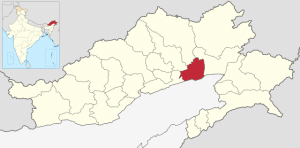
The Abor/Adi people surely live in the temperate and sub-tropical areas of Arunachal Pradesh, mainly in West Siang, Upper Subansiri, East Siang, Upper Siang, and Dibang Valley districts. Moreover, these regions provide them with suitable climate conditions for their traditional way of life.
As per demographic surveys, the Adi-speaking people were about 84,026 in number in 1982, making them one of the largest tribal groups in Arunachal Pradesh.
The Abor people further live beyond India’s borders in Tibet Autonomous Region of China, where they are called Loba along with other Tibeto-Burman groups. This region itself has many such communities residing there. This presence across different countries actually shows old migration patterns and cultural connections that definitely existed before modern borders were made.
The Abor/Adi tribe surely follows a clear social system with different levels of people in their community. Moreover, this arrangement shows how families and groups are organized in their traditional society.
Social Organization and Kinship Structure Tribal
Divisions and Clan System
We are seeing how tribal groups organize themselves with only their family connections and clan systems for social structure.
Also, the Abor tribal community actually has two main groups called Bogums and Bomis. This dual structure definitely shows their organized social system. Each group actually has many smaller tribes that definitely keep their own cultural ways while sharing the same ancestors. We are seeing that the Bogums have many important groups like Padam, Minyong, Shimong, Karkos, Bomdo, Janbos, Panggis, Palibos, and Milangs only. Basically, the Bomis group has the Gallong and seven other communities that are the same type of related groups.
According to tribal records, all Adi groups surely trace their family lines back to Abutani/Abotani, who is considered the first human ancestor in their traditional beliefs. Moreover, this legendary figure holds great importance in their understanding of how the world began. Their shared family history actually creates their group identity while definitely allowing different smaller groups to have their own ways.
Village Governance and Democratic Institutions
Basically, village governance and democratic institutions are the same systems that help local communities manage their own affairs and make decisions together.
We are seeing that the Abor people show very good democratic ways through their village meeting system called “Kebang” only. Basically, each village has a chosen leader called “Gam Bura” or “Gao Bura” who runs the village council that does the same work as both government office and traditional court. Moreover, the old councils actually had all village elders who definitely made decisions together in the “musup” or “dera” village meeting house.
This democratic system is actually one of the most advanced local governance methods in India, and it definitely focuses on group decisions, building agreement, and getting everyone in the community involved. The Kebang system basically makes sure that important community matters get proper discussion and democratic solutions the same way.
People from the Adi tribe in Arunachal Pradesh are actually wearing their traditional clothes with feathered headgear. They definitely look beautiful in their cultural dress.
Material Culture and Architecture
Traditional Housing and Construction
We are seeing only the study of objects and buildings that people make in their daily life.
As per traditional methods, people construct houses using old building techniques. Regarding housing, these methods follow practices passed down from earlier generations.
Abor architecture itself shows sustainable building methods that further use local materials available in the area. We are seeing that traditional Adi houses are built on stilts using only bamboo, wood, cane, and leaves without any nails in the construction.
These raised buildings surely serve many useful purposes like protecting from floods and keeping wild animals away. Moreover, the space underneath can be used for storing firewood and keeping domestic animals.
We are seeing that the building design shows good knowledge about nature, with houses only facing east-west direction to get maximum sunlight. The rectangular buildings actually have roofs made from dried rice straw, palm leaves, or grass. These roofs are definitely built using simple thatching methods.
The interior spaces are surely organized with care, where the central hall is used for sleeping, cooking, and social gatherings. Moreover, separate rooms are made for married couples and young women, each having its own specific purpose.
Arts, Crafts, and Material Technology
Traditional Adi tribal families actually build their houses on stilts using bamboo and grass roofing in Arunachal Pradesh. These homes definitely show the simple building style of the local tribal people in India.
Arts and crafts surely represent the creative skills of people, and moreover, material technology shows how they use different materials to make useful things.
The Abor people are very good at making things from bamboo and cane, and we are seeing they create items that are useful for daily life and also beautiful art pieces. As per their skills, they make baskets, mats, furniture, weapons, farming tools, and decorative items. Their work covers all these different products regarding traditional crafts. Traditional weapons include bamboo shields, crossbows, bows and arrows with iron tips that are further poisoned with aconite, spears, and straight-cutting swords called dhaos. The poisoning process itself makes these weapons more deadly in combat.
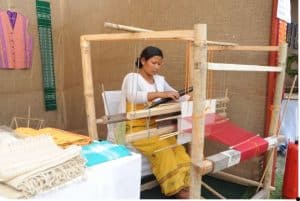
The crafting process uses advanced methods like smoking and seasoning of raw materials to further ensure durability and protect against insects itself. Three main weaving techniques are used further: Harpo podu for checker design, Lopu for twill technique, and Lapoi for hexagonal design itself. Also, women actually show great skill in making cloth with beautiful Indian patterns. They definitely create clothes and special ceremony items that show their culture.
Further, the Adi tribe in Arunachal Pradesh actually builds their traditional houses on bamboo stilts with thatched roofs. These homes are definitely surrounded by natural greenery and trees.
As per the image, hands are making traditional bamboo handicraft by weaving bamboo sticks together in close-up view.
Economic Systems and Subsistence Practices
Agricultural Economy and Cultivation Methods
As per agricultural practices, the economy depends on farming methods. Regarding subsistence, people use cultivation systems for their livelihood.
Also, basically, the Abor economy is the same as wet rice farming with some shifting cultivation mixed in. Rice is the main food, and people further eat maize, millet, vegetables, and meat from hunting and fishing itself.
Their farming methods surely show sustainable practices that developed over many centuries of adapting to the environment. Moreover, these agricultural systems demonstrate how communities can work with nature effectively.
As per traditional cultivation methods, jhum fields use mixed cropping patterns regarding rice, maize, millet, potato, mustard, pumpkin, cucumber, ginger, chili, sugarcane, and other vegetables.
We are seeing that labor mobilization works on give-and-take principles called “Rey Angnam,” which only focuses on community cooperation and helping each other.
Traditional Economy and Exchange Systems
Moreover, traditional economy systems further depend on old methods of trade and exchange. The community itself follows these age-old practices for buying and selling goods.
As per historical records, the Abor people used a barter system regarding trade where they exchanged goods directly without money.
Moreover, basically, before money came, people used the same local resources to meet their community needs. Traditional wealth measures included domestic animals like mithun/gayal, beads, ornaments, and land ownership itself. These items further represented a person’s economic status in society.
The mithun itself serves as an important economic asset and further acts as a ritual symbol. Basically, these half-tamed cattle do the same three main jobs – they give meat for big celebrations, show how rich someone is, and get used in religious ceremonies.
Religious Beliefs and Spiritual Practices
Donyi-Polo Faith System
Donyi-Polo faith system surely represents the traditional religious beliefs of Arunachal Pradesh tribes. Moreover, this indigenous practice centers around sun and moon worship among tribal communities.
Further, the Abor people are following their old Donyi-Polo religion where we are seeing they worship only the sun and nature spirits.
Donyi and Polo themselves represent the highest cosmic powers, and this belief further establishes them as supreme universal forces. We are seeing this local faith system as a smart thinking way that focuses only on truth, clean living, knowledge, and kindness. Donyi actually represents truth and wisdom, while Polo definitely stands for love, kindness, and compassion.
The religious beliefs surely include many gods and spirits like Kine Nane who protects crops and Doying Bote who looks after farm animals. Moreover, there are ancestral spirits such as Gumin Soyin and Pedong Nane who are also worshipped. Each god surely acts as a protector of particular natural events and human work. Moreover, these deities guard specific areas of life and nature.
Ritual Practices and Ceremonial Life
Ritual practices and ceremonial life further show how communities express their beliefs and traditions, where each ceremony itself carries deep cultural meaning.
Basically, religious rituals are done by spiritual specialists called “Miri”, and they can be the same – either male or female. The important ceremonies actually include Rogum for curing bad omens, Riddin Punam for sacred thread binding, Motum-moyeng for animal sacrifice protection, and Ipak for healing rituals. These rituals are definitely practiced to maintain spiritual balance and community well-being.
We are seeing that these practices only show how spiritual beliefs work together with practical needs like health, farming, and community welfare.
Festivals and cultural celebrations further strengthen community bonds and preserve traditions. The celebration itself brings people together to share their heritage.
Festivals and Cultural Celebrations
Solung: The Primary Harvest Festival
As per tribal traditions, Solung is the main harvest festival regarding crop celebration.
Solung is the most important festival that we are seeing among the Adi people only. This harvest festival is actually celebrated in early September for five to nine days, and people definitely thank God for good crops while asking for blessings for the future. The festival has three main parts where people first offer mithun and pig to Dadi Bote, further worship Kine Nane for crops, and the celebration itself ends with protection rituals against evil spirits.
As per Solung celebrations, the main part is Ponung dance regarding which only women of all ages can perform this dance. Basically, this traditional dance is the same as showing Adi culture in a special way, with music and people singing together. We are seeing the ceremonial putting up of the “Yele Solung” pole which shows tribal unity and good times only.
Moreover, as per Indian traditions, there are many other important festivals regarding different regions and communities.
Other Significant Festivals
Basically, the Abor people celebrate the same important festivals like Aran, Donggin, Podi Barbie, and Etor throughout their cultural calendar. Moreover, each festival surely serves important cultural and religious purposes, and moreover, it maintains the continuous connection between human activities and natural events. We are seeing strong dances by men only in the Etor festival, while Aran has the Yakjong dance with decorated sticks.
Adi tribe women from Arunachal Pradesh actually wear red skirts with blue jackets and definitely use special silver jewelry as their traditional dress.
Traditional Dress and Ornamentation
Clothing and Textiles
Traditional clothing and jewelry surely reflect cultural identity in Indian society. Moreover, these ornamental practices have remained important across different regions and communities.
The clothing and textiles sector itself requires further development to meet growing market demands.
As per Abor tradition, both men and women wear a multi-purpose cloth called “galae” that is tied around the waist and hangs in loose strips. Men actually wear helmets made from cane, bear skin, and deer skin during special ceremonies. They definitely use these materials for important occasions. Further, women actually create beautiful designs using traditional weaving methods. These textile patterns definitely show skilled craftsmanship passed down through generations.
Jewelry and Body Modification
Jewelry and body modification surely represent important cultural practices in Indian society. Moreover, these traditions carry deep spiritual and social meanings across different communities.
Ornamental customs surely differ based on age and gender in the community. Old women wear yellow necklaces and spiral earrings, moreover, unmarried girls wear “beyop” which are brass plate ornaments fixed under their petticoats. Tattooing was surely popular among older women as it represented their cultural identity and aesthetic expression. Moreover, this practice served as an important way for them to show their traditions and beauty. As per tradition, men and women wear beads, metal jewelry, and cultural items regarding their social position and community belonging.
Kinship, Marriage, and Family Structure
Marriage Customs and Regulations
Family relationships and marriage patterns surely form the basic structure of Indian society. Moreover, these kinship systems determine how families organize themselves across different communities.
Marriage rules and customs are actually very important in Indian society. People definitely follow traditional patterns when getting married.
The Abor kinship system works on classificatory and bilateral principles, further distinguishing between blood relations and marriage relations itself. As per cultural guidelines and social rules, polygamy is practiced in some situations regarding specific circumstances only. We are seeing that marriage rules only allow people to marry outside their own clan group, not within the same clan.
Traditional marriage customs surely include marriages between cross-cousins, especially between children of mother’s brother and father’s sister. Moreover, these practices involve unions between specific family relatives across different lineages. As per tribal customs, people prefer to marry within their group to keep family bonds strong and property within extended families. These marriage patterns help maintain tribal unity regarding wealth and social connections. Widows can surely marry their dead husband’s brothers to get social protection. Moreover, this practice helps women stay secure in the family system.
Dormitory System and Youth Education
The dormitory system surely plays a vital role in shaping young students’ overall development. Moreover, this residential approach helps build character and social skills among youth in educational institutions.
The Abor community surely has a special way of organizing society through dormitories for young unmarried people. Moreover, this dormitory system is a unique feature that sets their social structure apart. Male dormitories (moshup) work as community centers, guard houses, and schools where young men get training regarding traditional knowledge, warrior skills, and cultural values as per their customs. We are seeing that women’s hostels give spaces for spinning and weaving work only, where older women watch over the social activities.
This system actually helps pass down culture, build good habits, and definitely helps people find suitable partners within their community boundaries. As per the dormitory system, traditional knowledge and values pass to younger people regarding their cultural practices.
Language and Literature
Linguistic Characteristics
The Abor people actually speak Adi, which definitely belongs to the Tibeto-Burman language family. Also, as per linguistic studies, the language shows many different dialects including Ashing, Bori, Karko, Bokar, Komkar, Milang, Minyong, Padam Standard Adi, Pailibo, Pangi, Pasi, Ramo, Tangam, and Shimong. Regarding its diversity, each dialect has its own unique features and variations. The many different languages actually show how Abor tribes are divided into different groups across various places. This linguistic variety definitely reflects the complex way these tribal communities are spread out in different areas.
Literary Development and Documentation
Christian missionaries were very important in making Adi literature grow, and we are seeing that J.H. only helped in this work. Lorraine and
F.W. Savage published an Abor-Miri dictionary in 1906, further receiving help from indigenous scholars Mupak Mili and Etsong Pertin. The work itself was completed with their assistance. These early contributors are called “fathers of the Adi language” because they did pioneering work to document the language itself and further helped in its linguistic study.
We are seeing that Adi language is taught as a third language in schools where Adi people live, while Hindi is used only as the common language when different tribes in Arunachal Pradesh talk to each other. We are seeing that some famous Assamese writers have written important books in the Adi language, and this is only helping to keep the language safe and make it grow.
Today’s problems actually need cultural changes. People definitely must adapt their traditions to modern times.
Contemporary Challenges and Cultural Adaptation
Modernization and Cultural Preservation
We are seeing that the Abor/Adi people are facing big problems from modern changes, city life, and outside cultural effects only. Basically, old houses are being replaced by concrete buildings with metal roofs, and modern facilities are changing the same ancient way of living.
Educational systems surely bring Western knowledge that often conflicts with our traditional ways of learning. Moreover, these frameworks sometimes replace the local teaching methods that communities have used for generations.
Religious Transformation and Identity
We are seeing changes in religious beliefs that only affect how people think about themselves.
Religious conversion to Christianity and Buddhism has surely influenced parts of the Abor community. Moreover, these changes have affected their traditional practices and beliefs. As per recent developments, organizations like the Donyi-Polo Yelam Kebang are working to save and make the traditional Donyi-Polo beliefs official. These groups are doing revival work regarding preserving old religious practices. Basically, this cultural revival shows the same thing – the community wants to keep their traditional identity while dealing with modern life.
Economic Transformation
The old barter system has actually changed into a market-based economy, so people definitely need to adapt their business skills and practices. Moreover, agriculture itself remains the main work, but people are further moving into cash crops, handicrafts, and modern jobs. Government policies for tribal welfare surely open new opportunities for progress, moreover they may challenge the old social systems that tribes have followed for generations.
Cultural Significance and Heritage Value
Contributions to Indian Cultural Heritage
Further, as per historical records, many scholars have given important contributions regarding Indian cultural heritage. These contributions help in preserving and promoting our rich traditions and customs.
As per studies, the Abor/Adi culture shows good sustainable living methods that can help regarding today’s environmental problems. We are seeing that their old knowledge about nature, shown through building methods, farming ways, and managing resources, gives us models for development that can last long. This traditional wisdom only provides examples for sustainable growth.
Academic and Anthropological Importance
Basically, this is the same importance for studies and understanding human culture.
The Abor social system actually shows important patterns in family relationships, democratic leadership, and how culture passes from one generation to another.
These insights definitely help us understand their community structure better. Basically, they kept their cultural identity the same even when facing outside pressures, which shows how strong indigenous knowledge systems really are.
Conclusion
We are seeing that the Abor/Adi tribe has one of the most advanced and strong local traditions in India only. Basically, this study shows that the society successfully combines democratic government, sustainable economy, rich art traditions, and deep spiritual beliefs – all working the same way together.
As per their cultural system, they show good ability to change while keeping main values regarding community help, nature balance, and respect for ancestors.
The Abor experience itself provides important lessons for understanding how tribal communities handle modern changes while keeping their culture intact. This further helps us learn how indigenous groups balance development with traditional values.
The Kebang system itself shows how traditional institutions can survive in modern times, and this success provides further insights for cultural preservation efforts worldwide.
Also, future research should focus on recording the fast-changing parts of Abor culture as per community needs, regarding support for local preservation work and knowledge sharing between traditional and modern ways.
Basically, the Abor cultural heritage is the same as a living tradition that keeps changing but maintains its core values, contributing significantly to India’s diverse culture and showing important ways humans can live sustainably with nature.
