
Introduction: Inside the Dogon World
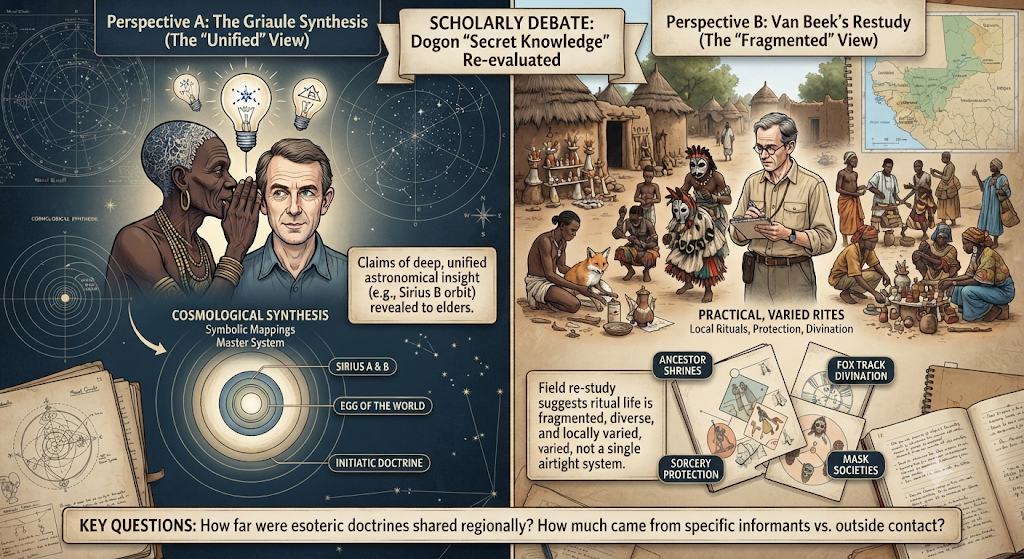
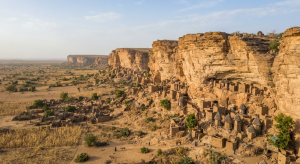
Where the sandstone walls of the Bandiagara Escarpment rise abruptly out of the sandy plains of central Mali, a living civilisation has shaped survival, cosmology, and stone into one of the most astonishing human landscapes on Earth. Most travellers encounter the Dogon through brief postcards—sun-baked mud granaries clinging to vertical rock faces, wooden masks dancing in plumes of dust, and ancient cliff caves overlooking the Sahel. Yet beneath those familiar images lies a world governed by exacting ecological trade-offs, deep linguistic antiquity, contested ethnographic histories, and acute modern pressures.
Thank you for reading this post, don't forget to subscribe!Geography, Deep Time, and the Architecture of Survival
The Bandiagara Escarpment stretches roughly 145 to 200 kilometres across Mali’s Mopti Region—extending geographically between roughly 13°15’N and 15°N latitude and 1°30’W to 4°W longitude—forming a dramatic geological wall where sandstone cliffs rise 100 to 300 metres (with relief reaching up to 500 metres relative to lower plains) above surrounding plateaus and plains. Inscribed by UNESCO in 1989 as a mixed natural and cultural World Heritage property covering 327,390 hectares, the escarpment sits right along the southern margin of the Sahara, inside a Sudano-Sahelian transition zone where scrubland, dry tablelands, steep mesas, and wind-eroded rock crevices meet.
Archaeological and historical research shows that the Dogon were not the first humans to inhabit this rugged corridor. Earliest known occupants, such as the Toloy, appear in the archaeological record around the third century BCE, followed by the Tellem around the eleventh century, who built cliffside dwellings and cylindrical granaries high in rock recesses to defend against raiders and hostile neighbours. Dogon oral history remembers the Tellem as “the ones we found”, and archaeological and historical evidence indicates that the Tellem abandoned the escarpment by the 1800s, while Dogon migration and settlement into the Bandiagara region expanded around the fifteenth or sixteenth century, closely linked to political upheavals following the breakup of the Mali Empire at the start of the fifteenth century.
Earthen Craft, Granaries, and Vernacular Engineering
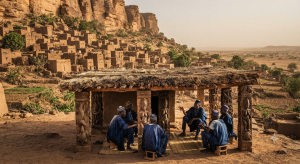
Earthen construction is ancient across West Africa and globally, where more than 50% of the world’s population lives in mud or loam buildings. In Dogon country, builders work with earth, stone, timber, and thatch—materials that demand ongoing seasonal maintenance rather than a one-time pour of concrete. Tales of earthen techniques developed roughly 2,500 years ago during a wetter era survive in fragments, preserved by rock overhangs and community upkeep, even as fewer people master the oldest methods today.
Granaries are among the most iconic structures in a Dogon settlement. Rather than being generic storage boxes, granaries are gendered and specialised: Dogon builders construct four types of granaries—two for men and two for women. Among women’s granaries, the square guyo ya commonly holds a wife’s personal belongings, whereas the less common round guyo totori is used for specific harvests.
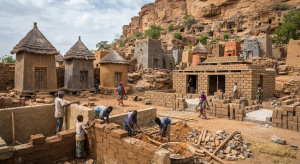
Contemporary vernacular projects in the region have also experimented with hydraulically compressed earth blocks (HCEB)—produced on-site since 2011 to cut transport costs—used without cement across interior walls, floor stones, and tiered roof stones to improve thermal comfort and train local masons, alongside initiatives such as 30 schools constructed over 20 years in partnership with local communities.
| Structural & Geographic Dimension | Key Facts & Recorded Figures | Practical & Cultural Function |
| Escarpment Span & Height | ~145–200 km stretch; cliffs 100–300 m high (up to 500 m relief) | Natural defence, microclimates, and cliff-base/plateau settlement |
| UNESCO Property Area | 327,390 hectares (inscribed 1989, mixed natural/cultural site) | Protects geological, archaeological, and living ethnological landscapes |
| Climate & Peak Heat | Wet season June–mid-October; dry season January–May; highs up to 47°C (Feb–Mar) | Governs planting windows, water harvesting, and harmattan dust exposure |
| Village & Compound Scale | ~44 houses per average village; Guinea extended families up to ~100 people | Concentrates kin cooperation around lineage heads and shared courtyards |
| Granary Typology | 4 types total (2 male, 2 female), including square guyo ya and round guyo totori | Separates grain/household reserves by gender, kinship, and harvest type |
Demographics, Language Islands, and Social Structure
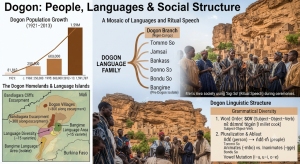
Putting a single number on the Dogon population requires care because estimates vary across censuses, surveys, and scholarly sources over time. Demographic summaries and estimates have reported figures ranging from around 250,000 in mid-20th-century references to ~600,000 in 1995 (462,000 in Mali and 138,000 in Burkina Faso), ~800,000 in broad cultural profiles, and 1,591,787 in 2012–2013 demographic tallies (with Mali figures around 1,751,965, or 8.7% of Mali’s population in that compilation). Earlier colonial records show rapid growth from 81,862 in the 1921 census to 250,000 by the early 1960s—more than a threefold increase over roughly four decades. Across the Bandiagara cliff corridor alone, the population is concentrated in roughly 300 villages along the escarpment.
A Mosaic of Languages and Secret Ritual Speech
“Dogon” is not a single monolithic tongue; it is a cluster of Dogon languages—often cited with around 15 mutually unintelligible varieties such as Tombo (Tommo So), Jamsai, Bankass, Donno Sɔ, and Bondu So—generally treated as an independent or distinct branch within the Niger-Congo family rather than a mere dialect of a neighbouring group. Linguist Roger Blench has suggested that the ancestor of Dogon may have diverged very early within Niger-Congo, with present-day languages reflecting an origin perhaps 3,000–4,000 years ago.
Even more remarkable is Bangime, spoken by roughly 1,500 ethnic Dogon across seven villages in southern Mali. Most linguists classify Bangime as an unrelated, ancient, pre-Dogon language isolate (though a minority, including Roger Blench, have hypothesised possible links to Proto-Nilo-Saharan), making it a living linguistic relic of an older population absorbed or joined by Dogon speakers. Alongside everyday speech, initiates in the men’s Awa society use Sigi So, a specialised ritual language associated with ceremonial rites.
Grammatically, Dogon languages display striking internal diversity across short distances:
-
Word order & verbs: Varieties such as Donno Sɔ and Tommo So follow a Subject–Object–Verb (SOV) order uncommon among many Niger-Congo neighbours, with seven oral vowels (occurring short and long for 14 vowel qualities) and two lexical tones (high and low).
-
Animacy & noun forms: In Tommo So, human plural nouns often take -m (e.g., ǹdɛ́ “person” → ǹdɛ̀-ḿ “people”), while Bondu So marks animate plurals with -mbo and inanimate singulars with -ŋge and uses vowel mutation (ablaut)—such as i–u, u–i, and o–e—to distinguish singular and plural forms.
Kinship, the Hogon, Castes, and Rites of Passage
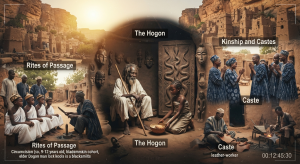
Dogon society is organised primarily along patrilineal kinship, with village leadership resting with a male elder—typically the oldest living son of the lineage founder. Greetings permeate daily social life: exchanges centred on sewa (“Is it peaceful/well?”) are so constant that outsiders have sometimes referred to the Dogon as the “sewa people”.
At the spiritual pivot of a community sits the Hogon (spiritual leader). Installation involves a six-month seclusion or initiation period without shaving or washing, wearing white garments, and avoiding physical touch. A prepubescent girl who has not yet menstruated initially tends to his meals and household before returning home at night, later succeeded by one of his wives who also leaves by night, as the Hogon lives alone in his dwelling—where tradition holds that the sacred snake Lébé visits at night to purify him and impart wisdom.
Social organisation also includes two endogamous castes—blacksmiths and leatherworkers—who typically live on the edge of or apart from the main village. Birth determines caste status; blacksmiths carry potent ritual roles and often modest material wealth, whereas leatherworkers conduct extensive regional trade. Unlike non-caste lineages, parallel-cousin marriage is permitted within castes, and caste boys are not circumcised in the same way. For non-caste boys, circumcision occurs in three-year age cohorts (for example, boys aged 9 to 12), performed by a blacksmith and followed by secluded recovery—a rite tied in Dogon thought to resolving an original mythical “dual soul” or twin/androgynous principle so each person assumes a clear social and gender identity.
Cosmology, Sirius, and the Griaule–van Beek Debate
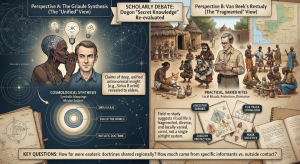
Few topics in anthropology have sparked as much fascination—and fierce scholarly debate—as Dogon cosmology. In the mid-twentieth century, French anthropologist Marcel Griaule (working with Germaine Dieterlen and colleagues, notably through Griaule’s famous 1946 series of conversations with the blind elder Ogotemmêli in Sanga, published in English as Conversations with Ogotemmêli) presented a sweeping metaphysical system.
In that account, the supreme creator Amma shapes the universe and earth, while twin primordial forces—Ogo (or Yurugu, associated with the pale fox and disruption/space-time) and the Nommo (water spirits linked to twinness, speech, and regeneration)—drive cosmic order and renewal. Griaule and Dieterlen reported that Dogon esoteric teachings described Sirius (Sigi Tolo) alongside a tiny, dense companion star (Po Tolo, linked to fo / po grain and Yurugu Tolo) orbiting on a 50-year cycle, as well as a third star (Emme), moons of Jupiter, and multiple calendars (lunar, solar, Venus, and Sirius).
Why Scholars Clashed Over “Secret Knowledge”
Because Sirius B (the white dwarf companion of Sirius A) was first observed telescopically by Alvan Graham Clark in 1862 and its ~50-year orbital period was established later in modern astronomy, claims of ancient Dogon astronomical insight quickly became famous in popular science and speculative writing—often stripped of their anthropological context.
Later field anthropologists, most prominently Walter E. A. van Beek in his restudy of the Dogon (“Dogon Restudied: A Field Evaluation of the Work of Marcel Griaule”), challenged the idea that Griaule’s grand, unified cosmological synthesis reflected everyday Dogon belief across the region. Van Beek noted several critical points:
-
Fragmented vs. unified theology: In field re-study, Dogon ritual life looked less like a single airtight philosophical textbook and more like a set of practical, locally varied rites—sacrifice, ancestor shrines, divination (such as reading fox tracks on divination tables), and protection against sorcery or misfortune—where mask societies and sacrificial altars are not always tightly welded into one master system.
Approaching Dogon cosmology honestly means holding both realities in view: the poetic, symbolic power of Dogon myth as recorded in mid-century ethnography, and the methodological caution of modern anthropologists who warn against turning complex oral symbolism into a literal modern astrophysics textbook.
Masks, the Awa Society, Dama, and the 60-Year Sigi
In Dogon ritual life, masks are not static museum sculptures—they are active spiritual presences that must be danced and painted or repainted to carry ritual force. Carved masks represent over 80 different figures—human archetypes, neighboring peoples, animals, plants, and spirit beings—and enter public space through the Awa men’s mask society.
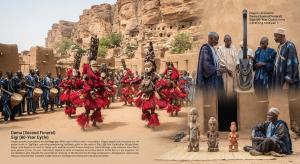
Two ceremonial cycles anchor this dramatic visual world:
-
The Dama (Second Funeral): Dogon funerary rites unfold in two stages—an initial burial and mourning sequence immediately after death, followed later by the dama, a multi-day celebration (often lasting several days, with an initial day known as Halic) that escorts the deceased’s spirit cleanly into the realm of ancestors so lingering spirits are not blamed for village misfortune. Historically, a village or cluster of villages might hold a dama roughly every 13 years on average during the dry season, though rising costs have made traditional dama ceremonies less frequent in some places, while occasional performances for outsiders have altered their traditional setting.
Alongside carved wood, red-dyed fibers—linked in myth to the female figure Yasigi and the yasigine ritual role—play a vital visual role in funerary and mask traditions. Meanwhile, centuries-old wooden sculptures, ancestor figures, and terracotta traditions from the Bandiagara region have long drawn collectors and museums worldwide, raising ongoing concerns over heritage preservation and illicit removal of cultural objects.
Farming on Stone and Sand: Millet, Onions, and Shifting Livelihoods
For generations, subsistence farming has anchored Dogon life across three distinct ecological zones: the sandy plateau, the steep escarpment slopes and pockets, and the lower plains. Hardy grains—especially pearl millet and fonio—form staple crops adapted to poor soils and low, variable rainfall, while shallots/onions cultivated in small irrigated garden plots and terraces have become one of the region’s best-known cash and food crops.
Because surface water is scarce and rainfall is concentrated in a single summer monsoon window, farming is a race against heat, evaporation, and soil exhaustion. Across the wider Sahel, climate models project declining yields for key crops such as millet and sorghum under warming scenarios, while crops like cowpeas, groundnuts, cassava, and rice may experience mixed effects from heat, water stress, and $\text{CO}_2$ dynamics.
At the same time, economic life has shifted dramatically since the colonial era. Following French military conquest in the 1890s, the introduction of colonial taxation and currency shifts (replacing cowry shells with French francs), early mission and school foundations such as the 1912 school in Sanga, and post-independence infrastructure like the 40-kilometer road linking Bandiagara and Sanga after 1960, Dogon households became increasingly tied to wider markets. Today, many young men migrate seasonally or for longer stretches to urban centers in Mali or neighboring countries such as Côte d’Ivoire (Ivory Coast) to earn cash wages and send remittances back home.
A World Under Pressure: Insecurity, Climate, and Cultural Continuity
Today, the Dogon world stands at a sobering crossroads. Although inscribed as a UNESCO World Heritage site in 1989, the Cliff of Bandiagara (Land of the Dogons) was placed on the List of World Heritage in Danger in 2023 amid the broader security crisis in Mali and the Sahel. Armed conflict, displacement, disrupted trade and tourism, and strained inter-community relations have made travel and fieldwork in parts of the region difficult and hazardous.
Compounding security challenges are ecological and social shifts:
-
Environmental strain: Recurring droughts, 40–50% local rainfall shortfalls, woodcutting, livestock grazing, and bushfires accelerate land degradation and weaken traditional ecological taboos that once protected sacred groves and totem species.
-
Generational & cultural change: Labor migration, formal schooling, religious shifts toward Islam and Christianity, and changing economics mean younger generations navigate worlds far beyond their grandparents’ villages.
Yet resilience remains visible in every stone terrace, every spoken greeting, and every effort by local artisans, masons, and elders to pass on living craft. Looking inside the Dogon world is not looking into a frozen museum of the past; it is witnessing an enduring human community negotiating memory, faith, and survival at the edge of the desert.
