
Indigenous Tribes of East Africa: Deep Ethnographies, Demographic Realities, and Ecological Stewardship
Across the Rift Valley escarpments, semi-arid savannas, montane forests, and saline lake basins of East Africa, indigenous communities maintain complex social, linguistic, and ecological systems that often escape mainstream travel narratives. Anthropological field studies, demographic censuses, and international legal rulings reveal a region shaped not by static isolation but by centuries of linguistic shift, seasonal mobility, customary commons governance, and contested land rights.
Thank you for reading this post, don't forget to subscribe!1. Savanna Foragers and Demographic Dynamics: The Hadza of Lake Eyasi
Living across roughly 4,000 square kilometres around Lake Eyasi in northern Tanzania’s Eastern Rift Valley, the Hadza represent one of East Africa’s best-studied hunting-and-gathering populations. Field estimates place self-identifying Hadza around 1,000 individuals, with roughly 300 living nomadically and obtaining more than 90% of their diet through foraging, while about 700 live in semi-settled camps near villages where wild foods are combined with purchased goods.
Hadza gathering near a baobab. Source: MOIZ HUSEIN / Getty Images
Demographic research by Nicholas Blurrton Jones, Kristen Hawkes, and colleagues in the American Journal of Physical Anthropology challenged assumptions that savanna foragers necessarily experience slow or declining growth. Comparative demographic analyses showed that the Hadza exhibited higher fertility, higher population density, and a faster growth rate than Kalahari-Kung foragers, with demographic parameters remaining consistent across two decades despite neighbouring encroachment and intermittent settlement schemes.
Foraging Ecology, Child Autonomy, and Language
-
Economic Role of Children: Ethnographic foraging studies indicate that Hadza children gather a substantial share of their own food—such as tubers, berries, and baobab fruit—reducing the survival penalty when mothers transition to subsequent pregnancies.
-
Linguistic Classification: The Hadza language, Hadzane, features dental, alveopalatal, and lateral click consonants and has historically been grouped with Khoisan languages, though many linguists classify it as a linguistic isolate due to minimal lexical cognates, with Swahili widely spoken as a second language.
-
Social Organisation: Camps form flexible, fluid clusters of kin and non-kin with egalitarian decision-making, shared food and labour, high female autonomy, and no centralised tribal chiefship.
-
Seasonal Shelter and Health: Dry-season living often occurs outdoors or beneath shelters, while wet-season camps use branch-and-grass huts; low population density and mobility reduce certain crowd-transmitted infections, though malaria, yellow fever, tuberculosis, tsetse-borne sleeping sickness, and injury remain real hazards.
2. Forest Stewards and Legal Precedent: The Ogiek and Sengwer
In Kenya’s highlands and Rift Valley forests—including the Mau Forest Complex, Mount Elgon, and Embobut Forest—forest-dwelling indigenous communities have long relied on apiculture, hunting, and wild plant gathering. According to Kenya’s 2019 census cited in conservation scholarship, the Ogiek number approximately 52,000 people, whose identity is closely tied to forest stewardship and honey gathering.
Ogiek homestead in Mau Forest. Source: Thomas Mukoya / REUTERS
Landmark Rulings and Climate Governance Gaps
In May 2017, the African Court on Human and Peoples’ Rights issued a landmark judgment in favor of the Ogiek, finding that the Kenyan government violated their rights to religion, culture, property, natural resources, and development through evictions from ancestral forest land and affirming their role as forest stewards.
Research on the Sengwer in Embobut Forest between 2009 and 2020 highlights how forest-based climate adaptation programmes—including the Natural Resource Management Project (NRMP), the Towers Protection and Climate Resilience Program (WaTER), and the Mingi Maisha Bora Program (MMMB)—frequently sidelined indigenous participation despite Kenya’s 2010 Constitution and 2016 Community Land Act. Researchers emphasise community-led biocultural protocols and Free, Prior, and Informed Consent (FPIC) to prevent top-down exclusion during conservation and climate initiatives.
Traditional beekeeping and hive maintenance. Source: Petri Oeschger / Getty Images
3. Pastoralist Commons, Herd Mobility, and Drought Adaptation: The Turkana
Across arid and semi-arid northwestern Kenya around Lake Turkana, pastoralism remains central to livelihood survival where rainfall is low and highly erratic. Research on Turkana County notes a 2009 census population of 855,399 (about 2.5% of Kenya’s population) across a landscape ranging from roughly 369 metres near the lake to 900 metres toward the western escarpment, with a long-term mean rainfall of around 216 mm.
Turkana livestock along Lake Turkana. Source: Vladimir Nardin / Getty Images
Ecological Strategies Under Accelerating Stress
Studies of drought adaptation among the Turkana document how herders balance environmental volatility through multi-species herds—combining camels, cattle, sheep, goats, and donkeys—alongside herd splitting, seasonal movement, and clan or territorial governance involving elders and seers (emuron). Researchers have noted a shift in drought frequency from roughly once every decade in the 1960s and 1970s to once every five years in the 1980s, and every two to three years in the 1990s, with ongoing volatility thereafter.
4. Customary Commons and Craft Specialisation: The Maasai and Datoga
Across East African savannas—where pastoralist groups occupy over 70% of Kenya’s land area and over 50% of Tanzania’s, according to comparative pastoral scholarship—customary governance structures regulate grazing, water access, and clan territory. Among the Maasai, territorial organization spans sections (olosho), clans (olgilata), age sets (olporror), settlements (ekang), and protected dry-season grazing reserves (olopololi or alalili) managed with elder councils.
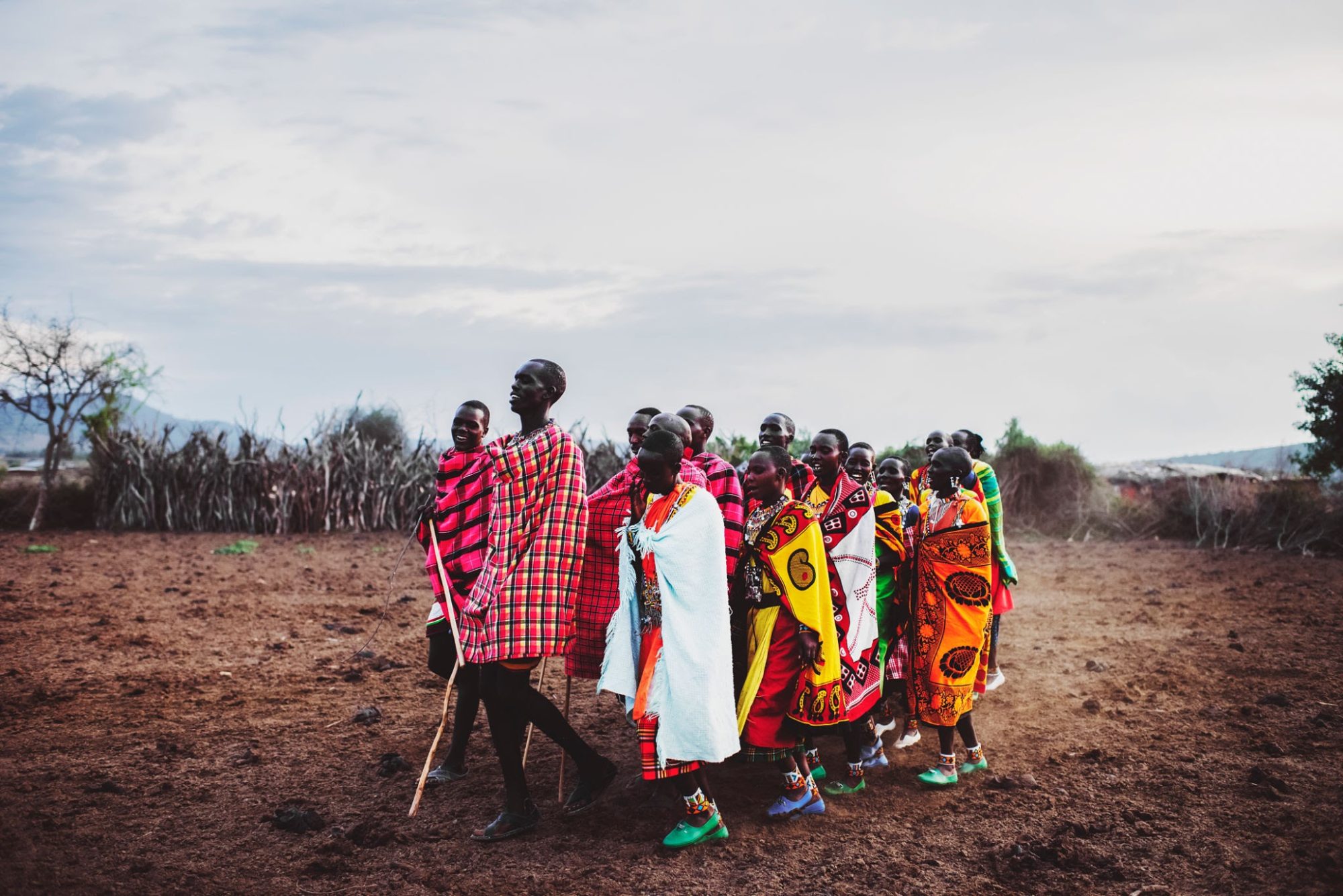
Maasai walkers near Ngorongoro. Source: Olya Hill / Getty Images
Datoga Metallurgy and Seasonal Grazing
In northern Tanzania, including around Lake Eyasi and Mbulu, the Datoga (including the Barabaig sub-group) practice pastoralism alongside specialized ironworking. Ethnographic and material studies describe Datoga blacksmiths melting scrap iron with goat-skin bellows to forge blades, tools, and balanced hunting spears with shaft-end counterweights.
Datoga beadwork and attire. Source: Nyamera Treks & Safaris
5. Language Shift, Lake Endorois, and Rift Valley Landscapes
Rift Valley lake and hills. Source: JordiStock / Getty Images
Around Lake Bogoria, the Endorois brought a landmark petition before the African Commission on Human and Peoples’ Rights following displacement from ancestral lands, resulting in a historic ruling recognizing their indigenous rights to land, religion, culture, and development.
Highlands of the Rift system. Source: Sergey Strelkov / Getty Images
The indigenous tribes of East Africa stand as living custodians of ancient traditions, ecological wisdom, and distinct cultural identities. From pastoralist communities navigating vast savannas to forest-dwelling groups preserving ancestral ways of life, each tribe adds a vital thread to the region’s human tapestry. As modernisation and environmental pressures reshape their landscapes, protecting their cultural heritage and land rights remains essential. Understanding their stories allows us to appreciate human diversity not as a relic of the past, but as a dynamic part of our shared present.
Comparative Snapshot of East African Indigenous Groups
|
Community |
Primary Region | Primary Subsistence & Economy | Key Ethnographic & Legal Highlights |
| Hadza | Lake Eyasi basin, northern Tanzania | Savanna hunting and gathering; mixed camp diets near villages | High fertility and growth relative to! Kung in demographic studies, click language (Hadzane). |
| Ogiek | Mau Forest and Mt. Elgon, Kenya | Forest apiculture, foraging, and small-scale livelihood adaptation | 2017 African Court judgement affirming ancestral land and conservation role |
| Sengwer | Embobut Forest, Elgeyo Marakwet, Kenya | Forest-linked livelihood and biocultural resource stewardship | High drought frequency; herd diversification and mobility under climate and security stress |
| Maasai | Kenya and northern Tanzania savannas | Pastoralism and specialised iron forging | Seasonal grazing cycles and forged spears/tools using bellows |
| Datoga | Southeastern Lake Turkana, Kenya | Lake-shore fishing and mixed adaptation | Historical Cushitic language shift toward Samburu; small population dynamics |
| El Mol | Southeastern Lake Turkana, Kenya | Lake-shore fishing and mixed adaptation | Historical Cushitic language shift toward Samburu; small population dynamics |
| Endorois | Lake Bogoria area, Kenya | Pastoralism and lake-basin customary livelihoods | Landmark ACHPR ruling on indigenous land, culture, and right to development |
