
Introduction : Sentinelese Tribe in India
The Sentinelese Tribe in India are one of the very few uncontacted peoples left in the world; they reside on North Sentinel Island in India, located within the Andaman and Nicobar archipelago.
This volume explores the enigmatic tribal group by delving into their demographic profile, subsistence pattern, material culture, social structure and anthropological importance, and also discusses the sensitive ethical issues surrounding their voluntary isolation.
Geographic Context and Demographic Profile
North Sentinel Island, about 40 miles west of Port Blair in the Bay of Bengal, is about 24 square miles of thick forest enveloped by treacherous coral reefs.
The island’s geography is not conducive to further development; shallow waters protect against the possibility of large vessels, while otherwise there are no harbours in any case and thick forests would block the passage for smaller boats
The dense forest plus coral reefs surrounding the island acted as a natural fortress where they could retain their independence from Indian and Burmese colonizers.
This natural barrier has functioned as a factor that prevents people outside the area from communicating with the inhabitants of this demographic enclave and also restricts observation, routine monitoring, and registration pertaining to its population data.
Due to the impossibility of accurate censuses being taken, population estimates of the Sentinalese generally range between fewer than 15 individuals up to a figure as high as 500.
Only 15 (12 Males and 3 Females) were recorded in the Indian Census of 2011, however these are only ones observed through aimerial and maritime reconnaissance and not necessarily a true number.
Most anthropological evaluations agree on figures between 50 and 200 people, with the most current handbook of the Anthropological Survey of India published in 2016 claiming a population range of between 100 and 150 individuals.
There is considerable debate about the actual population, as the tribe has avoided contact with outsiders and the Indian government has kept a respectful distance to protect their autonomy and health.
Subsistence Economy and Material Adaptations
The Sentinelese are hunter-gatherers, who may have adapted to their environment in the Andaman Islands by developing an invasive strategy that allowed them to insulate themselves from external influences.
The diet includes wild boar Anthropological findings suggest than, in comparison with other Andamanese such as the Jarawas and Onge, the Sentinelese rely more on marine resources; extensive deposits of calcined shell and midden animals being clear indicators for this.
They feed on foraging coconuts, wild honey, sapodilla and pandanus fruits with some accounts reporting them to eat raw flesh.
The Sentinelese lack agriculture not for technological limitation, but for the willful continuance of deep-rooted economic strategies.
The hunter-gatherer existence they lead has apparently been remarkably little challenged by ill health (35) of the community, or land cover change in forest—their own impressive conservation to their island’s natural habitat.
The women fish with small circular nets in shallow water, and collect vegetable foods, while the men make hunting trips with bow and arrows.
The presence of more than one family hearth at group sites indicates a semi-nomadic settlement pattern related to procurement activities.

Technological Systems and Material Culture
The purely media-centred description of Sentinalese as ‘Stone Age’ people, therefore, does not do justice to their dynamic use and selective adoption of metal technologies.
These men have no knowledge of metallurgy aside from cold forging but they collect scraps of metal scattered in shipwrecks and flotsam, producing arrowheads, adzes, chisels like this one.
Such technological pragmatism undermines the prediction of simple evolutionary stories, and illustrates their potential for cultural accommodation so that traditional knowledge systems remain.
Their armament system now shows development into more complex design biotypes corresponding to their high functional complexity.
The arrows used by the Sentinelese are of three types: heavy ovoid iron-tipped projectiles more than a metre long for hunting, smaller bamboo arrow with multiple forward prongs for fishing and a 2.5-metre-long harpoon with an ivory head and detachable foreshaft 0.9 meters in length designed to kill sea turtles.
These devices are wielded in flatbows which are described as having impressive accuracy when aiming for hostile forces (based on attempted contacts). Additional implements include adzes for wood work, pounding stones, baskets that accommodate distinct sizes of grains, wooden vessels and fishing nets along with canoe variants.
Their boat technology is also worthy of special attention, since it is one of only two of the Andamanese groups (the other being the Onge) to build canoes.
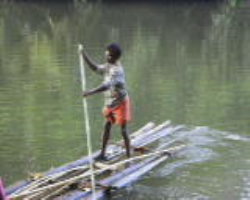
Such narrow outrigger canoes are sculled with long poles since not more than fishing in the lagoon and getting along coastwise is required of them, their use being confined to the lagoon area.
This technological constraint has contributed to their island isolation and facilitated the exploitation of reef resources.
Settlement Patterns and Social Organization
Observational evidence, albeit limited, indicates that the Sentinelese possess permanent and temporary settlements adapted to a semi-nomadic foraging lifestyle.
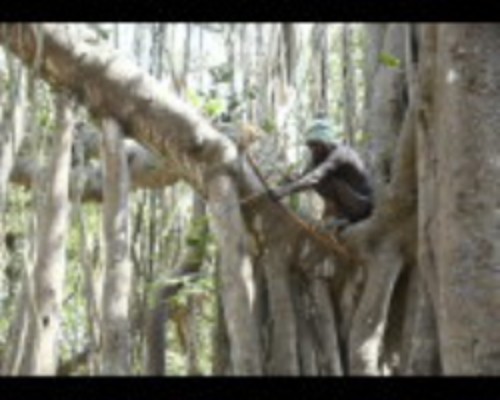
Their buildings are large communal huts with elevated platforms (Division of labour § social organization), partitioned family quarters, and several hearths indicating multi-family homes, as well as smaller lean-to shelters with pitched leaf roofs appropriate for nuclear families of three or four persons.
The houses are not provided with sidewalls and the floors were in some cases, covered with leaves or deadwood, which suggest temporary lodging during subsistence activities.
On social organization, kinship systems, and religious practices anthropological knowledge is so woefully limited by the lack of capacity for continued observation and linguistic communication.
Limited contact missions in 1990s revealed a clan-based society with an endogamous marriage system, but evidence remains speculative.
Rituals The use of ritual had been seen from afar, such as those for births, deaths (burial along with a local ceremonial element) and communitarian meals, indicating well-organized religious and societal activities.
There is at least a tentative recognition of priests or ritual specialists, which suggests social ranking above and beyond mere egalitarian structures.
Linguistic Isolation and Genetic Heritage
The language of the Sentinelese is completely unclassified, but linguistic studies of its unique lexical and phonological features (such as word length, extensive nasalisation, and a reduction in physical consonants), confirm no comprehension with the neighbouring Jarawa or Onge language.
This linguistic differentiation of the Great Andamanese since perhaps thousands of years indicates isolation from all other Andamanese groups, which agrees with the genetic data showing their deep common ancestry.
The 2016 assessment (Department of Anthropology, Government of India) by the Anthropological Survey of India found that the Sentinalese, Jarawa and Onge languages are mutually unintelligible, despite their putative common origin.
Genetic research of other related Andamanese peoples offers an indirect glimpse into the ancestry of the Sentinelese, since direct testing is impossible (forbidden by law) and unethical.
Research on Great Andamanese,Jarawa, and Onge populations confirms their belonging to one of the first human migrations following their exodus from Africa 50,000-70,000 years ago along a coastal route before there was any significant genetic divergence due to separation by distance or other factors found elsewhere in the world.
These groups have distinct genetic markers that prove a disconnection from other populations tens of thousands years ago, while their specific genetic make-up is closer to ancient indigenous peoples of Southeast Asia and Australia than Africans.
The extreme isolation has helped to preserve ancestral DNA traits that have disappeared over time in other populations through genetic drift, providing invaluable insights into human evolution.
Y-chromosome studies that the Andamanese men have belonged but to haplogroup D M174 with notably the D1a3 sublineage, separates from the combined group of East Asian populations around 23,000 years ago.
Historical Contact and Contemporary Protection Policies
The Sentinelese resistance to outsiders must be understood in the tragic context of other Andaman tribes decimated by British colonial rule.
During the 19th century, when British officials established a penal settlement on nearby islands, introduced diseases and violence brought devastation to the indigenous people; an onslaught of disease reduced the Onge population by 85%; the Great Andamanese numbers shrunk by 99%, while those of Jangil people became extinct.
One particularly traumatic episode took place in 1880 when colonial administrator Maurice Vidal Portman kidnapped six Sentinelese—two older adults and four children—and brought them to the Andaman capital of Port Blair, where the adults rapidly died of disease and Portman subsequently released gifts along with potentially fatal pathogens.
They may have been the basis of later hostility of Sentinelese to outsiders, and attacks on shipwreck victims, fishermen and contact missions. Among them were the 2006 murders of two fishermen whose boat ran aground and the 2018 killing of American missionary John Allen Chau who tried to make contact in violation of protections for the island.
Their apparent survival of the 2004 Indian Ocean tsunami and willingness to shoot arrows at relief helicopters or spread faeces on outsiders, suggests knowledge and a will to remain isolated.
After the disaster of similar forced contact policies with other Andamanese people, the Indian government declared North Sentinel Island a tribal reserve and banned travel within three nautical miles; this later became five nautical miles.
After pressure from Survival International and other campaigners, the authorities gave up attempting to contact them in 1996 subsequently adopting a “hands off” policy of respect and non-interference for the right to self-determination of the Sentinelese.
The island is currently patrolled 24/7 by the Indian Navy to discourage further clandestine visits and photography is banned, as well as any attempt at unauthorized contact being met with prosecution.

Anthropological Significance and Ethical Considerations
The Sentinelese form an unique depository of cultural and genetic diversity in pre-Neolithic Indian populations that merits not only protection but also careful anthropological study by scholars during future visits to the island.
Their self-imposed isolation defies Western models of development by which they are simply backward) that measure modernisation in terms of progress and offers alternative versions of the good life respecting harmony with the environment and cultural self-determination.
Conclusion
Modern anthropological ethics support the principle of non-interference with uncontacted peoples, knowing that by coming into contact one will breast new diseases like influenza to which they lack immunity.
This cordon sanitaire protects not just the Sentinelese’s impulse towards sovereignty but also embodies their distinctive lineage of human diversity.
The fact that they continue to exist as one of the final uncontacted peoples can be seen not only as a triumph of indigenous resistance but also as an example in modern times of just how precarious cultural survival is, even in our interconnected world.
The Sentinelese offers important precedents for respecting indigenous autonomy and acknowledging that isolation can be a legitimate choice rather than a deficiency in need of correction.
