

Thank you for reading this post, don't forget to subscribe!
The Berber Civilisation: Deep Time, Stone Epigraphy, Ecological Commons, and Sovereign Memory Across the Maghreb
1. Introduction: Reclaiming the Deep Horizon of the Maghreb
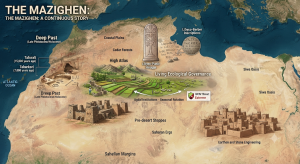
The Berber civilisation has further advanced our civilisation. For over two millennia, outside observers looked across the Mediterranean and the Sahara and saw only a series of borderlands waiting to be named by someone else. Greek geographers spoke of Libye as a continent defined from the outside; Phoenician mariners charted coves for trade and salt; Roman administrators drew provinces across Numidia and Mauretania; mediaeval chroniclers framed mountain and desert confederations through dynastic rivalry or frontier revolt; and modern colonial cartographers sliced living ecosystems into administrative lines. Yet beneath every layer of imperial naming stood—and still stands—the Imazighen (singular: Amazigh), whose history is not a footnote to Mediterranean empires but one of the longest continuous human stories on Earth.
Understanding the Berber Civilisation requires shifting our scale of time and geography. This is not a single uniform state frozen in one century, nor a people confined to a single valley. It is a multi-millennial tapestry woven across coastal plains, cedar forests, high alpine pastures (agdals), fortified earthen granaries (igoudar), oases, and Saharan ergs from the Atlantic littoral to Siwa and the Sahelian margins. In archaeogenetics, paleoclimatology, epigraphy, legal anthropology, and architectural ecology, researchers are uncovering details that overturn lazy clichés:
-
Late Pleistocene and Holocene depth: Genomic analyses of ancient North Africans—such as Late Stone Age Iberomaurusian individuals from Taforalt in eastern Morocco dated to roughly 15,000 years ago and Middle Holocene pastoralists at Takarkori in southwestern Libya dated to around 7,000 years ago—demonstrate deep local continuity intertwined with broader Mediterranean and African movements long before historical kingdoms emerged.
-
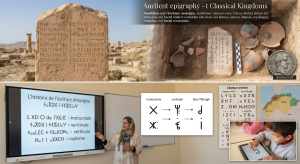
Indigenous geometric literacy: More than 1,000 Libyco-Berber inscriptions have been cataloged across North Africa, including monumental bilingual texts alongside Punic at Dougga (Thugga) dating to the reign of Micipsa (139/138 BCE), linking ancient Numidian and Mauretanian epigraphy to living Tifinagh traditions.
-
Living ecological governance: Across the High Atlas and Anti-Atlas, customary agdal institutions regulate seasonal pasture closures—with roughly 85% of High Atlas collective lands governed as pastoral agdals—even as conservation assessments show extreme extinction pressure on strict mountain endemics (95% of over 100 evaluated strict endemics face extinction threats under IUCN criteria).
-
Monumental earthen and stone engineering: From dry-stone terraces and communal ighrem / igoudar granaries to ksour and kasbahs built from rammed earth (tabia) and sun-dried mudbrick, Amazigh builders engineered thermal mass, grain security, and social memory in harsh climates.
| Analytical Lens | Core Timeframe / Scale | Key Empirical & Historical Anchor | Why It Matters for Understanding Amazigh Civilisation |
| Archaeogenetics | ~15,000 BCE to present | Taforalt (~15,000 BP) & Takarkori (~7,000 BP) ancient DNA; haplogroups E-M81, U6, M1 | Shows deep North African roots and multi-stream Holocene admixture rather than a single static stereotype. |
| Epigraphy & Script | Iron Age / Numidian era to modern Tifinagh | Greater than 1,000 Libyco-Berber inscriptions; 139/138 BCE Dougga bilingual monument | Proves indigenous geometric writing existed alongside Punic and Latin in ancient North Africa. |
| Pastoral & Agro-Ecology | Multi-century customary law to today | ~85% of High Atlas collective lands under agdal rules; 95% of those greater than 100 evaluated strict endemics threatened | Reveals sophisticated commons governance under acute climate and land-use stress. |
| Sovereignty & Statecraft | Classical kingdoms to mediaeval empires | Numidia (Massinissa), Mauretania, Almoravid & Almohad dynasties | Demonstrates that Amazigh polities shaped Mediterranean, Iberian, and Saharan geopolitics from within. |
2. Deep Prehistory and Archaeogenetics: From Iberomaurusian Foragers to Green Sahara Herders
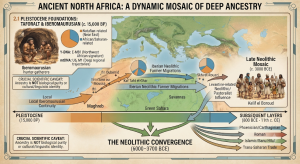
For decades, popular summaries treated North Africa’s deep past as an empty stage waiting for outside arrivals. Ancient DNA and bioarchaeology have overturned that view. Rather than a single moment of arrival, the deep ancestry of Maghrebi and Amazigh populations reflects thousands of years of regional continuity, climatic shifts, and periodic gene flow across the Mediterranean, the Near East, and the Sahara.
2.1 Pleistocene Foundations: Taforalt and the Iberomaurusian Horizon
At the site of Taforalt in eastern Morocco, archaeologists and geneticists have studied Iberomaurusian hunter-gatherers living roughly 15,000 years ago. Population genetic modelling indicates that these Late Pleistocene foragers can be represented through roughly two-thirds Natufian-related ancestry (linking to early Near Eastern/Levantine populations) and roughly one-third African ancestry (modelled alongside ancient Saharan lineages such as Takarkori).
In uniparental markers, ancient and modern North African lineages show distinct signatures:
-
Y-chromosome haplogroup E-M81 (a subclade within E1b1b) is heavily concentrated in Northwest Africa, reaching 42% in a combined North African sample reported by Arredi et al. (2004), with wide regional variation—around 76% among Saharawis in Morocco down to roughly 10% in Egypt.
-
Mitochondrial haplogroups U6 and M1 are long-standing markers of North and Northeast African demographic history, with U6 tracing a deep regional trajectory in North Africa over tens of thousands of years.
Crucial Scientific Caveat: Archaeogeneticists emphasize that there is no single “Berber gene,” no biological scale of “purity,” and no one-to-one equation between haplogroup frequencies and cultural or linguistic identity. Ancestry and Amazigh identity are distinct historical and cultural realities.
2.2 The Green Sahara and Neolithic Convergence
During the African Humid Period (the “Green Sahara”), seasonal monsoons turned vast stretches of today’s arid desert into savannas, lakes, and riverine corridors. At Takarkori in southwestern Libya, ancient genomes from herding women dating to around 7,000 years ago illuminate a pastoral world thriving in what is now the hyper-arid Sahara.
As the Neolithic transition unfolded across the Mediterranean and North Africa between roughly 6000 and 3700 BCE, multiple streams converged in the Maghreb:
-
Local Iberomaurusian-derived forager continuity (seen at sites such as Ifri Ouberrid around 5600 BCE and Ifri n’Amr ou Moussa around 5000 BCE).
-
Iberian Neolithic farmer migrations (visible at Kaf Taht el-Ghar around 5500–5000 BCE, combining Iberian farmer ancestry with roughly 15.4% to 27.4% local ancestry).
-
Levantine-related Neolithic/pastoralist influences (seen at Skhirat-Rouazi around 4800–4200 BCE, modelled at roughly 76.4% Levantine Neolithic and 23.6% local ancestry).
By the Late Neolithic (around 3000 BCE at sites like Kelif el Boroud), these streams merged into the broad ancestral mosaic that entered classical antiquity. Later eras—Phoenician and Carthaginian maritime settlements (from around 800 BCE), Roman rule, medieval Islamic conquests and migrations such as the Banu Hilal (7th to 11th centuries CE), and ongoing trans-Saharan trade—added further regional layers without erasing the deep Maghrebi foundation.
| Archaeological / Genetic Marker | Approximate Age / Context | Geographic Focus | Key Insight from Research |
| Taforalt (Iberomaurusian) | ~15,000 years ago | Eastern Morocco | Early Late Stone Age Maghrebi profile (~2/3 Natufian-related, ~1/3 African). |
| Takarkori Herders | ~7,000 years ago | Southwestern Libya | Documents pastoral women in the Green Sahara prior to aridification. |
| Kaf Taht el-Ghar & Skhirat-Rouazi | ~5500–4200 BCE | Morocco | Tracks Neolithic farmer/pastoralist arrivals mixing with local Maghrebi lineages. |
| Y-DNA Haplogroup E-M81 | Deep Holocene / Maghrebi spread | Maghreb (especially NW Africa) | High frequency in Northwest Africa (~42% combined North African sample). |
| mtDNA U6 & M1 | Late Pleistocene / Holocene | North & Northeast Africa | Reflects long-standing regional maternal continuity across North Africa. |
3. Language, Libyco-Berber Inscriptions, and the Continuity of Tifinagh
While Phoenician, Punic, Latin, Greek, and Arabic left vast written archives across North Africa, Tamazight (the Berber language family, forming a distinct branch of the Afro-Asiatic language family) remained primarily a living spoken and poetic medium for much of recorded history—yet it is backed by more than 1,000 ancient “Libyan”/Libyco-Berber inscriptions.
3.1 The Dougga Bilingual and Epigraphic Decoding
Epigraphers and linguists have classified Libyco-Berber writing into regional and structural variants:
-
Horizontal script (prominent in monumental texts such as Dougga, typically written right-to-left, with clearer word boundary markers and specific signs such as a final ).
-
Vertical script (common on shorter funerary stelae, frequently read bottom-to-top, with distinct glyph shapes such as a four-bar sign for ṭ compared to a trident-like sign in the horizontal script).
-
Saharan and Canarian branches, alongside living Tifinagh preserved especially among Tuareg communities for short personal notes, rock graffiti, and everyday objects.
3.2 Orthographic Quirks: Vowels, Dots, and Wordplay in Stone
Unlike full alphabetic scripts that write every vowel explicitly, classical Libyco-Berber scripts relied heavily on consonantal and positional conventions:
-
A dot served as a key separator/punctuation mark in many inscriptions.
-
Vocalisation was minimal: in certain Libyc traditions, a sign of three parallel bars (often transcribed as H) appeared at word endings to indicate a vowel (for instance, in the Latin-equivalent name FAUSTUS rendered as FUSTH), while Saharan/Tuareg traditions developed vowel point conventions known as taraqmt or taghrit.
Scholars debate the exact historical relationship between ancient Libyco-Berber and modern Tamazight dialects: while proper names and royal titles in Numidian inscriptions—such as reconstructing MSNSN GLDT W GJJ as “Massinissa the king (agellid), son of (u) Gaia”—offer tantalizing continuity, linguists caution against reading modern dialect forms uncritically back into antiquity where medieval textual attestation is scarce. In 2003, a standardized Neo-Tifinagh script was introduced for educational use in Morocco, bringing an ancient geometric family of signs into contemporary classrooms and digital typography alongside Unicode encoding efforts covering both Tifinagh and Libyc characters.
4. Classical Kingdoms and Frontier Statecraft: Numidia, Mauretania, and Rome
Before and alongside Rome’s Mediterranean expansion, indigenous North African polities were neither stateless tribes nor passive clients. Numidia (roughly eastern Algeria and northern Tunisia) and Mauretania (northern Morocco and western Algeria) were complex kingdoms with royal courts, cavalry forces, coinage, diplomatic alliances, and fortified towns.
4.1 Massinissa, Jugurtha, and Shifting Alliances
In the third and second centuries BCE, Massinissa (c. 241–148 BCE) forged a unified Numidian kingdom that navigated the titanic clash between Carthage and Rome. His state transformed mobile pastoral and agricultural territories into a centralized kingdom capable of projecting power across North Africa—and his successors, such as Micipsa, patronized monumental architecture and bilingual inscriptions at centers like Dougga.
Later, Jugurtha tested Roman military and political resolve in the late second century BCE, using deep knowledge of interior terrain, rapid cavalry mobility, and diplomatic leverage to turn a supposed “client war” into a grueling conflict that reshaped Roman politics. In Mauretania, rulers such as Juba II and Cleopatra Selene presided over a cosmopolitan court in Caesarea (Cherchell) that blended Hellenistic learning, Roman art, and local North African power.
4.2 Volubilis and the Reality of “Roman Africa”
Sites like Volubilis in Morocco—situated in fertile agricultural country near the foothills of the Zerhoun massif—illustrate how Roman urbanism and local Amazigh society interacted. Olive presses, forums, basilicas, and mosaics existed side by side with local lineages and frontier garrisons.
Yet assimilation was never total or uniform:
-
Coastal cities experienced heavier Mediterranean, Punic, and Italian integration and commercial exchange.
-
Mountain ranges (the Rif, Middle Atlas, High Atlas, Kabylie, Aurès) and desert fringes retained strong autonomous clan and confederation structures, seasonal migration routes, and local justice systems that Roman patrols could monitor or contain at passes rather than permanently homogenize.

5. Medieval Dynasties, Trans-Saharan Gold, and Al-Andalus
5.1 From Frontier Warriors to Imperial Builders
Crucially, Islamization in the Maghreb did not produce a single centralized caliphal province. Instead, Amazigh movements repeatedly founded major dynasties that united vast territories across North Africa and al-Andalus:
| Dynasty / Era | Core Origin & Base | Geographic Reach | Defining Historical & Cultural Impact |
| Rustamid Imamate (8th–10th c.) | Tiaret (western Algeria) | Central Maghreb & Saharan trade links | Ibadi Muslim scholarly and commercial hub bridging northern towns and desert routes. |
| Fatimid Rise (10th c.) | Kutama Amazigh support in Little Kabylie | Ifriqiya → Egypt & Levant | Kutama military power enabled the Fatimids to conquer Egypt and found Cairo (969 CE). |
| Almoravid Empire (11th–12th c.) | Sanhaja / Lamtuna desert confederation | Western Sahara, Morocco, western Algeria, Iberia | Linked trans-Saharan gold networks with Moroccan statecraft and Iberian frontiers. |
| Almohad Caliphate (12th–13th c.) | Masmuda movement (Tinmel, High Atlas) | Maghreb from Atlantic to Tripolitania & al-Andalus | Promoted Tawhid reform, monumental architecture (e.g., Tinmel, Koutoubia, Giralda), and philosophical patronage. |
| Marinids, Zayyanids & Hafsids (13th–16th c.) | Zenata & Masmuda lineages | Morocco, Tlemcen, Ifriqiya (Tunisia) | Shaped late medieval Maghrebi urbanism, madrasas, and Mediterranean diplomacy. |
5.2 The Sahara as a Bridge, Not a Wall
A persistent misconception treats the Sahara as an impassable barrier separating “Mediterranean” North Africa from sub-Saharan Africa. In reality, Amazigh desert confederations—especially Sanhaja groups and later Tuareg networks—operated trans-Saharan caravans carrying West African gold, kola, and enslaved people northward in exchange for salt, copper, textiles, horses, and books. Genetic and historical records both show that trans-Saharan movement from the eighth century onward created uneven sub-Saharan admixture gradients—higher in southern/Saharan and oasis communities and lower in northern mountain or coastal enclaves.
6. Ecological Commons, Pastoralism, and Vernacular Architecture
One of the least publicized achievements of Amazigh civilization lies in environmental governance and vernacular building—systems engineered over centuries for high climate variability, steep slopes, scarce water, and seasonal extremes.
6.1 The Agdal System and Transhumance in the Atlas
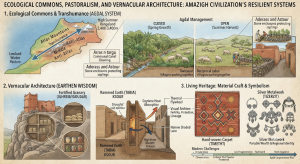
Across the High Atlas, Middle Atlas, and Anti-Atlas, communities developed the agdal—an Amazigh institution meaning “to prohibit” or “to protect.” Rather than treating pasture or forest resources as an open-access free-for-all, village assemblies (jmaa / customary rules) set opening and closing dates for grazing or resource harvesting:
-
During spring growth, an agdal is closed so grasses, herbs, and shrubs can regenerate.
-
Empirical and ecological assessments show that approximately 85% of High Atlas collective lands are rangelands managed under pastoral agdal rules, and in Morocco overall, 25% to 30% of small ruminants (sheep and goats) have been kept in mobile systems ranging from short-distance summer transhumance to nomadism.
Alongside agdals, Amazigh agro-ecosystems rely on interlocking collective practices documented in High Atlas ethnoecology:
-
Arras n targa: Collective annual cleaning and maintenance of irrigation canals so water reaches terraced plots fairly.
-
Tiwizi: Traditional reciprocal labor solidarity for heavy communal tasks—harvesting, threshing, building stone walls, or clearing channels.
-
Aderass and astour: Stone boundary/retaining walls (aderass) and small stone enclosures (astour) that protect young fruit trees and saplings from wind, erosion, and grazing animals while retaining moisture.
6.2 Granaries, Ksour, and Earthen Thermal Wisdom
In regions where droughts or raids threatened harvests, Amazigh communities built fortified collective granaries—known as ighrem (stone-and-mud fortified storehouses in hard-to-reach spots) or igoudar (communal granaries)—to store cereals, pulses, alfalfa, almonds, walnuts, and dried fruits year-round.
In pre-Saharan valleys and oases, builders raised ksour (fortified villages) and kasbahs using rammed earth (tabia) and mudbrick. Thick earthen walls act as a thermal flywheel: absorbing daytime desert heat slowly and releasing warmth gradually during cold desert nights, while narrow shaded lanes temper sun exposure.
6.3 Modern Fragility: Climate Stress, Endemic Biodiversity, and Youth Migration
These time-tested systems face severe pressure today. Ecological evaluations in the High Atlas—evaluating over 100 strictly endemic plant species under IUCN criteria—found that 95% are threatened with extinction (33% Critically Endangered, 62% Endangered, 4% Vulnerable, and only 1% Near Threatened). National agrobiodiversity assessments for Morocco likewise point to low soil biodiversity (averaging 0.3 on a 0.11–1.35 scale) amid pressures from recurring droughts, land fragmentation, commercial monocultures, and overgrazing.
Meanwhile, as father Lahssen from Jbel Saghro observed in transhumance reporting, erratic rainfall, rising feed costs, and younger generations seeking schooling and urban livelihoods are straining seasonal migration. Researchers studying agdals warn that without legal tenure security, co-governance with local communities, and support for youth and women’s cooperatives, centuries of ecological knowledge risk vanishing just when resilient dryland stewardship is most needed.
7. Material Craft, Symbolism, and Living Memory Today
Amazigh heritage lives not only in ruins and archives, but in woven carpets, silver metalwork, pottery, music, oral poetry, and civic movements.
7.1 Geometry, Silver, and Weaving as Visual Archive
In Amazigh textiles and silverwork, geometric motifs—diamonds, zigzags, chevrons, solar/star forms, and protective charms—function as a visual vocabulary tied to fertility, protection, lineage, and landscape. Silver jewelry (such as fibulae/brooches, pendants, and head adornments) historically carried regional stylistic signatures across the Atlas, Kabylie, and desert communities while serving as portable family wealth.
7.2 Recognition, Contestation, and the Road Ahead
Across North Africa—most visibly in Morocco (where Tamazight gained official status in the 2011 constitution and Tifinagh entered school curricula after 2003) and Algeria (where Tamazight became a national and official language in constitutional reforms)—Amazigh cultural expression has moved from the margins to mainstream debate. Yet debates continue over practical implementation in courts, media, administration, and public schools, as well as over the protection of mountain and oasis commons.
Ultimately, the Berber Civilization is a story of endurance without stagnation. From Late Pleistocene foragers at Taforalt and Saharan herders at Takarkori to Numidian kings, medieval imperial builders, and mountain stewards tending agdals under changing skies, the Imazighen have continually adapted without surrendering their distinct voice.
