


Introduction: The Titans of the Southern Savannah : The Zulu Tribe: Shaping African History
Thank you for reading this post, don't forget to subscribe!The sweeping undulating hills of modern-day KwaZulu-Natal in South Africa bear witness to one of the most remarkable socio-political evolutions in the annals of human history. To the global community, the Zulu nation (amaZulu) is often synonymous with unyielding martial prowess, epitomized by the legendary King Shaka kaSenzangakhona and the shocking tactical defeat of the British Empire at the Battle of Isandlwana in 1879. Yet, to reduce the Zulu trajectory solely to warfare is to fundamentally misunderstand a complex, philosophically rich, and structurally sophisticated society. Emerging from a loose agglomeration of minor Nguni-speaking pastoral clans in the late 16th century, the Zulu transformed from a tributary micro-state into a vast military and cultural hegemon. Drawing from deep archival research, localized oral histories, and academic anthropological studies, this comprehensive exploration moves beyond standard textbook narratives. It unpacks the hidden socio-economic mechanics, profound cosmological frameworks, and lesser-known historical statistics that shaped not only Southern Africa but the broader canvas of African history.
1. Genesis and Sociogenesis: From Obscurity to CentralizationThe Pre-Shakan Roots (c. 1574–1816)
Conventional historiography often presents the Zulu state as springing into existence fully formed under Shaka. However, archival research and genealogical tracking trace the clan’s origin to around 1574 under the patriarch Zulu kaMalandela. For over two centuries, the amaZulu were nothing more than a minor chieftaincy (isizwe), paying allegiance to larger neighboring powers such as the Mthethwa paramountcy led by Dingiswayo and the Ndwandwe under Zwide.
| Historical Phase | Era (Approximate) | Dominant Political Structure | Primary Economic Base |
| Foundational Period | 1574 – 1700 | Pastoral Clan / Lineage groups | Subsistence agriculture & cattle herding |
| Tributary State | 1700 – 1816 | Minor chiefdom under Mthethwa | Mixed farming, iron smelting, regional trade |
| Imperial Kingdom | 1816 – 1879 | Centralized military state (Impi) | State-controlled cattle redistribution & tribute |
| Colonial/Apartheid Era | 1879 – 1994 | Fragmented reserves & KwaZulu Homeland | Migrant labor, traditional administration |
Demographic Shifts and Environmental Pressures
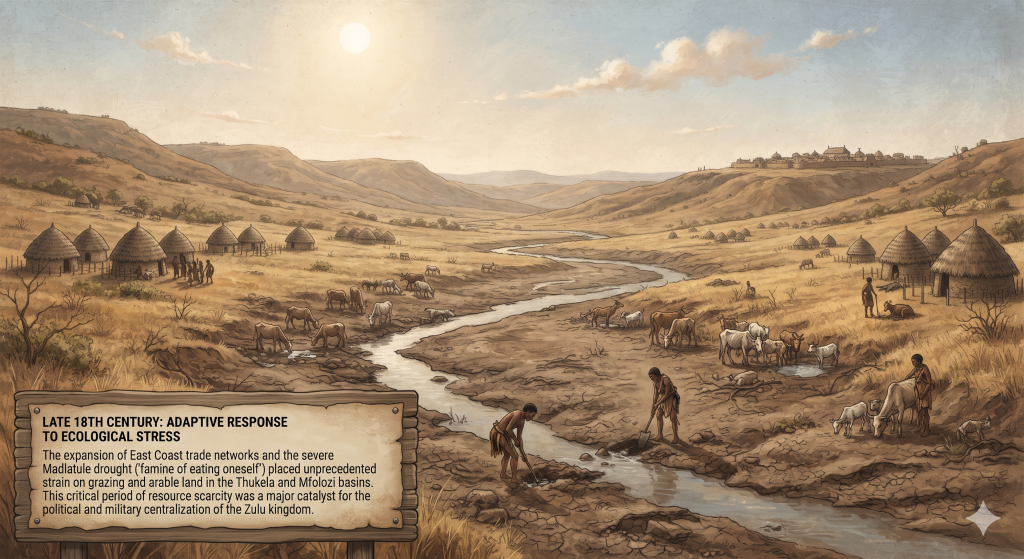
Academic analyses by economic historians point out that the rise of the Zulu kingdom was not merely a product of individual bloodthirsty ambition, but an adaptive response to severe ecological and demographic pressures. By the late 18th century, the expansion of East Coast trade networks, combined with severe cyclical droughts known in oral tradition as the Madlatule (the “famine of eating oneself”), placed unprecedented strain on arable land and grazing pastures along the Thukela and Mfolozi river basins.
It was within this crucible of ecological scarcity that Shaka revolutionized traditional Nguni governance. He restructured society from a loose kinship network into an integrated, meritocratic state apparatus where allegiance to the king superseded ancestral clan loyalties.
2. The Mechanics of Statecraft: Military, Social, and Economic Engineering
The Amabutho System: Beyond the Battlefield
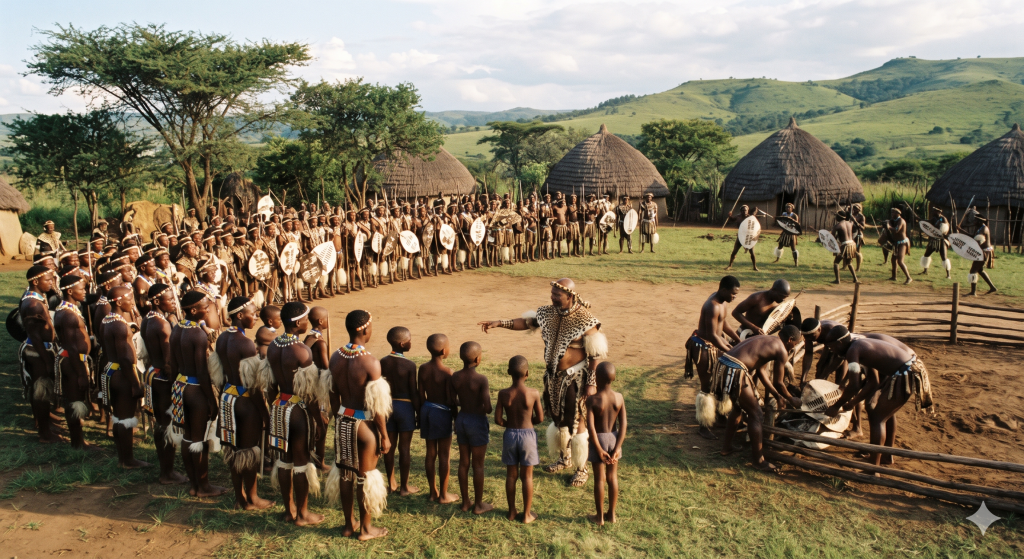
The cornerstone of Zulu statecraft was the amabutho (age-set regiments). While typically analyzed through a purely tactical lens, academic studies emphasize that the amabutho functioned primarily as a profound social engineering mechanism.
A) Conscription and Social Cohesion: Young men and women from diverse, conquered, and assimilated clans were inducted into mixed-age regiments. This deliberately dissolved localized ethnic identities, fusing them into a unified amaZulu consciousness.
B) Delayed Marriage and State Service: Warriors were prohibited from marrying until their regiment was formally “released” by the king, usually around their late thirties or early forties. This prolonged service kept a standing, highly disciplined professional standing army ready for deployment at a moment’s notice.
C) Economic Labor Pools: When not engaged in military campaigns, the amabutho served as the state’s primary labor force, constructing royal capital settlements (imizi), clearing expansive agricultural fields, and guarding the national cattle herds.
Tactical Innovation: The “Horns of the Bull” (Ilembe)
Shaka’s military innovations fundamentally altered African warfare. Abandoning the traditional Nguni method of exchanging distant pleasantries and light javelin throws (assegais), Shaka introduced:
- The Iklwa: A short, broad-bladed stabbing spear designed for close-quarter combat. Warriors were trained never to part with it, forcing decisive, hand-to-hand engagement.
- The Cowhide Shield: Larger, heavier shields utilized not just for defense, but to hook enemy shields aside and expose the torso.
- The “Horns of the Bull” (Enkundleni) Formation: A classic envelopment strategy. A) The Chest (Ilembe): Experienced veteran main forces pins the enemy center. B) The Horns (Umdido): Fast-moving younger regiments sweep around the flanks to encircle the enemy rear. C)The Loins (Reserves): Seated with their backs to the action, fresh troops await orders to exploit any collapse or reinforce a pressured flank. Cosmology, Ontology, and the Philosophy of Ubuntu
- The Spiritual Realm: Unkulunkulu and Amadlozi. Zulu ontology is deeply rooted in a dynamic spiritual architecture where the physical and metaphysical worlds are constantly intersecting.
- The Supreme Creator: Unkulunkulu is viewed as the primordial ancestor from whom all creation sprang, though he is traditionally seen as distant from daily human affairs.
- The Ancestors (Amadlozi): Far more active in daily life are the amadlozi—the ancestral spirits. Health, prosperity, misfortune, and harvest success are understood as direct reflections of the harmonious relationship maintained between the living and their forebears. Ritual slaughtering of cattle (isiko) serves as a sacramental bridge to communicate gratitude and petitions to the ancestral realm.
- Traditional Healers (Sangoma and Inyanga): The sangoma (diviner) and inyanga (herbalist) operate as society’s psychological and medical anchors, preserving an extensive pharmacopoeia of indigenous flora alongside spiritual mediation.
- Ubuntu: The Humanist CoreIntegral to Zulu philosophy is the maxim “Ubuntu ungamntu ngabantu” (“A person is a person through other persons”). Far from a modern political cliché, historical anthropological records demonstrate that Ubuntu formed the foundational legal and moral framework of traditional Zulu jurisprudence. Land was held communally by the chief in trust for the people; absolute private land ownership in the Western sense did not exist. Destitute individuals, orphans, and travelers were automatically absorbed into extended household units (imizi), ensuring a social safety net rooted entirely in communal interdependence.
- Conscription and Social Cohesion: Young men and women from diverse, conquered, and assimilated clans were inducted into mixed-age regiments. This deliberately dissolved localized ethnic identities, fusing them into a unified amaZulu consciousness.
- Delayed Marriage and State Service: Warriors were prohibited from marrying until their regiment was formally “released” by the king, usually around their late thirties or early forties. This prolonged service kept a standing, highly disciplined professional standing army ready for deployment at a moment’s notice.
The Anglo-Zulu War of 1879: Archival Insights and Statistical Realities
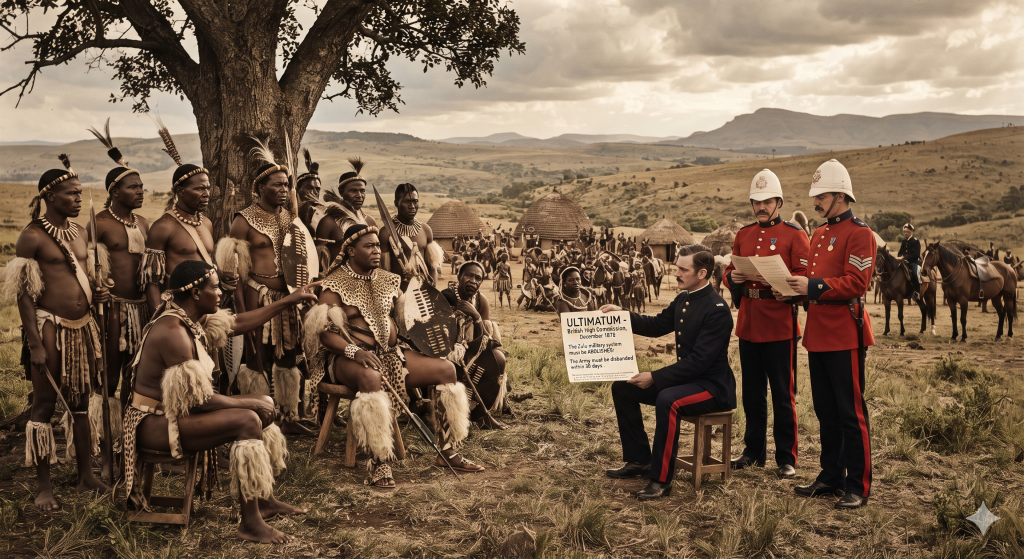
The Strategic LandscapeBy the late 1870s, the independent Zulu Kingdom under King Cetshwayo kaMpande stood as a sovereign obstacle to British imperial designs for a confederated South Africa.
British High Commissioner Sir Henry Bartle Frere engineered a pretext for invasion, issuing an impossible ultimatum demanding the complete dismantling of the Zulu military system within 30 days.
Statistical Breakdown of Forces (January 1879)
| Metric / Category | British Imperial Invasion Force | Zulu Kingdom Defense Force (Impi) |
| Total Estimated Available Troops | ~17,000 regular soldiers & colonial auxiliaries | ~40,000 to 50,000 mobilized warriors |
| Primary Firearms | Martini-Henry breech-loading rifles (rate of fire: 10–12 rounds/min) | Limited flintlocks, muskets, and traditional assegais |
| Logistical Dependency | Extended supply lines, wagons, wheeled artillery | Autonomous local foraging, cattle driving, runner networks |
| Primary Tactical Doctrine | European linear defensive square/volley fire | Mobile envelopment (“Horns of the Bull”) |
The Shock at Isandlwana and Rorke’s Drift
On January 22, 1879, at the Battle of Isandlwana, the Zulu impi executed the classic “Horns of the Bull” maneuver against an overconfident British column. Armed largely with traditional stabbing spears and sheer tactical discipline, the Zulu forces overwhelmed the British camp, inflicting over 1,300 casualties—representing one of the worst defeats ever suffered by the British military against an indigenous African army.
Although subsequent engagements—most famously the defense of Rorke’s Drift and the ultimate defeat at Ulundi later that year—led to the annexation of Zululand and the fragmentation of the kingdom, the war shattered the myth of European military invincibility across the continent.
5. Contemporary Resonance: Demographics, Politics, and Cultural Preservation
Modern Demographics and Language DominanceFar from fading into historical obscurity, the Zulu people constitute the largest ethnic linguistic group in modern South Africa.
Population Statistics: According to recent demographic analyses and census data, over 15.7 million people identify ethnically as Zulu, representing roughly one-fifth of South Africa’s total population.
Linguistic Reach: isiZulu is spoken as a first language by more than 13.8 million citizens, while over 50% of the entire South African population understands and communicates fluently in the language, making it the most widely spoken home language in the country. Cultural Continuity in the 21st CenturyToday, the Zulu nation bridges ancient traditions with modern democratic governance.
The Reed Dance (Umhlanga): Held annually at the royal eNyokeni Palace in Nongoma, this historic ceremony draws tens of thousands of young Zulu maidens. Far from a static tourist attraction, it serves as an active educational institution promoting female solidarity, health, and cultural pride.
Traditional Regalia and Beadwork (Umlando): The intricate geometric language of Zulu beadwork (isici) continues to communicate social standing, marital status, and emotional states without a single spoken word.
The Monarchy: The Zulu royal household remains a recognized constitutional cultural institution in contemporary South Africa, exercising profound moral and social authority over millions.
Conclusion: An Enduring Legacy
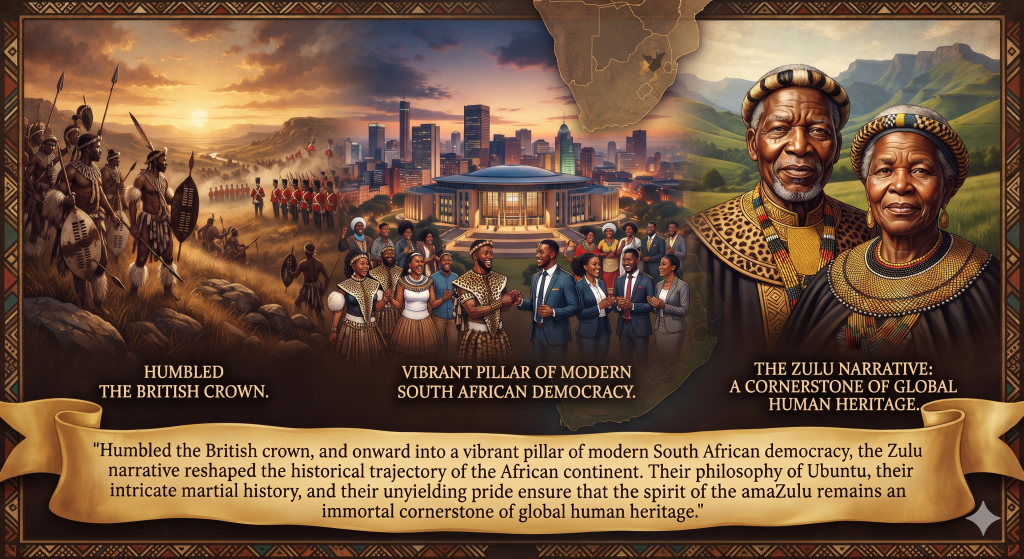
The history of the Zulu tribe is a testament to resilience, strategic genius, and deep-seated cultural preservation. From a minor hill clan on the banks of the White Mfolozi to an empire that humbled the British crown, and onward into a vibrant pillar of modern South African democracy, the Zulu narrative reshaped the historical trajectory of the African continent. Their philosophy of Ubuntu, their intricate martial history, and their unyielding pride ensure that the spirit of the amaZulu remains an immortal cornerstone of global human heritage.
