
Inside African Tribal Rituals
Across sub-Saharan Africa, ritual life functions as a living social, ecological, and moral archive. Rather than existing as an isolated Sunday or festival event divorced from everyday work, indigenous African rituals organise kinship, regulate authority, guide conflict resolution, encode ecological knowledge, and sustain psychological resilience across generations.
According to UNESCO’s Priority Africa data on the 2003 Convention for the Safeguarding of the Intangible Cultural Heritage, 50 African State Parties have inscribed 118 living heritage elements across the continent—including 92 on the Representative List, 25 on the Urgent Safeguarding List, and 1 selected for the Register of Good Safeguarding Practices—supported by US$4.8 million granted through the Intangible Cultural Heritage Fund. Yet formal heritage lists capture only a fraction of the daily and seasonal rites practiced across thousands of linguistic and cultural communities.
1. Introduction: Ritual as Social Architecture
In many Western religious frameworks, sacred worship is separated from civil administration, medicine, agriculture, and commerce. Across much of indigenous Africa, by contrast, ritual operates as social architecture—a structured system of symbols, performances, and obligations that holds communities together without relying solely on written statutes or state police.
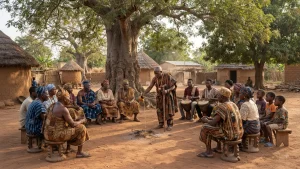
When people gather for a naming rite, a harvest invocation, a rainmaking ceremony, or an ancestral commemoration, they are doing more than expressing belief. They are reaffirming who belongs to the group, who owes duties to whom, how land and water are shared, and how grief or anger is channeled safely. In societies governed by lineage elders, age sets, council assemblies, or customary law—such as the Gada system of the Oromo or the Xeer Ciise oral customary framework of Somali-Issa communities—ritual and governance reinforce one another.
At the same time, treating “Africa” as culturally uniform is one of the biggest analytical errors an outside writer can make. Sub-Saharan Africa spans more than 2,000 languages and hundreds of distinct societies with diverse subsistence bases—pastoralists, shifting cultivators, forest foragers, riverine fishers, and urban dwellers. A ritual that makes complete sense in a semi-arid pastoral settlement will look very different from one in a tropical rain forest or a highland farming village. Reading African rituals accurately requires paying close attention to local ecology, social structure, and historical context rather than relying on generic “tribal” tropes.
2. Sacred Time, Space & Materiality
For many communities across Africa, time is not an abstract clock ticking evenly forward; it is marked by seasons, lunar cycles, agricultural milestones, genealogical memory, and ceremonial transitions. Certain days, seasons, or life stages carry distinct ritual weight. A planting rite opens the agricultural year; first-fruits or harvest gatherings mark gratitude and communal sharing; seasonal transitions—such as the Ngondo water-oracle traditions observed by the Sawa of Cameroon or the Oshituthi shomagongo marula fruit festival in Namibia—anchor collective memory to environment and calendar.
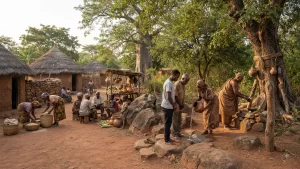
Space is equally structured. Everyday settlements, markets, and paths often sit alongside sacred thresholds: riverbanks, rock outcrops, ancestral compounds, initiation enclosures, or spirit groves. Crossing into a sacred space typically requires specific posture, speech, attire, or purification. It signals that normal social friction must pause and that participants are stepping into a realm governed by ancestral memory, spiritual accountability, or communal solidarity.
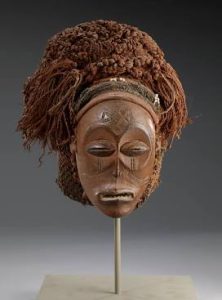
Material objects play a crucial role in this symbolism, though museum display cases often strip them of context. Carved wooden masks, raffia or plant-fibre fringes, iron bells, gourds, woven cloth, earth pigments, and libations of milk, palm wine, or beer are not mere decoration. In West and Central African masquerade traditions—such as Gẹlẹdẹ, Ijele, Makishi, or Gule Wamkulu—a mask only comes alive when joined with music, footwork, voice, and communal response. The physical materials carry layered meanings tied to fertility, elder wisdom, protective power, or ancestral presence.
3. Initiation & Age-Grade Systems
In many East, Northeast, and Southern African societies, age-set and age-grade systems serve as a primary engine of social organisation. Rather than dividing people solely by household wealth or nuclear family ties, age-set systems group peers who undergo initiation within a defined window into lifelong cohorts that move together through stages of life.
Ethnographic studies of East African groups—including the Maasai, Arusha, Nandi, and Kikuyu—show how initiation rites mark the transition from youth into structured adulthood or warriorhood (ilmurran/moran) and later into senior elderhood. Among the Maasai, initiation recruitment typically brings young men in their mid-teens to early twenties into a shared age set, with ritual specialists and elders guiding transitions across sets. Familiar outward displays such as high-jumping dances sit inside a much larger educational process that teaches endurance, self-restraint, collective discipline, and responsibility to the wider community.
Because age-set peers share formative rites and mutual obligations across different settlements, these cohorts create horizontal social bridges across clans and neighbourhoods. When livestock need protection, disputes require mediation, or major ceremonies demand coordinated labor, age-set solidarity provides a ready-made framework for cooperation and mutual accountability.
4. Healing, Divination & Moral Balance
Across much of African ritual thought, illness, misfortune, and social disharmony are closely linked. A persistent sickness, crop failure, recurring conflict, or sudden crisis may be interpreted not merely as an isolated physical event but as a sign of strained relationships—among living kin, between humans and elders/ancestors, or between a community and its environment.
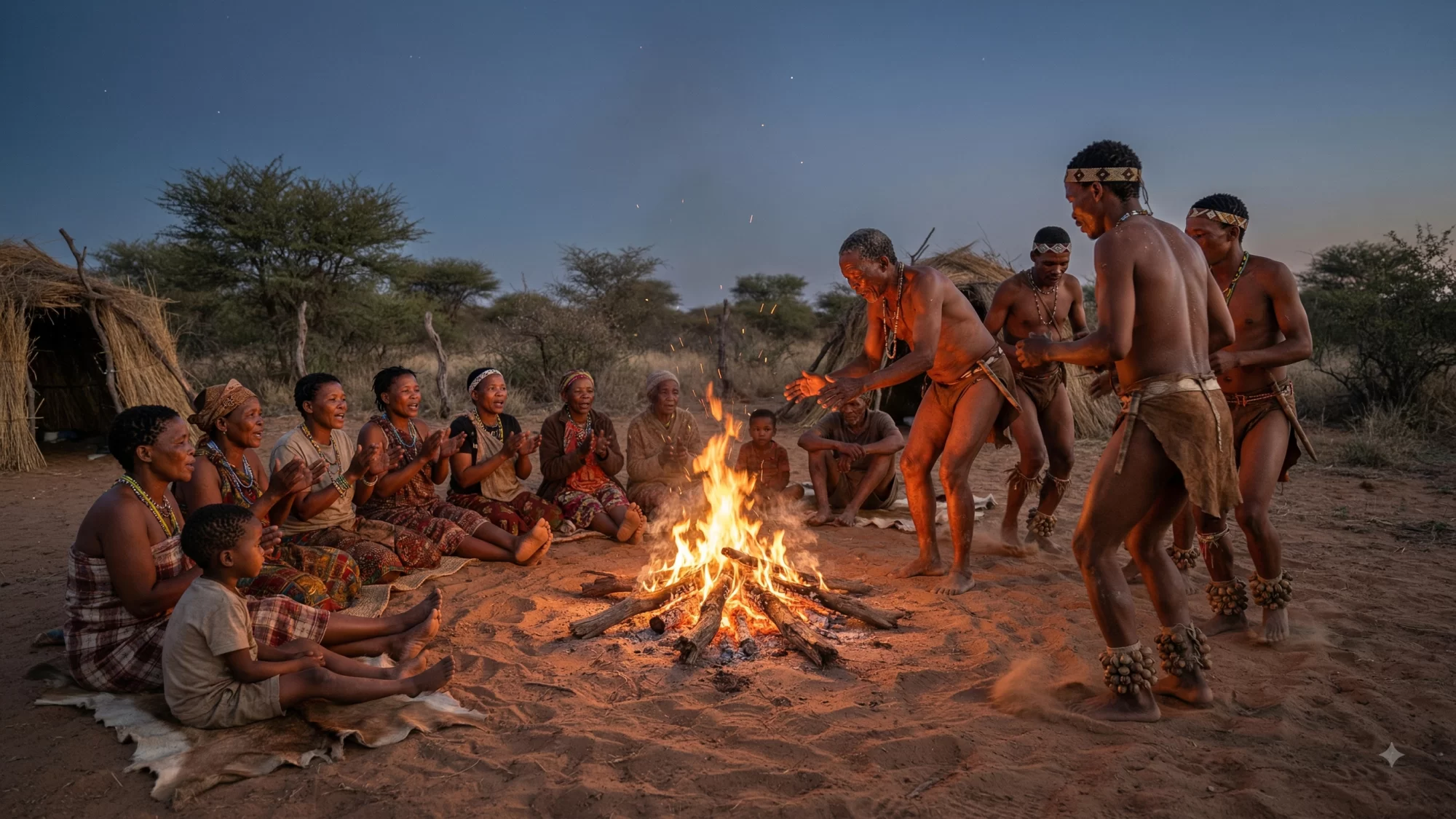
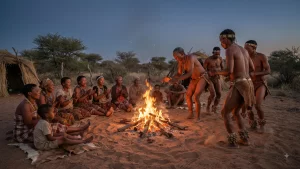
Healing and divination rituals aim to diagnose what is out of balance and restore harmony. Among Kalahari San (Bushman) communities such as the Ju|’hoansi, the communal healing or trance dance brings women and men together around a night fire: women sit singing and clapping complex rhythms while healers dance and draw on spiritual energy (n/om) to heal and strengthen group cohesion. Elsewhere, specialized divination systems—such as Ifá among the Yoruba or Xooy among the Serer—use structured symbolic readings, proverbs, and dialogue to help individuals and families reflect on choices, obligations, and conflict.
Everyday body practices also connect physical care with cultural identity. Among the Himba of northwestern Namibia, otjize—a blend of butterfat and red ochre—protects skin and braided hair against arid sun and dryness while signalling beauty, vitality, and continuity with ancestral customs. Rather than separating body, mind, spirit, and social relationships, these rituals treat well-being as a shared, relational state.
5. Ancestors, Land & Ecological Stewardship
In African ritual traditions, ancestors (abadimo, ovakuru, or lineage elders) are widely understood not as distant ghosts but as active moral presences connected to family memory, land, and continuity. Pouring libations, sharing food or drink, speaking genealogies, and honouring burial sites or shrines express gratitude and remind the living of their duties to past and future generations.
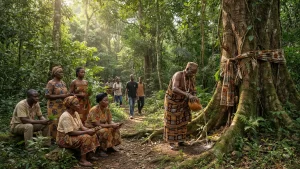
This connection between ancestors, land, and ritual frequently produces indigenous ecological stewardship. Peer-reviewed research on sub-Saharan African sacred groves—such as the Kaya forests of the Mijikenda in Kenya or spirit-protected groves and shrines across West, Central, and Southern Africa—shows that spiritually governed forest patches and natural sites often preserve high biodiversity, rare medicinal plants, water sources, and mature trees through taboos against logging, hunting, or clearing. In forest environments like the Ituri region, songs, shared routines, and collective rituals also help ease everyday camp friction and reinforce cooperation with the forest environment.
When sacred groves or customary taboos weaken due to land pressure, commercial extraction, or rapid social shifts, communities often lose more than a scenic spot—they risk losing medicinal plant knowledge, watershed protection, and generational anchors of restraint.
6. Modernity, Tourism & Cultural Continuity
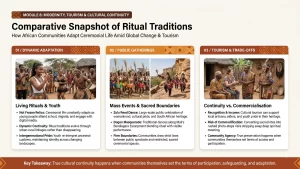
African rituals are not frozen relics from a pre-modern past. Communities continually adapt ceremonial life as young people attend school, migrate to cities, engage with global media, and navigate changing economic and religious landscapes.
Tourism and outside attention bring real trade-offs. On one hand, cultural recognition and income can support artisans, elders, and youth pride in heritage. On the other hand, turning sacred rites into rushed photo stops or commercialised spectacles can strip away spiritual meaning or strain community norms. True cultural continuity happens when communities themselves set the terms of participation, safeguarding, and adaptation.
Comparative Snapshot of Ritual Traditions
| Tradition / Group | Primary Region | Core Ritual Focus | Key Social Function |
| Maasai Age-Set & Dance Rites | Kenya & Tanzania | Warrior/elder transitions & cattle symbolism | Builds cross-community solidarity and discipline |
| Himba Otjize & Family Rites | Northwestern Namibia | Ancestral respect & life-stage markers | Preserves lineage ties and desert adaptation |
| San Healing Trance Dance | Kalahari (Southern Africa) | Communal singing, clapping & healing trance | Restores group harmony and shares care |
| Ituri Forest Gatherings | DR Congo (Ituri Forest) | Song, dance & forest-centered harmony | Defuses camp tensions and reinforces sharing |
| Dogon Mask Ceremonies | Mali (Bandiagara region) | Ancestral, mythic & funerary masquerades | Transmits oral history and moral order |
| Southern African Reed Dance | South Africa & Eswatini | Large-scale communal procession & song | Reinforces civic identity and cultural continuity |
7. Conclusion & Further Reading
At their core, African tribal rituals are living systems of meaning, memory, and community care. They show how societies use rhythm, symbol, space, kinship, and shared story to navigate birth, growing up, conflict, healing, environmental change, and loss.
