
The Turkana Tribe: Life of the Desert Lands of Kenya
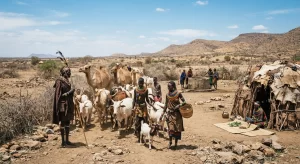
Across the sun-scorched rift valleys and volcanic badlands of northwestern Kenya lies a landscape that tests human endurance at every turn. Here, along the western and southern shores of Lake Turkana—a closed, alkaline desert lake fed largely by the Omo River from Ethiopia—live the Turkana, one of East Africa’s largest and most resilient pastoralist communities. To casual observers, the arid thornbush plains, basalt lava fields, and seasonal dry riverbeds (ngikalalei) appear harsh and unforgiving. Yet for generations of Turkana herders, fishers, craftspeople, and elders, this demanding terrain is a finely calibrated ecological archive, a living theatre of social order, and a home rich in specialised knowledge.
Drawing on ethnographic monographs, ecological studies, census records, and linguistic research, this in-depth exploration examines how the Turkana navigate desert survival, organise kinship and age-set institutions, manage multi-species herds under high climatic variability, harvest aquatic and botanical resources, and preserve intricate material traditions in a rapidly changing world.
1. Geography, Climate, and Demographic Realities of Turkana
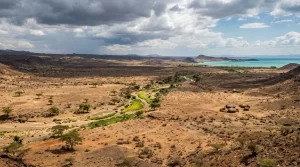
Turkana County occupies the northwestern corner of Kenya, bordering South Sudan, Uganda, and Ethiopia, with Lake Turkana forming a dramatic inland sea along its eastern flank. Covering roughly 68,233 to 71,598 square kilometres, it is vast in scale yet sparsely populated compared to highland and coastal regions of Kenya. According to Kenya’s 2019 National Population and Housing Census, the county recorded 926,976 residents (478,087 males, 448,868 females, and 21 intersex persons), resulting in a low overall population density of approximately 13.6 people per square kilometre and an annual growth rate of 0.81% between 2009 and 2019 (rising from 855,399 in 2009).
Demographically, the population is remarkably young. In the 2019 census data for Turkana County, 418,812 people were aged 0 to 14 years, 484,916 were aged 15 to 64 years, and 23,224 were aged 65 and older (including 690 individuals aged 90 and above). Earlier scholarly estimates in 2004 placed the Turkana population closer to 300,000, while the 2009 census climbed above 825,000—a shift that underscores both historical undercounting in remote pastoral zones and significant demographic growth over recent decades.
Unlike predictable temperate climates with four distinct seasons, the Turkana basin operates on high inter-annual and spatial rainfall variability. Rains are scarce, localized, and irregular; a localised storm can turn one dry riverbed (lagga) green while a valley a few kilometres away remains parched. Researchers studying pastoral ecology describe Turkana rangelands as a disequilibrium system, meaning plant biomass and water availability are driven heavily by erratic rainfall and episodic drought rather than steady equilibrium carrying capacities.
| Demographic & Spatial Indicator | Indicator Recorded Figure / Detail | Context & Significance |
| 2019 County Population | 926,976 residents | Up from 855,399 in the 2009 census |
| Sex Breakdown (2019) | 478,087 M / 448,868 F / 21 I | Reflects county-wide enumeration totals |
| Youth Share (Ages 0–14) | 418,812 individuals (~45.2%) | Indicates a broad demographic base of children and youth |
| Working-Age Group (15–64) | 484,916 individuals (~52.3%) | Primary labour force for herding, fishing, and trade |
| Older Adults (65+) | 23,224 individuals (~2.5%) | Includes 690 people recorded at age 90 or older |
| Approximate Area & Density | ~68,233–71,598 km²; ~13.6/km² | Low density suited to mobile grazing across wide rangelands |
2. Origins, Oral Traditions, and Linguistic Architecture
The Turkana belong to the Eastern Nilotic branch of the Nilo-Saharan language family. Linguists and oral historians note close affinities between Turkana and neighbouring Karamojong cluster languages, reflected in shared core roots—such as tuŋa in expressions for “human being”. Oral traditions among both Turkana and Karamojong elders speak of common ancestral origins before migration; ecological adaptation and territorial divergence shaped distinct identities.
Within Turkana itself, regional dialects vary across the territory, with a widely recognised central speech pattern and distinct variations toward the southwestern reaches. Linguistically, Turkana is a terraced-level tone language in which high and low tones carry lexical and grammatical weight. Scholars of Eastern Nilotic phonology have documented a nine-vowel system (/i, /ɪ/, /u, /ʊ/, /e/, /ɛ/, /o/, /ɔ/, /a/) governed by Advanced Tongue Root (ATR) vowel harmony, alongside morpho-phonological processes such as vowel raising after +ATR vowels when adjacent to /a/ and consonant/vowel alternations in rapid speech.
In daily Turkana speech, grammatical prefixes and suffixes track number, possession, tense/aspect, and verb voice with remarkable precision. Rather than relying on abstract written codices, oral mastery—proverbs, genealogical recitals, songs of cattle and raids, and persuasive elder deliberation—serves as the primary medium for transmitting law, history, and ecological knowledge.

3. Kinship, Matrifocal Hearths, and the Age-Set Polity
Social life among nomadic Turkana is neither chaotic nor centrally autocratic; it is woven from two interlocking architectures: kinship/household segments and age-and-generation systems.
Polygynous Households and Matrifocal Autonomy
When the household head dies, these maternal hearths frequently divide into separate herd-managing units unless an adult brother steps in to hold the composite herd together. Because household fission and re-aggregation recur across generations, oral genealogies among pastoralists tend to have relatively shallow time depth compared to sedentary lineages with permanent land titles.
Clans are exogamous, meaning marriage is prohibited within both the father’s and mother’s clans. Because clan members are scattered widely across vast rangelands, clans rarely act as unified political or ceremonial bodies; instead, local cooperation, shared grazing security, and mutual support anchor everyday survival.
Generations, Age-Sets, and Asapan Initiation
Above the household, public authority and collective defense are organized through generations and age-sets. Ethnographic studies of the Turkana age-set system describe alternating generational divisions—such as Ngimoru and Ngirisai—where senior elders (ngikasukou) hold moral, ritual, and decision-making leadership.
Young men progress toward recognised adulthood and age-set membership through asapan, a pivotal initiation ceremony involving the ritual spearing and communal consumption of an animal (such as a bull, castrated male goat, or camel), anointing, and social recognition by elders. Once initiated into an age-set, men share lifelong bonds of brotherhood, mutual obligation, and deference toward senior age-sets. Women typically align with their husband’s generational status upon marriage, linking domestic ties to the broader age-graded social order.
In a dry environment where grazing and water are contested, and external state enforcement has historically been thin in remote borderlands, age-sets historically coordinated security scouting, herd protection, and inter-group conflict—even as elders and herders recognized the steep human and economic costs of raiding and sought peace whenever resource conditions allowed.
4. Pastoralism, Herd Dynamics, and Desert Survival
For traditional Turkana pastoralists, livestock are far more than commodities; they are living savings accounts, nutritional lifelines, bridewealth, ritual offerings, and emblems of social standing. Historically, pastoral studies estimated that livestock products—milk, blood, and meat—supplied up to 80% of total food energy in traditional Turkana households during favourable pastoral periods.
Multi-Species Strategy: Camels, Goats, Sheep, and Cattle
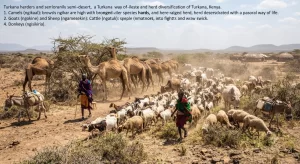
Surviving desert droughts requires species diversification because different animals cope with heat, water scarcity, and browse/graze depletion in complementary ways:
-
Camels (ngikaal): Essential in dry seasons when other animals yield less milk. Camels browse high shrubs and trees, travel long distances between water points, and can be milked multiple times a day—sometimes four times or, in peak/specific conditions, even more frequently—while their hides provide weatherproof shelters and their blood or meat provides emergency food.
-
Goats (ngakine) and Sheep (ngamesekin): Small Smallstock reproduce faster than camels or cattle, thrive on hardy scrub and grasses, supply regular milk (especially goats), meat, and skins for clothing and vessels, and allow herders to rebuild herds relatively quickly after losses.
-
Cattle (ngatuk): Valued deeply for prestige, bridewealth, and milk during greener periods, though more vulnerable to prolonged drought and water stress than camels or small stock.
-
Donkeys (ngisikiria): Vital pack animals for moving household goods, water containers, and children when camps relocate.
Field research on livestock ecology in Turkana documents how herd composition and growth respond sharply to rainfall, disease, and management. For example, multi-year ecological herd trials in central Turkana starting with 108 goats, 48 sheep, and 22 camels illustrated rapid reproductive potential in small stock—with sheep annual net increases reaching roughly 66.7% to 78.4% in observed periods and goats ranging from 27.8% to 65.6% depending on season and veterinary treatment—while camels showed much slower numerical growth (4.5% net increase over the September 1986–December 1988 study window, with 5 births and 4 deaths).
Larger livestock surveys in Turkana County also highlight the scale of multi-species herding groups, with average herding ensembles often holding hundreds of cattle and camels alongside thousands of goats and smaller numbers of donkeys. Herders identify individual animals through ear-notching/ear-tags, brand marks, coat patterns, and horn shapes, and estimate age through tooth eruption and wear (dentition) rather than calendar dates.
| Livestock Type | Primary Ecological & Dietary Role | Key Vulnerability / Management Note |
| Camels | Dry-season milk, high browse, long-range travel, hides, occasional blood/meat | Slow reproductive rate; requires disease/parasite vigilance |
| Goats | Twice-daily milking (seasonal), hardy browse, meat, hides, fast herd recovery | Sensitive to severe drought late in dry season |
| Sheep | Meat, skins, occasional milk, rapid lambing/growth under favorable forage | High birth rates can rebound quickly after losses |
| Cattle | High cultural/bridewealth value, milk in wetter spells, ceremonial importance | High water demand and drought sensitivity in arid zones |
| Donkeys | Transporting household gear and camp loads during seasonal moves | Essential mobility support for nomadic camps |
5. Fishing, Lake Turkana Ecology, and Changing Livelihoods
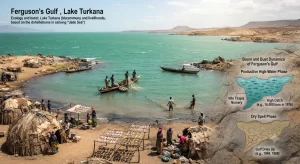
While inland pastoralists move with rain and pasture, communities along the shores of Lake Turkana—often called the “Jade Sea” for its striking blue-green hues—have developed specialized lacustrine livelihoods. Lake Turkana sits in a closed desert basin where the Omo River supplies roughly 90% of water inflow, and strong prevailing winds mix the water column (holomictic mixing) under alkaline conditions (around pH 9.5).
Shallow bays and lagoons such as Ferguson’s Gulf have historically served as productive nurseries and fishing grounds for Nile tilapia (Oreochromis niloticus) and other tilapiines, alongside Nile perch (Lates niloticus) and silversides. Ecological studies of Ferguson’s Gulf highlight dramatic boom-and-bust dynamics tied to water levels: in a peak year like 1976, roughly 16,000 tons of tilapia were harvested from around 10 square kilometers of the gulf, whereas in dry spells (such as 1946, 1955–56, and 1988) the gulf dried up completely.
Fisheries research also documents ecological pressures—including heavy predation by Nile perch and large Nile crocodile populations, wind and oxygen shifts in shallow lagoons, and a notable decline in the median length at first maturity of Ferguson’s Gulf tilapia from 39 cm total length in 1953 to 26 cm in 1982. Today, lakeside fishers and pastoralists alike confront compounding pressures: climate variability, upstream water regulation on the Omo basin (such as Gibe III dam operations noted in regional commentary), oil exploration and land-use shifts, and growing market integration.
6. Ethnobotany: Trees, Palms, and Desert Medicine
To walk through Turkana with an experienced elder or herder is to discover that a seemingly sparse thorn landscape is a pharmacy, hardware store, and pantry. Botanical and ecological studies in southern and central Turkana underscore the central role of trees and woody shrubs in desert life.
Acacia Tortilis (Umbrella Thorn)
Few trees matter more to Turkana ecology and livelihoods than Acacia tortilis (also classified under Vachellia tortilis), the iconic flat-topped umbrella thorn. Adapted to extreme heat (tolerating temperatures up to around 50°C in arid zones) and very low rainfall, A. tortilis develops mixed tap and lateral root systems that stabilize soil and tap deep moisture. Morphometric research in southern Turkana shows that root-to-shoot biomass ratios shift as trees mature—from roughly 1.5 in small trees to around 0.2 in mid-sized and large trees—while stem diameter grows incrementally with age.
Every part of Acacia tortilis and related arid-zone acacias has practical utility: nutritious pods and leaves browsed by livestock, gum exudates, durable timber and poles for shelters and implements, tannin-rich bark used in tanning and dyeing, and traditional medicinal remedies for digestive ailments, respiratory complaints, wounds, and livestock conditions.
Doum Palms, Wooden Vessels, and Craft Materials
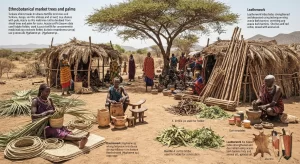
Along riverbanks, springs, and lake margins, doum palms (Hyphaene species) provide strong fibrous fronds for weaving mats, baskets, ropes, and lashing, while hard woods and hides are shaped into everyday tools. Detailed craft documentation of Turkana material culture shows how artisans hollow out wooden milk containers (akurum and apangach), weave strips of cow or goat hide and palm fiber, carve wooden headrests/stools (emakuk), and prepare red ochre mixed with animal oil to finish leather sheaths and spearhead covers (akuroru).
7. Adornment, Beadwork, and Body Art as Living Identity
Turkana adornment is visually unmistakable and deeply communicative. Rather than treating jewelry merely as casual decoration, Turkana women and men use beads, metals, feathers, and hairstyles to signal age, marital/social standing, clan/regional ties, personal history, and aesthetic pride.
Heavy Collars and Layered Necklaces
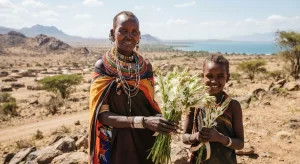
Turkana women frequently wear elaborate multi-strand bead collars stacked high around the neck, paired with beaded headbands, ear ornaments, waist belts, and metal or beaded bracelets. Ethnographic accounts and cultural reports note that the cumulative weight of a woman’s beadwork can reach several kilograms (up to around 5 kg in notable examples) and is often worn day and night continuously—sometimes set aside only during specific mourning periods or particular life transitions. Colors—crimson, white, ochre yellow, cobalt blue, black, and brass/metal accents—create striking geometric bands and textures against dark skin and woven or hide wraps.
Hairstyles, Headrests, and Personal Objects
Hair dressing and personal artifacts also carry rich meaning. Men often shape mud-pack chignons or wear ostrich/bird plumes on ceremonial occasions, resting their heads at night on carved wooden headrests/stools (ekicholong / emakuk) that preserve intricate hair arrangements while serving as portable seats during the day.
Through these objects, daily life becomes an art form: a carved headrest or a multi-layered bead collar is simultaneously utilitarian, aesthetic, and socially legible.
8. Resilience, Transformation, and the Future of Turkana
Today, life in Turkana stands at a historic crossroads. Towns like Lodwar have grown as administrative, commercial, and service hubs, while mobile schools, health outreach, mobile banking, improved roads, and cross-border trade connect remote settlements to wider networks. At the same time, climate extremes, herd losses during severe droughts, competing land claims, and shifts in lake ecology test traditional coping strategies.
What makes the Turkana story endure is not an unchanging museum past, but adaptive intelligence: knowing how to read clouds over dry riverbeds, balance multi-species herds when grass is scarce, resolve disputes through elder consensus, and carry deep cultural memory forward into new realities. In the desert lands around Lake Turkana, survival has always been a dialogue between human ingenuity and an untamed landscape.
Conclusion: Enduring Spirit Beneath a Vast Sky
Life across the sun-scorched plains and volcanic shores of northwestern Kenya demands a rare kind of courage, and the Turkana people embody that resilience every single day. Where others might see only arid expanses, shifting sands, and relentless heat, the Turkana have built a deeply coherent way of life shaped by observation, movement, and community. Their pastoralist heritage is far more than an economic choice; it is a living dialogue with seasons, water sources, and livestock that has kept generations moving forward through unforgiving terrain.
What makes the Turkana story so compelling is how tradition and adaptation coexist in real time. Oral histories, beadwork, music, and social bonds anchor identity across extended families, even as prolonged droughts, changing climate patterns, and shifting regional borders test old rhythms. Navigating these pressures requires constant resourcefulness, whether herding camels and goats across dry riverbeds, fishing along the Jade Sea, or engaging with newer economic and educational opportunities without losing sight of ancestral values.
Ultimately, understanding the Turkana invites us to look beyond stereotypes of harshness and scarcity. Their world reveals how human ingenuity flourishes when people know their landscape intimately and stand together when conditions turn difficult. As external forces continue to reshape East Africa’s drylands, the Turkana remain a powerful testament to adaptability, dignity, and cultural continuity. Preserving their stories—and listening to their voices on their own terms—ensures that the wisdom forged in Kenya’s desert lands is honored not merely as a relic of the past, but as a vital part of our shared human heritage.
