
The Mang Tribe of India: History, Culture, Social Resistance, and Modern Struggles
The story of the Mang tribe (also known historically and constitutionally as Matang, Madiga-affiliates, or Mankh) cuts across the deepest crosscurrents of Indian social history. Positioned at the intersection of indigenous roots, caste apartheid, colonial criminalization, and fierce cultural creativity, the Mangs remain one of the most resilient yet structurally marginalized communities of Western and Deccan India.
While predominantly categorized constitutionally under the Scheduled Castes (SC) framework rather than the Scheduled Tribes (ST), their sociological journey mirrors the dispossession, displacement, and autonomy struggles characteristic of India’s tribal and indigenous populations. From guarding mediaeval hill forts to fighting the British Empire, from crafting folk music instruments like the Halgi to pioneering radical subaltern literature, the history of the Mangs is a chronicle of survival against centuries of institutional oppression.
1. Who Are the Mang Tribe? Origins, Demographics, and Ethnohistory
Ethymological and Indigenous Roots
Colonial ethnographers, regional oral traditions, and subaltern scholars offer diverging accounts of how the community emerged:
-
Indigenous and Forest-Dwelling Origins: Oral mythologies across Maharashtra, Karnataka, and Telangana identify the community’s original ancestors with the forests and scrublands of the Deccan Plateau. Subaltern historian and social reformer Mahatma Jyotirao Phule posited in works like Gulamgiri (Slavery) that communities such as the Mangs and Mahars were the original indigenous inhabitants (Moolnivasi) of the land, displaced and subjugated by incoming pastoral and clerical hierarchies.
-
Etymological Theories: Some linguists trace the word ‘Mang’ to ‘Matanga’, an ancient ascetic sage mentioned in Buddhist and epic traditions who belonged to an outcast forest lineage. Others associate it with the Prakrit root denoting power, physical prowess, or work associated with wild fibers, ropes, and leather craft.
-
The Tribal-Caste Frontier: Sociologists observe that communities like the Mang, Berad (Ramoshi), and Bedar historically occupied a porous zone between distinct tribal collectivities and the village economy. They possessed clan totems, ancestor-worshipping cults, and village-boundary duties, only later being forcefully absorbed into the village periphery under the feudal Balutedar system.
Geographic Footprint and Demographics
The community is primarily concentrated in the Deccan region of Western and Southern India:
-
Maharashtra: Forms the largest concentration, notably across Marathwada (Nanded, Latur, Beed, Parbhani), Western Maharashtra (Kolhapur, Sangli, Satara, Solapur, Pune), and parts of Vidarbha.
-
Karnataka: Closely allied and historically intertwined with the Madiga community in districts such as Belagavi, Bidar, Kalaburagi, and Raichur.
-
Telangana and Andhra Pradesh: Often identified alongside or within the broader Madiga cultural-occupational complex.
-
Madhya Pradesh and Gujarat: Smaller migrant and frontier pockets exist along southern borders.
2. The Village Balutedar Economy: Labour, Servitude, and Segregation
Under the pre-colonial village system in Maharashtra (the Bara Balutedar structure), the village was structured around hereditary labour without monetary exchange.
THE DECCAN PRE-COLONIAL VILLAGE MODEL |
[ Village Center (Gaonthan) ]
|
Physical Boundary |
Peripheral Settlements (Ves / Maharwada / Mangwada) ]
|
Occupational Roles of the Mangs
-
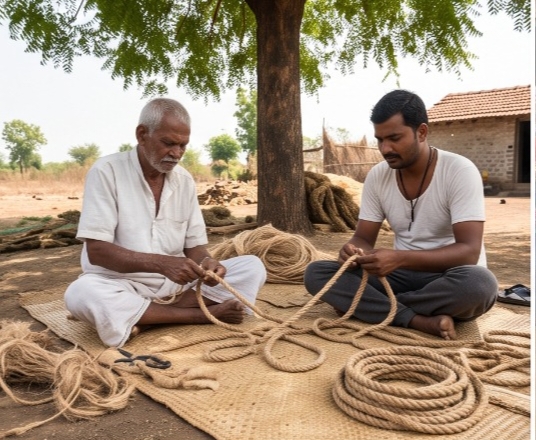
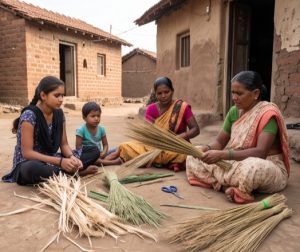
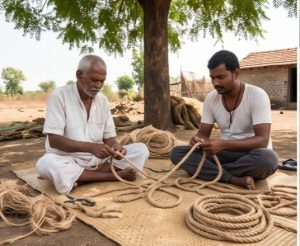
Rope-Making and Agro-Processing: Harvesting wild agave (ghaypat), sisal, and hemp fibers to weave heavy-duty ropes essential for cattle yokes, deep-well water extraction (mot), and thatched roofing.
-
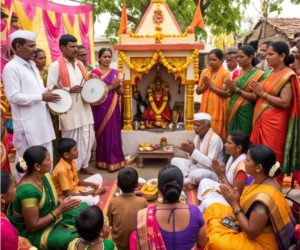
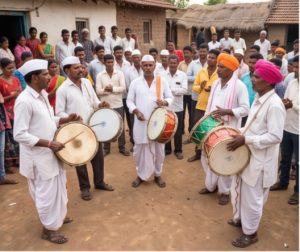
Folk Instruments and Performance: Tanning and stretching animal hide over circular wooden or metal frames to manufacture the Halgi and Daf—percussion instruments central to festivals, weddings, and village announcements.
-
Village Security and Execution Duties: Operating as physical enforcers, guards, and at times, court executioners for feudal chieftains and local rulers.
-
Midwifery and Sanitation: Mang women traditionally served as local village midwives (suin), assisting childbirth in rural regions despite being treated as “untouchable” by caste-privileged families immediately after the delivery was complete.
This paradox—where their labour, music, craft, and healthcare skills were indispensable to daily survival, yet their touch was treated as polluting—defines the historical tragedy of the community.
3. Martial Legacy: From Deccan Forts to Freedom Fighters
Contrary to the stereotype of passive acceptance, the Mangs maintained a robust martial tradition. Throughout the 17th to 19th centuries, their physical prowess made them critical military recruits.
Krantiguru Lahuji Raghoji Salve (1794–1881)
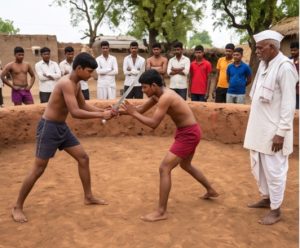
No figure captures the revolutionary ethos of the community better than Lahuji Salve, reverently known as Vastad (Master Wrestler):
-
The Akhada as Resistance Ground: Operating in Pune, Lahuji established an akhada (wrestling gymnasium and martial arts center). It was not just an athletic ground; it was an anti-colonial training facility where youth were trained in physical combat, stick-fighting (lathi), swordsmanship, and guerrilla tactics.
-
Patron of Mass Education: When Mahatma Jyotirao Phule and Savitribai Phule opened India’s first schools for girls and untouchable communities in Pune in 1848, Lahuji Salve used his physical protection network and influence to safeguard the schools and recruit students from the Mang community, including India’s first Dalit woman poet-essayist, Muktabai.
Muktabai: The Voice of Subaltern Rationality (1855)
At just eleven years old, Muktabai, a young Mang student at the Phule school, wrote an essay titled About the Grief of the Mahars and the Mangs (published in the periodical Dnyanodaya in 1855). Her text remains one of the earliest written feminist, anti-caste manifestos in Indian history:
“Let that religion where only a few are privileged and the rest despised vanish from the earth, and let it never dwell in our minds again… Oh Lord, what agony we endured under the rule of the Peshwas! If a Mang or Mahar walked past their doors, they were beheaded if their shadow fell on a high-caste man.”
Muktabai documented the draconian laws under the late Peshwa regime, where Dalits were forced to tie earthen pots around their necks to catch their spit and sweep brooms behind them to erase their footprints.
 4. Colonial Trauma: The Criminal Tribes Act of 1871
The 19th century brought catastrophic administrative violence upon wandering, pastoral, and militant subaltern communities across the subcontinent.
| Year | Milestone | Impact on the Mang and Allied Groups |
| 1871 | Passage of the Criminal Tribes Act (CTA) | Declared entire castes/tribes “genetically and occupationally criminal.” |
| 1911 | Amendment & Settlement Camps | Compulsory biometric registration, roll calls twice a day, confinement in barbed-wire settlements. |
| 1952 | Habitual Offenders Act / Repeal | Denotification of CTA; replaced by local policing surveillance and lingering social stigma. |
The British administration viewed wandering artisan groups, rope-makers, and former warriors with deep suspicion. Under the CTA, thousands of Mang families were subjected to:
-
Forced Confinement: Restricted mobility; families were barred from leaving village confines without permits signed by the village headman (Patil).
-
Destruction of Livelihoods: Traditional foraging for wild grasses and wood to make ropes and musical instruments was criminalised under newly enacted British forest reservations.
-
Intergenerational Stigma: Children born into these communities were branded criminals at birth, creating deep psychological and economic devastation that persists today.
5. Literature, Art, and Culture: Annabhau Sathe and Folk Performance
Despite severe disenfranchisement, the Mang community gave Maharashtra its most vital folk-art traditions and 20th-century proletarian literature.
Tukaram Bhaurao ‘Annabhau’ Sathe: The People’s Poet
Annabhau Sathe (1920–1969), born into a poor Mang family in Sangli district, migrated to the textile mills of Bombay (Mumbai). Despite having only two days of formal schooling, he went on to write:
-
35 novels, including the masterpiece Fakira (which won the State Government Award in 1961), depicting the life of a heroic Mang rebel who looted colonial granaries to feed starving villagers during famine.
-
Over 300 short stories, 15 collections of folk plays (Loknatya), travelogues, and dynamic ballads (Powadas).
-
The Sanyukta Maharashtra Movement: Annabhau, alongside Amar Sheikh and D.N. Gavankar, formed the Lal Bawta Kalapathak (Red Flag Cultural Troupe). Using the traditional Tamasha and Lavani formats, they electrified millions of working-class citizens in the movement that carved out the state of Maharashtra in 1960.
His famous formulation remains the defining creed of modern subaltern assertiveness:
“The earth does not balance on the head of Sheshnaga; it rests on the palms of the toiling worker and the peasant.”
Musical Heritage: The Halgi, Daf, and Tamasha
The Mang community preserves an extraordinary sonic legacy:
-
The Halgi: A shallow frame drum beaten with two thin bamboo sticks (Chopani). The tempo of the Halgi drives rural agricultural festivals, pola (bullock celebrations), protests, and religious fairs.
6. Contemporary Socio-Economic Realities and Human Development
In 21st-century India, the Mang community faces deep socio-economic hurdles. While constitutional reservations under the Scheduled Castes category opened doors for some, structural disparities remain acute.
HUMAN DEVELOPMENT VULNERABILITIES |
[ Educational Exclusion ] |
• High dropout rates between secondary and tertiary levels |
• Limited representation in higher STEM and corporate jobs |
[ Occupational Precarity ] |
• Loss of traditional rope market to nylon & plastics |
• Concentration in landless agricultural labor & sanitation |
[ Political Fragmentation ] |
• Demand for Sub-categorization (A, B, C, D quota models) |
• Underrepresentation in mainstream legislative bodies |
1. Educational Deficits and Literacy Gaps
While overall Dalit literacy has risen steadily, educational attainment among Mangs lags behind more urbanized Scheduled Castes.
-
A substantial percentage of students drop out after secondary education due to financial distress.
-
First-generation learners face institutional hostility and a lack of resources in rural colleges, keeping entry into higher corporate, technical, and civil service roles disproportionately low.
2. Occupational Displacement
The traditional village economy has disintegrated without being replaced by adequate formal employment:
-
Synthetic Disruption: The invention of cheap nylon ropes and industrial polymers destroyed the traditional market for handwoven ghaypat (sisal/agave) ropes.
-
Informalization of Labor: Displaced rural Mangs have migrated en masse to urban peripheries (Pune, Mumbai, Solapur, Hyderabad), working as day-wage construction laborers, municipal sanitation workers (safai karamcharis), and gig-economy workers.
-
Landlessness: Unlike peasant cultivator castes, the Mangs rarely owned agricultural land. In rural areas, they remain predominantly landless farmhands (khet mazdoor), vulnerable to seasonal drought and agrarian debt cycles.
7. The Internal Sub-Categorization Debate: The Justice Usha Mehra Commission
One of the central political debates involving the Mang community in Maharashtra (mirrored by the Madigas in Andhra Pradesh and Telangana) is the demand for sub-categorization within the Scheduled Caste quota.
The Core Grievance
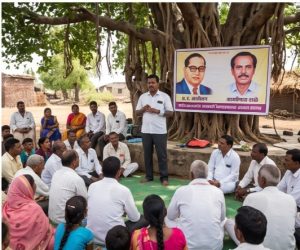
Community leaders and sociologists point out that within the 13% SC reservation quota in Maharashtra, the benefits of education, urban mobility, and government employment have been disproportionately accessed by communities that were early adopters of English education and political mobilization (such as the Mahars under Dr. B.R. Ambedkar’s direct leadership).
Government Commissions and Responses
To address these grievances, successive commissions were constituted:
-
The Justice Usha Mehra Commission (2008): Examined the feasibility of sub-categorization in Andhra Pradesh, observing that internal stratification within SCs required policy intervention to ensure equitable benefits reached the most backward groups like the Madigas.
-
The Lahuji Salve Commission (Maharashtra): Formed to evaluate the social and educational backwards of the Matang community, it recommended targeted economic packages, student hostels, soft loans, and statutory welfare boards.
-
The Supreme Court Ruling (August 2024): A 7-judge Constitution bench of the Supreme Court of India ruled that states have the constitutional authority to sub-classify Scheduled Castes to provide preferential reservation to more backward sub-groups, validating decades of mobilization by communities like the Mangs and Madigas.
8. The Way Forward: Pathways to Dignity and Empowerment
Reversing historical injustices requires targeted policy interventions, community mobilization, and cultural preservation.
ROADMAP FOR INCLUSIVE DEVELOPMENT |
[ 1. Economic Upgrades ] |
Modernization of agro-fiber and leather crafts |
Capital access via micro-credit & entrepreneurship |
[ 2. Targeted Education ] |
Dedicated residential schools & college hostels |
Digital literacy centers in rural settlements |
[ 3. Cultural Preservation ] |
State-supported folk art academies for Halgi/Tamasha |
Academic translation of Annabhau Sathe's works |
[ 4. Policy Realization ] |
Transparent implementation of welfare commissions |
Systematic land redistribution to landless laborers |
Strategic Interventions
-
Reviving Fiber and Leather Enterprises: Rather than abandoning traditional skills, state craft boards should invest in modern processing units for natural, eco-friendly sisal and plant fibers. This bridges traditional artisan knowledge with modern sustainable design markets.
-
Residential Schooling Networks: Replicating the model of Navodaya Vidyalayas and Eklavya Model Residential Schools within rural Mang settlements (vastis) to ensure children do not drop out due to economic pressures.
-
Archiving Subaltern Culture: The literary, theatrical, and musical heritage pioneered by Annabhau Sathe and local folk artists needs formal institutional preservation, university chairs, and international translation projects.
Conclusion: A Living Legacy of Resistance
The Mang community’s journey is not merely a tale of destitution—it is a study in cultural endurance and defiance. They built the fortifications of the Deccan, defended villages against invaders, provided the rhythmic heartbeat of rural life through their music, and produced literary icons who articulated the struggles of India’s working class.
Securing justice for the Mang community in modern India requires moving beyond token welfare gestures. It demands structural reform: equitable access to quality education, economic modernization, fair representation, and an honest reckoning with the deep-rooted caste and tribal hierarchies that continue to shape rural society.
