
The Reang (Bru) Tribe: Cultural Heritage, Social Fabric, and the Long Journey for Dignity in Modern India
The undulating, mist-covered ridges of Northeast India harbour ancient and resilient Reang Tribe environments, harmony, and migratory endurance. Among the diverse indigenous peoples inhabiting this frontier, the Reang—endonymically known as the Bru—stand out as a distinct cultural tapestry. Recognised as a Particularly Vulnerable Tribal Group (PVTG) in Tripura and residing across borderlands in Mizoram and Assam, the Bru people embody both the poetic brilliance of indigenous traditions and the harrowing sociopolitical upheavals of modern India.
From the breathtaking, acrobatic equilibrium of the Hojagiri dance to their self-sustaining Jhum (slash-and-burn) agriculture, the Reang have historically inhabited an intimate kinship with the subtropical forests. Yet, their recent history has been marked by displacement, decades inside makeshift relief camps, and an arduous struggle for political identity, land security, and human development.
1. Introduction: Who Are the Bru (Reang) People?
The Reang constitute the second-largest indigenous community in the state of Tripura, following the Tipra (Tripuri). Within colonial ethnography and state administrative records, they are commonly cataloged as “Reang”, an exonym popularized during British administrative surveys and the reign of the Manikya dynasty. Within their own oral tradition and vernacular consciousness, they identify proudly as “Bru”, a word signifying “human being” or “person.”
Unlike many dominant indigenous groups of the plains, the Bru maintained a prolonged semi-nomadic existence along the hill ranges of Chittagong Hill Tracts (modern Bangladesh), the Lushai Hills (Mizoram), and the valleys of Tripura. Because of their acute socio-economic marginalization, traditional agricultural dependence, and historical vulnerability, the Government of India designates the Reang in Tripura as a Particularly Vulnerable Tribal Group (PVTG). This status acknowledges an urgent imperative for targeted developmental assistance, linguistic preservation, and legal protection.
| Key Attribute | Details |
| Self-Designation | Bru |
| Administrative Name | Reang (or Riang) |
| Linguistic Family | Tibeto-Burman (Bodo-Garo branch, Kau Bru) |
| Primary Geographic Enclaves | Tripura, Mizoram (Kolasib, Mamit), Assam (Hailakandi, Karimganj) |
| Constitutional Classification | Scheduled Tribe (ST); designated PVTG in Tripura |
| Signature Cultural Expression | Hojagiri Dance |
| Traditional Economy | Jhum (shifting agroforestry) and bamboo craftsmanship |
2. Historical Origins and Migration Chronicles
Indigenous history in Northeast India is rarely set in stone tablets or recorded in royal gazettes; it breathes through the ancestral memory of storytellers, shamans, and ceremonial ballads (Kau-bru rwchabmung). The Bru trace their ancestry to migrations descending through the river valleys of Southeast Asia into the rugged frontiers of the Indo-Burma biodiversity hotspot.
The Mythological Genesis and the Shan States Connection
According to oral lore, the forefathers of the Bru people migrated from the undulating Shan plateau of upper Burma (Myanmar), moving gradually through the Chittagong Hill Tracts along the banks of the Karnaphuli, Mayani, and Kaladan rivers. They navigated hill terrain in search of fertile ridges suitable for shifting cultivation, free from predatory empires and exploitative lowland tax collectors.
One prevalent oral genesis myth narrates the union of two ancestral beings, Bru-ha and Bru-ma, created by the supreme cosmological architect Achu Sibrai (an indigenous deity later syncretized with Lord Shiva). Guided by auspicious omens—the flight of mountain birds and the course of forest streams—the clans traversed dense canopy forests, establishing autonomous village domains ruled by clan chiefs called Choudhurys or Rai.
Encounters with the Manikya Dynasty of Tripura
As the kingdom of Twipra (ruled by the Manikya dynasty) expanded its influence between the 15th and 19th centuries, the Bru hill communities were integrated into the royal administrative matrix. Unlike the sedentary, rice-farming communities of the plains, the Bru served the Manikya monarchs as specialized hill soldiers, elephant catchers (Khedda operators), and forest scouts.
However, this political alliance was fraught with tensions. The royal court levied tribute in the form of raw cotton, sesame, woven hill cloths, and manual forest labor (Titun). When royal tax collectors imposed predatory extractions upon the hill villagers, the Bru rose in armed rebellion to protect their communal autonomy.
The Ratanmani Reang Revolt (1942–1943)
The most historic uprising occurred during the height of the Second World War. Under the spiritual and political leadership of Ratanmani Reang, an ascetic reformer and charismatic leader, the Bru waged a rebellion against the feudal oppression of local moneylenders, aristocratic tax collectors, and state-backed middle-tier chieftains.
Ratanmani preached socio-religious egalitarianism influenced by Vaishnavite Bhakti ideals fused with Bru animistic equity, calling for an end to forced extraction and wartime grain hoarding. While the royal forces brutally suppressed the rebellion, capturing and executing Ratanmani and scattering his followers, the revolt remains an enduring symbol of the Bru commitment to human dignity, self-determination, and peasant solidarity.
3. Demographics, Clan Formations, and Social Structure
The Bru are not an undifferentiated monolith; their society is organized into a detailed system of clans, lineages, and village assemblies designed to prevent the concentration of autocratic power while preserving kinship ties.
The Dual Moieties: Meska and Molsoi
Bru society is broadly divided into two major divisions or moieties: the Meska and the Molsoi. Within these two broad branches exist several distinct exogamous clans (Pang or Hukumu), including:
-
Meska sub-clans: Meska, Chorkhi, Raikchak, Tuimaya, Wairem.
-
Molsoi sub-clans: Molsoi, Apet, Riang, Nokhret, Uchoi.
These clan divisions traditionally determined marriage alliances, cooperative work regimes (Yaol), and ritual roles during village-wide festivals. Inter-clan marriage was carefully organized to prevent endogamous incest while weaving cross-valley safety nets against crop failures or local raids.
The Traditional Three-Tiered Governance Matrix
Long before formal Panchayati Raj institutions or Autonomous District Councils were introduced, the Bru managed their society through an indigenous, consensus-driven justice system:
                  ┌───────────────────────────────┐
                  │          KACHKAU              │
                  │   (Supreme Chieftain / Rai)   │
                  │  Appellate / Territorial Body │
                  └──────────────┬────────────────┘
                                 │
                  ┌──────────────┴────────────────┐
                  │           BARUA               │
                  │   (Regional Zonal Council)    │
                  │   Inter-Village Arbitrations  │
                  └──────────────┬────────────────┘
                                 │
                  ┌──────────────┴────────────────┐
                  │         CHOUDHURY             │
                  │   (Village Headman & Council) │
                  │  Day-to-day Disputes, Custom  │
                  └───────────────────────────────┘
-
The Village Council (Kami-Kachkau): Led by the Choudhury, assisted by the Karbari (secretary/messenger). The village assembly decides matters regarding land allocation for Jhum, minor civil infractions, boundary arbitrations, and matrimonial ruptures.
-
The Regional Council (Barua): Mediates inter-village resource disputes, water-sharing conflicts, or matters unresolved by a single village headman.
-
The Supreme Chieftain (Rai or Kachkau): The ultimate traditional authority of the entire Bru community. The Rai’s court served as an appellate body interpreting the unwritten customary code (Bru Niam).
Decisions within this framework were marked by restorative rather than purely punitive justice; wrongdoers were typically fined in livestock, rice beer, or community feasts designed to restore broken kinship bonds.
4. Language and Oral Heritage: Kau Bru
The language of the Bru is Kau Bru, a recognized dialectal variant within the Kokborok language cluster, situated inside the Bodo-Garo subgroup of the larger Tibeto-Burman language family.
Linguistic Anatomy and Phonological Nuance
Kau Bru retains archaic phonological features, tone contours, and vocabulary that have shifted in lowland standard Kokborok. Its morphology is agglutinative, expressing intricate emotional states, spatial orientations, and ecological interactions through compounding suffixes.
For example, directions are often expressed relative to river currents and mountain elevations rather than simple cardinal directions: uphill, downhill, up-river, and down-river.
                          Tibeto-Burman
                                │
                      Bodo-Koch-Garo Branch
                                │
                         Kokborok Group
                                │
               ┌────────────────┴────────────────┐
               │                                 │
       Standard Kokborok                      Kau Bru
     (Debbarma / Jamatia)             (Phonetically archaic,
                                      distinct tonal patterns)
The Script Dilemma: Latin vs. Bengali vs. Ol Chiki vs. Indigenous Innovations
A major challenge for modern Bru cultural preservation is the medium of writing. Historically an oral tongue, Kau Bru literature has been preserved through phonetic experimentation:
-
The Bengali Script: Historically utilized in Tripura state schoolbooks and administrative documents.
-
The Latin (Roman) Script: Widely favored by educated youth, civil society groups (such as the Mizoram Bru Displaced People’s Forum), and Christian converts, who argue that the Latin alphabet captures Kau Bru’s complex tonal accents and glottal stops more accurately.
-
Indigenous Scripts: Recent revitalization movements have introduced or promoted indigenous scripts, such as Bru-Kwtwr, though Latin orthography remains the predominant vehicle for internet publishing, hymn books, and community news.
The lack of standard script institutionalization in regional schools creates educational bottlenecks for Bru children, whose native tongue is often absent in early primary curricula.
5. Cultural Lifeways, Music, and the Masterful Hojagiri Dance
The Bru worldview finds its clearest expression through artistic performance. Music, dance, and daily labor are not compartmentalized; they form a single rhythmic cycle governed by the forest seasons.
The Hojagiri Dance: Balance on the Edge of Eternity
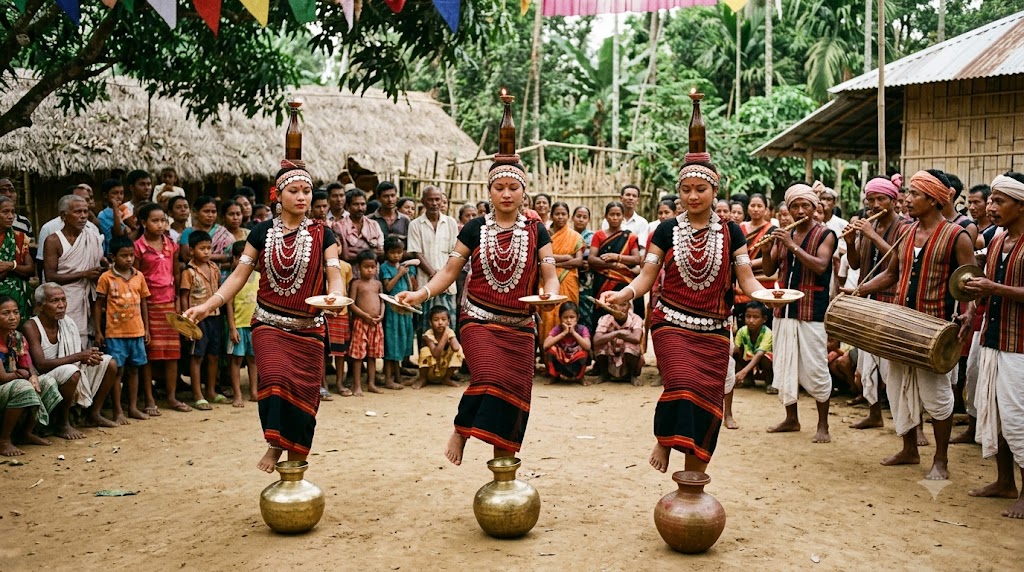
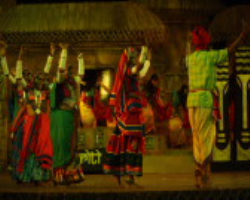
Celebrated across India’s cultural landscape, the Hojagiri dance is the crown jewel of Bru folklore. Performed exclusively by young women and girls, the dance is an extraordinary synthesis of physical balance, rhythmic footwork, and spiritual devotion performed during the Hojagiri festival (honoring the goddess Mailuma, the guardian spirit of paddy crops).
   [Earthen Pitcher balanced on head] ───┐
                                          │
   [Lamps / Plates balanced on hands] ───┼──>  [Micro-articulations of the hips/waist]
                                          │     (Feet tread on rim of bronze pitcher/platter)
   [Still upper torso & eyes] ───────────┘
The performer stands atop an earthen pitcher (Kalsi) or balances her feet on the precarious edge of a spinning brass platter. While keeping her upper body, neck, and head entirely motionless—frequently balancing a lighted lamp or bottle atop her head—the dancer moves her lower torso, hips, and feet in micro-rhythmic synchrony to the percussive beat.
The performance represents the physical balance required for agricultural survival in the hills: one false move, and the crop—or the dancer—falls.
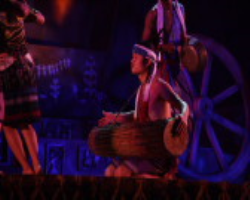
Musical Instruments of the Hills
The acoustic soundscape of a Bru hamlet relies on indigenous materials harvested from the bamboo groves:
-
Kham: A double-membrane wood-and-hide drum providing deep syncopation for ritual invocations.
-
Chongpreng: A pluck-string bamboo zither tuned to traditional pentatonic intervals.
6. Indigenous Religion, Cosmovision, and the Christian Transition
The spiritual life of the Bru has shifted significantly over the past century, moving from a deeply animist landscape inhabited by earth spirits to widespread conversion to institutional Christianity.
The Ancestral Pantheon: Earth Deities and Shamanic Healing
Traditionally, the Bru world was non-dualistic: humans shared forest spaces, streams, cliffs, and skies with an invisible pantheon of benevolent and wrathful spirits (Mtai). Key deities in this traditional cosmos include:
-
Achu Sibrai: The primordial father-creator, associated with mountain heights, generative life, and moral order.
-
Mailuma: The goddess of paddy, harvested rice, and maternal bounty. She is propitiated through seasonal rites to protect grain stores from rot, rodents, and drought.
-
Khuluma: The goddess of cotton, honoring the crop that historically sustained traditional Bru textiles.
-
Tuibuma: The goddess of running waters, rivers, and monsoon deluges.
Spiritual mediation was conducted by the Ochai (the village priest-shaman). The Ochai performed divination using bamboo shoots, rice grains, and sacrificial animals to identify which forest spirit had been offended by an imbalance, subsequently performing complex restoration rituals (Goria Puja, Katang Puja).
The Spread of Christianity
This religious shift led to significant changes:
-
Literacy & Education: Mission schools popularized Latin-script primers, fostering a modern cadre of literate youth.
-
Decline of Shamanic Practices: Traditional sacrifices directed by the Ochai declined as villages adopted chapel-centric weekly worship.
-
Cultural Re-interpretation: While dances like Hojagiri continue as secular cultural expressions, the underlying ceremonial invocations to Mailuma and Sibrai are increasingly preserved as community folklore rather than living spiritual cults.

7. Traditional Economy: Swidden Agriculture (Jhum) and Material Culture
The historical economy of the Bru people was built around mutual aid, forest management, and household self-sufficiency.
The Jhum Calendar (Huk)
Bru economic life followed the seasonal rhythms of Jhum (swidden or shifting agroforestry), a cycle suited to thin mountain topsoils:
  DECEMBER - JANUARY         FEBRUARY - MARCH              APRIL                   OCTOBER - NOVEMBER
┌─────────────────────┐    ┌─────────────────────┐    ┌─────────────────────┐    ┌─────────────────────┐
│ Site Selection &    │───>│ Drying & Controlled │───>│ Multi-Crop Sowing   │───>│ Harvesting, Storage │
│ Slashing the Forest │    │ Burning of Biomass  │    │ at First Monsoon    │    │ & Jhum Feast        │
└─────────────────────┘    └─────────────────────┘    └─────────────────────┘    └─────────────────────┘
-
Site Selection (Huk Rung): The village elders select secondary forest patches, leaving old-growth forests intact around stream catchments.
-
Clearing (Huk Hama): Undergrowth and bamboo thickets are slashed with Dao (cleavers) during early winter.
-
Dibbling and Sowing (Huk Wama): With the arrival of early rains, families walk along slopes, using a pointed stick to plant a variety of seeds in a single hole.
A single Jhum plot yielded upland paddy, sesame (Kacham), maize, chillies, melons, root vegetables, and mountain cotton (Khulu). This multi-crop strategy shielded the community against the total failure of any single crop.
Material Culture and Bamboo Architecture
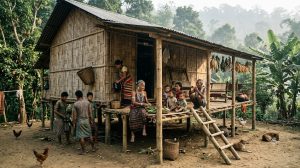
The material culture of the Bru centers on bamboo (Wathwi, Wamono). Houses (Nokh) are constructed on wooden and bamboo stilts (Tong-Ghar) along steep mountain slopes. This elevation provides several practical advantages:
-
Protection against wild animals, snakes, and flooding.
-
Natural underfloor airflow that dries crops and cools the living quarters.
-
Space underneath the house to shelter domestic pigs and poultry.
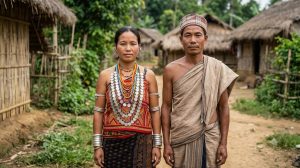
Bru weaving traditions, mastered by women using back-strap loin looms, produce stunning traditional textiles such as the Rignai (a lower wrap-around skirt) and the Risa (a narrow chest-wrap woven with elaborate geometric motifs).
8. The Bru Displacement Crisis: 1997–Present
No contemporary portrait of the Bru is complete without examining their modern refugee crisis. In the late 20th century, the community was caught in an acute human rights dilemma along the borders of Tripura and Mizoram.
Roots of the Inter-Ethnic Rift (1997)
Following the creation of Mizoram statehood in 1987, ethno-nationalist identity politics gathered momentum across the Lushai Hills. The Bru, who resided in Mamit, Kolasib, and Lunglei districts of western Mizoram, voiced concerns regarding linguistic marginalization, cultural exclusion, and underrepresentation in local governance.
In October 1997, after a Mizo forest official was killed by Bru insurgents inside the Dampa Tiger Reserve, retaliatory ethnic violence erupted across western Mizoram. Over thirty Bru villages were burned, and widespread violence forced over 37,000 Bru men, women, and children to flee their homes into northern Tripura.
       WESTERN MIZORAM                           NORTHERN TRIPURA
 (Mamit, Kolasib, Lunglei)                    (Kanchanpur, Panisagar)
  ───────────────────────                     ───────────────────────
   October 1997 Violence   ═════════════════>  6 Make-Shift Relief Camps
   Villages razed, fled                        (Naisingpara, Ashapara,
   across the state border                     Hazacherra, etc.)
                                                       │
                                                       │ 23 Years of Protracted
                                                       │ Uncertainty & Hardship
                                                       ▼
                                               JANUARY 2020 ACCORD
                                            Permanent Resettlement in Tripura
Decades in the Relief Camps: Kanchanpur
The displaced Bru were housed across six makeshift relief camps in the Kanchanpur and Panisagar sub-divisions of North Tripura district—including Naisingpara, Ashapara, and Hazacherra.
For over two decades, an entire generation of Bru children grew up under tarpaulin sheets and bamboo huts:
-
Dependent on basic government rations (cash doles of a few rupees and raw rice quotas).
-
Lacking formal land ownership, electricity, and clean piped water.
-
Barred from formal public-sector employment, forcing adults into poorly paid agricultural labor on local plantations.
-
Facing recurrent health crises, including malaria, waterborne epidemics, and high infant mortality.
The Historic Quadripartite Agreement of 2020
A significant breakthrough occurred on January 16, 2020, when a landmark quadripartite agreement was signed in New Delhi between:
-
The Government of India (Ministry of Home Affairs),
-
The State Government of Tripura,
-
The State Government of Mizoram,
-
Representatives of the displaced Bru organizations (MBDPF and BDF).
Under this historic pact, the Government of India abandoned forced repatriation, allowing roughly 34,000 displaced Bru refugees to permanently settle inside Tripura as legitimate citizens with full civic and voting rights.
Resettlement Package Specifications
  ┌─────────────────────────────────────────────────────────────┐
  │         THE 2020 QUADRIPARTITE FINANCIAL & LAND PACT        │
  ├─────────────────────────────────────────────────────────────┤
  │  Residential Plot:      1,200 sq. ft. (1.5 Ganda) per family │
  │  Housing Grant:         ₹1,50,000 per family                │
  │  Fixed Deposit:         ₹4,00,000 per family (2-yr lock-in) │
  │  Monthly Allowance:     ₹5,000 per month for two years      │
  │  Free Rations:          Ration cards & grain for two years  │
  └─────────────────────────────────────────────────────────────┘
The comprehensive rehabilitation plan involved acquiring designated land plots across several districts of Tripura (including Dhalai, North Tripura, South Tripura, and Khowai) to build planned model villages equipped with primary health centres, Anganwadi facilities, and schools.

9. Contemporary Challenges and Human Development Trajectories
While the 2020 Accord offered a legal and geographic resolution, the ground reality of integration presents several ongoing challenges for the community.
1. Land Allocation Bottlenecks and Local Tensions
Finding thousands of acres of cultivable land in a small, densely populated state like Tripura has produced localized friction. In areas such as Kanchanpur, local non-tribal and resident indigenous associations (such as the Joint Movement Committee) organized strikes against large-scale resettlement clusters, fearing pressure on local water supplies, communal forests, and electoral balances. Consequently, the progress of parceling out individual land deeds has experienced bureaucratic delays.
2. Transition from Swidden to Sedentary Livelihoods
The transition from traditional Jhum cultivation to sedentary agriculture or wage labor is a major economic hurdle. Having lost their ancestral commons, resettled families often lack the capital, irrigation infrastructure, and equipment required for settled terrace or wet-paddy farming, leading to underemployment among youth.
3. Education, Language, and Literacy Gaps
                  ┌────────────────────────────────────────┐
                  │       EDUCATIONAL BOTTLENECKS          │
                  └───────────────────┬────────────────────┘
                                      │
         ┌────────────────────────────┴───────────────────────────┐
         │                                                        │
         ▼                                                        ▼
[Early Childhood]                                        [Higher Education]
Absence of Kau Bru in schools;                           High dropout rates; economic
abrupt immersion in standard                             distress forces adolescents
Bengali or English media.                                into seasonal manual labor.
The Bru literacy rate remains lower than the statewide averages of both Tripura and Mizoram. Because Kau Bru is rarely utilized as a primary language of instruction, children face structural disadvantages when entering primary schools using Bengali or English.
4. Preservation of Intangible Cultural Heritage
Urbanization, resettlement into denser model villages, and cultural homogenization have placed oral traditions under pressure. The ancient craft of medicinal root gathering (Baidya), the complex songs of the Ochai, and specialized loom techniques run the risk of fading unless actively documented and supported by community-led cultural initiatives.
10. The Path Forward: Preserving Identity and Securing the Future
Securing a sustainable future for the Bru people requires going beyond basic relief distribution toward genuine, self-sustaining community empowerment.
                     ┌──────────────────────────────────┐
                     │    STRATEGIC PILLARS FOR BRU     │
                     │          EMPOWERMENT             │
                     └────────────────┬─────────────────┘
                                      │
      ┌──────────────────┬────────────┴─────┬──────────────────┐
      │                  │                  │                  │
      ▼                  ▼                  ▼                  ▼
[Land Titling]    [Agro-Forestry]    [Mother-Tongue]     [Market Access]
Expedited FRA     Organic bamboo,    Bilingual school    Direct producer
pattas with       horticulture, &    primers in Latin    cooperatives for
water rights      rubber initiatives & Bengali scripts   Risa & craft goods
1. Robust Implementation of the Forest Rights Act (FRA, 2006)
Beyond the 1,200-square-foot residential plots allocated in the 2020 pact, the state must grant community forest resource rights under the Forest Rights Act. Access to surrounding forest ecosystems is essential for seasonal foraging, sustainable bamboo harvesting, and pastoral stability.
2. Cultivating Ecological and Commercial Cooperatives
The Bru possess deep expertise in working with bamboo, timber, and traditional weaving. Establishing regional bamboo artisan cooperatives and providing direct market access for authentic Bru textiles—such as the Risa—can bypass middlemen and establish sustainable local income streams.
3. Mother-Tongue Early Childhood Education
Educational authorities should develop bilingual primers that use Kau Bru as a transitional bridge during the early school years. Creating community-approved standardized spelling systems—using both Latin and Bengali scripts—will preserve local oral traditions while supporting formal academic progress.
4. Women’s Leadership and Grassroots Self-Help Groups (SHGs)
Bru women are the central stewards of household economies, seed conservation, and textile arts. Empowering female-led Self-Help Groups with microcredit and clean energy solutions (like solar-powered weaving looms and cold-storage facilities) can directly improve family health and educational outcomes.
Conclusion: The Resilient Spirit of the Bru
The story of the Bru (Reang) people is an inspiring chapter in the human struggle for dignity and survival. They have weathered imperial taxation, displaced exiles, harsh living conditions, and the complex friction of modern borderland politics. Yet, through decades in relief camps, their songs have not been silenced; through displacement, their dancers have not lost their step.
When a young Bru girl ascends a brass platter, adjusts her gaze to the horizon, and dances the Hojagiri with a flickering light balanced on her head, she does more than perform for an audience: she demonstrates the balance her community maintains every day. As India works toward inclusive national growth, honoring the land rights, cultural heritage, and democratic voice of the Bru people is an essential step toward ensuring that this unique indigenous culture continues to thrive on its own terms.
