
The Unbroken Thread: The Vaiphei Tribe, Highland Heritage, and the Pursuit of Dignity in Modern India
Introduction: The Children of Khul and the Living Echo of the Hills
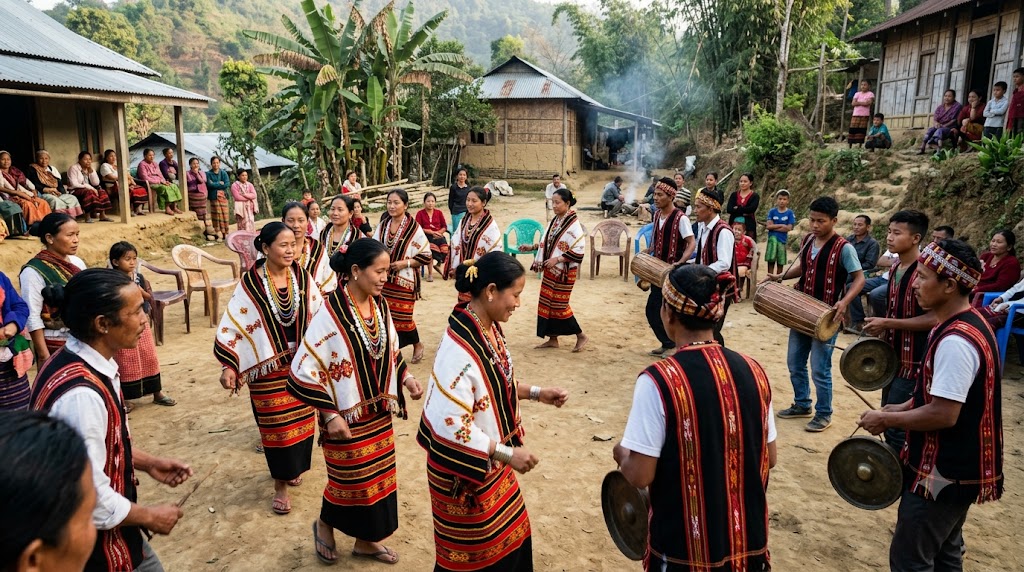
High in the mist-veiled ridges of the Indo-Burma biodiversity hotspot, across the verdant folds of Manipur, Assam, Meghalaya, and Mizoram, lives a community whose oral epics run as deep as the mountain gorges they inhabit. The Vaiphei people—recognized formally as a Scheduled Tribe under the Constitution of India—stand as one of the most culturally resilient yet historically overlooked highland societies of Northeast India. Belonging broadly to the larger Zo/Kuki-Chin ethno-linguistic continuum, the Vaiphei possess an unmistakably distinct historical consciousness, a sophisticated customary legal system, and an intricate social architecture.
For centuries, indigenous communities across the frontier highlands have lived in reciprocal relationship with rugged landscapes. Yet, in popular national discourse, their stories are often flattened into romanticized anthropological footnotes or obscured by headlines of geopolitical friction. The story of the Vaiphei defies simple categories. It is a chronicle of ancient cave myths, trans-border migrations, patriarchal clan councils, exquisite handloom motifs, dramatic religious transformations, and a relentless modern struggle for educational access, infrastructural parity, and indigenous self-determination.
Understanding the Vaiphei is not merely an academic exercise in regional ethnography. It is an inquiry into how a close-knit tribal society preserves its cultural anchor while navigating the high-speed currents of modern democracy, market economies, and socio-political polarization in twenty-first-century India.
Etymology and Primordial Origins: The Legend of the Cave Emergence
To understand the worldview of a Vaiphei elder, one must first understand the concept of Khul.
Like many indigenous peoples belonging to the Zo or Kuki-Chin-Mizo lineage, the Vaiphei trace their genesis to a primordial subterranean emergence. According to oral lore passed down across centuries through bardic songs (Lapi) and fireside narratives, humanity once existed deep within the earth. The ancestors emerged into the sunlit world through a mythical subterranean cavern known as Khul (or Chhinlung in allied dialects).
Legend recounts that the emergence was perilous. A mythical beast, often described as a ferocious feline or monster (Gulpheigum or Khaobawl), stood guard at the opening of the cavern, slaughtering those who attempted to exit. It was only through the courage, cunning, and collective sacrifice of legendary clan founders—who disguised themselves or fought back with elemental weapons—that the beast was slain, allowing the ancestors to step out into the hills and forests of the upper world.
The name Vaiphei itself carries potent geographical and historical significance. Linguistic and clan traditions offer two complementary interpretations:
-
“People of the Plains/Valley Border”: A widely cited etymology derives the name from Vai (meaning plain, valley, or foreign domain, historically referring to the fertile plains of the Kabaw Valley or the lowlands) and Phei (meaning slope, side, or walking path). Thus, Vaiphei denotes the highland people who traversed or dwelt along the sloping ridges adjacent to the expansive plains.
-
“The Swift Travellers”: Another oral tradition links the term to their historical prowess as mobile pathfinders, hunters, and hill pioneers who negotiated treacherous mountain slopes (Phei) with uncommon swiftness and military coordination during early tribal migrations.
Historically, before establishing their current settlements across the hills of modern Manipur, the Vaiphei traversed the Chin Hills of northwestern Myanmar, the Lushai Hills (modern Mizoram), and the southern hills of Manipur, moving through historic tracts such as the Chinwin river valleys and the ridges of Kale-Kabaw.

Geographical Distribution: Mapping the Vaiphei Settlements
The Vaiphei population is concentrated primarily within the state of Manipur, with historic and demographic outposts in neighboring states of Northeast India:
+------------------+-------------------------------------------------------+
| Region / State   | Primary Concentration & Notable Centers               |
+------------------+-------------------------------------------------------+
| Manipur          | Churachandpur District (Tuibong, Kangwai, Songtal),   |
|                  | Kangpokpi, Pherzawl, and pockets of Senapati          |
+------------------+-------------------------------------------------------+
| Mizoram          | Champhai, Aizawl, and northern border tracts          |
+------------------+-------------------------------------------------------+
| Assam            | Dima Hasao (North Cachar Hills) and Karbi Anglong     |
+------------------+-------------------------------------------------------+
| Meghalaya        | Shillong (primarily student & professional diaspora)  |
+------------------+-------------------------------------------------------+
Linguistic Identity: The Vaiphei Pau within the Tibeto-Burman Family
The mother tongue of the community is Vaiphei Pau (often referred to simply as Vaiphei), a language belonging to the Northern Kuki-Chin sub-branch of the broader Tibeto-Burman linguistic superfamily.
Phonology and Tonal Nuance
Vaiphei Pau is a tonal language. A slight shift in pitch, cadence, or vowel length alters the lexical meaning of a word entirely. Like many tribal languages of the Indo-Burmese frontier, it historically lacked an indigenous script. The entire literary weight, legal framework, and ecological knowledge of the Vaiphei were preserved through an intricate oral tradition consisting of:
-
Pu-pa La (Ancestral Chants): Archaic songs narrating clan origins, legendary wars, and hunting expeditions.
-
Huan La (Agricultural Songs): Melodies sung during collective field clearing and harvest.
-
Dau La (Laments and Dirges): Elegiac poetry recited during bereavement.
The Roman Script and Literacy Evolution
With the arrival of Christian missionaries in the late nineteenth and early twentieth centuries, Vaiphei Pau adopted the Roman alphabet. The translation of Christian scriptures, hymnals, and primers ignited a swift transition from purely oral documentation to written literature. Today, Vaiphei Pau boasts a vibrant corpus of published literature, poetry, journals, news bulletins, and digital content, serving as an irreplaceable anchor of identity for the younger generation.
Social Architecture: Clans, Kinship, and the Customary Village Council
The traditional social structure of the Vaiphei is a masterclass in decentralized, lineage-based community organization. Far from being an anarchic highland society, traditional Vaiphei life operated under strict, universally respected customary laws (Pupau Dan).
Patrilineal Clans (Hnam and Phung)
Vaiphei society is strictly patrilineal. Lineage, inheritance, and clan identity are transmitted through the father’s line. The tribe is divided into several prominent clans and sub-clans (Phung), including among others:
-
Numsuah
-
Khaute
-
Baite
-
Neihsiel
-
Thanglet
-
Dunggel
-
Songthu
Each clan possesses ancestral taboos, legendary patriarchs, and specific ceremonial roles during communal observances. Despite clan demarcations, endogamy and exogamy have evolved flexibly; marriage within the broader tribe is standard, while clan exogamy was traditionally encouraged to forge inter-lineage solidarity.
       [ Haosa / Village Chief ]
        (Custodial Land Authority)
                  |
     +------------+------------+
     |                         |
[ Upas / Village Elders ]   [ Thiampu / Priest ]*
(Council of Deliberation)   (*Historical pre-Christian era)
     |                         |
     +------------+------------+
                  |
        [ Val Upa / Youth Leader ]
     (Mobilizes Youth, Labor & Defense)
                  |
      [ Villagers / Clansmen ]
  (Communal Reciprocity & Cultivators)
The Chieftainship: Haosa and the Village Republic
At the heart of traditional administration sits the Haosa (Village Chief). In traditional Vaiphei governance, the Haosa was not an arbitrary despot, but rather a hereditary custodian of the village territory and protector of his people.
-
Land Custodianship: The village territory belonged collectively to the community, with the Haosa acting as nominal overlord and trustee. He allocated plots to households for jhum cultivation based on family capacity.
-
The Council of Elders (Upas): The chief never ruled in isolation. He was guided by the Upas (wise elders and lineage heads). The council arbitrated disputes, resolved property contentions, maintained civil order, and preserved communal morality.
-
Tribute and Reciprocity: In exchange for administrative leadership and spiritual stewardship, villagers historically offered the chief Changseo (a customary annual measure of paddy) and Sa-khaw (the front shoulder or leg of any hunted wild beast). In return, the chief was obligated to support widows, orphans, and destitute villagers during famines.

The Val Upa and Youth Mobilisation
Youth occupied a formalised space in civic responsibility through the institution of the Val Upa (Youth Commander/Elder). The youth of the village functioned as a disciplined civic corps: clearing jungle paths, repairing village bamboo aqueducts, defending settlements against wild animals, and constructing homes for newlyweds or the elderly through collective labor (Lawm).
The Traditional Economic Engine: Jhum Cultivation and Indigenous Agro-Ecology
Historically, the subsistence economy of the Vaiphei revolved around Jhum—shifting or slash-and-burn hill cultivation—complemented by hunting, gathering, and livestock rearing.
The Ecological Cycle of Jhum
Rather than destructive exploitation, traditional shifting cultivation operated on long, ecologically sustainable rotational cycles (traditionally 10 to 15 years per plot, though modern demographic pressures have shortened this window drastically):
-
Bawl (Site Selection and Jungle Clearing): In the dry winter months (December–January), village elders identified hill slopes ready for clearing, ensuring sacred groves and water-retaining ridge tops remained untouched.
-
Tuh (Sowing): With the arrival of early pre-monsoon showers, the earth was dibbled using iron-tipped hoes and bamboo sticks. Seeds of upland paddy, maize, millet, job’s tears, pumpkins, hill chilies, ginger, and sesame were intercropped simultaneously.
-
Huo (Weeding and Tending): Throughout the heavy monsoon rains, families engaged in arduous, non-stop weeding.
-
At (Harvesting): By late autumn, crops were harvested sequentially, processed using woven bamboo threshing tools, and carried back up steep hills in large conical carrying baskets (Kho).
   [ December - January ] --------> [ February - March ]
     Jungle Clearing (Bawl)           Controlled Burning (Mei Halle)
               |                                     |
               v                                     v
   [ October - November ] <-------- [ April - August ]
     Harvest & Feasting (At)          Sowing & Monsoon Weeding (Tuh/Huo)
Beyond agriculture, the surrounding subtropical rainforests served as an open-air pharmacy and larder. Vaiphei women possessed comprehensive ethno-botanical mastery, gathering wild herbs, bamboo shoots (Gawm / Usoi), medicinal barks, and edible fungi, while men practiced sustainable fishing using woven basket traps (Guh) and natural herbal ichthyotoxins.
Material Culture and Indigenous Craftsmanship
The material culture of the Vaiphei is characterized by practical elegance, resource efficiency, and deep aesthetic sensitivity.
The Master Weavers and Traditional Textiles
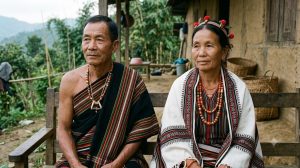
Weaving on the traditional backstrap loin loom (Puan-tak) is the birthright and artistic hallmark of Vaiphei women. Textile patterns are not merely decorative fabrics; they are visual declarations of clan prestige, social standing, and ethnic identity.
-
Puandum: A celebrated, deeply symbolic cloth woven with alternating black, red, yellow, and green bands. It is an indispensable cultural textile presented during weddings, solemn diplomatic gatherings, and funerals as a mark of supreme honor.
-
Thangsuo Puan: Historically the most prestigious fabric in the entire Zo-Kuki-Chin-Vaiphei world. Only an accomplished warrior who had conquered enemies in battle, or a generous benefactor who had hosted the great communal “Feast of Merit,” earned the customary right to drape this legendary textile. Its bold geometrical stripes communicate heroism, social responsibility, and ancestral validation.
-
Kavak Puan: Everyday yet intricately bordered wraps worn with effortless grace during village councils and domestic chores.
Bamboo, Wood, and Cane Architecture
The material landscape of an ancestral Vaiphei village was built almost entirely from bamboo (Gua) and hardwood timber.
Traditional houses (In) were raised slightly on wooden stilts along mountain contours. Split-bamboo walling (Pha) allowed cross-ventilation during sweltering monsoon months, while thick thatched roofs woven from wild imperata grass (Di) insulated families against winter mountain chill. Conical grain baskets, sleeping mats, winnowing trays, storage bins, and drinking mugs were fashioned with exquisite cane joinery, leaving virtually zero non-biodegradable waste.
The Spiritual Transition: From Indigeneity to Christianity
No historical account of the modern Vaiphei can be complete without examining the watershed religious transition that took place over the twentieth century.
Pre-Christian Animism (Pu-pa Biakna)
Before the dawn of the twentieth century, the Vaiphei practiced an indigenous animistic faith. They believed in a supreme celestial creator, often referred to as Chung Pathian—a benevolent deity dwelling above the sky who was the source of life, fertility, and justice.
However, everyday existence required navigating a world inhabited by nature spirits (Dawi / Thilha) that occupied deep gorges, giant trees, craggy cliffs, and freshwater springs. Sickness, crop failure, and sudden misfortunes were attributed to spiritual disruptions or malevolent spirits.
The village shaman or priest (Thiampu) was the central mediator. He diagnosed illnesses through divination, conducted restorative rituals, and performed animal sacrifices (fowls, pigs, or mithuns) to pacify offended spirits and restore cosmic equilibrium.
The Advent of Christianity and Socio-Cultural Metamorphosis
Between 1910 and the 1950s, Welsh Presbyterian missionaries, American Baptist evangelists, and indigenous native evangelists penetrated the southern hills of Manipur. The message of the Christian gospel found fertile ground among the Vaiphei for several socio-historical reasons:
-
Liberation from Spirit Pacification: Christianity eliminated the exhausting, expensive economic burden of constant livestock sacrifices demanded by the old rituals.
-
Introduction of Modern Literacy: The missionaries established schools, introduced the Roman script, and printed books, turning educational empowerment into a pathway toward social mobility.
-
Modern Healthcare: Western medicine and sanitation principles drastically curtailed cholera, malaria, and dysentery outbreaks, undermining reliance on spirit divination.
Today, virtually the entire Vaiphei population adheres to Christianity, divided among denominations such as the Presbyterian Church of India, the Evangelical Synod Church (ESC), the Baptist Church, and other local fellowships.
Christianity did not obliterate Vaiphei identity; rather, it was indigenized. Ancestral songs gave way to choral gospel hymns sung in four-part harmony in the native tongue, customary charity transformed into Christian diaconal work, and the church council absorbed many of the collaborative community functions formerly anchored by the village youth dormitory.
Festivals, Music, and Communal Joy
The traditional calendar was punctuated by joyous celebrations tied to the agricultural cycle and social milestones.
Thazing Lap: The Autumn Feast of Cleansing and Memory
Among the traditional festivals, Thazing Lap (celebrated during the autumn transition, roughly around September or October) holds pride of place. As crops mature and the monsoon rains abate, the entire village paused to clean public paths, repair community infrastructure, and honor the memory of ancestors.
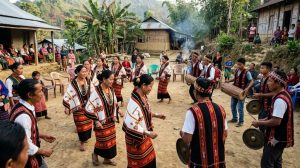
It was a period of communal feasting, where families shared meat, brewed rice beverages (Zu—in the pre-Christian era), recited ancestral ballads, and sought blessings for a bountiful harvest. In modern times, cultural revival groups and civil society bodies celebrate Thazing Lap as an annual cultural festival, replacing ancient rituals with traditional dance performances, ethnic fashion showcases, sports competitions, and prayer services.
Musical Instruments and Folk Dances
The traditional acoustics of the Vaiphei hills were defined by resonant percussion and natural wind instruments:
-
Khuong (The Drum): Hollowed out of seasoned hardwood trunks and stretched with dry cowhide or deer skin. The heartbeat of every community gathering.
-
Dah (Brass Gongs): Heavy metal gongs of varying diameters, played in rhythmic polyphony during solemn occasions, victory feasts, and funeral rites.
-
Pheiphit (Bamboo Flutes & Pipes): Used by herders and suitors to play haunting, lyrical mountain melodies.
Post-Independence Integration and the Search for Autonomy
Following India’s independence in 1947 and the merger of Manipur with the Indian Union in 1949, the political ecosystem of the frontier hills changed irrevocably.
Constitutional Recognition as a Scheduled Tribe
Under the Constitution (Scheduled Tribes) Order of 1950 (amended in 1956), the Vaiphei were officially scheduled, ensuring constitutional protections, affirmative action in higher education, reserved positions in government employment, and specialized developmental funding.
       [ 1949 - 1956 ]
  Merger with Indian Union & Formal
  Scheduled Tribe Status (ST Order, 1956)
             |
             v
       [ 1970s - 1990s ]
  Emergence of Vaiphei Peoples' Council (VPC)
  & Apex Student Bodies (Zillai)
             |
             v
       [ 21st Century ]
  Demands for Greater Local Autonomy,
  Infrastructural Upgrades, & Identity Preservation
The Vaiphei Peoples’ Council (VPC) and Civil Apex Bodies
To represent their democratic aspirations and interface with the Union Government and the Manipur State Government, the community established apex civic bodies:
-
Vaiphei Peoples’ Council (VPC): The supreme socio-political representative council, coordinating clan affairs, preserving customary boundaries, and addressing legislative representations.
-
Zillai (Vaiphei Students’ Association): Founded in 1939, Zillai is one of the oldest and most organized indigenous student organizations in the region. It plays an active role in educational promotion, literature development, youth welfare, career counseling, and human rights advocacy.
-
Vaiphei Nam Nu Nuplei (Women’s Council): Mobilizing women for community development, anti-substance-abuse campaigns, and indigenous cultural transmission.
Human Development Realities: Achievements and Structural Deficits
The human development trajectory of the Vaiphei displays a striking duality: impressive educational dynamism contrasted against acute rural underdevelopment.
+------------------------------------+---------------------------------------+
| Key Strengths / Achievements       | Persistent Structural Challenges      |
+------------------------------------+---------------------------------------+
| High literacy rate (>80%)          | Inadequate healthcare infrastructure  |
| Progressive female literacy        | Severe agrarian market disconnection  |
| Strong community solidarity networks| Youth unemployment & brain drain      |
| Vibrant linguistic & print culture | Instability from regional conflicts   |
+------------------------------------+---------------------------------------+
1. Education: The Pride of the Hills
Through early mission schooling, community patronage, and deep cultural valuation of academic pursuit, the Vaiphei boast a literacy rate exceeding 80%, far outpacing the national average for Scheduled Tribes in many rural pockets.
Female literacy has climbed steadily, with Vaiphei women holding university degrees, entering civil services, leading academic research, and serving in national healthcare facilities. Thousands of Vaiphei youth study in Tier-1 educational centers across India, including New Delhi, Bengaluru, Shillong, Kolkata, and Guwahati.
2. The Healthcare Deficit in Remote Villages
While urban centers like Churachandpur have primary medical centers and private clinics, rural Vaiphei settlements face severe healthcare precarity:
-
Geographical Isolation: In remote villages across Pherzawl and interior hill pockets, primary healthcare centers (PHCs) frequently lack doctors, lifesaving drugs, and reliable electricity.
-
Emergency Transit Failures: Due to unpaved, monsoon-ravaged dirt roads, transporting pregnant women or critically ill elders to district hospitals often requires carrying patients on woven bamboo stretchers across steep mountain tracks for hours.
-
Maternal and Infant Health: While community awareness has diminished maternal mortality rates, institutional delivery access remains constrained in remote highland enclaves.
3. Agrarian Vulnerability and Economic Bottlenecks
The traditional hill economy is trapped at an ecological crossroads:
-
Declining Jhum Sustainability: Population growth and restricted forest reserves have compressed the jhum cycle from 15 years down to 3–5 years, resulting in soil exhaustion, diminished crop yields, and hillside erosion.
-
Lack of Horticultural Value Chains: Hill farmers cultivate high-value organic produce—such as king chili, ginger, turmeric, and pineapples—yet face devastating economic losses due to the total absence of rural cold-storage units, agro-processing facilities, and direct market linkage. Middlemen often capture the profit, leaving cultivators impoverished.
-
Financial Exclusion: Despite national banking inclusion drives, formal credit penetration remains minuscule in remote villages, forcing farmers to rely on informal borrowing networks during crop failures.
The Complex Struggles of Modernity: Land, Identity, and Geopolitics
The contemporary existence of the Vaiphei community is profoundly shaped by complex historical forces, administrative ambiguities, and regional conflicts in Northeast India.
1. The Traditional Land Tenure Paradox
One of the most consequential issues confronting the Vaiphei and allied tribal groups is the clash between indigenous customary land tenure and modern land administration models:
-
In the hill areas of Manipur, land has historically been governed through customary tribal laws anchored by the Village Chief (Haosa) and village bodies, outside the purview of the standard land revenue systems applied in the plains.
-
Attempts by state administrations to introduce centralized land surveys, digitize land records, and designate expansive forest reserves have frequently sparked intense friction. Tribal communities perceive these measures as an existential threat to ancestral land rights and an erosion of protections guaranteed under Article 371C of the Indian Constitution.
-
Conversely, the traditional chieftainship model faces internal reform debates: younger generations and reformist intellectuals occasionally advocate for democratized village governance, arguing that absolute custodial land ownership by chiefs can sometimes hinder individual home titles, collateralized agricultural bank loans, and municipal planning.
2. Identity Maintenance Within the Zo-Kuki Spectrum
The ethnic taxonomy of Northeast India is notoriously intricate. The Vaiphei maintain a multifaceted, layered identity:
-
They are an independent, officially recognized Scheduled Tribe with their own language (Vaiphei Pau), literature, and customary institutions.
-
Simultaneously, they share deep genealogical, linguistic, and historical kinship with the broader Zo / Kuki / Chin / Zomi family.
-
Navigating these broader confederations has historically generated nuanced political deliberations. The community continually strives to preserve its distinct cultural autonomy while building solidarity with allied neighboring groups to advocate collectively for regional development, political empowerment, and constitutional security.
3. Living in Conflict Zones: Displacement, Trauma, and Resilience
The hills of Manipur have repeatedly experienced waves of ethnic tension, regional insurgencies, and inter-community strife over the decades.
Whether during the devastating inter-ethnic clashes of the 1990s or subsequent regional upheavals, smaller communities like the Vaiphei frequently endure disproportionate hardships:
-
Internal Displacement: Villagers have faced the loss of ancestral homes, arson, and displacement to relief camps, disrupting entire generations of schoolchildren and university students.
-
Economic Blockades and Hyperinflation: Frequent roadblocks and regional turmoil paralyze trade, causing fuel and food shortages in hill settlements.
-
Psychological Toll: Decades of navigating militarized spaces, civil unrest, and socio-political polarization have left deep intergenerational psychological scars among the youth, prompting an exodus of skilled workers and graduates toward metro cities across mainland India.
A Living Blueprint: Pathways for Sustainable Development and Cultural Preservation
If the story of the Vaiphei is to remain a living testament to indigenous human resilience rather than an elegy of struggle, targeted structural interventions are imperative.
1. Decentralized Infrastructure and Healthcare Lifelines
2. Organic Agro-Processing and Green Value Chains
Shifting cultivation must be gently, voluntarily complemented by sustainable agro-forestry, terrace farming, and cash crops (such as high-grade organic coffee, avocados, ginger, and turmeric).
-
Establishing Community-Owned Cooperatives backed by micro-cold-storage units in hubs like Kangwai and Tuibong would allow farmers to package, brand, and ship GI-tagged products directly to metropolitan centers.
-
This approach turns organic farming from a subsistence gamble into a reliable regional enterprise.
3. Institutional Protection of Weaving and Digital Handloom Platforms
The exquisite handloom artistry of Vaiphei women deserves international visibility:
-
Establishing handloom development clusters equipped with modern yarn banks and design-finishing centers.
-
Leveraging e-commerce platforms to link rural weavers directly to fair-trade ethical textile markets worldwide, protecting patterns like the Puandum and Thangsuo Puan from intellectual property piracy and commercial mass-production counterfeits.
4. Digital Archiving of Oral Literature and Epics
Because modernization and urban migration inevitably dilute village oral traditions, urgent academic and community initiatives are required to record, transcribe, and digitally archive the remaining corpus of ancestral chants (Pu-pa La), clan genealogies, and medicinal plant lore held by village elders before this living library vanishes.
Chronology: Key Historical Milestones of the Vaiphei Tribe
Pre-Colonial Era
├── Mythical emergence from "Khul" (Primordial Cave)
├── Early migrations across the Chin Hills, Kabaw Valley, and southern hills of Manipur
└── Establishment of decentralized village republics governed by the "Haosa" and "Upas"

Early to Mid-20th Century
├── 1900s–1930s: Arrival of Christian missionaries; adoption of the Roman script for Vaiphei Pau
├── 1939: Founding of Zillai (Vaiphei Students' Association) to champion education
├── 1947–1949: Integration of Manipur into the Indian Union
└── 1956: Formal constitutional recognition as a Scheduled Tribe under the amended Presidential Order

Late 20th Century to Present
├── Proliferation of indigenous literature, biblical translations, and civic organizations (VPC)
├── Navigating socio-political friction, administrative boundary debates, and economic shifts
└── Rise of educated diaspora; active advocacy for constitutional protections and cultural survival
The Vaiphei Spirit in the Twenty-First Century
The journey of the Vaiphei people—from the ancient, sacred shadows of the subterranean Khul to the halls of modern universities and democratic assemblies—embodies the sheer resilience of India’s indigenous civilizations.
They are a people who have survived colonial disruptions, ideological overhauls, geographical fractures, and socio-political storms, not by retreating into bitter isolation, but by anchoring themselves to their enduring core values: unshakeable kinship solidarity, reverence for memory, quiet courage in the face of scarcity, and an innate capacity to weave beauty from the raw fibers of their mountains.
As modern India strides forward into its developmental future, its true civilizational greatness will be judged by its capacity to listen to, protect, and empower its highland guardians. The Vaiphei do not seek paternalistic charity; they demand structural equality, infrastructural justice, and the constitutional space to preserve their ancestral roots while sharing their unique gifts with the nation and the wider world.
