
Introduction: Stories Through the Rhythm in African Music
Stories Through the Rhythm in African Music. Across the African continent, rhythm is far more than an accompaniment to song or a pulse for dancing feet. It is a living archive, a linguistic bridge, a mnemonic vault, and an acoustic telecommunications network forged over millennia. Where Western musicological traditions have historically separated melody, harmony, and rhythm into distinct tiers—often treating percussion as secondary colour—indigenous African musical systems treat rhythmic architecture as the primary carrier of narrative, genealogy, law, ethics, and collective memory.
Thank you for reading this post, don't forget to subscribe!When a master drummer strikes a taut membrane or a jali (griot) plucks a kora along the Niger River basin, listeners are not merely hearing beats; they are decoding layered stories. Those stories travel through tonal contours, metric ratios, call-and-response interlocks, and syncopated silences that hold entire histories in motion. Drawing on ethnomusicological monographs, acoustic phonetics research, cognitive neuroscience studies, and oral history scholarship, this article explores how rhythm encodes meaning across African societies—and why its deepest mechanics remain astonishingly rich and underappreciated.
1. Rhythm as Linguistic Architecture: Speech Surrogacy and Tonal Grammar
A vast proportion of sub-Saharan languages—including Yorùbá, Igbo, Ewe, Akan, Lingala, and many Bantu and Mande tongues are tonal languages, meaning pitch height and pitch contour distinguish lexical meaning and grammatical function. In Yorùbá, for example, speakers rely on three primary linguistic pitch registers—commonly analysed as low, mid, and high—alongside gliding contours and downstep/upstep interactions across syllables.
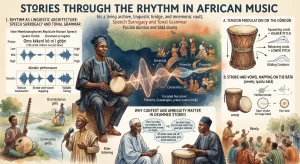
How Membranophones Replicate Human Speech: Stories Through the Rhythm in African Music
A. Tension modulation on the dùndún:
Tucked under the player’s arm, the dùndún features two drumheads linked by taut leather tension cords running along a carved wooden hourglass body. Squeezing or releasing the cords under the arm alters membrane tension in real time, shifting fundamental frequency and producing smooth pitch glides that mirror the rise and fall of spoken syllables.
B. Stroke-and-vowel mapping on the bàtá:
C. Syllabic timing and micro-intonation: Stories Through the Rhythm in African Music
Studies comparing spoken phrases with drummed surrogates demonstrate that rhythmic spacing and relative pitch shifts follow linguistic rules—including contextual adjustments where a high tone preceding a low tone behaves differently than one preceding a mid tone.
Why Context and Ambiguity Matter in Drummed Stories
Because multiple words in a tonal language can share identical tone patterns and syllable counts, speech surrogacy is not an automatic dictionary lookup. It relies on idiomatic formulas, proverbs, and shared cultural context. A drummed phrase often states a compressed proverb or praise line (oríkì) whose full narrative meaning is completed by the listener’s cultural competence. When a drummer plays a lineage formula at a naming ceremony or royal gathering, the rhythm and pitch contour act like a compressed hyperlink to an entire ancestral story.
2. Oral History, Genealogy, and Mnemonic Engineering
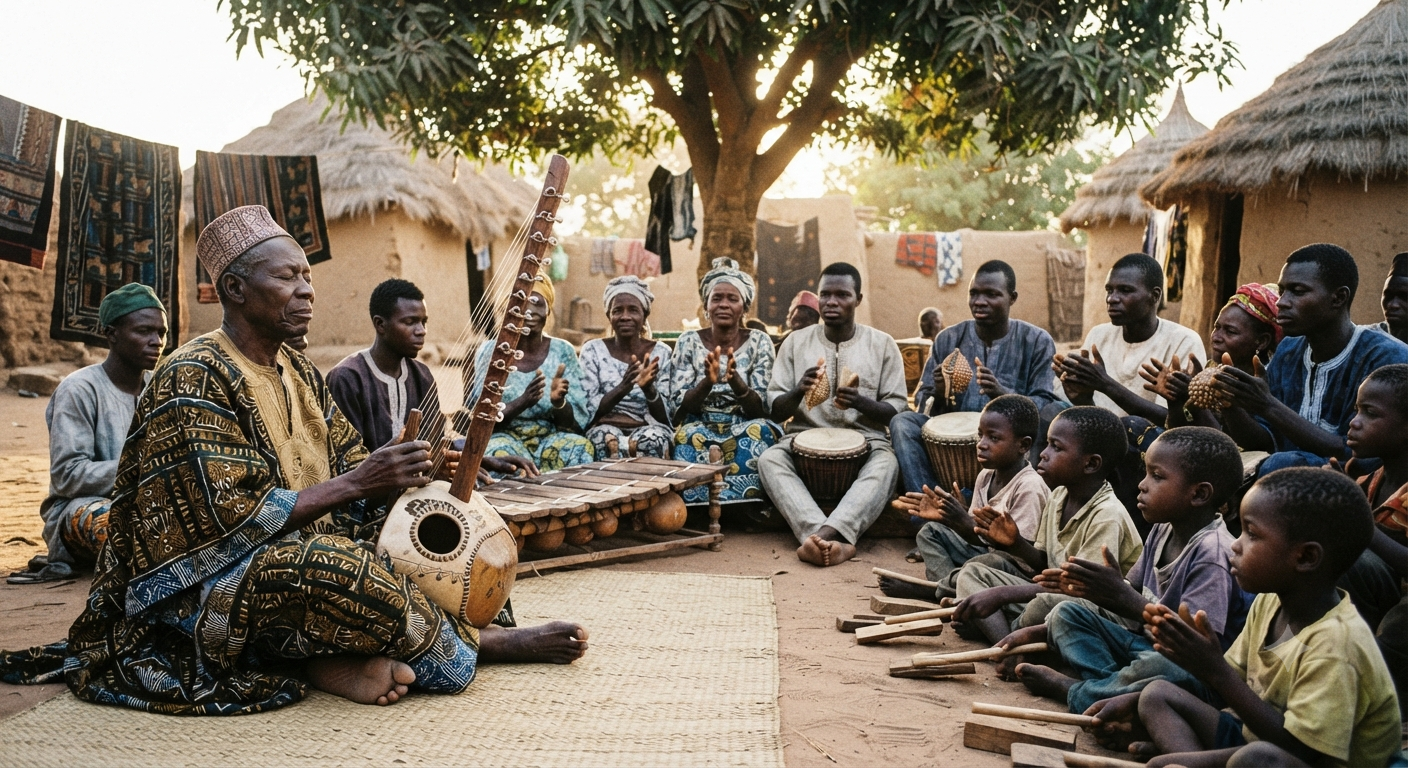
Before widespread alphabetic literacy across much of sub-Saharan Africa, societies built sophisticated oral-aural memory systems to preserve dynasties, land treaties, migrations, moral codes, and clan histories. Rhythm was essential to that engineering. In West Africa’s Mande cultural sphere—spanning Mali, Guinea, Senegal, The Gambia, and neighbouring regions—hereditary bards known as griots (or jalolu/jeliba) serve as historians, genealogists, diplomats, and social commentators.
Their narratives are rarely recited as flat prose; they are woven into interlocking ostinatos played on the 21-string kora, the balafon (wooden xylophone with gourd resonators), or the ngoni lute, paired with vocal declamation and rhythmic propulsion.
Rhythm as a Cognitive Anchor for Long Narratives
Ethnomusicological studies of oral traditions highlight how rhythmic recurrence and formulaic motifs function as mnemonic scaffolds:
1. Metric stability anchors historical sequences: Repeating rhythmic cycles give both performer and listener a steady temporal grid. When a jali recounts centuries of lineage or the founding of an empire, the underlying rhythmic groove prevents temporal drift and cues transitions between historical episodes.
2. Shift in groove signals shift in narrative register: Changing rhythmic density, tempo feel, or ostinato pattern often signals a move from historical chronicle to proverb, moral warning, or praise.
3. Communal participation reinforces memory: In traditions such as Ewe drumming in Ghana, Shona mbira performance in Zimbabwe, or Xhosa and Zulu vocal traditions in Southern Africa, rhythmic participation turns passive listening into active communal rehearsal, embedding cultural values across generations.
3. Polyrhythm, Cross-Rhythm, and Timeline Figures:
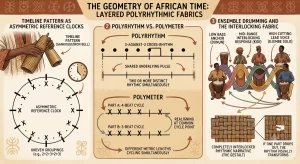
Timeline Patterns as Asymmetric Reference Clocks
A timeline—frequently played on an iron bell (such as the Ewe gankogui or West African double bell), a struck idiophone, or a steady percussion ostinato—acts as an asymmetric reference pattern around which other rhythmic parts orient themselves.
Rather than placing heavy stress uniformly on Beat 1, timeline patterns often use uneven groupings (such as additive groupings of 2 and 3 subdivisions within a cycle) that create forward propulsion and clear rotational anchor points. Skilled musicians can hear the timeline’s structural pivot even when no single instrument is playing a heavy “downbeat.
Polyrhythm vs. Polymeter:
A. Polyrhythm occurs when two or more distinct rhythmic ratios are heard simultaneously against a shared underlying pulse or cycle—such as a 3-against-2 or 4-against-3 cross-rhythm.
B. Polymeter occurs when different parts cycle through different metric lengths simultaneously before realigning at a common cycle point.
In ensemble drumming, no single drum holds the entire story alone. Each part contributes a complementary rhythmic contour—a low bass anchor, a mid-range interlocking response, a high cutting or lead voice—so the complete narrative emerges only when the parts interlock. If one player drops out or shifts phase, the gestalt of the rhythm visibly transforms.
4. Quantitative & Empirical Insights: What Research and Data Reveal
While lived musical practice is the primary authority in African music, acoustic phonetics, cognitive neuroscience, and comparative musicology have increasingly examined the measurable mechanics of rhythm and speech surrogacy:
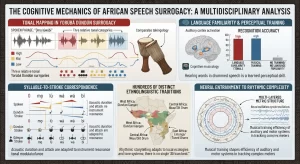
- Three-register tonal mapping in Yorùbá surrogacy:
Acoustic analyses of Yorùbá dùndún speech surrogacy show that drummers consistently organise pitch production around three relative tonal categories (low, mid, and high) while adjusting fundamental frequency contours dynamically across syllables and phrases rather than treating each tone as a rigid, isolated note.
- Syllable-to-stroke correspondence: Phonetic and acoustic studies of talking drums indicate strong alignment between spoken syllable counts, tonal glides, and drummed strokes/modulations—though drummers adapt acoustic duration and attack to the physical resonance and sustain of each instrument (for example, a longer-sustaining dùndún versus a shorter-decay gángan).
- Language familiarity and musical training: Experimental perception research investigating Yorùbá speech surrogacy demonstrates that recognition accuracy of drummed linguistic messages depends on both language familiarity (understanding the tonal language and idiomatic repertoire) and musical/perceptual training—confirming that “hearing the words” in drummed speech is a learned perceptual skill rather than pure guesswork.
- Neural entrainment and rhythmic complexity: Cognitive neuroscience studies examining neural entrainment to polyrhythmic patterns show that listeners’ brain oscillations synchronise with periodicities in complex rhythms, with musical training and exposure shaping how efficiently the auditory and motor systems track multi-layered metric structures.
- Hundreds of living ethnolinguistic traditions: Across Africa’s roughly 2,000+ living languages and hundreds of distinct ethnocultural groups, rhythmic storytelling adapts to local ecologies, instruments, and linguistic tone systems—meaning there is no single “African beat,” but hundreds of distinct rhythmic grammars.
5. Rhythm as Social Governance, Protest, and Resistance
Rhythm in African music has never been confined to entertainment. Across precolonial kingdoms, community councils, rites of passage, agricultural work parties, and anti-colonial struggles, rhythm has functioned as public communication and collective mobilization.
Ceremony, Labor, and Social Order
- Work songs and communal labor: Synchronized rhythmic singing and percussion coordinate repetitive physical tasks—clearing land, pounding grain, rowing, or harvesting—reducing perceived effort while building solidarity.
- Rites of passage and civic life: Specific rhythmic cycles belong to specific life stages, guilds, masquerades, or seasonal calendars. Playing the wrong rhythm at the wrong moment or place can be a social breach or a deliberate act of satire.
Coded Resistance and Historical Memory.
Because rhythm can carry layered meaning—and because drums were often misunderstood by outsiders—rhythmic performance became a potent vehicle for satire, coded critique, and historical witness. Praise songs could subtly warn a ruler against tyranny by invoking cautionary ancestors; proverbs embedded in percussion could critique colonial authorities in plain sight; and rhythmic traditions carried across the Atlantic became foundational pillars of African diasporic genres—from jazz, blues, and funk to salsa, rumba, reggae, and hip-hop—while preserving historical memory of resilience.
6. Modern Transformations
From Studio Production to Global Pop
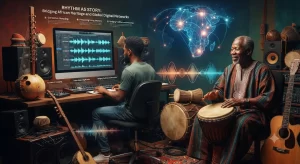
Today, the stories encoded in African rhythms are traveling across global digital networks at unprecedented speed. Contemporary genres—including Afrobeats, Amapiano, Highlife, Soukous, Mbalax, Kuduro, and Afro-house—reimagine traditional rhythmic cells, timeline syncopations, and percussive call-and-response inside modern digital audio workstations.
Yet modern production also raises urgent questions for ethnomusicologists, archivists, and artists:
- Context vs. sampling: When a rhythmic ostinato or tonal motif is extracted as a loop or sample, its original narrative, ceremonial context, or linguistic proverb can easily be stripped away unless creators actively credit and contextualize its roots.
- Preserving living masters: Many deep speech-surrogacy vocabularies, archaic praise lineages, and specialized ensemble repertoires live in the memory of aging master drummers and jali elders. Documenting these traditions ethically—with community consent and fair attribution—is critical before oral chains break.
- Bridging tradition and innovation: Many contemporary African musicians deliberately weave ancestral proverbs, tonal phrasing, and indigenous percussion back into global arrangements, proving that rhythmic storytelling is not a museum relic but an evolving language.
Conclusion: Listening for the Story Inside the Pulse
To listen to African music through its rhythm is to discover a universe where time is sculpted rather than merely counted. Every cross-rhythm, every pitch glide on a tension drum, every interlocking bell pattern, and every pause between strokes carries human experience—joy, grief, ancestry, humor, warning, and hope.
The next time you hear an African percussion ensemble, a kora cascade, or a modern rhythm-driven track, listen past the surface groove. Beneath the pulse lies a grammar of sound—one that has spoken histories across valleys, forests, and oceans long before ink touched paper.
