
Thank you for reading this post, don't forget to subscribe!
THE ROLE OF ELDERS IN AFRICAN TRIBAL COMMUNITIES – SOME TRADITIONAL INDIGENOUS WISDOM

NATURE : THE ROLE OF ELDERS IN AFRICAN TRIBAL COMMUNITIES
In African indigenous communities, nature is not an external backdrop or a warehouse of raw commodities. Elders teach younger generations that rivers, forests, soil, wildlife, and seasonal winds belong to a shared living web where human survival depends on restraint and reciprocity.
When a grandmother or grandfather walks a child past a sacred grove or a drying riverbed, the lesson goes far beyond physical geography. It carries an ethical code: take only what is needed, leave roots and seed bearers intact, and honor places where spirits, ancestors, and living creatures converge.
Across sub-Saharan Africa, approximately 60% to 70% of rural households depend directly on natural ecosystems for food, fuelwood, wild forage, water, and building materials.
‘nsitu’ in Malawi, or ‘abosompow’ in Ghana—have survived for centuries because elders maintain the taboos, ritual boundaries, and collective accountability that keep loggers and poachers out. In Ghana alone, more than 2,000 sacred groves have been documented, ranging from tiny family shrines under a single ancient tree to forests spanning hundreds of hectares that harbour rare primates, birds, and medicinal flora.
Elders read nature through close, continuous observation across decades rather than brief snapshots. An elder who has watched rainy seasons shift over fifty years notices subtle shifts in bird migrations, termite mound activity, flowering times of wild trees, and water levels in springs.
In semi-arid pastoral zones—from the Maasai steppes of East Africa to the Sahelian belts of West Africa—elders guide herd movement by interpreting cloud formations, wind direction, grass regrowth, and predator tracks.
“The land does not belong to us alone; we hold it in trust for those who walk here after our footsteps have faded.”
Wildlife relationships also reflect deep ecological balance shaped by elder guidance. Where predators such as lions, leopards, or elephants clash with livestock and crops, elders often act as cultural mediators between human livelihood and wild species.
Rather than calling for blanket eradication, traditional governance systems frequently distinguish between habitual problem animals and normal wildlife movement, using regulated hunting rituals, buffer zones, or compensated losses within clan networks to keep conflict from spiralling.
At the same time, nature in African indigenous thought carries a spiritual dimension that keeps human arrogance in check. When a community views a waterfall, mountain peak, or baobab tree as a site of ancestral memory or spiritual presence, careless pollution feels like disrespect to one’s own lineage.
Younger people who grow up hearing elders explain why a stream must stay clean for downstream neighbours and unborn grandchildren learn environmental stewardship as a family duty rather than an abstract chore. Even when modern economic pressures test those norms, the core insight remains clear: healthy land supports healthy people, and harming the land eventually harms the household.
| Ecological Domain | Role of Elders in Indigenous Practice | Typical Community & Ecological Impact |
| Sacred Groves & Forests | Define ritual boundaries, enforce taboos, and oversee customary tree protection. | Preserves old-growth pockets, native biodiversity, watershed protection, and carbon storage |
| Water & Wetlands | Monitor springs, regulate riverbank clearing, and mediate seasonal water sharing | Reduces siltation, protects dry-season drinking water, and prevents upstream-downstream disputes |
| Rangelands & Wildlife | Track weather signs, manage rotational grazing, and guide conflict resolution. | Prevents overgrazing, supports soil recovery, and encourages coexistence with wildlife |
| Seasonal Forecasting | Interpret bio-indicators such as plant phenology, insects, and wind shifts. | Helps families time planting, livestock movement, and food storage ahead of weather swings. |
MEDICINAL PLANTS – THE ROLE OF ELDERS IN AFRICAN TRIBAL COMMUNITIES
Walk into a rural village clinic or a bustling urban market in Lagos, Nairobi, Kumasi, or Kampala, and you will quickly see how central herbal knowledge remains to everyday healthcare. Across Africa, roughly 70% to 80% of the population relies on traditional medicine—much of it rooted in medicinal plants—either as a primary source of care or alongside biomedical clinics.
Africa hosts an extraordinary botanical wealth, with between 40,000 and 45,000 plant species across the continent, of which an estimated 5,000 or more are used medicinally in various local traditions.
Unlike quick-fix commercial pills pulled off a shelf, elder-led herbal practice is deeply contextual. An experienced herbal elder asks about the patient’s diet, sleep, stress, recent travel, duration of symptoms, and family history before choosing a remedy. Two people with similar headaches or stomach pain might receive different combinations of leaves, infusions, decoctions, or poultices depending on age, physical strength, and underlying conditions.
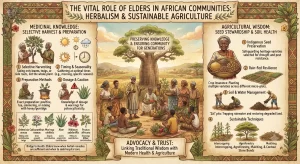
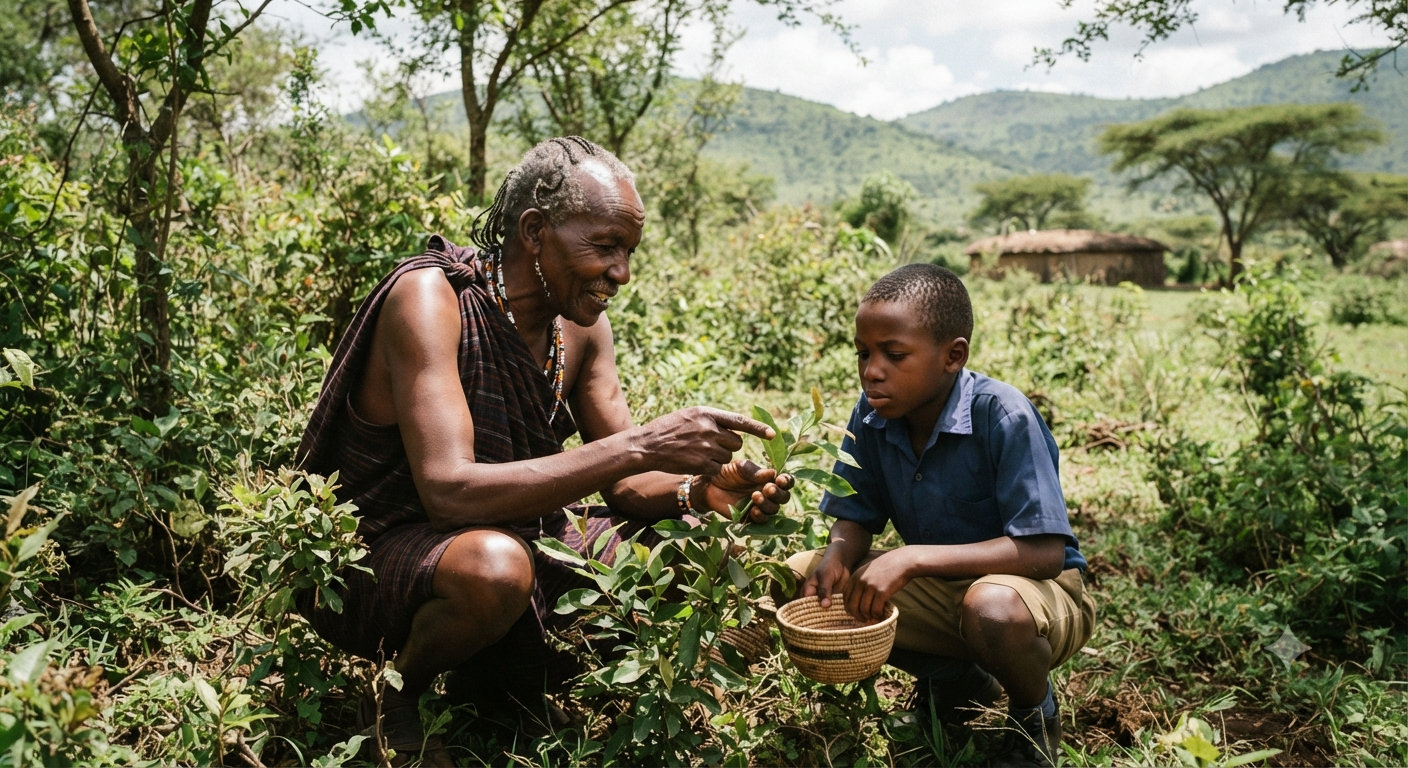
Equally important is how elders teach safe harvesting and preparation. A novice might strip all the bark off a single tree and kill it, or harvest leaves right after heavy rain when active compounds are diluted, or boil delicate aromatic herbs until volatile oils evaporate. Elders train apprentices in sustainable harvesting rules:
-
Selective part harvesting: Taking a few mature leaves, twigs, or side roots rather than uprooting an entire plant or girdling a main trunk.
-
Timing and seasonality: Gathering specific plants during dry or rainy windows, morning hours, or particular growth stages when potency is highest.
-
Exact preparation methods: Knowing whether to crush fresh leaves for a poultice, steep dried herbs in warm water, simmer roots slowly, or pair an ingredient with porridge or honey to ease harsh taste and improve tolerance.
-
Dosage and caution: A clear warning about bitter or potent plants that can irritate the stomach, affect blood pressure, or pose risks during pregnancy if taken in excess.
Well-known African botanicals illustrate how deeply this knowledge is woven into daily life and global pharmacology. Artemisia annua and related species have long drawn scientific interest in malaria research, while Catharanthus roseus (Madagascar periwinkle) yielded alkaloids that transformed modern chemotherapy for certain leukaemias and lymphomas.
Other plants—such as Moringa oleifera for nutritional support, Aloe species for skin care and digestive comfort, Hibiscus sabdariffa for cooling drinks and wellness traditions, and Prunus africana (African cherry) for traditional prostate care—show the breadth of remedies familiar to elders across different regions.
In many communities, elders also recognise the boundary between what herbal remedies can handle and when hospital care is urgent. A seasoned elder may treat mild seasonal colds, minor cuts, or mild indigestion at home while urging immediate clinic transfer for high fever in infants, severe dehydration, obstructed labour, trauma, or persistent chest pain.
When trust exists between elders and local health workers, families seek help earlier and avoid dangerous delays. Conversely, when elders are dismissed outright without dialogue, families sometimes hide herbal use from doctors and nurses, creating avoidable drug-herb interactions or misunderstandings.
AGRICULTURE: THE ROLE OF ELDERS IN AFRICAN TRIBAL COMMUNITIES
In African farming communities, agriculture is not merely a set of mechanical tasks like ploughing, sowing, weeding, and harvesting. It is a disciplined rhythm shaped by memory, soil intuition, seed stewardship, and community solidarity.
Elders stand at the centre of this rhythm because smallholder farming—which produces up to 70% to 80% of food in much of sub-Saharan Africa—depends heavily on rain-fed conditions, variable microclimates, and resilient crop varieties.
One of the greatest contributions elders make to agriculture is indigenous seed preservation. Long before commercial hybrid seeds became widespread, elders carefully selected seeds from the healthiest, most drought-tolerant, pest-resistant, or fast-maturing plants at harvest time.
Women elders in particular often safeguard diverse seed baskets containing heritage varieties of sorghum, millet, cowpeas, groundnuts, yams, cassava cultivars, and leafy vegetables. Keeping multiple varieties planted across different micro-plots acts as built-in crop insurance: if an early dry spell hits sandy upland soil, drought-hardy millet or cowpeas may still yield while moisture-hungry crops struggle.
Elders also pass down time-tested soil and water management practices that build resilience without heavy machinery or costly inputs. Across the Sahel and West Africa, techniques such as zaï planting pits—digging small basins enriched with compost or manure to trap scarce rainwater and attract termites that aerate soil—have helped farmers restore degraded crusted land and boost yields.
Intercropping (growing maize or sorghum alongside legumes like beans or groundnuts), agroforestry (leaving nitrogen-fixing trees such as Faidherbia albida standing in fields), mulching with crop residue, and contour stone bunds on slopes all reflect practical agricultural wisdom refined over generations.
“A good farmer does not fight the soil; a good farmer listens to what the earth is asking for this season.”
Seasonal calendars guided by elders help families plan labor and food security across the entire year. By watching early rains, flowering trees, or shifting winds, elders advise when to clear brush, when to prepare seedbeds, and how much grain to store securely in granaries rather than selling all at once right after harvest when prices dip lowest.
They also remind households to reserve seed stock before consuming the harvest and to plant quick-maturing crops or kitchen gardens to bridge the “hunger gap” before the next main harvest arrives.
Beyond technical farming methods, elders keep collective agricultural labor alive. In many tribal communities, major tasks like clearing land, planting, or harvesting involve rotating work groups where neighbors help one another and share a meal afterward.
Elders organize these rhythms, settle land boundary disagreements peacefully before planting begins, and remind young people that working the land is honorable foundational work—not something to look down upon. Where young people have drifted toward cities only to face scarce jobs and high living costs, elders who show how profitable and dignified smart farming can be help bridge the generational divide.
| Indigenous Farming Practice | How It Works in Practice | Key Benefits for Households & Land |
| Heritage Seed Selection & Saving | Choosing resilient plants at harvest and storing diverse seeds for next season | Protects local crop diversity, lowers seed costs, and improves climate resilience |
| Intercropping & Crop Rotation | Pairing cereals with legumes or rotating plots across seasons | Enhances soil fertility naturally, reduces pest buildup, and diversifies family nutrition |
| Water Harvesting & Soil Pits | Using zaï pits, stone lines, or contour ridges to catch runoff | Captures scarce rainfall, curbs erosion, and rehabilitates degraded dryland plots |
| Agroforestry & Mulching | Keeping shade/nitrogen trees in fields and covering soil with organic matter | Moderates soil heat, retains moisture, and provides fodder, fruit, or fuelwood |
ORAL TRADITIONS
Before paper archives, printed textbooks, or digital cloud storage existed in most African villages, the human voice was the primary library. Oral traditions—encompassing proverbs, folktales, genealogies, praise songs, riddles, epic narratives, and courtroom oratory—carry history, law, psychology, and moral philosophy across generations. Elders are the living custodians of this spoken archive, turning ordinary evenings or community gatherings into memorable lessons that stick in the mind far longer than dry lectures.
In African oral culture, proverbs work like compressed wisdom capsules. A single crisp saying can calm an argument, warn against impulsiveness, or nudge a stubborn relative toward humility without sounding harsh or preachy.
Consider the well-known East African proverb, “Haba na haba hujaza kibaba” (“Little by little fills the measure”), or West African sayings reminding people that a single tree does not make a forest or that haste ruins soup. Because elders weave proverbs naturally into everyday conversation, children absorb nuanced social judgment simply by paying attention to how elders speak during real-life situations.
Storytelling itself is an interactive art rather than a one-way broadcast. Around an evening fire or courtyard, an elder might use animal fables—featuring clever hares, cautious tortoises, boastful hyenas, or wise elders—to explore themes of greed, fairness, courage, betrayal, and cooperation. Children listen closely, ask questions, sing refrains, and debate what a character should have done differently. Through this back-and-forth, young listeners practice empathy, moral reasoning, and active listening while learning the cadences, metaphors, and vocabulary of their mother tongue.
Genealogies and historical narratives serve another vital purpose: anchoring identity and kinship. In many societies, specialist storytellers, bards, or lineage elders recite family histories, clan migrations, alliances, and past crises. Knowing who your ancestors were, where your family came from, and how past generations overcame famine, conflict, or displacement gives young people a sense of belonging and continuity. In communities where formal written records of local history are scarce, elders’ memories often hold the clearest account of land treaties, clan relationships, and shared victories.
Oral traditions also shape leadership and conflict resolution. Skilled elders are respected speakers not because they shout the loudest, but because they listen patiently, speak thoughtfully, use measured metaphors, and help people save face when resolving disputes. Watching an elder calm two angry families using calm words and shared history teaches younger men and women that strong leadership relies on restraint, fairness, and emotional maturity rather than brute force.
SOCIAL VALUES
One of the clearest roles of elders is peacebuilding and dispute resolution. Disagreements over land boundaries, bridewealth, livestock damage, inheritance, or family tensions can easily harden into long-running feuds if left unchecked. Elders provide a respected, accessible forum where grievances can be aired openly before resentment festers. Rather than focusing solely on punishing a winner and humiliating a loser, traditional elder councils typically aim to restore social harmony, clarify responsibility, arrange fair restitution, and rebuild working relationships between families.
Elders also model and enforce norms of respect, hospitality, and care for the vulnerable. In many communities, welcoming a traveler, sharing food when someone visits, checking on an elderly neighbor living alone, or rallying around a family hit by illness or bereavement is treated as basic human decency. Elders remind younger generations that wealth and status mean little if a person turns a cold shoulder to relatives or neighbors in trouble. When children see elders treat both rich and poor community members with dignity, social cohesion stays stronger.
Mentorship and rites of passage are another major avenue for instilling social values. As young people transition into adulthood, responsibility, marriage, or leadership roles, elders often guide them through structured counsel—sometimes formal initiation or coming-of-age teachings, and sometimes ongoing one-on-one mentorship. These teachings emphasize self-control, reliability, honesty, respect for parents and elders, and willingness to contribute labor or wisdom to the common good.
At the same time, healthy social values grow when elders stay open to fair dialogue rather than clinging rigidly to harmful customs. Across Africa today, many thoughtful elders actively speak out against practices that harm children or families—such as child marriage, excessive funeral or wedding expenses that push poor families into debt, or unfair exclusion—while lifting up timeless values like solidarity, humility, accountability, and care for the community. When elders pair moral authority with fairness and openness, they earn genuine respect across generations.
| Core Social Value | How Elders Model & Reinforce It | Everyday Effect on Community Life |
| Restorative Conflict Resolution | Host mediation circles, hear all sides, and guide fair restitution | Defuses disputes early, lowers legal costs, and repairs family ties |
| Mutual Aid & Solidarity | Encourage collective labor, food sharing, and support in crises | Creates a social safety net when households face illness or hardship |
| Intergenerational Respect | Teaches attentive listening, polite address, and care for older adults | Builds strong family bonds and keeps younger people connected to roots |
| Civic Accountability | Call out selfish behavior, greed, or neglect of family duties | Encourages honesty, reliability, and stewardship of shared resources |
WOMEN
Any honest look at African tribal wisdom must highlight the vital, multifaceted leadership of women—and especially older women, often called queen mothers, grandmothers, senior matrons, or women elders. In far too many popular accounts, “elders” is pictured almost exclusively as a group of older men sitting under a shade tree. In reality, senior women hold immense authority, practical knowledge, and moral influence across family life, agriculture, healing, trade, spirituality, and community governance.
In many African societies, older women are the primary teachers of children during their earliest and most formative years. Grandmothers often pass on lullabies, moral stories, household skills, manners, and early health habits while parents are busy farming or trading. Because grandmothers typically have more time and emotional space than busy young parents, the bond between grandmothers and grandchildren frequently becomes a safe haven where children feel heard, comforted, and guided without fear.
Economically, women form the backbone of household food security and local trade across much of Africa, accounting for roughly 60% to 80% of the agricultural labor force in many areas and dominating local food markets. Senior women elders bring decades of sharp commercial and agricultural know-how:
-
Food processing and storage: Knowing how to dry, ferment, mill, smoke, or store grains, tubers, fish, and vegetables so food lasts through lean months without spoilage.
-
Market savvy and credit groups: Organizing informal savings and credit associations (tontines, chamas, susu, or rotating savings groups) that help women buy seeds, pay school fees, or start small businesses.
-
Maternal and child care: Guiding young mothers on nutrition, breastfeeding, infant care, and recovery after childbirth with practical experience.
-
Conflict mediation within families: Stepping in quietly to settle domestic tensions, support vulnerable wives or widows, and protect children’s welfare.
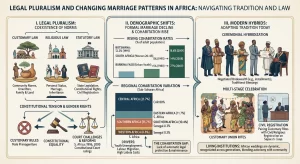
In several traditional governance systems, senior women hold formal institutional seats alongside male elders. Among the Akan of Ghana, for example, the Ohemaa (queen mother) works alongside the chief in appointing leaders, settling disputes, advocating for women and youth, and guarding cultural traditions. In other communities, women’s councils or senior matriarchs hold veto power or moral authority over matters affecting land, markets, peace, and family harmony. When women’s voices are included at the table, decisions tend to reflect practical household realities—such as water access, school safety, food prices, and health—that might otherwise be overlooked.
Older women also play a crucial role in keeping indigenous languages and cultural memory alive. Because mothers and grandmothers often spend hours speaking with children at home and in the fields, they are frequently the strongest everyday transmitters of native vocabulary, songs, prayers, and cultural etiquette. Supporting senior women elders—and ensuring their wisdom is recognized rather than sidelined—is essential for keeping families and communities resilient.
INTEGRATION WITH MODERN SCIENCE
Indigenous wisdom and modern science are sometimes framed as rivals locked in a zero-sum contest, yet in practice they often complement each other remarkably well. Modern science excels at controlled testing, chemical analysis, climate modeling, and large-scale data collection, while indigenous elder knowledge offers long-term place-based observation, holistic context, and cultural legitimacy on the ground. Bringing the two together—respectfully and ethically—can produce solutions that neither approach could achieve alone.
In healthcare and pharmaceutical research, ethnopharmacology has long used traditional herbal knowledge as a starting point for investigation. When researchers listen to elders who have used a particular plant for generations to treat infections, inflammation, or metabolic issues, scientists can screen extracts in laboratories, identify active compounds, test safety and toxicity, and understand how preparation methods affect potency. At the same time, scientific research can help standardize dosages and verify whether a traditional remedy is safe or potentially harmful, protecting consumers while honoring the communities that preserved the knowledge.
“Modern science explains how something works under a microscope; indigenous wisdom often shows where, when, and why it matters in real life.”
Climate adaptation and agriculture offer another rich area for integration. Meteorologists can provide seasonal rainfall outlooks and temperature projections, while elders bring detailed knowledge of local microclimates, soil behavior, flood paths, and crop traits. When agricultural extension workers, climate scientists, and village elders sit down together before a planting season, farmers get clearer, more locally relevant guidance—combining improved seed options or weather alerts with proven practices like intercropping, mulching, and water harvesting.
Conservation and natural resource management also benefit when scientific surveys partner with elder stewardship. Ecologists mapping biodiversity or forest cover sometimes discover that the healthiest pockets of native flora and fauna sit inside areas protected for generations by elders’ customary rules. Collaborative mapping, community-led monitoring, and joint management agreements allow conservationists to share ecological data and technical tools while elders lead local enforcement and cultural stewardship.
For true integration to succeed, however, mutual respect and fair benefit-sharing are non-negotiable. Historically, outsiders sometimes extracted plant knowledge, cultural stories, or biological resources from indigenous communities without credit, consent, or fair return. Ethical collaboration requires prior informed consent, transparent partnership, co-authorship or credit where appropriate, and tangible benefits—such as better local healthcare, agricultural training, or revenue sharing—flowing back to the communities whose elders kept that wisdom alive.
| Sector | What Indigenous Elders Bring | What Modern Science Brings | Value of Working Together |
| Medicine & Health | Long-term observation, holistic patient context, herbal traditions | Chemical analysis, clinical safety testing, diagnostics, acute care | Safer, validated remedies and stronger trust between clinics and families |
| Agriculture & Climate | Local weather cues, heritage seeds, soil & water conservation skills | Climate models, agronomy research, pest/disease tracking, soil testing | More reliable harvests and practical climate adaptation for smallholders |
| Ecology & Conservation | Sacred grove protection, multi-decade wildlife & habitat memory | Satellite/GIS mapping, population counts, ecosystem modeling | Stronger habitat protection and community ownership of conservation |
| Education & Heritage | Living stories, proverbs, native language fluency, moral mentorship | Documentation tools, curriculum design, archiving technology | Richer learning for youth and lasting preservation of local heritage |
THE CHALLENGES OF PRESERVING KNOWLEDGE
Despite its richness and practical value, indigenous elder knowledge faces serious pressure across Africa today. Much of this wisdom is oral, experiential, and embedded in everyday life—meaning it does not automatically transfer unless older and younger generations actually spend time together in shared spaces and shared work. When the links between elders and youth fray, centuries of accumulated insight can disappear within just one or two generations.
Rapid urbanization and youth migration are among the biggest drivers of this gap. Millions of young Africans move from rural villages to growing towns and cities in search of schooling, wage jobs, or new opportunities. Living far from ancestral land, family farms, and elder relatives leaves young people with fewer chances to learn plant names, seasonal signs, traditional crafts, or community conflict resolution through daily immersion. Even when young people visit home on holidays, fast-paced schedules and digital screens often leave little time for unhurried conversation with grandparents.
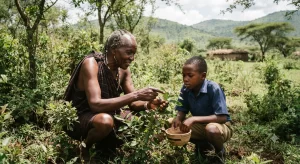
Formal schooling and shifting cultural attitudes also play a role. Many national school curricula have historically prioritized foreign languages, textbook memorization, and Western models of success while giving little room to local history, indigenous languages, or traditional ecological knowledge. As a result, some young people grow up viewing rural or traditional practices as “backward” or outdated, while some elders feel alienated by modern lifestyles and worry that their words no longer carry weight. Language loss compounds the problem: UNESCO has repeatedly warned that hundreds of African languages face endangerment or shift toward dominant regional or global languages, and when a language fades, specialized terms for plants, soils, rituals, and proverbs often fade with it.
Economic stress, environmental change, and health challenges add further strain. Extreme weather, droughts, floods, and land pressures sometimes push ecosystems past thresholds where old rules of thumb need updating, testing families’ patience and resources. Meanwhile, when elders pass away before sharing their deeper specialized knowledge—whether in herbalism, mediation, storytelling, or seed stewardship—irreplaceable expertise can vanish overnight.
| Challenge | How It Threatens Indigenous Knowledge | Practical Ways Communities Are Responding |
| Urbanization & Youth Migration | Separates young people from rural land, elders, and daily apprenticeship | Hosting seasonal youth camps, farm/forest walks, and intergenerational dialogues |
| Language Shift & Schooling Gaps | Erodes native terms for plants, ecology, and oral proverbs | Adding local language/culture modules in schools and recording elder voices |
| Lack of Documentation | Leaves specialized knowledge vulnerable when elders pass away | Audio/video recording, community seed/herbarium registers, and written books |
| Unfair Extraction or Neglect | Risks exploiting knowledge without credit or sidelining elders’ voice | Building ethical partnerships, youth-elder mentorships, and local leadership |
Preserving this knowledge does not mean freezing communities in the past or rejecting modern progress. Rather, it means building bridges so younger generations can carry forward what is wise, healthy, and life-giving while adapting thoughtfully to today’s world. Recording elders’ stories and plant knowledge with their permission, encouraging young people to ask questions and listen closely, teaching native languages at home and in school, and giving elders a welcoming voice in modern community projects all help keep that living flame burning bright. When a community honors its elders and listens with an open heart, hard-won wisdom becomes a steady guide for tomorrow rather than a memory left behind.
