
Introduction: Traditional African Weddings
A traditional African wedding is rarely just a romance between two people. Across more than three thousand ethnic groups and over fifty nations, marriage functions as a constitutional treaty between lineages, an economic balancing mechanism, a spiritual alignment with ancestors, and a long-term social safety net. Popular travel articles often flatten these ceremonies into a few bright clichés—kente cloth, drumbeats, or a single cash payment. Ethnographic books, legal scholarship, and demographic surveys tell a far more intricate story.
The Architecture of Kinship Beyond the Couple
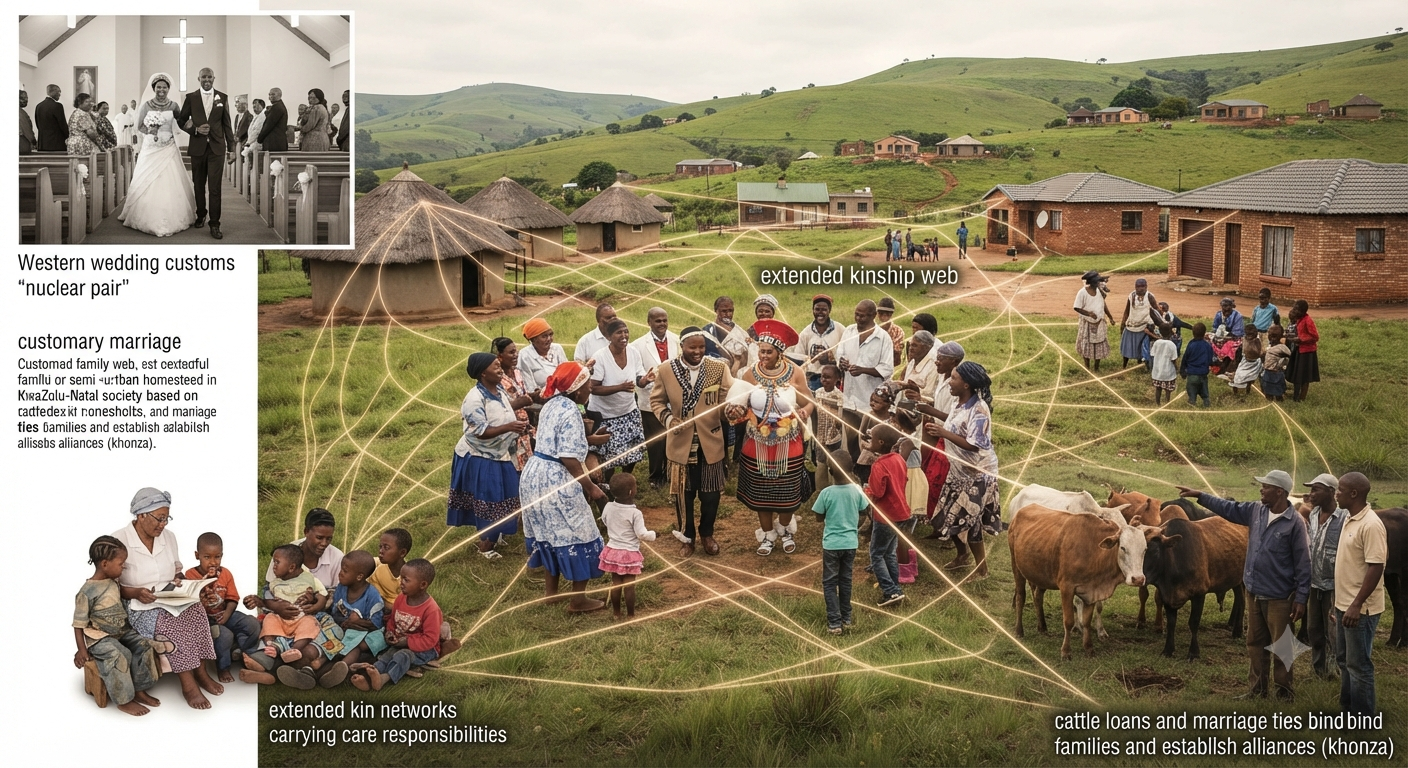
Western wedding customs usually centre on the nuclear pair leaving their parents to build a separate household. In much of sub-Saharan Africa, customary marriage historically operates inside an extended kinship web where rights, obligations, and children are distributed across wider family lines.
Anthropological studies of southern Africa show how homesteads and alliances were woven together through marriage exchanges. Among groups such as the Zulu, political clientage (called khonza) could link a patron and a client through cattle loans and marriage ties, turning private household agreements into wider political networks. Even where modern urban life encourages smaller households, demographic research highlights how deeply extended kin structures still shape family life. In South Africa, for example, research drawing on household survey microdata notes that by 2008 only 30% of African children shared a household with their fathers, compared with 70% of white children, while extended kin networks continued to carry major care responsibilities.
How Lineage Rules Shape Union and Descent: Traditional African Weddings
Different African societies organise descent, authority, and inheritance along distinct lines, which directly affects how a wedding is negotiated and what happens if tragedy strikes:
-
Patrilineal transfers and filiation: In many patrilineal systems, marriage transfers specific rights regarding the woman’s domestic and reproductive labour and establishes clear lineage membership for her children. In several Southern African traditions, children born within a recognised marriage belong to the paternal family, whereas children born outside marriage often remain with the maternal family.
-
Levirate and ghost unions: Ethnographic records document levirate marriage, where a brother of a deceased husband may marry his widowed sister-in-law—a custom recorded among groups such as the Luo, Nandi, Dinka, Nuer, Shona, and Igbo. Among Nilotic peoples like the Dinka and Nuer, researchers have also documented ghost marriage, in which a man’s brother stands in after the intended groom dies so that children raised in the union are socially recognised as belonging to the deceased man’s line.
-
Sororate and lineage continuity: Where a marriage faces childlessness or early death of a spouse, customary rules in some societies have allowed a sister or close relative to step in so that inter-family commitments and lineage continuity are preserved.
Bridewealth Economics: Risk, Cattle, and Modern Cash
One of the most misunderstood elements of African weddings is bridewealth—known in Zulu as lobola, in Shona as roora, and referred to across the continent by many local names. Rather than a simple commercial sale of a person, anthropological research on southern African pastoral-agricultural societies shows that cattle bridewealth once acted as an economic stabilising system.
In mixed farming and herding economies, households faced severe seasonal and ecological risks: drought, cattle disease, crop blight, raids, and confiscation. Cattle and grain operated as complementary stores of value. A bad year for herds might be cushioned by grain surpluses, while a poor harvest could be offset through livestock exchange. Historical ethnography also notes that bridewealth circuits were often tightly regulated, with rules restricting casual leakage of cattle out of the exchange system and requiring repayment or adjustment in cases of severe breach or childlessness.
What Empirical Studies Reveal About Bridewealth Today
Empirical demographic and public health studies challenge simplistic assumptions about how bridewealth operates in practice:
-
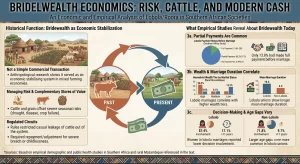
Partial payments are common: A study of bridewealth and sexual and reproductive practices in southern Africa found that among husbands who negotiated lobola before marriage (48.7%, or 203 of 417 in the sample), only 13.8% (28 of 203) had made full payment at that point, while 85.2% (173 of 203) had made partial payments and 0.49% (1 of 203) had made no payment yet. Reported tension from lobola negotiations within marriage was 6.4% (13 of 203).
-
Wealth and marriage duration correlate with lobola: Longitudinal research in rural Mozambique comparing lobolo and non-lobolo marriages found sharp differences across household wealth tiers: in the study baseline, 24.2% of women in lobolo marriages belonged to the high-wealth group compared with 8.6% of women in non-lobolo marriages, while only 8.6% of lobolo wives were in the low-wealth group versus 19.2% of non-lobolo wives. Mean marriage duration in that sample was 10.2 years for lobolo unions compared with 6.3 years for non-lobolo unions.
-
Decision-making and age gaps vary: In the same rural Mozambican study, 57.4% of women in lobolo marriages reported involvement in the marriage decision versus 71.8% in non-lobolo marriages, and spousal age gaps of 11 or more years occurred in 17.1% of lobolo unions compared with 9.7% of non-lobolo unions.
| Indicator in Study Sample | Lobolo Marriage | Non-Lobolo Marriage |
| Mean age at marriage (years) | 18.7 | 19.3 |
| Mean marriage duration (years) | 10.2 | 6.3 |
| Polygynous marriage (%) | 25.8% | 16.1% |
| High household wealth tier (%) | 24.2% | 8.6% |
| Woman involved in marriage decision (%) | 57.4% | 71.8% |
Ritual Mechanics: Ancestors, Taboos, and Public Witness
Traditional African wedding rituals are designed to make a private bond visible to the living community and legible to the spirit world. Many steps happen long before any festive gathering.
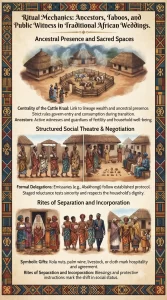
In southern African homestead traditions studied by anthropologists, space and ritual boundaries carried deep symbolic weight. Cattle kraals, or byres, sat at the centre of the homestead, linked to lineage wealth and ancestral presence, while strict rules governed who could enter enclosures or partake in certain foods and drinks during transition periods. Ancestors were often spoken of as active witnesses and guardians of fertility and household well-being; early ethnographies recorded prayers asking ancestors for plentiful harvests, multiplying herds, and childbearing.
Across West, East, and Southern Africa, ceremonies also rely on structured social theatre:
-
Formal delegations and staged reluctance: Rather than a casual drop-in, negotiations frequently start with formal emissaries—such as abakhongi in Zulu practice—who approach the bride’s family through established protocol where initial hesitation or testing of sincerity signals respect for the household’s dignity.
-
Symbolic gifts and food: Items such as kola nuts, palm wine, yams, livestock, or woven cloth act as physical markers of hospitality, peace, and agreement between two extended families.
-
Rites of separation and incorporation: A bride’s departure from her natal home and entry into her marital network often involves blessings, protective instructions, or symbolic thresholds marking her shift in social status.
Legal Pluralism: Customary Law, Courts, and State Statutes
One of the sharpest realities of weddings in Africa today is legal pluralism—the coexistence of customary law, religious personal law, and statutory civil law within the same country.
Legal scholars studying African family law point out that colonial administrations frequently codified or altered customary rules while placing traditional courts at the lower tiers of state justice systems. After independence, most African states retained a dualist or plural legal structure rather than erasing customary law altogether, because millions of citizens organise marriage, family obligations, land access, and inheritance through customary norms.
Constitutional Tension and Women’s Rights
Legal pluralism creates real friction when older customary rules—such as male-favoured inheritance or rigid patriarchal authority—collide with constitutional equality guarantees and international human rights standards. For example, constitutional developments in countries like South Africa (1996) and Kenya (2010) subject customary law to constitutional rights, and South Africa’s Constitutional Court struck down the automatic customary rule of male primogeniture where it conflicted with equality principles.
Demographic Shifts: Declining Formal Marriage and Rising Cohabitation
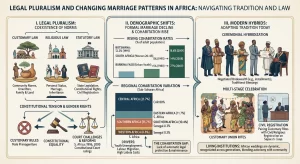
Anyone looking at wedding celebrations on social media might assume formal marriage is universal across Africa. Demographic research over the past three decades tells a surprising counter-story: in several parts of Southern and Central Africa, formal marriage rates have dropped sharply while cohabitation has risen.
Economists and demographers studying South Africa have documented a long-term decline in marriage rates since the mid-twentieth century, alongside high youth unemployment, labour migration, and the rising financial cost of establishing a household and meeting lobola expectations. Research on contemporary Zulu society notes that marriage rates among isiZulu speakers have been particularly low, with survey microdata showing that by 2008 only 3 in 10 Zulu adults were or had ever been married. Meanwhile, the share of African women aged 20 to 45 in South Africa reporting cohabitation rose from 5% in 1995 to 14% in 2008, and broader South African family policy data noted cohabiting couples growing from 1.2 million in 1996 to 2.4 million in 2001.
Regional Contrast Across Sub-Saharan Africa
Cohabitation patterns vary widely by region, urbanization, and religious context:
-
Regional averages: A multi-country analysis across sixteen sub-Saharan African nations reported cohabitation prevalence at 21.7% in Central Africa, 11.7% in Eastern Africa, 10.4% in Southern Africa, and 6.8% in Western Africa.
-
Botswana and urban youth: In Botswana, census data showed individuals aged 15 and older identifying as cohabiting rising from 12.2% in 1991 to 18.6% (reported around 17% to 18.6% across census analyses) by 2001, while cohabiting unions as a share of current unions climbed from 31% in 1991 to 46% in 2001. Studies in urban centers such as Ouagadougou and Bobo-Dioulasso in Burkina Faso also found cohabitation among young women aged 15–24 rising from less than 5% in 1980 to 27% in 2000.
Modern Hybrids: How Couples Adapt Tradition Today
A groom’s family might send a smaller delegation or settle part of a bridewealth agreement in installments while still honoring the formal sequence of visits and blessings. Couples frequently pair a customary family ceremony—complete with traditional textiles, speeches, and elders’ blessings—with a civil registration or religious service on a separate day. Far from disappearing, traditional African weddings remain living institutions: contested, renegotiated across generations, and continually reshaped by the people who practice them.
