
Thank you for reading this post, don't forget to subscribe!
Traditional African Weddings: Kinship Economics, Ancestral Covenants, and Living Rituals Across a Diverse Continent
Traditional African weddings rarely centre on a single day or a purely private romance between two individuals. Across thousands of ethnic communities from the Sahel to the Cape, marriage functions as a multi-stage social covenant that links lineages, redistributes labour and wealth, honours ancestors, and establishes legal and spiritual legitimacy for future generations.
Popular travel and lifestyle articles frequently flatten this vast reality into a handful of colourful snapshots—a flash of kente cloth, a pouring of libations, or a lively dance. Ethnographic monographs, historical records, and demographic studies reveal a far more intricate system shaped by ecology, kinship structure, legal pluralism, and evolving economic pressures.
Why African Marriage Is a Lineage Institution Rather Than a Private Contract
In many Western legal and cultural frameworks, marriage begins with individual consent and culminates in a nuclear household. Across much of traditional Africa, marriage operates primarily as an alliance between kin groups—clans, lineages, extended families, and sometimes political houses—rather than a standalone contract between two isolated people.
Anthropologists such as Claude Lévi-Strauss, Jack Goody, and Meyer Fortes analysed how marriage rules regulate alliances and obligations across descent groups. In societies organised around descent groups, a marriage changes how two networks of relatives relate to one another over decades. Elders, aunts, uncles, lineage spokespersons, and sometimes traditional rulers participate directly in introductions, character enquiries, negotiations, and blessings.
Key structural features distinguish lineage-based marriage systems across the continent:
- Collective accountability: Disputes within a marriage often involve elder relatives from both sides, who act as mediators and guarantors of mutual conduct.
- Ancestral witness: Many communities view marriage as unfolding under the watch of departed ancestors who safeguard fertility, prosperity, and moral order.
- Intergenerational continuity: Marriage establishes recognised parentage, inheritance lines, and social belonging for children within a broader kin network.
- Gradual consolidation: Rather than a single instantaneous switch from single to married status, traditional marriage often unfolds in stages—from initial enquiries and formal introductions to bridewealth agreements, ceremonial transfers, and childbirth or household establishment.
Bridewealth, Lobola, and the Economics of Reciprocity Traditional African Weddings
MDPI
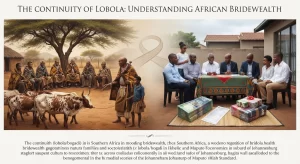
One of the most misunderstood institutions in African marriage is bridewealth—known in Southern Africa as ‘lobola’ or ‘bogadi’ and referred to by many other regional terms across the continent.
Outside observers sometimes mistake bridewealth for buying a bride as chattel. Anthropological scholarship and historical records point to a different logic: bridewealth acts as a circulating social and economic transfer that validates a union, recognises the shift of labour and lineage ties, and weaves enduring obligations between two families.
Cattle, Pastoralism, and Symbolic Value in Traditional African Weddings
In Southern and Eastern African pastoral and mixed-farming societies, cattle historically held supreme economic and ritual value. Ethnographic studies of Southern African homesteads describe cattle not merely as livestock but as storehouses of wealth, markers of status, and mediums of ritual communication with ancestors. Historical accounts from Tswana and Southern African communities note that transfers such as bogadi expressed gratitude and formal recognition between families rather than a commercial sale of a person.
Over time, cash, purchased goods, and negotiated schedules have frequently supplemented or replaced live cattle, especially in urban and wage-earning settings. Yet the symbolic weight of negotiation—carried out through appointed intermediaries and elders—often remains central even when payments are made in currency or installments.
What Longitudinal Data Reveals About Bridewealth Today
Empirical demographic research shows how bridewealth interacts with age, household wealth, union stability, and social change. A longitudinal study in rural Mozambique examining 1,552 women across multiple survey waves found that while the proportion of marriages involving lobolo declined over time, bridewealth marriages still displayed distinct structural patterns:
| Metric / Characteristic | Lobolo Marriage (Rural Mozambique Study) | Non-Lobolo Marriage (Rural Mozambique Study) |
| Average respondent age | 28.9 years | 25.7 years |
| High household wealth share | 24.2% | 8.6% |
| Average marriage duration | 10.2 years | 6.3 years |
| Polygynous marriage share | 25.8% | 16.1% |
| Personal involvement in marriage decisions | 57.4% | 71.8% |
In multivariable analyses controlling for other factors, women in bridewealth marriages in that rural Mozambican setting were less likely to divorce over a five-year window and less likely to work outside subsistence agriculture, while showing no statistically significant difference from non-bridewealth peers in measured autonomy scores or modern contraceptive use. Researchers interpret this shift as evidence that bridewealth is evolving from a rigid instrument of family control toward a marker of economic capability and social standing.
Patrilineal vs. Matrilineal Systems: Traditional African Weddings
Matrilineal Kinship and Residence in Traditional African Weddings
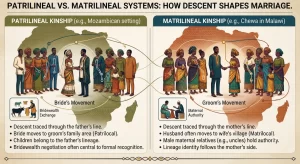
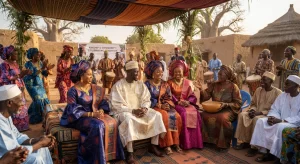
In matrilineal societies—such as the Chewa in Malawi and neighbouring areas, as well as several Central and West African groups—lineage identity, clan membership, and key rights over land or children follow the mother’s side of the family. Research on the Chewa in Malawi highlights matrilocality, where a husband often moves to his wife’s village or family area at marriage, and male matrilineal relatives (such as a woman’s brothers or maternal uncles) hold major guardianship and authority roles within the lineage.
This arrangement shifts everyday bargaining dynamics compared with patrilineal households, where a wife moves into her husband’s kin group. Even where colonial policies, mission teachings, or labour migration altered practices over the past century, matrilineal norms continue to shape property, caregiving, and family authority.
Patrilineal Kinship and Lineage Continuity
In patrilineal societies, children belong to the father’s lineage, and marriage frequently involves moving the bride into or near the groom’s family network alongside formal bridewealth negotiations. Because lineage continuity depends on recognised offspring, rituals around fertility, elder blessing, and formal recognition of the union carry intense cultural weight.
Polygyny, Kinship Alliances, and Demographic Trends in Traditional African Weddings
ResearchGate
Polygyny—one husband married to multiple wives—is frequently discussed in stereotypes as if it were universal across Africa. Demographic evidence shows a much more nuanced picture.
According to Pew Research Center analysis of global marriage data, sub-Saharan Africa has the highest regional prevalence of polygamy worldwide at roughly 11% overall, while remaining a minority marriage form across most countries and varying sharply by nation, religion, urbanization, and wealth. In comparative cross-national datasets cited in demographic literature, prevalence is higher in several West and Central African countries—such as Burkina Faso (36%), Mali (34%), Nigeria (28%), and Senegal (23%)—than in many other parts of the continent.
Why Polygyny Exists and Why It Changes
Anthropological and economic studies explain polygyny through multiple overlapping factors rather than a single cause:
Research Gate
- Wealth, status, and labour: In historical agrarian and pastoral economies, larger households could mobilise more agricultural or herding labour and signal greater wealth and social standing.
- Ecology and child mortality: Economic anthropology research, including work by James Fenske (2012), links variation in sub-Saharan African polygyny rates to child mortality and ecological or economic shocks.
- Co-wife dynamics and caregiving: Ethnographic research in Southern Africa, including M. Connie Anderson’s work on polygyny, notes that some women historically or contemporarily weigh practical factors—such as sharing domestic work, childcare support, companionship, or limited options among economically secure men—alongside emotional, religious, and legal tensions.
- Rising costs and shifting norms: Across many communities, schooling costs, housing expenses, religious teachings, and changing expectations around companionship have reduced polygyny over time, contributing to broader fertility shifts documented across African demographic surveys.
Rites of Passage, Material Symbols, and Hidden Meanings
Esposa Group
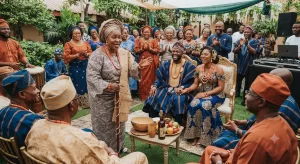
Traditional African wedding ceremonies are rich in performative detail. Every gesture, cloth pattern, and spoken exchange carries meaning for those who know the cultural code.
Oratory, Riddles, and Family Testing
In many traditions, wedding proceedings rely heavily on skilled speakers—spokespersons, elders, or traditional orators—who use proverbs, formal greetings, and playful tests to negotiate between families. Comparative ethnographic research on marriage rites notes staged moments such as presenting a decoy or mock bride before bringing forward the true bride, turning a serious family alliance into a lively communal drama.
Textiles, Beads, and Body Adornment
Cloth and adornment communicate identity, status, and solidarity without a single word spoken:
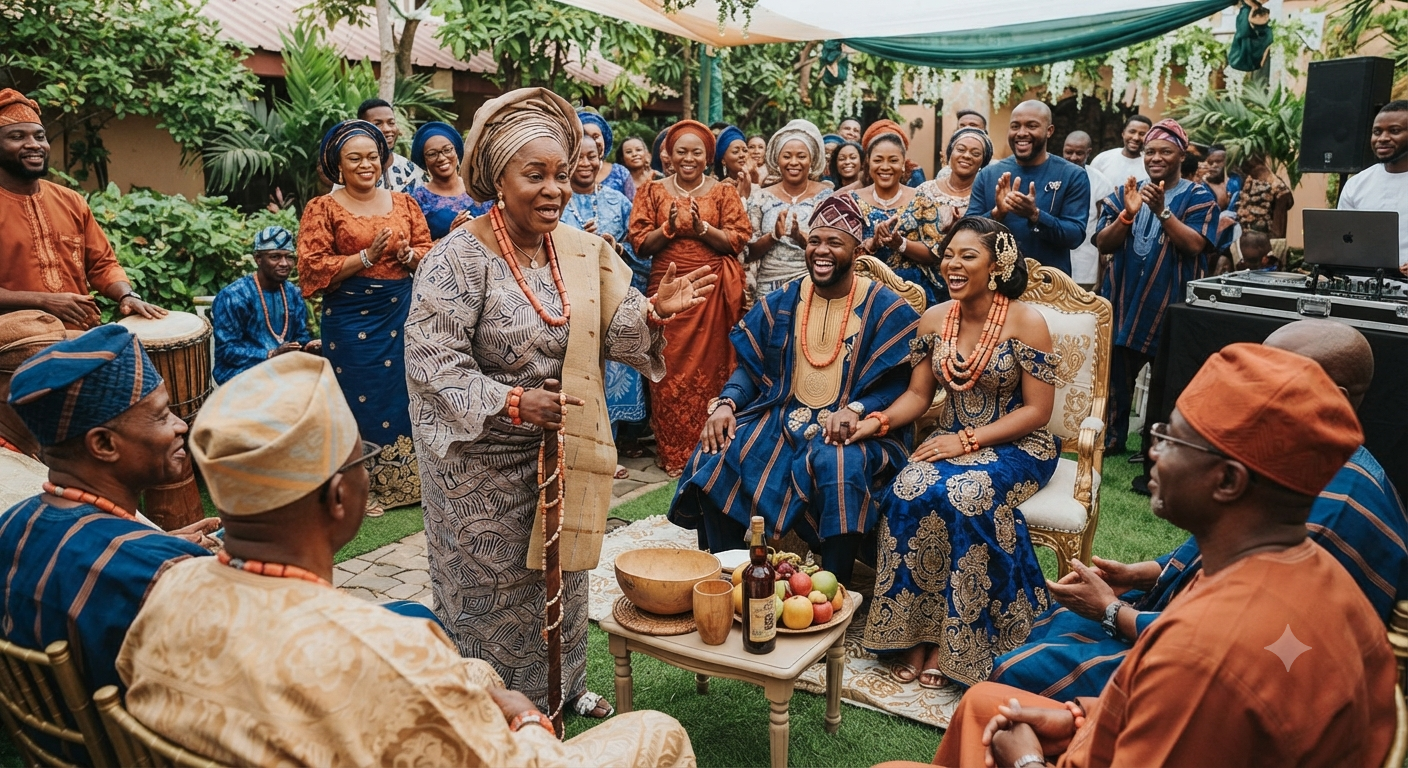
- Coordinated family cloth (Aso Ebi): In West African celebrations, matching or coordinated fabrics worn by relatives and guests visually display family unity and collective backing for the couple.
- Woven ceremonial cloth: Handwoven prestige textiles—such as kente in Akan and Ewe traditions—carry named patterns and colors tied to history, achievement, and moral ideals.
- Beadwork and ceremonial ornaments: In East and Southern African beadwork traditions, colors, arrangement, and layered collars or bracelets can signal age grade, marital status, clan affiliation, or festive occasion.
Libations, Blessings, and Ancestral Memory
Rituals invoking ancestors or elders—such as pouring libations of water, palm wine, or local brew, or offering blessings with milk, herbs, or ceremonial foods—anchor the living couple in a longer chain of memory. Pouring liquid onto the earth serves as an act of remembrance and gratitude, asking forebears to look favorably on the new household.
Legal Pluralism and Modern African Weddings
Today, a single African wedding often spans multiple legal and religious tracks. Across much of the continent, legal pluralism means customary law, statutory civil law, and religious law (such as Islamic or Christian marriage rites) operate side by side.
A couple might complete customary introductions and bridewealth negotiations with their families, hold a church or mosque ceremony, and register a civil marriage with the state. Because customary practices are often unwritten and locally varied, legal scholars frequently examine how statutory statutes, constitutional equality guarantees, and regional frameworks—such as the African Union’s Maputo Protocol—interact with customary marriage, inheritance, and spousal rights.
For modern couples, traditional ceremonies increasingly blend heritage with personal choice: keeping elder blessings, symbolic gifts, and vibrant cultural dress while negotiating modern roles, careers, and household finances on their own terms.
