

The Sukte (Tedim Chin-Zomi) Tribe: Culture, Identity, and the Human Struggle for Modern Survival
Across the emerald ridges, mist-covered ravines, and rugged highlands that straddle the international border between Northeast India and northwestern Myanmar lies the ancestral homeland of a historically misunderstood community: the Sukte (historically documented as Sokte or Sukte Paite/Tedim Chin).
Within India’s borderlands—primarily across the hills of Manipur, segments of Mizoram, and contiguous highland tracts—the Sukte people embody the multifaceted journey of indigenous hill tribes navigating transition. Their story is not an isolated narrative; it is an enduring human chronicle of cross-border kinship, rich oral traditions, autonomous village governance, and the relentless friction between traditional indigenous lifeways and modern state borders.
1. Who Are the Sukte? Lineage, Nomenclature, and Ancestral Origins
The Meaning Behind the Name: Lineage as Destiny
In the Tibeto-Burman linguistic universe of the Chin-Kuki-Zomi family, names are rarely arbitrary; they are historical markers. Oral genealogies passed down by village elders (Upas) trace the name Sukte directly to an ancestral patriarch, Mang Suak (or Suakzang), a pivotal figure in the northern Chin hills.
-
The term Sukte (etymologically linked to Suak-te) translates essentially as “the descendants of Suak” or “those of Suak’s lineage.”
-
The root word Suak in archaic dialects connotes birth, emergence, or fruitful generation, while the suffix -te serves as a plural or patronymic identifier denoting kinship, descent, and clan affiliation.
In colonial military dispatches and ethnographies—most notably Bertram S. Carey and H.N. Tuck’s 1896 work The Chin Hills—the community was frequently recorded phonetically as the Sokte. Colonial administrators encountered them as an uncompromising highland power that commanded strategic mountain passes and fiercely resisted territorial subjugation.
Genealogical Roots: The Cradle of Ciimnuai
Like their closely related kin—the Paite, Tedim, Guite, Thadou, and Vaiphei—the Sukte trace their cosmogony back to Ciimnuai (often written Chin Nwe), an ancient highland cradle located near Tedim in the present-day Chin State of Myanmar.
According to collective tribal memory:
-
The original ancestors did not emerge from distant continents but from the womb of the highland earth itself (symbolized in legend as emerging from a subterranean rock shelter or cave, known as Chhinlung or Khur).
-
From Ciimnuai, demographic expansion, localized shortages of swidden land, and inter-clan feuds caused successive outward migrations across the Manipur River valley and into the southern highlands of contemporary Manipur (especially the Churachandpur district) and adjacent regions of Mizoram.

The Linguistic Landscape: Tedim Chin Dialectology
Linguistically, the Sukte speak a northern variant of the Kuki-Chin language family, closely aligned with or identical to the Tedim dialect (Tedim pau / Sukte pau).
-
It is a tonal, monosyllabic-rooted language rich in poetic metaphor, parallelisms, and compound idioms.
-
Because the language relies on specific tonal inflections (rising, falling, and level tones), an identical syllable can mean an ancestral spirit, a crop harvest, or an act of defiance depending entirely on pitch.
-
In pre-colonial times, the language was entirely oral, preserving genealogies spanning twenty to thirty generations through rhythmic mnemonic chants (Pausa) recited during feasts of merit.
2. The Geography of Kinship: Living Across an Arbitrary Border
[ Northern Chin Hills / Ciimnuai ]│┌────────────────┴────────────────┐▼ ▼[ Manipur, India ] [ Chin State, Myanmar ](Churachandpur / Pherzawl) (Tedim / Tonzang)│ │└───────────[ The FMR ]───────────┘(Fragmented by modern geopolitics)
The Highland Ecosystem
The traditional homeland of the Sukte sits in a geopolitical shatter zone. Geographically, this region encompasses the southern hills of Manipur, the eastern fringes of Mizoram, and the mountain spine running through Tedim and Tonzang townships in Myanmar.
The terrain is characterized by:
-
Steep V-shaped river valleys carved by the Tuitha (Khuga) and Manipur rivers.
-
Dense subtropical evergreen and pine forests.
-
Ridge-top settlements engineered specifically for territorial defense, panoramic surveillance, and disease avoidance (staying above mosquito-infested valley bottoms).
The Impact of the 1947–1948 Partition and Border Drawing
For the Sukte, modern borders were drawn without their consent or consultation. When the British Empire withdrew from South Asia and Burma gained independence, colonial border commissions drew arbitrary boundary lines cutting straight through the mountain ridges of the Patkai and Chin hills.
-
Families on both sides: A single clan found its agricultural lands divided between two fledgling nation-states: India and the Union of Burma.
-
The Free Movement Regime (FMR): For decades, India and Myanmar maintained an informal understanding, later formalized as the Free Movement Regime (FMR), allowing indigenous hill tribes living within 16 kilometers of either side to cross the border without passports or visas.
-
To the Sukte, crossing this line was never an act of “international immigration”; it was simply visiting an uncle, attending a matrimonial feast, or tending an ancestral hillside field.

3. Traditional Social Structure, Chieftainship, and Customary Law
┌──────────────────────┐│ Hausa (Village ││ Chief) │└──────────┬───────────┘│┌──────────┴───────────┐│ Upas (Council of ││ Elder Advisors) │└──────────┬───────────┘│┌────────────────────────┼────────────────────────┐▼ ▼ ▼┌──────────────┐ ┌──────────────┐ ┌──────────────┐│ Siampu │ │ Tangko │ │ Villagers ││ (Priest) │ │ (Crier) │ │ (Clans/Folk) │└──────────────┘ └──────────────┘ └──────────────┘
The Chieftainship System (Hausa)
At the center of historic Sukte society was the institution of the Hausa (Chief). Unlike egalitarian hunter-gatherer societies, the northern Chin-Kuki tribes developed a hereditary aristocratic chieftainship.
The Hausa was the executive custodian of the village territory (Gam). However, an effective chief was never an absolute tyrant; his authority rested on his capacity to protect the village from raids, allocate fertile swidden plots fairly, and arbitrate complex disputes.
Key characteristics of the village hierarchy included:
-
The Hausa: The hereditary leader who held ceremonial ownership of village land.
-
The Upas (Council of Elders): Respected elder statesmen drawn from the principal clans who advised the chief and tempered autocratic impulses.
-
The Tangko (Town Crier): The designated herald who proclaimed the chief’s decrees and communal work schedules across the village terraces at sunrise.
-
The Siampu (Priest/Diviner): The spiritual mediator responsible for communal propitiations and diagnosing malevolent spiritual encounters.
Customary Tributes and Rights
Under historical Sukte customary law (Dan), villagers honored their chief through specific structural offerings:
-
Busun (Paddy Tribute): Each household contributed a basket of harvested grain from their swidden fields to support the chief’s household, which in turn functioned as a communal granary during famines.
-
Sa-chhiat / Sa-sa (Meat Tithe): Hunters who brought down game (such as barking deer, wild boar, or serow) were required by custom to present a specific cut of the animal—typically the shoulder or hindquarter—to the Hausa.
-
Communal Labor (Khuangchawi / Lawm): Villagers contributed labor to maintain village trails, reinforce protective stockades, and construct or repair the chief’s house.
The Clan Dynamic: Patrilineal Solidarity
Sukte society is strictly patrilineal. Lineage passes directly from father to son.
-
Clans are exogamous units, meaning one cannot marry within one’s immediate sub-clan, reinforcing social cohesion and military alliances with neighboring clans.
-
The eldest son (Upa) or in some customs the youngest son (Naupang) inherited specific responsibilities, but inheritance laws favored the protection of ancestral family heirlooms, including brass gongs (Dah), antique flintlock muskets, and ceremonial bead necklaces (Khi).
4. Indigenous Belief Systems: The World of Spirits and Nature
[ Pasian / Pathian ](Supreme, Benevolent High God)│┌────────────────────┴────────────────────┐▼ ▼[ Dawi / Kau ] [ Human Realm ](Spirits of Cliffs, Streams, (Protected by Rites,Forests, and Caves) Taboos, and Altars)
The Cosmos Before Monotheism: Pasian and the Spirits
Before the mass conversions to Christianity during the late 19th and mid-20th centuries, the Sukte lived in an animated cosmos. At the apex was Pasian (or Pathian), the supreme, benevolent creator deity who dwelled in the heavens and wished no harm upon humanity.
However, day-to-day spiritual anxieties centered on the Dawi or Kau—the capricious spirits that inhabited the natural world:
-
Mountain peaks, deep river eddies, towering banyan trees, and limestone fissures were each associated with specific territorial spirits.
-
Misfortune, prolonged fever, poor crop yields, and mental distress were viewed not as random biological incidents, but as spiritual imbalances caused by inadvertently trespassing into a spirit’s sanctuary.
The Siampu’s Role and Sacrificial Reconciliation
The village priest, the Siampu, functioned as an indigenous healer, psychologist, and ritualist:
-
By casting lots, inspecting the liver patterns of sacrificial chickens, or reading eggshell fractures, the Siampu diagnosed which specific spirit was offended.
-
To appease the spirit, blood sacrifices—ranging from white roosters to pigs and mithuns (Bos frontalis)—were performed at boundary stones, village gates, or domestic hearths.
-
Rites were reinforced by Genuis (customary taboos), where an entire household or village would declare a period of quarantine, halting all agricultural labor and barring outsiders from entering the settlement to prevent spiritual contamination.
The Cult of the Mithun (Sial)
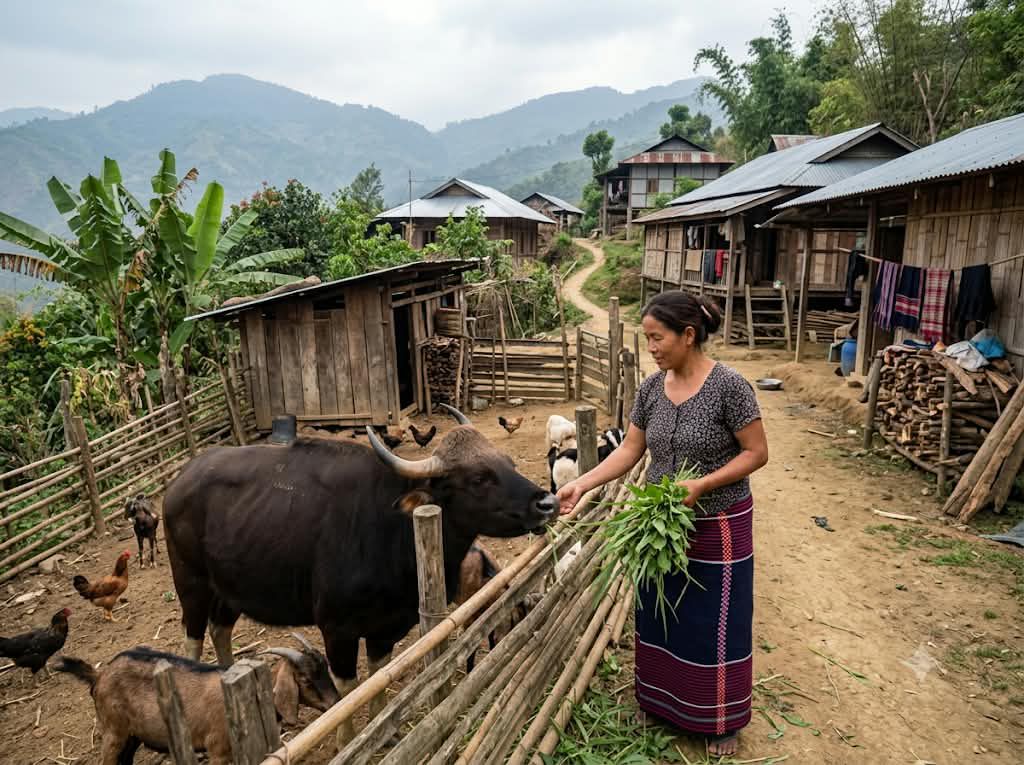
In Sukte culture, the Mithun (Sial) is not merely livestock; it is a sacred animal:
-
It was the ultimate standard of wealth, currency, and bridal exchange.
-
A man’s socio-religious standing in life—and his eventual entry into the ancestral afterlife (Mithi Khua)—was determined by the number of feasts of merit he hosted, each validated by the ceremonial sacrifice of mithuns.
5. Material Culture, Attire, and the Rhythms of Daily Life
The Art of the Back-Strap Loom
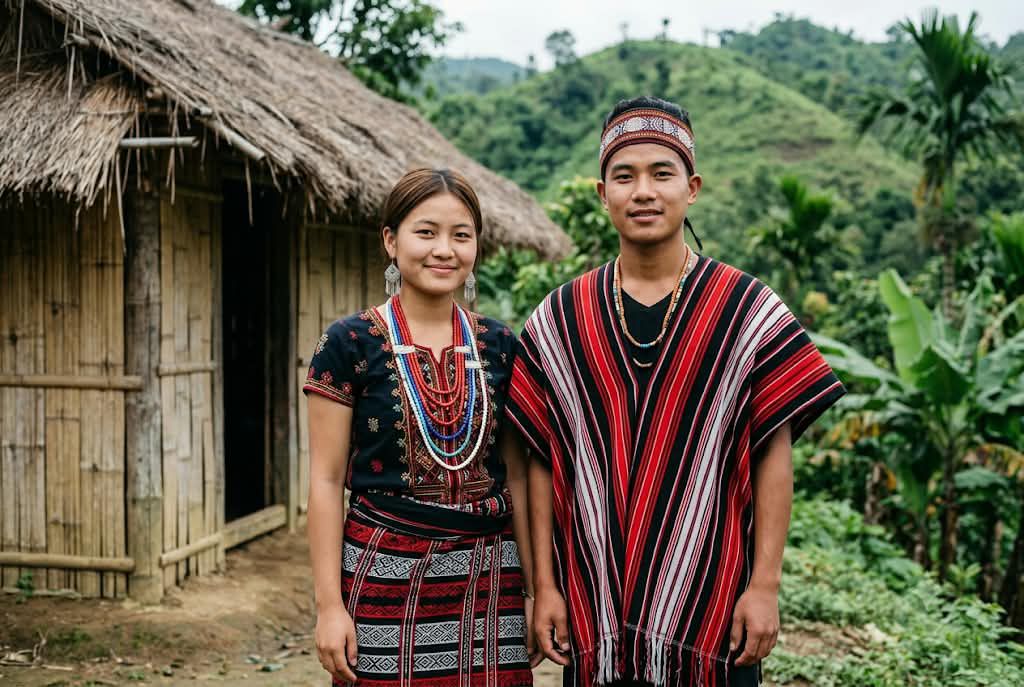
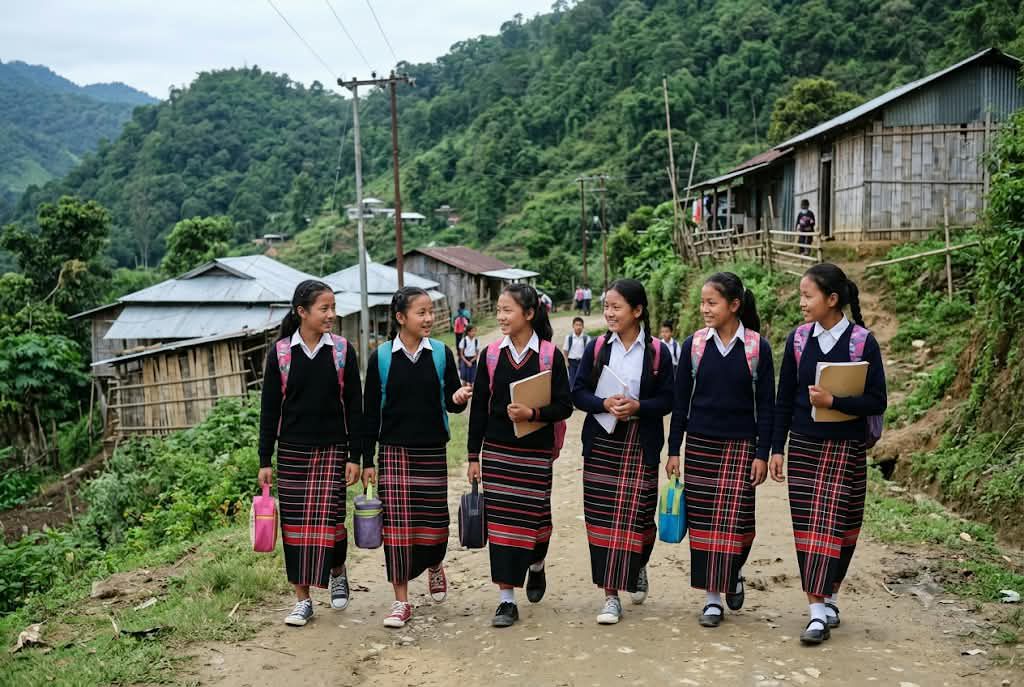
Textile production among the Sukte is a living heritage preserved by tribal women. Using traditional loin looms (back-strap looms), weavers produce heavy, tightly structured cotton textiles designed to withstand the biting chill of the winter hills.
[ Core Elements of Traditional Sukte Material Culture ]│┌──────────────────────────┼──────────────────────────┐▼ ▼ ▼[ Handwoven Textiles ] [ Brass Gongs & Beads ] [ Vernacular Shelters ]• Puandum (Mourning/Honor) • Dah (Acoustic Status) • Raised Timber Posts• Thangnang (Warrior Cloth)• Khi (Heirloom Necklaces) • Bamboo & Thatch Walls
-
Iconic Motifs: Sukte shawls utilize geometric symmetry, featuring broad stripes of deep black, rich madder red, indigo blue, and pale yellow.
-
The Puandum: A revered black-based cloth framed with red and yellow stripes, given as a token of respect or wrapped around a deceased elder as an honorable shroud.
-
The Thangnang: Historically reserved for distinguished warriors, hunters, or leaders who had hosted expansive communal feasts.
Traditional Weapons and Acoustic Heritage
-
The Dao (Chem): A heavy, broad-bladed cleaver carried in a wooden sheath. It serves as an all-purpose tool for clearing jungle paths, cutting bamboo, butchering meat, and defense.
-
Brass Gongs (Dah): Sourced through ancient trans-Himalayan trade routes, these heavy bronze and brass instruments were beaten during festivals, war mobilizations, and funerary passages. Their deep, resonant vibrations carry across mountain ridges, communicating messages across valleys.
-
Antique Beads (Khi): Amber, carnelian, and banded agate necklaces passed down across generations, serving as familial insurance policies and sacred heirlooms.
Vernacular Architecture
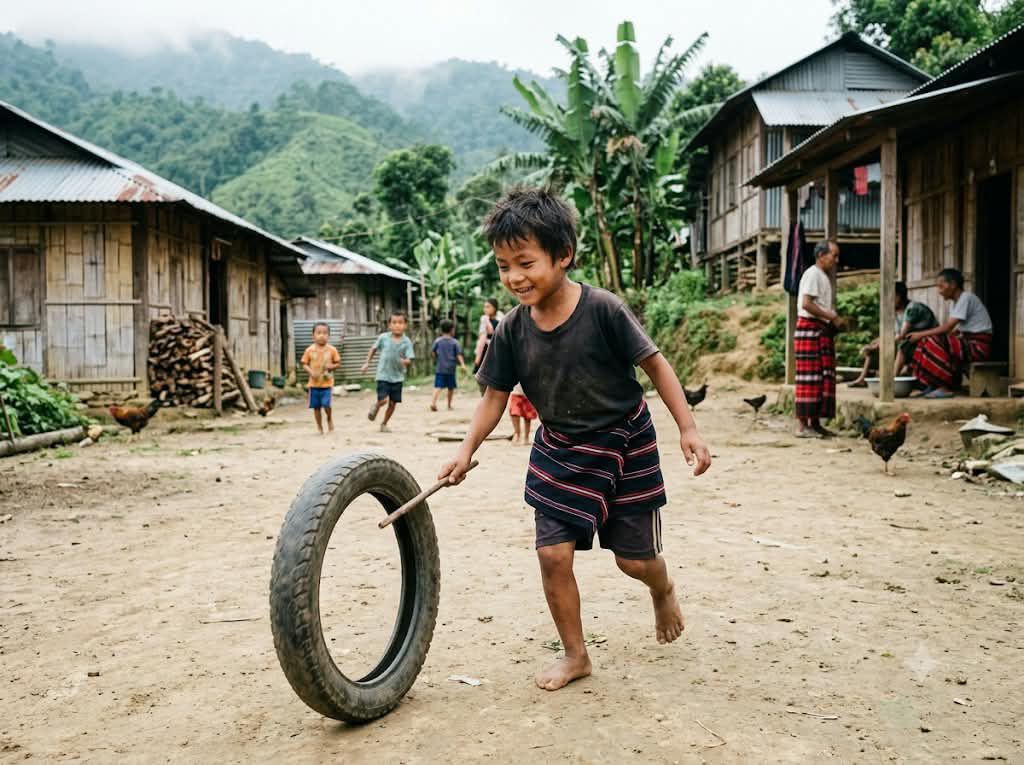
Traditional Sukte villages were built atop narrow, defensible ridges.
-
Houses were constructed using split bamboo, hardwood corner posts, and thatched roofs woven from jungle grass.
-
The structure was built on a slightly raised platform (Innsang), with the space underneath housing pigs and poultry, creating an efficient household ecosystem.
-
The front porch was decorated with the bleached skull horns of hunted deer, wild boar, and sacrificed mithuns—acting as a visual catalog of the household’s industry and generosity.
6. The Colonial Encounter: Conflict, Pacification, and Administrative Division
[ Traditional Highland Autonomy ]│▼ (1889–1893: Sukte / Chin Resistance)[ The Chin-Lushai Expeditions ]│▼ (Annexation & Colonial Pacification)[ The Chin Hills Regulation of 1896 ]│▼ (1947: Post-Colonial Drawing of Boundaries)[ Permanent Administrative Separation (India - Myanmar) ]
The Chin-Lushai Expeditions (1889–1893)
During the late 19th century, British imperial expansion from Bengal, Assam, and Upper Burma pushed into the interior highlands. The Sukte, fiercely protective of their territorial sovereignty and accustomed to exacting tribute from lowland plains, refused to submit to the British Crown.
This defiance triggered the Chin-Lushai Expeditions:
-
British forces under generals such as Sir George White launched coordinated military columns into the Chin and Lushai hills to burn non-compliant villages, destroy grain stores, and disarm local warriors.
-
Despite fighting with outdated flintlocks, spears, and rock-fall ambushes on steep ridgelines, Sukte chiefs mounted a formidable resistance.
-
Overwhelming British artillery and systematic scorched-earth campaigns ultimately forced the Sukte chiefs into conditional surrender.
The Chin Hills Regulation of 1896
Following pacification, the British enacted the Chin Hills Regulation of 1896.
-
Rather than imposing standard British civil law, the administration recognized the power of the hereditary chiefs to maintain daily civil order.
-
It codified tribal customary law, provided administrative autonomy, and instituted an “Inner Line” approach to limit outside exploitation.
-
However, this framework permanently froze the boundary between the Chin Hills (administered from Rangoon/Burma) and the Lushai/Manipur hill tracts (administered from Assam/India), laying the legal and cartographic groundwork for modern territorial division.
7. The Spiritual Watershed: The Advent of Christianity
The Arrival of Missionaries
The turn of the 20th century brought a spiritual and cultural transformation across the region. American Baptist missionaries (such as Arthur Carson and Laura Carson) and British evangelists arrived in the Chin Hills, while Welsh Presbyterian and Baptist missions expanded across the Lushai Hills and southern Manipur.
Initially, tribal chiefs resisted the new faith, viewing it as a subversive doctrine that threatened:
-
The ancestral spirit sacrifices that protected village crops.
-
The communal feasts that legitimized the authority of the chiefs.
-
The traditional brewing of fermented rice beer (Zu), which sat at the center of social bonding and conflict arbitration.
The Great Conversion: Mass Awakening and Modern Script
Despite early resistance, Christian evangelism took deep root between the 1920s and 1950s:
-
Missionaries developed a Latin-based alphabet for the Tedim/Sukte language, establishing the community’s first formal literacy programs, dictionaries, and printed translations of the Bible.
-
Christianity introduced modern primary schools and dispensaries, significantly reducing mortality rates from endemic dysentery, malaria, and smallpox.
-
In a remarkably short period, the old animist pantheon was set aside. Today, the Sukte population is overwhelmingly Christian, primarily belonging to Baptist, Presbyterian, Evangelical, and Salvation Army denominations.
The Cultural Price of Conversion
While Christianity brought literacy and modern medical awareness, it also exacted a cultural cost:
-
Zealous early converts frequently burned traditional wood carvings, discarded ancestral heirlooms, and dismantled ceremonial feast platforms, viewing them as idolatrous artifacts.
-
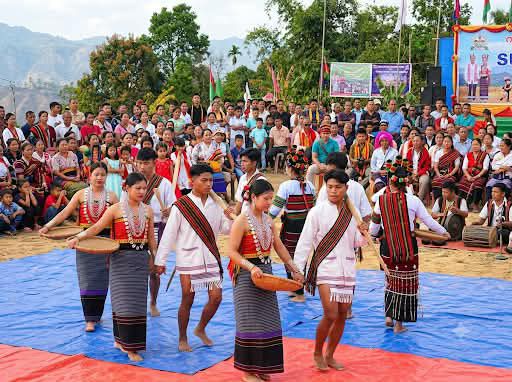
Traditional folksongs, community dances, and oral epics associated with ritual hunting fell into disuse.
-
Today, Sukte intellectuals and cultural leaders are working to reconcile their Christian faith with indigenous preservation, reintroducing traditional garments, folk melodies, and indigenous agricultural terminology into the liturgical sphere.
8. Agrarian Economy, Forest Ecology, and Food Security
[ The Annual Jhum (Swidden) Calendar ]│┌────────────────────────┼────────────────────────┐▼ ▼ ▼[ Dec - Feb ] [ Mar - Apr ] [ Sep - Nov ]Slashing dense forest; Burning the dried biomass Harvest of hill rice,drying brush on slopes. and dibbling mixed seeds. maize, millet, & beans.
Jhum Farming: The Slashing and Burning of Slopes
The foundational economy of the Sukte has long been swidden agriculture, locally known as Jhum (Lou):
-
Fallow Cycles: Historically, villages managed vast communal forest territories. A plot would be cleared, farmed for one or two seasons, and left fallow for 10 to 15 years to allow natural forest regeneration and soil restoration.
-
Biodiversity in the Fields: A single Jhum field was rarely a monoculture. Farmers planted hill rice interspersed with maize, job’s tears, finger millet, runner beans, pumpkins, ginger, and chilies, ensuring food security against pest attacks or unseasonal rains.
Modern Pressures on the Swidden System
In modern India, demographic expansion and reserved forest policies have reduced the land available for traditional farming:
-
Fallow cycles have shrunk from 15 years to 4–6 years, degrading topsoil, lowering crop yields, and exacerbating slope erosion during the monsoon season.
-
This ecological pressure has pushed rural Sukte families toward mono-crop cash farming, including broom grass, ginger, and rubber, exposing them to price volatility in regional markets.
The Culinary Identity of the Highlands
Sukte food traditions are rooted in preservation, smoke, and natural foraging:
-
Meats: Pork and beef are staples, regularly cured over kitchen hearth fires to produce long-lasting smoked cuts (Sa-gaw).
-
Vegetables: Meals revolve around wild mountain greens, bamboo shoots (Noh), fermented soybeans, and broad beans, boiled without commercial oils and seasoned with fresh ginger and fiery indigenous bird’s eye chilies.
-
Fermented Staples: Fermented bamboo shoots are used as an acidic base in slow-cooked stews, serving as both a flavor enhancer and a digestive aid.
9. Modern Challenges: Statelessness, Armed Conflict, and Border Fencing
[ Geopolitical Realities in the Borderlands ]│┌──────────────────────────────┼──────────────────────────────┐▼ ▼ ▼[ The 2021 Myanmar Coup ] [ FMR Suspension & Border ] [ Internal Manipur Dynamics ]Refugee influx across border; Fencing projects that bisect Contested ethnic land claims,families fleeing airstrikes. ancestral village territories. scheduled tribe ambiguities.
The Fallout of the 2021 Myanmar Military Coup
The February 2021 military coup in Myanmar changed daily life across the borderlands.
-
Across Tedim, Tonzang, and adjacent Chin regions, civilian populations organized resistance movements against the ruling military junta, triggering airstrikes, burned settlements, and displaced communities.
-
Tens of thousands of ethnic kin fled across the border into Mizoram and the hill districts of Manipur.
-
For the Sukte residing in India, those arriving were not foreign nationals, but immediate family members, cousins, and lifelong friends.
-
Local village councils and church networks mobilized food, bamboo shelters, and emergency medical supplies, placing a considerable strain on limited community resources.
The Scrapping of the Free Movement Regime (FMR) and Border Fencing
In early 2024, the Government of India announced plans to suspend the Free Movement Regime (FMR) and construct a continuous security fence along the 1,643-kilometer India-Myanmar border.
For the Sukte and related borderland communities, this policy presents deep social and human challenges:
-
Partition of Ancestral Space: The proposed fence cuts across ancestral farmlands, shared water catchments, and traditional burial grounds.
-
Severing Kinship: It threatens to criminalize daily cross-border family connections that have existed for centuries.
-
Economic Isolation: Small-scale border trade, which provides a living for local women selling agricultural goods, faces complete disruption.
Socio-Political Realities in Manipur
Within the state of Manipur, the Sukte navigate a complex political environment:
-
Their status as an ethnic minority within the broader Kuki-Zomi-Chin tribal umbrella leaves them vulnerable during larger ethnic conflicts.
-
Land administration policies, contested forest boundaries, and debates over tribal inclusion create persistent anxiety regarding identity and constitutional protections.
-
Many struggle to secure official Scheduled Tribe (ST) recognition under their specific clan name, often being subsumed under broader administrative categories that do not reflect their self-identification.
10. Socio-Economic Realities and Human Development Indicators
The Rural-Urban Educational Divide
While the Sukte boast high basic literacy rates—primarily due to community-run church programs and local vernacular schools—higher education remains difficult to access:
-
The High School Drop-Out Rate: Village schools in peripheral districts often lack science laboratories, mathematics teachers, and reliable electricity.
-
Out-Migration for Higher Education: Students who seek university degrees must leave their ancestral hills for Churachandpur town, Imphal, Shillong, Guwahati, or metropolitan centers like Delhi, Bengaluru, and Hyderabad.
Healthcare Vulnerabilities
Healthcare access in remote border villages remains fragile:
-
Primary Health Centres (PHCs) are frequently understaffed, lacking doctors, functional ultrasound machines, and essential medications.
-
Critical emergencies require navigating unpaved, monsoon-damaged roads for 6 to 12 hours to reach regional hospitals, driving up out-of-pocket healthcare costs and keeping families in debt cycles.
[ Core Human Development Pressures for Rural Sukte Communities ]│┌───────────────────┬─────────────┴─────┬───────────────────┐▼ ▼ ▼ ▼[ Road Access ] [ Healthcare ] [ Employment ] [ Connectivity ]Unpaved hill roads Under-resourced High reliance on Intermittent powerwashed out during primary clinics; subsistence farming; and mobile dataannual monsoons. distant hospitals. few local industries. in border areas.
Economic Stagnation and Youth Employment
Modern industrial manufacturing is virtually absent in these border regions:
-
The local economy relies on subsistence agriculture, state government employment, and military or paramilitary recruitment.
-
This lack of local opportunity has driven a steady outward migration of young people to major Indian cities, where they find work in retail, hospitality, aviation, and customer service.
-
While the remittances they send home help support rural families, this migration draws energetic young people away from the village communities, weakening local traditions and customary governance.
11. The Struggle for Cultural Preservation and Tribal Identity
The Challenge of Linguistic Erosion
The proliferation of digital culture, Hindi and English educational media, and migration to urban centers are contributing to language shift among the younger generation:
-
While youth remain fluent in daily conversational Tedim/Sukte, archaic vocabularies, complex genealogical terms, and traditional folk metaphors are gradually fading from use.
-
Church services, though conducted in the vernacular, increasingly incorporate English loanwords, displacing indigenous phrasing.
Community-Led Revitalization Initiatives
In response, cultural organizations, youth associations, and diaspora groups are stepping up preservation efforts:
-
Publishing Dictionaries and Readers: Native linguists and church scholars are producing updated lexicons, children’s readers, and primers to document dialectical nuances.
-
Preserving Traditional Music: Musicians are blending indigenous acoustic instruments with modern recording styles, revitalizing traditional oral epics for younger audiences on digital platforms.
-
Reviving Festivals: Annual celebrations such as Khuado—the harvest thanksgiving festival historically held to drive away malevolent spirits and celebrate the gathering of crops—are being organized in community spaces across Churachandpur, Shillong, and New Delhi.
12. The Road Ahead: Balancing Tradition and Modernity
The story of the Sukte tribe illustrates the resilience of indigenous communities across South and Southeast Asia. Surviving imperial pacification, Christian conversion, geographic division, and modern military unrest, they continue to protect their identity and autonomy.
Addressing their current challenges requires a thoughtful, human-centered approach:
-
Balanced Border Policies: Security strategies in border areas must accommodate the rights, livelihoods, and kinship ties of indigenous communities living along the frontier.
-
Investment in Basic Services: Rural hill districts need reliable all-weather roads, well-equipped local clinics, and quality schools so families are not forced to migrate for basic services.
-
Support for Indigenous Rights: Customary village councils should be recognized and supported as essential partners in local conservation and development projects.
The Sukte are not an isolated relic of an ancient world; they are active participants in modern society. Protecting their cultural heritage and supporting their sustainable development ensures that their language, songs, and traditions continue to enrich the cultural fabric of Northeast India.
Key Reference Facts
| Metric / Dimension | Traditional Baseline | Modern Reality |
| Linguistic Family | Tibeto-Burman (Northern Chin / Kuki-Chin) | Tedim / Sukte; increasing English and regional bilingualism |
| Geographic Core | Ciimnuai, Chin Hills, Tedim, Tonzang | Southern Manipur (Churachandpur, Pherzawl), Mizoram, Myanmar |
| Social Organization | Hereditary Chieftain (Hausa) & Elder Council (Upas) | Hybrid village councils, legal statutory structures, church bodies |
| Economic Basis | Jhum (Swidden) farming, hunting, local barter | Subsistence farming, horticulture, service-sector migration |
| Religious Orientation | Animist cosmology (Pasian, nature spirits, sacrifice) | Predominantly Christian (Baptist, Presbyterian, Evangelical) |
| Strategic Challenges | Inter-clan conflicts, British colonial incursions | Border fencing, suspension of FMR, regional instability |
