
Tribal Art and Handicrafts of India: A Comprehensive Deep Dive into Heritage, Livelihoods, and Contemporary Relevance
Author’s Note: Why This Blog Post Matters and What Drives This Exploration
Every piece of Art and Handicrafts tells a story, but Indian tribal art tells the story of human resilience, cosmological connection, and an unbroken lineage of sustainable living that stretches back millennia. When we look at a Warli painting on a mud wall or run our fingers over a delicately carved Dhokra brass figurine, we are not merely touching an aesthetic artifact; we are interacting with living archives of indigenous knowledge, ancient metallurgy, spiritual philosophy, and community-centric economics.
I created this comprehensive exploration because tribal art in India sits at a critical crossroads. On one hand, it represents some of the most sophisticated, eco-friendly, and visually captivating craft traditions in the world. On the other hand, the artisans—the true custodians of this heritage—face monumental systemic challenges, from economic precarity and market exploitation to the loss of traditional raw materials and cultural appropriation.
This blog post is designed to be much more than a superficial list of craft forms. It is an immersive, highly detailed, and data-driven journey intended to:
-
Demystify the Philosophy: Unpack the spiritual and ecological worldview that breathes life into tribal creations.
-
Provide Exhaustive Categorization: Explore major and minor art forms across different states, detailing techniques, motifs, and materials.
-
Examine Socio-Economic Realities: Analyze government interventions, market economics, fair-trade realities, and livelihood statistics.
-
Address Common Reader Questions: Answer the burning questions that art enthusiasts, conscious consumers, researchers, and policymakers ask regarding authenticity, ethics, and preservation.
-
Chart the Future: Highlight how contemporary design interventions, Geographical Indication (GI) tags, and ethical e-commerce can safeguard these traditions without diluting their soul.
Whether you are an art collector, a student of anthropology, a conscious shopper, or simply someone who appreciates the beauty of handmade traditions, this guide will provide you with deep insights, actionable knowledge, and a profound appreciation for India’s indigenous creators.
1. Introduction: The Soul of Indigenous India
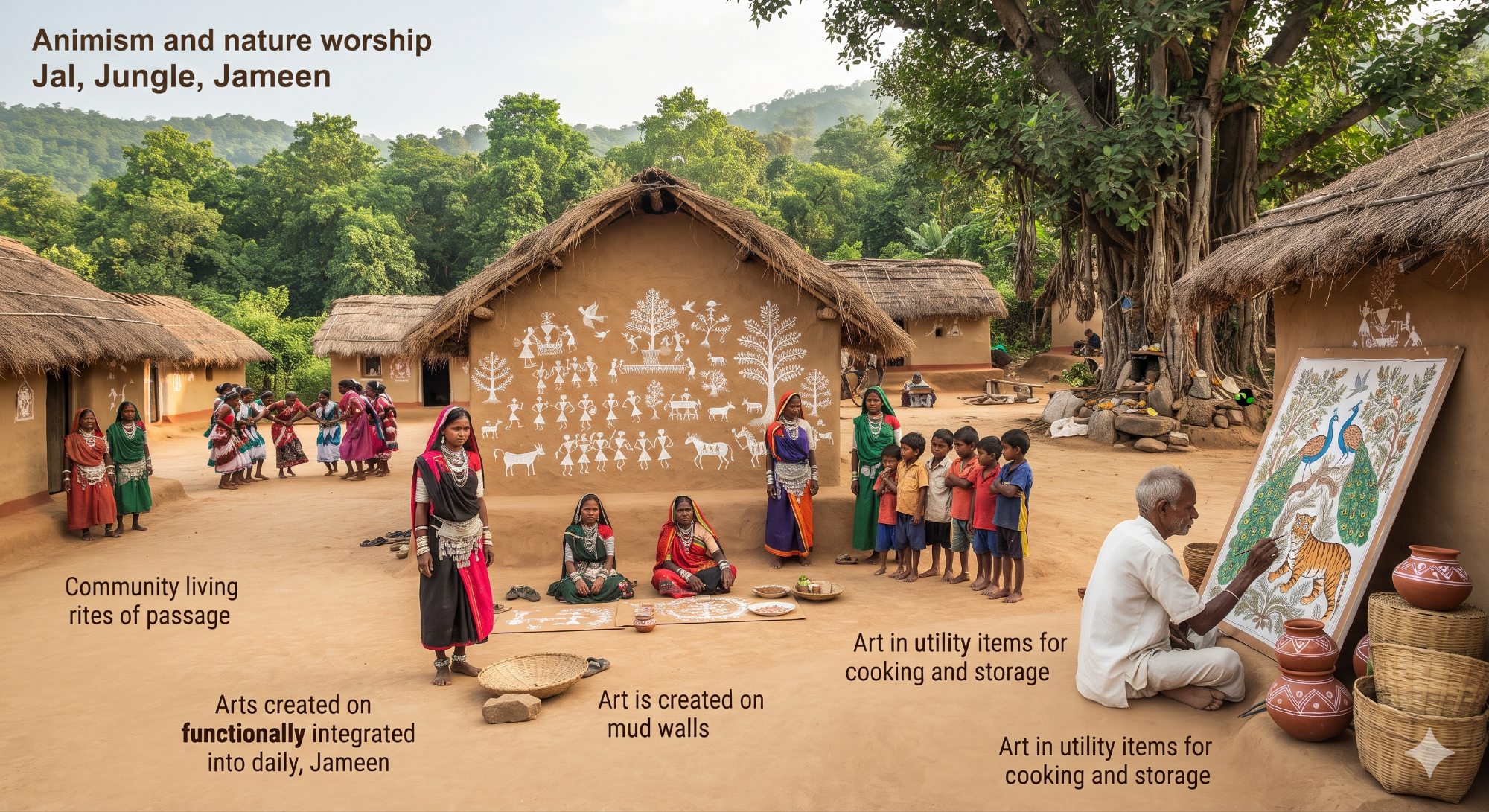
India’s cultural tapestry is globally renowned, yet mainstream discourse often focuses on classical traditions—temple architecture, courtly miniature paintings, and royal textiles. Beneath this upper layer lies the deep, nutrient-rich soil of tribal and indigenous art (Adivasi Kala). Spanning central, eastern, western, and northeastern India, these art forms are rooted in animism, nature worship, oral history, and community living.
Unlike classical art, which often developed within royal patronage and codified aesthetic treatises (like the Natya Shastra or Shilpa Shastras), tribal art is spontaneous, organic, and functionally integrated into daily life. It is created not for gallery walls or royal salons, but for mud walls during harvest festivals, for rituals warding off disease, as utility items for cooking and storage, and as markers of tribal identity and rites of passage.
The Philosophical Core: Nature as Muse and Deity
In tribal ontology, humans are not masters of nature; they are equal participants in an interconnected web of life. Forests (Jal, Jungle, Jameen—Water, Forest, Land) are sacred spaces. Consequently, tribal art reflects an intimate, biomimicry-driven understanding of flora and fauna.
Economic and Cultural Significance at a Glance
To understand the sheer scale of the tribal craft economy, let us examine some macro-level insights derived from cultural heritage and handicraft development reports:
2. Comprehensive Taxonomy of Major Tribal Art Forms of India
A. Warli Painting (Maharashtra)
-
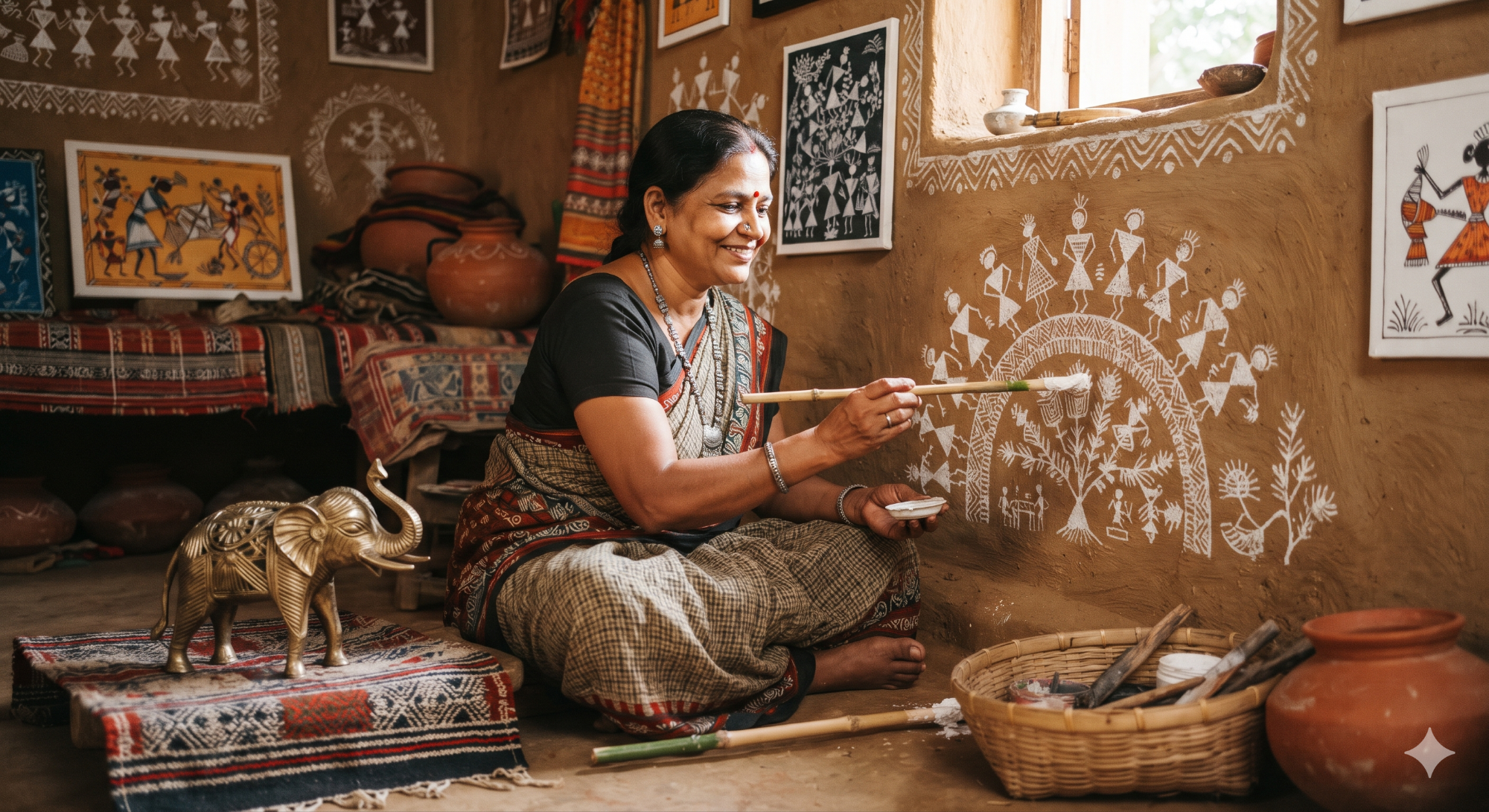
Medium & Technique: Traditionally executed on the mud walls of huts. The background is a mixture of cow dung and red earth (providing an ochre-red base), while the pigment used for painting is a simple paste of rice flour and water, bound with gum.
-
Visual Motifs: Deceptively simple geometric shapes—circles, triangles, and squares. The circle represents the sun and moon; the triangle signifies mountains and conical trees; the square indicates a sacred enclosure (Chauk), often housing Palaghag (the mother goddess of fertility).
-
The Tarpa Dance: One of the most famous Warli motifs is the spiral dance around a Tarpa (a trumpet-like wind instrument) player, symbolizing the cyclical nature of life, cosmic harmony, and community bonding.
B. Gond Art (Madhya Pradesh & Central India)
-
Community: The Gond tribe, one of the largest indigenous communities in India, predominantly spread across Madhya Pradesh, Chhattisgarh, Odisha, and Andhra Pradesh.
-
Medium & Technique: Historically painted on mud walls during festivals like Diwali and Nag Panchami, Gond art has successfully transitioned to canvas, paper, and wood. Artists use acrylics and poster colors, applying intricate patterns of dots, dashes, fish scales, teardrops, and zig-zags.
-
Thematic Basis: Rooted in the belief that “good melihat (viewing) brings good luck,” Gond art illustrates tribal myths, oral epics, trees of life, and animals. Each artist has a distinct signature pattern (Jangarh Singh Shyam revolutionized modern Gond art by bringing it to paper in the 1980s).
-
Key Symbolism: The Tree of Life is central, depicting how all living beings—roots, trunks, birds, snakes, and humans—are interconnected and sustained by Mother Earth.
C. Dhokra Metal Craft (West Bengal, Odisha, Jharkhand, Chhattisgarh)
-
Community: Malhar, Dhara, and Karmali metal-smiths (often referred to as Dhokra or Drokha craftspeople).
-
Technique: Lost-wax casting (Cire Perdue), a metallurgical technique practised continuously for over 4,000 years (the famous Indus Valley artefact, the “Dancing Girl of Mohenjo-daro”, was made using this exact method).
-
Process Steps:
-
A core shape is made of clay and allowed to dry.
-
The clay core is wrapped in a layer of beeswax mixed with tree resin.
-
The wax is intricately carved with fine threads and decorative patterns.
-
The wax-covered core is coated in successive layers of fine clay and dried.
-
The mold is heated; the wax melts and pours out through a small channel, leaving a hollow cavity.
-
Molten brass, bronze, or copper is poured into the cavity to replace the wax.
-
Once cooled, the outer clay shell is broken away to reveal the raw metal figurine, which is then polished and finished.
-
-
Artistic Appeal: Primitive, rustic charm with intricate filigree-like surface details, depicting horses, elephants, deities, musicians, and everyday tribal life.
D. Pithora Paintings (Gujarat & Madhya Pradesh)
-
Community: Rathwa, Nayak, and Talavia tribes of the Chhota Udepur region in Gujarat.
-
Medium & Technique: Ritualistic wall paintings done inside homes to appease God Pithora during weddings, childbirth, or fulfilment of vows. Natural pigments are mixed with milk and liquor (mahua spirit).
-
Visual Structure: Highly structured and narrative. A Pithora painting always features Lord Ganesha, horses of various deities, the Sun, the Moon, and scenes of tribal agriculture, hunting, and village festivity. It is considered a living ritual rather than a decorative painting; the artist (Badwa) sings and chants throughout the creation process.
E. Saora Paintings (Odisha)
-
Community: The Lanjia Saora tribe of southern Odisha.
-
Medium & Technique: Also known as Idital, these wall murals are painted on reddish-brown mud walls using white rice paste.
-
Iconography: Highly linear and geometric compared to Gond or Pithora art. They serve as altars for the dead and offerings to ancestors (Idial deities). Stick-figure humans, horses, elephants, the sun, the moon, and ladders (symbolising the ascent of souls to heaven) dominate the compositions.
3. Comparative Matrix of Major Indian Tribal Art Forms
To help scholars, collectors, and enthusiasts compare these traditions at a glance, the following detailed matrix outlines their geographic origin, primary materials, key motifs, and cultural function:
4. Socio-Economic Dimensions and Livelihoods
Behind every exquisite piece of Dhokra art or vibrant Gond canvas lies the grueling daily reality of rural artisans. Understanding the economics of tribal handicrafts requires looking at statistics, supply chain bottlenecks, and intervention models.
Economic Vulnerability and the Middleman Problem
Historically, tribal artisans operated in isolated rural pockets with zero direct access to urban or international consumer markets.
-
The Exploitation Cycle: Local traders and middlemen (sahukars or dalals) often advanced small cash loans to artisans during lean agricultural seasons, binding them to produce crafts at throwaway prices. A brass Dhokra figurine that takes 5 days of labor might be purchased from the artisan for ₹200 and resold in metropolitan emporiums for ₹2,500.
-
Raw Material Inflation: Prices of brass, copper, high-grade canvas, and specialized brushes have risen sharply over the past decade, while artisan wages have struggled to keep pace.
Government and Cooperative Interventions
Recognizing these disparities, various institutional frameworks have been established to support tribal livelihoods:
5. Frequently Asked Questions (FAQs): Reader Inquiries & Myth-Busting
When exploring Indian tribal art, readers, collectors, and students frequently encounter several common questions and misconceptions. Here are detailed, authoritative answers:
Q1: What is the exact difference between “Folk Art” and “Tribal Art” in India?
-
Answer: While both fall under the broad umbrella of traditional and indigenous expressions, there is a distinct anthropological difference. Tribal Art (Adivasi Kala) originates from specific ethnic indigenous groups (Scheduled Tribes) living in forested or hilly tracts, deeply tied to animistic beliefs, communal living, and distinct dialects (e.g., Warli, Gond, Saora). Folk Art, on the other hand, is practiced by rural agrarian or occupational castes within mainstream village societies, often tied to caste guilds, localized feudal patronages, or specific Hindu festivals (e.g., Madhubani by Maithil Brahmins/Kayasthas, or Pattachitra by traditional painter castes).
Q2: How can a buyer ensure that the tribal art piece they are purchasing is authentic and ethically sourced?
-
Answer: Look for the following markers of authenticity:
-
Certification: Purchase from verified institutional channels like Tribes India, state government emporiums (e.g., Mrignayanee, Gurjari), or ethical social enterprises that work directly with artisan co-ops.
-
Imperfect Perfection: Handmade tribal art carries the subtle irregularities of human touch—uneven brushstrokes in Gond art, slight variations in wax threads in Dhokra, or natural grain variations in Bastar wood. Perfect symmetry often indicates mass-produced factory imitation.
-
Artisan Provenance: Reputable sellers often provide the name of the artisan, their village, and the cooperative group they belong to.
-
Q3: Are traditional tribal art forms dying out, or are they adapting to the modern world?
-
Answer: It is a complex duality. Traditional ritual contexts (like painting mud walls for weddings) are declining due to modern brick-and-mortar housing and changing lifestyles. However, many tribal art forms have experienced a renaissance through canvas, digital adaptation, fashion integration, and home decor. Artists in Patangarh (Madhya Pradesh), known as the “Village of Gond Artists,” have successfully transitioned their skills to global art markets, sending their children to school and achieving financial independence through their art.
Q4: How is technology and e-commerce impacting tribal artisans today?
-
Answer: Digital platforms have been a double-edged sword. On the positive side, direct-to-consumer (D2C) brands, Instagram galleries, and government e-marketplaces allow talented artisans to bypass exploitative middlemen and sell directly to global buyers in New York, London, and Tokyo. On the negative side, the digital divide remains vast; many elder master craftspeople lack digital literacy, smartphone access, or fluency in English/Hindi for online marketing, meaning younger intermediaries or urban entrepreneurs still capture a significant share of digital profits.
6. Challenges Facing Tribal Artisans in the 21st Century
Despite cultural revivals and government schemes, indigenous craft communities face existential threats that require urgent policy and societal intervention:
-
Environmental Degradation and Raw Material Scarcity:
-
Traditional crafts rely heavily on natural resources—red soil, specific types of clay, river reeds, herbal dyes, and sustainable timber (like sal or teak). Deforestation, climate change, and mining activities in central and eastern India have severely disrupted access to these raw materials.
-
-
Cultural Appropriation and Copyright Infringement:
-
Fast-fashion brands, corporate decor chains, and digital printers frequently copy tribal motifs (such as Warli or Gond patterns) onto mass-produced fabrics, home furnishings, and wallpapers without paying royalties, granting attribution, or acknowledging the source communities.
-
-
Lack of Intergenerational Knowledge Transfer:
-
Younger generations in tribal communities are increasingly migrating to urban centers for low-wage manual labor or gig economy jobs because traditional craft production fails to guarantee a stable, middle-class income. If youth refuse to learn these intricate techniques from their elders, entire lineages of intangible cultural heritage risk extinction within a single generation.
-
-
Financial Literacy and Banking Inclusion:
-
Many rural artisans struggle with formal banking, credit availability, GST compliance, and digital payment systems, leaving them vulnerable to local debt traps when emergency expenses arise.
-
7. The Path Forward: Conservation, Ethical Consumption, and Empowerment
Safeguarding India’s tribal art and handicraft heritage is not merely a charitable exercise; it is an economic and cultural imperative. To ensure these traditions thrive in the 21st century, a multi-stakeholder approach is essential:
-
For Consumers: Practice conscious patronage. Buy directly from certified ethical platforms, ask about the provenance of your art pieces, and pay fair prices without aggressive bargaining. Respect the cultural context behind the symbols.
-
For Designers and Brands: Collaborate ethically with tribal master artisans through co-creation models rather than extraction models. Ensure fair wage agreements, transparent credit attribution, and profit-sharing mechanisms.
-
For Policymakers: Strengthen GI tag enforcement against commercial counterfeits, expand rural digital infrastructure, provide easy micro-credit facilities for artisan cooperatives, and integrate indigenous art modules into mainstream school and university curricula.
8. Conclusion
Tribal art and handicrafts of India are the beating heart of our collective cultural consciousness. They remind us of a time-tested philosophy where human expression coexists in profound harmony with the natural world. From the spirited rhythm of the Warli dance circles to the gleaming, ancient metallurgy of Dhokra, these creations embody the resilience, beauty, and deep wisdom of India’s indigenous peoples.
As conscious global citizens, our role is clear: move beyond passive admiration, embrace ethical acquisition, champion artisan welfare, and ensure that the fires of these ancient indigenous furnaces continue to burn brightly for generations to come.
