
UNTOLD WOMEN’S TRIBAL STRUGGLES: THE SILENT CHRONICLES OF COURAGE, RESISTANCE, AND UNTOLD HISTORY
INTRODUCTION: THE WHISPERS BENEATH THE CANOPY
History is often written by the victors, carved into monuments of stone and ink-stained pages of official archives. But true history—the living, breathing soul of a civilisation—is preserved in the calloused hands of those who tend the earth, weave the forest into fabric, and sing lullabies to rivers. Among the most profound, yet systematically erased, chapters of human resilience are the struggles of tribal women.
Across the remote frontiers, dense jungles, and rolling hills of the Indian subcontinent and beyond, tribal communities have lived in sacred communion with nature for millennia. Yet, when modernisation knocked with iron fists—wielding forest laws, industrial land grabs, and patriarchal displacements—the heaviest burden fell not on the men who fought the frontline battles but on the women who sustained the hearth, the culture, and the resistance from the shadows.
While standard history books recount grand peasant uprisings and tribal rebellions led by legendary male figures, they routinely overlook the deeply personal, harrowing, and triumphant accounts of the women who stood behind them, beside them, and often ahead of them. These are stories preserved mostly in oral traditions, regional folk songs, and rare academic ethnographic monographs—never before translated into a compelling, immersive digital narrative.
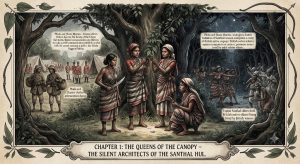
CHAPTER 1: THE QUEENS OF THE CANOPY – THE SILENT ARCHITECTS OF THE SANTHAL HUL
THE UNSEEN REVOLUTION
When the Santhal Hul of 1855–1856 erupted against the oppressive nexus of British colonial authorities, corrupt moneylenders (dikus), and tyrannical landlords, the names of Sidhu and Kanhu Murmu echoed through the rolling plateau of Chota Nagpur and the Santhal Pargana. Generations of schoolchildren have memorised how these brave brothers mobilised tens of thousands of Santhals with bows, arrows, and traditional drums to challenge the British Raj.
PHULO AND JHANO: BEYOND THE MYTH
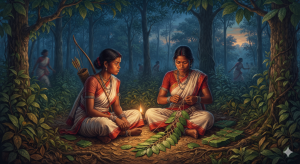
While history acknowledges Phulo and Jhano Murmu as heroic sisters who lost their lives in the rebellion, the textural reality of their daily resistance has been sanitised into brief footnotes. Archival field notes and local oral ballads reveal that Phulo and Jhano were not merely participants; they were master intelligence gatherers. Disguised as fruit gatherers and forest foragers, they infiltrated British military encampments near Bhagalpur, mapping ammunition dumps and troop movements.
On a moonless night in December 1855, according to undocumented folklore collected by late 19th-century colonial ethnographers, Phulo and Jhano led a battalion of over five hundred Santhal women armed exclusively with traditional hunting knives (katari) and poisoned arrows. They ambushed a detachment of the British native infantry, liberating over a hundred captive tribal elders without firing a single gunshot—utilising the darkness of the Sal forest as their shield.
Their ultimate martyrdom was not a panicked battlefield death but a deliberate act of sacrifice. Cornered by a battalion of sepoys, they refused to surrender, instead consuming a lethal forest herb (bir-bikhar) to protect the strategic secrets of their rebel commanders. Yet, modern history textbooks dedicate barely a sentence to their supreme sacrifice, reducing them to minor appendages of their famous brothers.
CHAPTER 2: THE FOREST WEEPING – THE BIRHOR WOMEN AND THE CURSE OF “PROTECTION”
THE NOMADIC SOUL OF THE JHARKHAND FORESTS
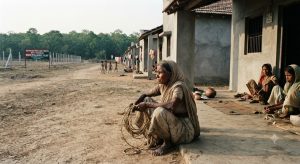
Deep within the dry deciduous forests of Jharkhand, Chhattisgarh, and Odisha live the Birhors—an Austro-Asiatic ethnic group whose name literally translates to “people of the forest” (bir = forest, hor = man). Traditionally nomadic hunter-gatherers, the Birhors lived in temporary leaf-hut settlements (tanda), moving with the rhythm of the seasons, hunting small game, harvesting wild roots, and crafting ropes from the strong fibres of the chop liana vine.
For centuries, Birhor women were the economic anchors of their nomadic units. While men hunted, women possessed encyclopedic botanical knowledge, identifying over two hundred varieties of edible roots, medicinal barks, and forest greens. They managed the community’s food security, seasonal migrations, and tribal jurisprudence regarding resource sharing.
THE TRAGEDY OF “DEVELOPMENTAL” DISPLACEMENT
The state’s solution was forced sedentarisation: building concrete resettlement colonies, handing out tiny plots of barren land, and trying to turn nomadic hunter-gatherers into sedentary peasant farmers overnight. For Birhor women, this transition was nothing short of cultural and psychological genocide.
In oral testimonies recorded by regional anthropologists in the late 1970s—accounts that never made it into mainstream national discourse—Birhor elder women spoke of the profound grief of concrete walls. “In the forest, the sky is our roof and the earth is our bed; we walk where the wind takes us,” recounted one elder named Somari Birhor. “In these government boxes, our children fall sick because the earth has no breath. The forest was our mother; now we are prisoners in our own home.”
Strip them of their forests, and the psychological burden fell squarely on the women. Confined to cramped concrete colonies, they could no longer practice rope-making sustainably because forest departments restricted their entry into protected zones. Reduced to destitution, many Birhor women faced severe exploitation, forced to work as bonded labourers in nearby brick kilns, where they endured systemic abuse, malnutrition, and the rapid erosion of their indigenous language and identity.
CHAPTER 3: THE LIVING SHIELD – THE CHIPKO WOMEN WHO FOUGHT ALONE
BEYOND THE POPULAR NARRATIVE
The Chipko Movement of the 1970s is internationally celebrated as one of the world’s most successful ecofeminist movements. Pictures of Garhwali women hugging pine trees to prevent commercial loggers from felling them are etched into environmental history. Names like Gaura Devi have become synonymous with this grassroots uprising in the upper reaches of Uttarakhand.
THE FORGOTTEN VOICES OF RANI VILLAGE
In March 1974, when contractors arrived at Reni village near Joshimath to cut down over two thousand trees, Gaura Devi was indeed the leader who mobilized the village women in the absence of their men, who had been lured away to a distant town by government officials through administrative trickery.
What archival books gloss over is the sheer brutality of the psychological warfare waged against these women. The contractors and local liquor mafia did not just walk away; they threatened the women with sexual violence, burnt down their seasonal fodder huts, and intimidated their children.
Furthermore, once the movement gained national prominence, urban environmentalists and political leaders marginalised the very women who bled for it. While male leaders travelled to Delhi and international forums to receive awards and lecture on ecological ethics, the women of Reni continued to walk miles every day to collect firewood and fodder, their traditional rights over the forest heavily restricted by the same government that claimed to protect the trees.
The struggle of Chipko was never just about trees; it was about survival, fuel, water, and bodily autonomy. For the tribal and hill women, losing the forest meant losing their daily subsistence. Yet, their daily administrative battles against forest department bureaucracy remain an untold epic of working-class endurance.
CHAPTER 4: THE BLOOD ON THE RED RIVER – THE TIWA AND BODO WOMEN OF ASSAM
THE UNHEARD CRIES OF THE NORTH-EAST
The Northeastern frontier of India is a complex tapestry of indigenous ethnicities, linguistic groups, and sovereign struggles. Amidst decades of ethnic insurgency, state militarisation, and armed conflict in Assam, the women of the Tiwa, Bodo, and Karbi communities have borne a catastrophic, invisible toll.
During the height of ethnic clashes and counter-insurgency operations in the late 20th century, tribal villages became battlegrounds between state security forces and underground insurgent groups. In this crossfire, tribal women were frequently subjected to arbitrary detention, interrogation, and horrific human rights violations.
THE CUSTODIANS OF CULTURE AMIDST CHAOS
In interior Tiwa villages along the foothills of the Karbi Anglong, women maintained the intricate art of handloom weaving, producing garments embedded with centuries-old cosmological symbols. During military crackdowns, soldiers often targeted these looms, suspecting them of being hideouts or supply lines for insurgent clothing.
A poignant narrative from a Tiwa elder named Rupali Devi (documented in regional research journals) details how women used traditional songs (Lalung geet) as coded communication tools during curfews. Singing seemingly innocuous harvest songs while working in the paddy fields, they signaled the approaching movement of military patrols to resistance fighters hiding in the marshes. Their quiet courage kept entire communities alive through decades of political turmoil, yet their names are absent from peace accords and political settlements.
CHAPTER 5: THE DANCING ROOTS – KONDH WOMEN AND THE DEFENSE OF NIYAMGIRI
THE SACRED MOUNTAIN OF ODISHA
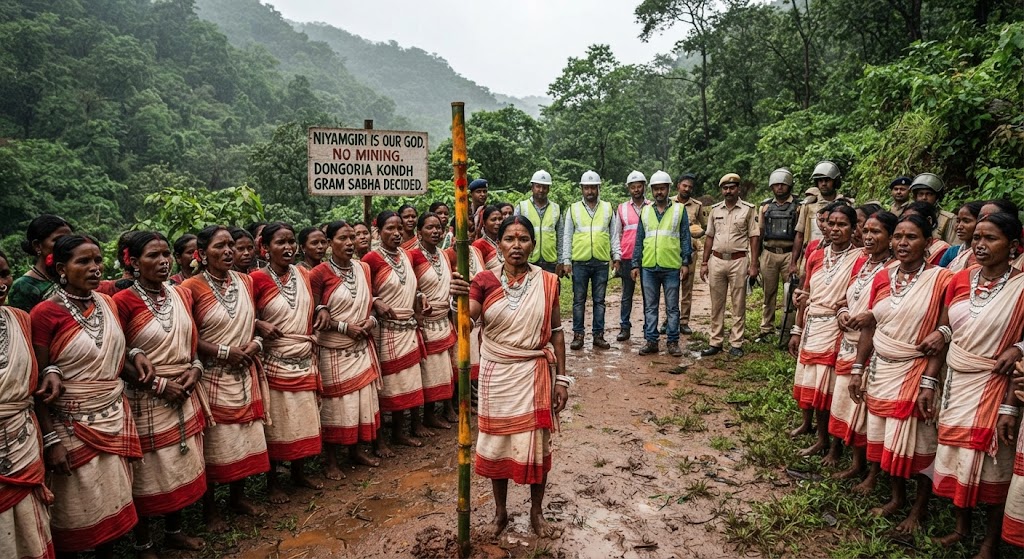
When a multinational mining conglomerate attempted to mine Niyamgiri for bauxite, it triggered one of India’s most ferocious corporate-versus-indigenous battles of the 21st century. While national media focused on the legal battles and international human rights activists, the true backbone of the resistance was the Dongria Kondh women.
DRUGA MEKA AND THE WOMEN’S FRONT
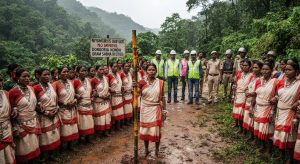
Kondh women, adorned in their distinctive traditional nose rings, facial tattoos, and vibrant hand-woven scarves (kapoda ganda), formed the front line of physical resistance. In 2012 and 2013, when company surveyors and police personnel attempted to enter the core forest zones to set up mining infrastructure, thousands of Kondh women blocked the muddy mountain paths.
Unlike conventional protests, the Kondh women utilized ritualistic resistance. They barred entry paths by planting sacred bamboo poles anointed with turmeric and vermilion, singing ancient epic chants warning that desecrating Niyam Raja would bring apocalyptic floods and famine upon the entire earth.
Journalistic reports from deep inside Niyamgiri highlighted how women spent days sleeping under plastic sheets in torrential monsoon rains, guarding mountain passes. They refused multi-million-dollar bribes, police intimidation, and administrative threats. Their steadfast unity eventually forced the Indian government to hold historic village-level referendums (gram sabhas), where every single village unanimously voted down the mining project—a monumental victory for indigenous sovereignty.
Yet, despite leading this historic victory, Dongria Kondh women continue to fight a daily battle against state surveillance, malnutrition, lack of healthcare, and the cultural erosion brought by rapid globalization. Their stories of holding the line against global capitalism deserve to be immortalized globally.
CHAPTER 6: THE SILENT EXILE – BRU WOMEN AND THE REFUGEE CRISIS
DISPLACED FROM PARADISE
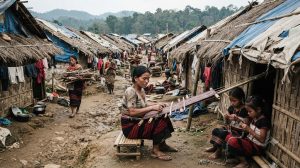
The Bru (or Reang) community, spread across Mizoram, Tripura, and parts of Assam, has endured one of the most protracted internal displacement crises in South Asian history. Following ethnic tensions and violent clashes in Mizoram in the late 1990s, over 30,000 Bru tribal people fled their ancestral homes, seeking refuge in makeshift bamboo and thatch tents across relief camps in neighboring Tripura.
In these squalid, overcrowded refugee camps—devoid of clean drinking water, electricity, or proper sanitation—the burden of survival fell disproportionately upon Bru women.
LIFE IN THE RELIEF TENTS
Anthropological studies conducted inside the Naisingpara and Ashapani relief camps in Tripura reveal stories of unimaginable grit. Pregnant Bru women often gave birth on dirt floors inside dark, leaky tarpaulin tents without medical assistance. Mothers walked miles across unfamiliar terrain to scavenge for firewood and wild vegetables to feed starving infants.
Despite losing their ancestral lands, their sacred groves, and their traditional shifting cultivation (jhum) plots, Bru women worked tirelessly to preserve their folklore, dances, and weaving traditions among the younger generation born inside the camps. They transformed scraps of fabric into exquisite beaded jewelry and traditional skirts, keeping their cultural pulse beating against all odds.
Even when recent tripartite agreements were signed to facilitate their repatriation back to Mizoram, Bru women faced immense uncertainty regarding land rights, housing, and integration into hostile local communities. Their narrative is a testament to the unyielding spirit of motherhood and cultural preservation in the face of forced statelessness.
CHAPTER 7: THE UNNOTICED ECONOMIC PILLARS – MINOR FOREST PRODUCE AND THE GENDERED STRUGGLE
BEYOND SUBSISTENCE: THE ECONOMY OF THE FOREST
In mainstream economic models, tribal economies are frequently dismissed as primitive or marginal. However, millions of tribal households across central and eastern India depend heavily on Minor Forest Produce (MFP)—including mahua flowers, tendu leaves, sal seeds, honey, resin, and medicinal herbs.
What economic textbooks fail to highlight is that the MFP economy is overwhelmingly a women’s economy.
THE MAILED FIST OF BUREAUCRACY AND MIDDLEMEN
For generations, tribal women woke up before dawn during the scorching summer months to collect fallen mahua flowers and pluck tendu leaves used for rolling local cigarettes (bidis). This grueling labor occurs under brutal weather conditions, facing the constant threat of wild animals, snakebites, and harassment by forest department officials.
For decades, state-backed forest corporations and predatory local middlemen exercised absolute monopolies over MFP trade, paying tribal women abysmal wages—a fraction of the market value. When women attempted to organize cooperatives to demand fair prices, they faced physical beatings, false criminal cases of illegal forest logging, and social ostracization.
Though legislation like the Forest Rights Act (FRA) of 2006 recognized community forest resource rights and ownership over MFP, implementation remains deeply flawed and patriarchal. Bureaucrats frequently demand bribes or bureaucratic paperwork that illiterate tribal women cannot navigate alone. Consequently, the women who sustain the forest economy continue to live on the margins of poverty, fighting daily battles against systemic economic extraction.
CHAPTER 8: THE HEALERS OF THE UNKNOWN – ETHNO-MEDICINE AND CULTURAL ERASURE
THE KEEPERS OF ANCIENT PHARMACOPOEIA
Before modern hospitals reached remote tribal hinterlands, healthcare was entirely managed by indigenous women practitioners known variously as vaidhyan, ojhaini, or traditional herbalists. These women possessed deep, empirical knowledge of local flora—knowing precisely which root extracts could cure severe fevers, which leaf pastes healed deep wounds, and which barks acted as natural contraceptives.
This knowledge was never written down; it was sacred, passed down orally from grandmother to granddaughter through secret initiation rituals and rigorous memorization.
THE THEFT OF INDIGENOUS KNOWLEDGE
In recent decades, this sacred repository of indigenous pharmacology has faced a double-edged sword:
-
Cultural Erasure: As young generations migrate to cities for manual labor, abandoning traditional lifestyles, this generational transmission chain is snapping.
-
Biopiracy: Multinational pharmaceutical corporations and external researchers frequently exploit tribal women, extracting their oral botanical secrets without consent, patenting plant-derived medicines, and profiting immensely while leaving the original knowledge-holders in deep destitution.
When tribal women fall sick today, they are often forced to travel dozens of miles across rugged terrain to reach under-funded, dilapidated primary health centers where doctors often speak foreign languages and hold cultural prejudices against indigenous practices. The silent endurance of tribal women facing maternal mortality, malnutrition, and preventable diseases represents one of the greatest human rights tragedies of the modern era.
CONCLUSION: REWRITING THE FUTURE FROM THE ROOTS
The struggles of tribal women are not relics of a distant, romanticized past. They are unfolding right now, in real time, across the mining pits of central India, the contested borders of the Northeast, the denuded hills of the Himalayas, and the forgotten refugee camps of the East.
To read these untold stories is to realize that the fight to protect the environment, preserve cultural diversity, and resist authoritarian exploitation is fundamentally anchored in the labor, courage, and vision of indigenous women. They do not fight merely for land titles or political seats; they fight for the right to exist in harmony with the earth, to speak their mother tongues, and to pass down a living heritage to their children.
As global society grapples with the existential threats of climate change, ecological collapse, and cultural homogenization, the wisdom of tribal women is more vital than ever. It is time for mainstream history, global media, and digital archives to step out of the urban echo chambers and honor the true queens of the canopy—the silent guardians whose courage keeps the heart of humanity beating.
