
How Indian Tribes Depend on the Forest
Spanning dense tropical canopies, rolling hills, and river valleys across the subcontinent, India’s forests are far more than ecological landscapes; they are ancestral homes, grocery stores, pharmacies, and cathedrals. Home to over 100 million indigenous people—locally known as Adivasis—belonging to hundreds of distinct Scheduled Tribes (STs), these ecosystems form the bedrock of a complex, time-tested civilisation.
Thank you for reading this post, don't forget to subscribe!To understand how Indian tribes depend on the forest is to explore a profound, reciprocal relationship where human survival, cultural identity, and ecological conservation are inextricably bound together.
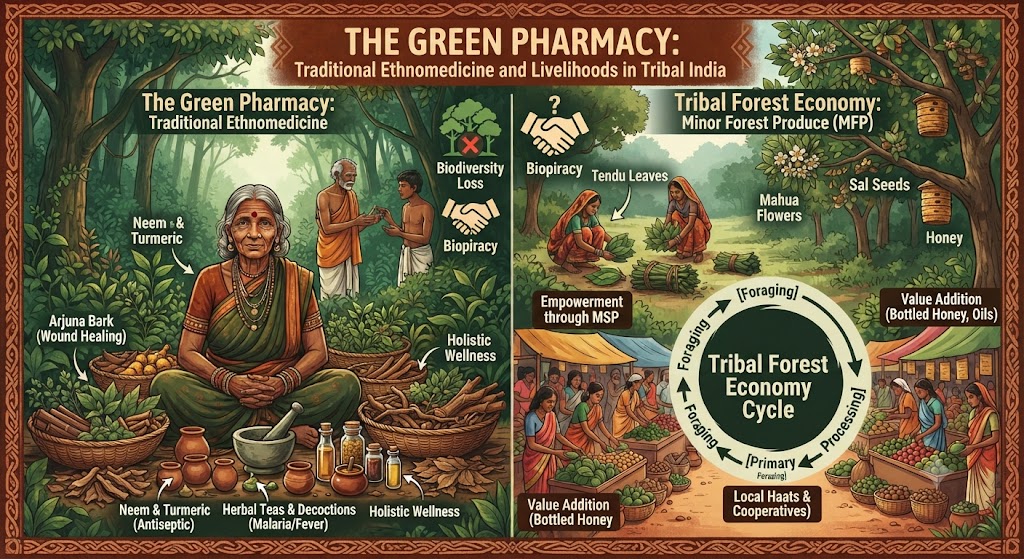
1. The Forest as a Lifeline: An Introduction to Tribal Demographics and Dependence
The relationship between India’s tribal communities and their forest environments is rooted in millennia of harmonious coexistence. Unlike modern industrial systems that view nature primarily as a stock of raw materials, Adivasi worldviews perceive the forest as a living entity, a provider, and an ancestor.
The legal architecture governing this relationship has evolved through struggles for recognition. The landmark Scheduled Tribes and Other Traditional Forest Dwellers (Recognition of Forest Rights) Act, 2006 (commonly known as the Forest Rights Act or FRA) was enacted precisely to redress the “historical injustice” meted out to forest-dwelling communities whose rights over land and habitat were systematically ignored during colonial and post-colonial eras. Yet, balancing conservation policies with the daily survival needs of these communities remains a critical socioeconomic challenge in contemporary India.
2. Food Security: The Forest Pantry
For millions of Adivasis, the forest is the ultimate supermarket—one that requires no currency, issues no receipts, and provides a remarkably diverse and resilient diet. While mainstream diets rely heavily on a few staple grains, tribal diets are characterised by a staggering bio-cultural diversity drawn directly from wild flora and fauna.
Wild Edibles and Nutritional Buffers
-
Tubers and Roots: During times of drought or pre-harvest agricultural scarcity (often called the “lean months”), deep-rooting forest tubers serve as vital safety nets against starvation.
-
Flowers and Fruits: Mahua (Madhuca indica) flowers, for instance, are a cornerstone of tribal life in central India. They are eaten raw, cooked, dried for storage, or fermented, providing crucial carbohydrates and minerals. Tamarind, amla, jackfruit, and numerous wild berries supplement vital vitamins and micronutrients.
-
Leafy Greens: Chakoda leaves, bamboo shoots, and various wild ferns are harvested seasonally, enriching diets with iron, calcium, and essential amino acids.
How Indian tribes depend on the forest – Hunting, Fishing, and Protein Sources
Traditionally, small-scale hunting and river/stream fishing provided essential animal proteins. While strict wildlife protection laws (such as the Wildlife Protection Act of 1972) have drastically curtailed traditional hunting practices, forest streams, wetlands, and seasonal foraging still supply fish, crabs, snails, and insects that form crucial components of rural tribal nutrition.
3. The Green Pharmacy: Traditional Ethnomedicine
Long before modern pharmaceuticals reached rural India, indigenous communities developed sophisticated systems of healthcare based entirely on forest biodiversity. Known as ethnomedicine or tribal traditional medicine, this knowledge is handed down orally through generations, often guarded by community shamans, traditional healers, and village elders (Vaidyas or Baidyas).
The Scale of Ethnomedicinal Knowledge
India is home to over 8,000 medicinal plant species, a vast majority of which thrive in forested ecosystems. Tribal communities possess empirical knowledge of the precise uses, harvesting seasons, and preparation methods for thousands of these plants.
-
Wound Healing and Antiseptics: Barks of trees like arjuna or leaves of specific creepers are crushed into pastes to treat cuts, burns, and snakebites instantly.
-
Preventive and Holistic Care: Rather than focusing solely on symptom suppression, tribal medicine often incorporates dietary adjustments, herbal teas, and spiritual wellness rooted in the harmony of body and nature.
Biodiversity Loss and Intellectual Property
Today, this invaluable bio-cultural heritage faces threats from two distinct directions:
-
Deforestation and Habitat Loss: As forests shrink or degrade due to commercial logging, mining, and infrastructure projects, medicinal flora disappears before it can even be scientifically cataloged.
-
Biopiracy and Erosion of Knowledge: Younger generations, drawn toward modern lifestyles and formal education, often fail to inherit traditional healing arts. Simultaneously, pharmaceutical companies have historically capitalised on indigenous knowledge without securing prior informed consent or sharing economic benefits with tribal custodians.
4. Livelihoods and the Economy of Minor Forest Produce (MFP)
Beyond immediate subsistence, forests are the engines of the tribal cash economy. While agriculture provides seasonal yields, year-round survival depends heavily on the collection, processing, and sale of Minor Forest Produce (MFP).
What is Minor Forest Produce?
Minor forest produce encompasses all non-timber forest products of plant and animal origin. This includes:
-
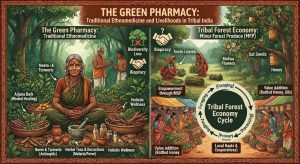
Tendu Leaves: Used extensively across central India to wrap bidis (indigenous cigarettes). The collection of tendu leaves is a major seasonal employment generator, employing millions of tribal women.
-
Gum Karaya, Sal Seeds, and Mahua: Vital raw materials utilised in food processing, cosmetics, and pharmaceuticals.
-
Resins, Gums, Lac, and Honey: Harvested skilfully from deep within the forest canopy, requiring intimate knowledge of tree biology and bee behavior.
+-----------------------------------------------------------------+
|               The Tribal Forest Economy Cycle                   |
|                                                                 |
|  [Sustainable Foraging] ---> [Primary Processing]               |
|           ^                            |                        |
|           |                            v                        |
|   [Fair Pricing / MSP] <--- [Local Haats & Cooperatives]        |
+-----------------------------------------------------------------+
Economic Vulnerability and State Intervention
Historically, tribal gatherers faced severe exploitation by local middlemen and traders who paid abysmal prices for hard-earned forest goods. To counter this, the Government of India introduced the Mechanism for Marketing of Minor Forest Produce (MFP) through the Minimum Support Price (MSP) and Development of Value Chain for MFP scheme. Implemented via agencies like TRIFED, this initiative guarantees minimum safety-net prices for dozens of forest items, empowering local Gram Sabhas (village assemblies) and cooperative societies to manage trade locally.
Value addition—such as processing raw honey into bottled organic honey or cold-pressing oil from mahua seeds locally rather than selling raw materials cheaply—has begun transforming local tribal economies into more resilient enterprises.
5. Cultural, Spiritual, and Social Architecture
Sacred Groves and Conservation Ethics
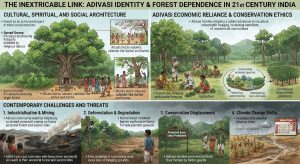
Across India—from the Sarnas of Jharkhand to the Devarakadu of the Western Ghats—tribal communities protect patches of virgin forests known as sacred groves.
-
These spaces are shielded by deep-seated religious taboos: cutting wood, hunting animals, or even plucking leaves within a sacred grove is strictly forbidden.
Rituals Tied to Forest Cycles
Tribal festivals coincide meticulously with nature’s calendar.
-
Karma is dedicated to the worship of the Karam tree, invoking fertility, strength, and community well-being.
6. Contemporary Challenges and Threats to Forest Dependence
Despite constitutional safeguards, legal frameworks like the Forest Rights Act, and welfare programs, India’s forest-dependent tribes face compounding crises in the 21st century.
| Challenge Area | Description | Impact on Tribal Communities |
| Industrialisation & Mining | Large-scale coal mining, bauxite extraction, and iron ore projects in central and eastern India. | Displacement from ancestral lands, destruction of sacred sites, and severe water/air pollution. |
| Deforestation & Degradation | Commercial monoculture plantations (like teak or eucalyptus) replacing mixed native forests. | Loss of wild foods, medicinal plants, and traditional foraging grounds. |
| Conservation Displacement | “Fortress conservation” models evicting tribals from protected areas (national parks and tiger reserves). | Alienation from traditional livelihoods and erosion of community-based conservation stewardship. |
| Climate Change Shifts | Unpredictable rainfall patterns, prolonged droughts, and shifting flowering times of trees like Mahua. | Disruption of traditional agricultural and foraging calendars, leading to acute seasonal food insecurity. |
7. The Path Forward: Securing Rights and Sustainable Futures
Protecting India’s forest-dependent tribes is not merely a matter of social justice or welfare distribution; it is a vital strategy for global ecological preservation. Empirical studies consistently demonstrate that forests managed by indigenous communities boast lower deforestation rates and higher biodiversity than government-managed commercial blocks.
Moving forward, effective stewardship requires:
-
Expanding Value-Chain Infrastructure: Empowering tribal cooperatives with modern processing tools so that wealth is retained locally rather than extracted by urban conglomerates.
Conclusion
The story of India’s tribal communities is a powerful testament to the viability of a life lived in balance with the natural world. From the food on their plates to the medicines that heal their wounds, and from the seasonal cash in their pockets to the gods they worship beneath ancient canopies, the forest is the very breath of Adivasi society.
As India charts its path toward modern economic development, recognizing, respecting, and fiercely protecting the rights of these forest custodians is essential—not only to preserve a rich tapestry of human culture, but to safeguard the green lungs that sustain the entire subcontinent.
