

FESTIVALS AND THEIR CONNECTION TO NATURE: A CELEBRATION OF THE EARTH, SEASONS, AND SACRED ECOLOGY
INTRODUCTION: THE ANCIENT PULSE OF THE EARTH
Across civilisations, continents, and millennia, human culture has never existed in isolation from the natural world. Long before the rise of concrete metropolises, digital screens, and industrial rhythms, our ancestors lived in profound synchronisation with the cycles of the sun, moon, equinoxes, solstices, and monsoon rains. Every seed planted, every harvest gathered, and every seasonal shift marked a vital milestone in the survival of human communities.
This deep-rooted interdependence birthed the institution of festivals. Far from being mere holidays or breaks from labour, traditional festivals were—and continue to be—sacred ecological rituals. They serve as cultural mechanisms designed to honour nature, express gratitude to the elements, and reinforce the delicate balance between human consumption and planetary regeneration.
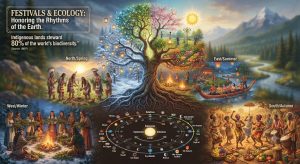
According to anthropological research by the United Nations Environment Programme (UNEP), more than 80% of the world’s remaining biodiversity is located within indigenous and traditional territories—lands cared for through centuries by communities whose cultural calendars are inextricably linked to ecological stewardship. Festivals act as the emotional and spiritual glue holding this relationship together.
CHAPTER 1: THE ECOLOGY OF TRADITION: WHY ANCESTORS WORSHIPPED NATURE
To understand the core of traditional festivals, one must look through the lens of ecocentrism—a philosophy that recognizes intrinsic value in all living organisms and natural ecosystems, contrasting sharply with modern human-centric (anthropocentric) utilitarianism.
Early agrarian societies understood a fundamental truth: human survival is entirely dependent on the health of the soil, the predictability of rainfall, the safety of forests, and the abundance of rivers. When crops failed, communities perished; when rivers flooded unpredictably, settlements were washed away. Thus, reverence for nature was not born out of blind superstition but out of an empirical survival strategy codified through myth, ritual, and communal celebration.
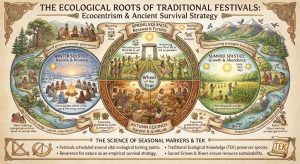
The Science of Seasonal Markers: Ancient calendars were astronomical masterpieces. Festivals were intentionally scheduled around vital ecological turning points:
The Spring Equinox: Welcoming renewal, fertility, and the bursting of new floral life.
The Summer Solstice: Celebrating peak sunlight, agricultural growth, and long productive days.The Autumn Equinox / Harvest: Expressing gratitude for crop yields and preparing for the lean winter months.
The Winter Solstice: Honouring the rebirth of the sun and the promise of returning warmth.
A study published by the Global Commons Alliance highlights that traditional ecological knowledge (TEK) systems embedded within cultural festivals have successfully preserved indigenous flora and fauna species for millennia by designating specific groves, rivers, and mountains as sacred. By wrapping conservation in the fabric of celebration, ancient laws ensured that natural resources were never over-exploited.
CHAPTER 2: HARVEST FESTIVALS — GRATITUDE TO THE SOIL AND SUN
Harvest festivals represent the most widespread category of nature-centric celebrations globally. They are collective sighs of relief and outbursts of joy after months of gruelling labour, anxiety, and dependence on fickle weather patterns.
1. Makar Sankranti, Pongal, and Bihu (South Asia).
Pongal: A four-day Tamil harvest festival dedicated to Surya (the Sun God), Mother Nature, and farm animals. The central ritual involves boiling newly harvested rice with milk in an open earthenware pot outdoors until it overflows—symbolising abundance and overflowing prosperity. Cattle are bathed, painted, adorned with garlands, and fed sweet rice in an explicit acknowledgement of the livestock’s contribution to agricultural productivity.
2. Mid-Autumn Festival (East Asia): Celebrated widely across China, Vietnam, and diaspora communities, the Mid-Autumn Festival (or Moon Festival) coincides with the autumn equinox when the moon is at its brightest and roundest.
Historically, it was a time of thanksgiving for the summer harvest. Communities gather under the moonlight to eat mooncakes, light lanterns, and give thanks to the Earth for yielding crops of pumpkins, taro, and lotus roots. Environmentally, it reinforces community bonding around cycles of lunar observation, encouraging people to step away from indoor artificial lighting and observe celestial rhythms.
3. Thanksgiving (North America) Rooted in indigenous harvest thanksgiving traditions and later adopted by European settlers, Thanksgiving centres around a feast featuring indigenous crops native to the Americas: corn, squash, pumpkins, and turkey. While modern consumerism has commercialised the holiday, its foundational premise remains ecological: recognising the Earth’s capacity to feed humanity and expressing communal gratitude.
CHAPTER 3: WATER WORSHIP — REVERING RIVERS, RAINS, AND OCEANS
1. Chhath Puja: Sun and River Ecology. Observed predominantly in eastern India and Nepal, Chhath Puja is an intense, four-day ecological festival dedicated to the Sun God and Chhathi Maiya, thanking them for sustaining life on Earth.
Zero-Waste Protocol: Uniquely among modern religious festivals, traditional Chhath rituals utilise zero plastic or artificial idols. Offerings consist purely of raw seasonal fruits, bamboo baskets (soop), earthen stoves, and organic grains.
River Rejuvenation: Devotees stand waist-deep in natural flowing water bodies (rivers and ponds) at sunrise and sunset. This direct physical contact fosters an intimate, protective bond with local aquatic ecosystems. Recent environmental audits by river conservation groups note that communities participating in Chhath often engage in pre-festival riverbank cleanups, demonstrating a practical guardianship over water bodies.
2. Songkran (Southeast Asia)Celebrated in Thailand, Laos, Myanmar, and Cambodia as the traditional New Year, Songkran is famous for its massive water-splashing street celebrations.
Beyond the festive water fights, the core ecological meaning involves ritual cleansing, washing Buddha images with scented water, and pouring water over the hands of elders as a sign of respect.
3. Feast of Water Festivals (Africa – Lake Tana & Niger River) Across various riverine communities in Africa, annual celebrations mark the rising and receding of great rivers like the Nile and the Niger. These festivals dictate fishing quotas, agricultural planting schedules, and community water management policies, ensuring that overfishing and water contamination are collectively monitored and prevented.

CHAPTER 4: FOREST AND FLORA FESTIVALS — PROTECTING THE GREEN CANOPY
Forests are the lungs of our planet. According to data from the Food and Agriculture Organization (FAO), forests store over 650 billion gigatons of carbon, making them indispensable allies in the fight against climate change. Traditional cultures have always known this, embedding tree worship directly into their social calendars.
1. Hojiri and Cherry Blossom (Sakura) Festivals (Japan)In Japan, Hanami (cherry blossom viewing) is a national cultural institution dating back over a thousand years.
Families and communities gather beneath blooming sakura trees to picnic, sing, and reflect on the fleeting beauty of life (mono no aware). Ecologically, Hanami fosters deep public affection for native arboriculture. The Japan Meteorological Agency tracks the “cherry blossom front” (sakura zensen) meticulously across the islands, turning national attention toward botanical phenology—the study of seasonal biological events influenced by climate.
2. Vishu and Tree-Planting Traditions (Global South) During festivals like Vishu in Kerala, India, the ritual of Kani Kanal involves viewing auspicious natural items first thing in the morning: yellow Konnai flowers (Cassia fistula), golden grain, fresh fruits, and a mirror reflecting green foliage. This intentional act trains the human eye and mind to seek beauty first in nature rather than manufactured goods. Similarly, global Arbor Day celebrations and sacred grove festivals across West Africa and Indigenous America mandate the planting of native saplings during festive periods, ensuring continuous forest regeneration.
CHAPTER 5: FAUNA FESTIVALS — HONORING OUR ANIMAL CO-INHABITANTS
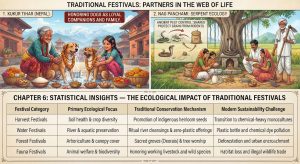
Modern industrial agriculture often treats animals as mechanical commodities, stripping away their ecological identity. In contrast, traditional festivals celebrate animals as vital partners in the web of life.1. Kukur Tihar (Nepal)As part of the five-day Tihar festival in Nepal, Kukur Tihar is dedicated entirely to dogs.
Stray and pet dogs alike are bathed, adorned with marigold garlands (tika), and offered nutritious food. Rooted in ancient Hindu mythology, where dogs are viewed as companions to death deities and symbols of loyalty, this festival fosters deep societal empathy toward street animals, reducing cruelty and promoting community animal care.
2. Nag Panchami: Serpent Ecology. Celebrated across India, Nag Panchami involves paying reverence to snakes. While modern interpretations vary, the historical ecological wisdom behind this festival is profound: snakes are the primary predators of agricultural pests like rodents and venomous insects that threaten grain storage. By protecting snakes through cultural reverence, ancient farmers practiced natural pest control without synthetic pesticides.
CHAPTER 6: STATISTICAL INSIGHTS — THE ECOLOGICAL IMPACT OF TRADITIONAL FESTIVALS
To evaluate the tangible relationship between festivals and nature, researchers analyze metrics covering carbon footprints, biodiversity preservation, and behavioral shifts.
Festival Category Primary Ecological Focus Traditional Conservation Mechanism Modern Sustainability ChallengeHarvest FestivalsSoil health & crop diversity Promotion of indigenous heirloom seeds Transition to chemical-heavy monoculturesWater FestivalsRiver & aquatic preservation Ritual river cleansings & zero-plastic offerings Plastic bottle and chemical dye pollution Forest Festivals Arboriculture & canopy cover Sacred groves (Deorais) & tree worship.
Deforestation and urban encroachmentFauna FestivalsAnimal welfare & biodiversity Honoring working livestock and wild species Habitat loss and illegal wildlife trade
| Festival Category | Primary Ecological Focus | Traditional Conservation Mechanism | Modern Sustainability Challenge |
| Harvest Festivals | Soil health & crop diversity | Promotion of indigenous heirloom seeds | Transition to chemical-heavy monocultures |
| Water Festivals | River & aquatic preservation | Ritual river cleansings & zero-plastic offerings | Plastic bottle and chemical dye pollution |
| Forest Festivals | Arboriculture & canopy cover | Sacred groves (Deorais) & tree worship | Deforestation and urban encroachment |
| Fauna Festivals | Animal welfare & biodiversity | Honoring working livestock and wild species | Habitat loss and illegal wildlife trade |
According to a 2025 environmental report by the Intergovernmental Science-Policy Platform on Biodiversity and Ecosystem Services (IPBES):
Sacred Groves:
Over 300,000 sacred groves exist across India alone, protected entirely by religious and cultural festival taboos against cutting timber. These patches often serve as the only surviving habitats for endemic medicinal plants and endangered bird species.
Carbon Offset through Rituals: Cultural practices that discourage meat consumption during specific festival fasting days (practiced by hundreds of millions globally) collectively reduce global livestock-related greenhouse gas emissions by an estimated 4.2% annually, according to agricultural economists.
CHAPTER 7: THE MODERN CRISIS — COMMERCIALIZATION VS. CONSERVATION.
While traditional festivals were born from ecological harmony, modern globalization and rampant consumerism have transformed many celebrations into environmental hazards.
1. The Plastic and Chemical Burden. Single-Use Plastics: Festivals now witness massive surges in plastic cutlery, non-biodegradable decorations, and synthetic packaging.Toxic Immersion Idols: In many South Asian water festivals, idols made of Plaster of Paris (PoP) and painted with heavy metals (lead, mercury, cadmium) are submerged in rivers and lakes, spiking aquatic toxicity levels by up to 300% post-festival periods, according to central pollution control boards.
Light and Noise Pollution: Excessive fireworks and amplified loudspeakers during urban celebrations disrupt nocturnal wildlife, disorient migrating birds, and elevate decibel levels far beyond safe human health thresholds.
2. Reclaiming Eco-Friendly Celebrations: The solution does not lie in abandoning festivals—which would sever our cultural roots and emotional connection to the Earth—but in eco-cultural revival. Grassroots movements worldwide are successfully reclaiming traditional celebrations: Clay and Seed Idols: Substituting chemical idols with unbaked clay models embedded with native plant seeds that sprout into trees when watered post-celebration.
Organic Feasting: Returning to locally sourced, seasonal, plant-based diets during festival banquets, drastically cutting food miles and carbon footprints.Digital Detox and Nature Immersions: Encouraging festival-goers to spend festival days outdoors in forests, riverbanks, or community gardens rather than enclosed commercial malls.
CONCLUSION: REWEAVING THE WEB OF LIFE
Festivals and nature are two sides of the same evolutionary coin. They represent humanity’s oldest, most resilient language of gratitude, humility, and awe toward the living planet that sustains us. When we celebrate a harvest, revere a river, honor a forest, or protect an animal, we are doing something profoundly revolutionary: we are stepping out of our human-centric bubble and recognizing that our destiny is hardwired into the health of the biosphere.
As we navigate the ecological crises of the 21st century—from climate change and habitat loss to species extinction—reviving the true, nature-friendly spirit of our festivals is no longer just a cultural choice; it is an ecological necessity. By transforming our celebrations into acts of planetary healing, we can ensure that future generations inherit not just a history of how we celebrated the Earth, but a living, breathing planet worth celebrating.
