
Digital Skills for Tribal Youth
Given the current improvements in communication systems, if we are to keep pace with the developed world, we must place special emphasis on our ‘Digital Skills for Tribal Youth’ programme.
Across the globe, indigenous and tribal communities preserve some of the planet’s deepest reservoirs of ecological wisdom, linguistic heritage, and sustainable living practices.
Yet, as the world transitions at breakneck speed into an automated, knowledge-driven global economy, tribal youth frequently find themselves positioned at the sharpest edge of the digital divide.
For decades, geographic isolation, socioeconomic marginalisation, and institutional neglect have threatened to lock successive generations of indigenous young people out of modern economic life.
Today, a fundamental paradigm shift is underway. Connectivity and digital literacy are no longer viewed merely as consumer conveniences; they have become foundational civil rights, equivalent to clean drinking water, electricity, and primary healthcare.
Equipping tribal youth with digital capabilities does not require erasing cultural heritage in the name of assimilation. When designed with indigenous sovereignty and agency at the centre, digital skills training empowers youth to document endangered oral histories, launch independent green enterprises, access advanced telemedicine and distance education, and participate in global civic discourse on their own terms.
Achieving this requires looking beyond optimistic rhetoric. Bridging the gap requires an honest assessment of the global and regional digital divide, verifiable data on educational and economic outcomes, and an examination of the systemic bottlenecks that continue to hinder progress.
The Modern Imperative: Why Digital Literacy is Foundational for Tribal Communities
To understand why digital empowerment matters so acutely for tribal populations, one must first recognize the structural barriers that have historically circumscribed their opportunities:
-
Geographic and Infrastructural Insulation: Many tribal hamlets, reservations, and ancestral territories are situated in topographically rugged zones—dense forests, high mountain valleys, arid deserts, or fragmented archipelagos. Traditional brick-and-mortar infrastructure, from paved transport corridors to physical banking institutions and accredited vocational training colleges, often stops dozens of miles before reaching these settlements.
-
Economic Vulnerability and Informality: Without certified, marketable technical skills, indigenous youth are overwhelmingly pushed into the unorganised labour market. In regions ranging from Latin America and Sub-Saharan Africa to Central and South Asia, tribal youth depend disproportionately on subsistence agriculture, seasonal manual wage labor, or low-margin artisanal crafts brokered by predatory middlemen.
-
The Velocity of the Knowledge Economy: The modern global workforce increasingly demands digital fluency. Routine administrative tasks, agricultural logistics, supply chain monitoring, and customer services are digitalised. An individual without basic digital literacy is rendered economically invisible.
Digital literacy is the master key that unlocks access to every other developmental pillar. When a young indigenous person learns how to utilise a networked device, navigate cloud-based educational platforms, process digital transactions, and critically evaluate online information, the penalty of physical distance is dramatically reduced. It provides an immediate pipeline to:
-
Accredited secondary and tertiary education through open digital repositories.
-
High-yield financial tools via decentralised, mobile-first banking architectures.
-
Direct-to-consumer digital marketplaces that eliminate exploitative regional intermediaries.
-
Global advocacy platforms where tribal youth can directly represent their communities in climate change summits, human rights forums, and international land rights councils.
Transforming Everyday Reality: Quality of Life, Healthcare, and Civic Governance
The most immediate and tangible impact of digital competency is realized in everyday living conditions. For communities situated hours or days away from administrative capitals, digital tools streamline access to basic human essentials.
Telemedicine and Preventative Community Health
Tribal tracts face chronic deficits in healthcare personnel. Primary health centres in remote zones frequently operate without diagnostic instruments or specialized doctors.
Digital skills training transforms local youth into frontline community health advocates. Equipped with point-of-care digital diagnostic kits, pulse oximeters, smart glucometers, and telemedicine software:
-
Trained youth can record clinical vitals, securely upload patient histories to cloud servers, and facilitate live teleconsultations between community elders and medical specialists based in metropolitan teaching hospitals.
-
During epidemiological outbreaks (such as waterborne pathogens or respiratory viruses), digitally literate youth can collect geospatial health data via open-source mobile forms (such as KoboToolbox or ODK), mapping clusters in real time to alert regional health authorities.
-
Digital literacy enables youth to counter digital health misinformation circulating via encrypted chat apps, translating verified public health advisories into local indigenous dialects.
Digital Identity and Direct Benefit Transfers
Historically, welfare delivery to indigenous regions was plagued by administrative leakages, phantom beneficiaries, and bureaucratic gatekeeping. Tribal citizens routinely lost significant portions of state subsidies simply by paying for transit to distant regional administrative offices.
With the proliferation of sovereign digital identity systems and mobile banking platforms, digital literacy gives youth the autonomy to navigate government welfare portals independently. They can:
-
Apply for educational scholarships, agricultural crop insurance compensations, and housing grants without relying on commission-charging intermediaries.
-
Track municipal budgets, verify land title records via digitised land registries, and file administrative appeals when basic public utilities fail.
-
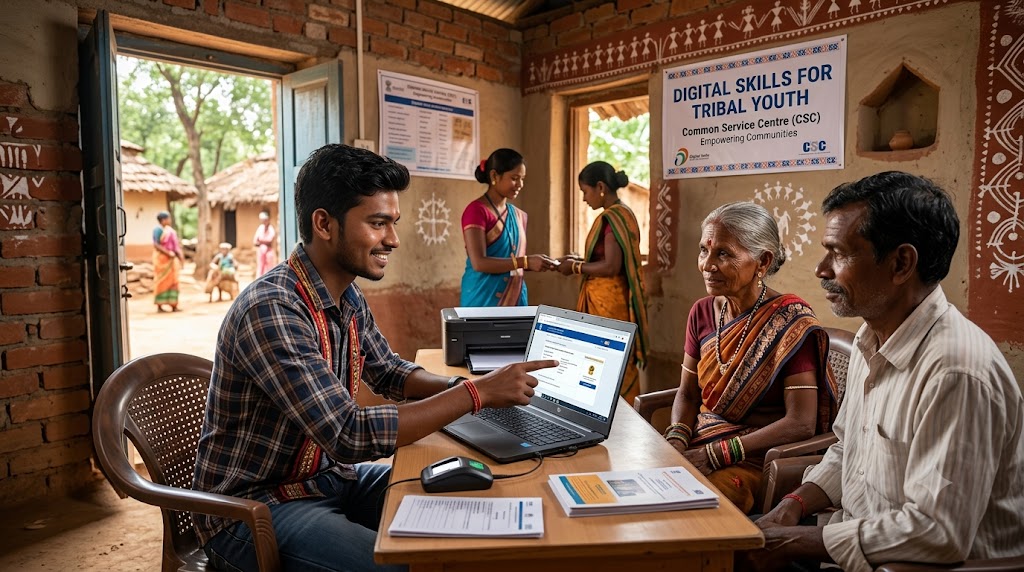
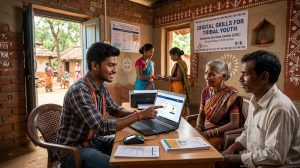
Operate decentralised Common Service Centres (CSCs) or digital kiosks within their own villages, transforming civic assistance into a sustainable micro-enterprise while helping non-literate community members access their statutory entitlements.
Re-Engineering the Economic Trajectory: Employment and Entrepreneurship
Entry-Level IT, Remote Freelancing, and the Gig Economy
The rapid mainstreaming of distributed, remote work models has opened unprecedented economic avenues for tribal young adults who master practical digital competencies:
-
Data Annotation, Processing, and AI Model Tuning: The global artificial intelligence and machine learning ecosystem relies on vast volumes of human-curated training data. With targeted, short-cycle training in computer basics, image segmentation, optical character recognition (OCR) correction, and audio labelling, tribal youth can access freelance annotation platforms.
-
Localised Content Creation and Translation: Natural Language Processing (NLP) models are expanding into regional and indigenous languages. Tribal youth who possess bilingual digital fluency are uniquely qualified to work as cultural annotators, dialect translators, and localisation testers for educational technology firms, government communication arms, and global NGOs.
-
Web Design, Social Media Management, and Remote Administration: Proficiency in responsive web platforms (such as WordPress, Shopify, and Webflow), search engine optimisation (SEO), and digital content design allows indigenous creators to secure retainers from national and international clients without leaving their ancestral homes.
Tribal E-Commerce and Decoupling from Middlemen
Indigenous artisans, organic farmers, and herbalists possess extraordinary traditional knowledge, producing unique textiles, forest products, and handcrafts. Yet, traditionally, up to 70% to 85% of the final retail margin on these goods was captured by urban consolidators, traders, and logistics aggregators.
Traditional Tribal Supply Chain (Predatory Margins):
[Tribal Producer] ──(Earns 10-15%)──> [Local Moneylender/Middleman] ──> [Regional Wholesaler] ──> [Urban Retailer] ──> [End Consumer]

Digitally Enabled Sovereign Supply Chain (Direct-to-Consumer):
[Tribal Producer/Youth Co-Op] ──(Retains 75-85%)──> [E-Commerce Platform / Social Commerce] ──> [End Consumer]
When tribal youth are trained in product photography, inventory management, digital payment processing, and social media marketing:
-
They form local producer co-operatives that sell directly to global consumers through e-commerce marketplaces and direct-to-consumer websites.
-
They leverage geographical indication (GI) tags and fair-trade certifications, embedding their community’s unique cultural narratives directly into the product branding.
-
Profits are funnelled directly back into local village economies, stabilising household finances and establishing autonomous economic security.
The Hard Reality: Assessing Global and Regional Progress Through Data
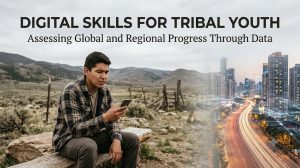
While individual success stories illustrate the potential of digital transformation, an honest macro-level assessment reveals a stark and persistent shortfall. Has the global development apparatus fulfilled its promises to tribal youth? Empirical evidence paints a sobering picture.
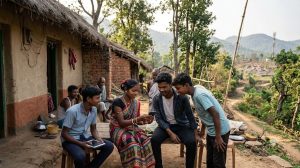
The Connectivity and Infrastructure Deficit
According to data compiled by the International Telecommunication Union (ITU) and the United Nations:
-
In the United States, data from the Federal Communications Commission (FCC) and the National Congress of American Indians (NCAI) reveals that approximately 18% of residents living on tribal lands lack access to standard broadband services, compared to just 4% of Americans nationwide. Independent academic studies suggest the actual unserved figure exceeds 30% when mobile broadband speeds and real-world latency thresholds are factored in.
-
In Latin America, the Economic Commission for Latin America and the Caribbean (ECLAC) found that in countries such as Bolivia, Guatemala, and Peru, the digital gap between indigenous and non-indigenous households exceeds 25 to 30 percentage points in personal computer ownership and stable domestic internet access.
-
Across India, home to over 104 million Scheduled Tribe (ST) citizens (comprising 8.6% of the national population per the Census):
-
The Ministry of Communications reports that thousands of tribal-majority villages still lack stable 4G/5G mobile tower connectivity.
-
According to the Unified District Information System for Education Plus (UDISE+), fewer than 30% of government schools in designated tribal (ITDA) districts possess functional computer laboratories with broadband access, compared to an urban national average exceeding 70%.
-
The National Family Health Survey (NFHS-5) demonstrated that while digital adoption among Indian women has grown, only 30% to 35% of rural tribal women reported ever having used the internet, in contrast to over 60% of urban women.
-
| Region / Metric | National / Urban Average | Indigenous / Tribal Land Average | Disparity Gap |
| U.S. Broadband Access (FCC Standards) | 96% | ~70% – 82% | 14% – 26% Deficit |
| India: School Computer Labs (UDISE+) | ~72% (Urban) | <30% (Tribal Districts) | >42% Deficit |
| Latin America: Household PC Ownership | ~45% – 55% | ~15% – 20% | 30% Deficit |
| Sub-Saharan Africa: Rural Device Ownership | ~40% (National Avg) | <12% (Nomadic/Forest Groups) | 28% Deficit |
Educational Attrition and Skills Polarization
Infrastructure is only the first hurdle. The educational pipeline reveals an even sharper drop-off:
-
Primary-to-Tertiary Dropout Rates: In indigenous-dominated zones, secondary school dropout rates are disproportionately high. In India’s Scheduled Tribe communities, gross enrollment ratios (GER) drop precipitously from over 95% at the primary level down to less than 15% at the higher education level. Because most advanced digital skills training (coding, systems administration, software testing) is taught at the tertiary level in urban technical universities, tribal youth are systemically excluded before they even reach the age of specialized vocational training.
-
The Hardware-to-Pedagogy Mismatch: In many public sector initiatives, policy success has been conflated with hardware distribution. Thousands of computers have been procured and delivered to remote community centers, only to sit unused in unopened boxes due to unmetered power outages, lack of technician support, or the absence of certified computer instructors who speak the indigenous language.
-
The Gender Divide within Marginalized Groups: Within tribal communities, young women face compounded exclusion. Cultural expectations regarding domestic labor, early marriage pressures, and unequal household resource allocation mean that when a single smartphone enters an underprivileged tribal household, it is almost exclusively monopolized by adult men.
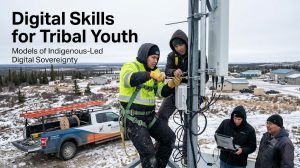
Global Case Studies: Models of Indigenous-Led Digital Sovereignty
Despite these structural hurdles, breakthrough initiatives around the world demonstrate that sustainable change is possible when tribal youth take ownership of technology design, deployment, and governance.
Case 1: First Mile Connectivity Consortium (FMCC) – Canada
In the remote, sub-arctic reaches of Northern Canada, commercial telecommunications providers historically refused to lay fiber networks, claiming the tiny populations of First Nations reserves did not justify capital expenditures.
The First Mile Connectivity Consortium (FMCC) completely upended this dynamic:
-
First Nations communities organized their own community-owned internet service providers (ISPs).
-
Indigenous youth were recruited and trained as network engineers, cable splicers, and server technicians.
-
These young technicians climbed towers, configured low-orbit satellite downlinks, and ran local Wi-Fi meshes across their communities.
-
By treating broadband as public community infrastructure rather than an extractive corporate commodity, the FMCC lowered internet costs, created high-paying technical jobs for local youth, and kept financial returns within the tribal governance network.
Case 2: The GOAL (Going Online as Leaders) Initiative – India
Launched as a joint venture between the Ministry of Tribal Affairs and industry stakeholders, the GOAL Programme targets rural tribal youth across India’s core tribal belts (including Jharkhand, Odisha, Madhya Pradesh, and Chhattisgarh).
-
The initiative matches young tribal women and men with seasoned urban professionals in business, digital marketing, and governance for long-term digital mentorship.
-
Participants receive a connected mobile device, data allowances, and a structured curriculum focused on entrepreneurship, online safety, and digital financial management.
-
Graduates have established local honey and wild-harvested agricultural collectives, built direct e-commerce stores, and taken on roles as master trainers who run digital workshops for village self-help groups (SHGs).
Case 3: Indigenous Mapping and Territorial Defense in the Amazon Basin
Across Brazil, Colombia, and Ecuador, indigenous groups face illegal deforestation, wildcat mining, and violent land encroachment. Tribal federations have joined forces with open-source technology platforms to train indigenous youth in digital cartography and spatial monitoring:
-
Using hand-held GPS loggers, open-source smartphone applications (such as Mapeo), and commercial off-the-shelf camera drones, young indigenous rangers document illegal logging activities within protected ancestral forest reserves.
-
They process spatial metadata, construct tamper-evident digital legal dossiers, and cross-reference their ground-truth data with high-resolution satellite imagery from Global Forest Watch.
-
Rather than relying on distant, slow-moving bureaucratic agencies, these digitally literate rangers broadcast real-time spatial evidence directly to international courts, human rights tribunals, and global media outlets, deterring land grabbers and protecting fragile ecosystems.
Beyond Economics: Cultural Preservation, Sovereignty, and Global Voice
A common misconception among traditionalists is that the introduction of modern computing technology inevitably erodes tribal culture, accelerates language loss, and causes indigenous youth to abandon their roots. When deployed with cultural intentionality, the reality is the exact opposite: digital tools are proving to be powerful instruments for cultural renaissance and linguistic defense.
                  Digital Media Infrastructure
            ┌───────────────────┼───────────────────┐
            │                   │                   │
            ▼                   ▼                   ▼
    Living Lexicons      Oral Traditions      Augmented Reality
(Audio apps, dictionary  (Crowdsourced video   (Virtual preservation
 databases, predictive   repositories, cloud-   of sacred historical
      keyboards)          hosted elder lore)        monuments)
Digital Lexicography and Rescuing Endangered Languages
According to UNESCO, of the world’s estimated 7,000 languages, more than 50% could become extinct by the end of this century—the overwhelming majority being unwritten or low-resource indigenous tongues. When an elder passes away without their language being documented, centuries of botanical, philosophical, and ecological knowledge vanish with them.
Indigenous youth are turning this tide through digital archiving:
-
Mobile Dictionaries and Living Lexicons: Youth developers collaborate with linguistics institutions to build mobile dictionary apps that record pronunciation, colloquial expressions, and grammatical syntax directly from elderly native speakers.
-
Predictive Typing Keyboards and Unicode Standardization: Indigenous software engineers have successfully campaigned to standardize tribal writing scripts into the international Unicode Consortium. Developing custom Android and iOS keyboards for native alphabets enables young community members to text, post on social media, and write emails in their mother tongue.
-
Automated Translation Platforms: Community-led projects are feeding indigenous linguistic corpora into open-source machine learning translation platforms, lowering the linguistic barrier between indigenous vernaculars and dominant international languages.
Democratizing Oral History and Media Sovereignty
Tribal histories have historically been written through the extractive lens of non-indigenous anthropologists, historians, and commercial film crews. Digital media production puts editorial power back into the hands of tribal youth:
-
Sovereign Podcasting and YouTube Channels: Armed with entry-level video cameras, open-source video editing suites, and podcasting tools, indigenous storytellers broadcast unvarnished narratives regarding tribal folklore, cultural ceremonies, environmental stewardship, and modern community challenges.
-
Virtual Reality (VR) and 3D Photogrammetry: Young native technologists are deploying drone photogrammetry and LIDAR scanning to create high-resolution 3D virtual archives of sacred geographical landmarks, rock art, and ceremonial artifacts, preserving their spatial heritage against environmental degradation and climate disruptions.
Structural Bottlenecks: Why Most Digital Skills Initiatives Falter
To construct interventions that deliver long-term value, policymakers, non-profit organizations, and corporate social responsibility (CSR) programs must address the structural failure points that have derailed previous initiatives.
The Five Critical Fault Lines
[The Digital Enablement Chasm]
1. Grid Instability    ──> Devices idle; intermittent blackouts
2. Curricular Alienation──> Urban models fail in tribal realities
3. Language Monoculture ──> English-only interfaces exclude learners
4. Hardware Abandonment ──> Broken hardware sits discarded; zero local repair
5. Connectivity Costs   ──> Data packages unaffordable; connectivity lapses
-
Grid Instability and the Energy Deficit: You cannot power an internet economy on a failing electrical grid. Hundreds of computing centers established in rural tribal schools sit dark for days at a time due to chronic voltage drops, load shedding, and storm damage. Any digital skills program that fails to bundle decentralized, off-grid solar energy infrastructure with its computing hardware is fundamentally compromised from day one.
-
Pedagogical and Curricular Alienation: Standardized corporate training curricula designed for urban software hubs fall flat in tribal classrooms. Teaching an indigenous student who has limited exposure to formal banking how to build a mock stock-trading dashboard or enterprise sales funnel is pedagogically counterproductive. Curricula must be rooted in immediate local utility—such as managing agricultural yields, mapping regional forest flora, organizing eco-tourism bookings, or administering local governance records.
-
Linguistic Exclusion and Monoculture: The global internet remains overwhelmingly dominated by a handful of languages, primarily English, Mandarin, Spanish, and regional dominant tongues. When educational software interfaces, coding documentation, and support manuals are unavailable in local dialects, the cognitive friction of learning is doubled: the student must master a foreign language before they can begin to learn computer science.
-
Hardware Lifecycle and the Absence of Repair Ecosystems: Most development programs focus entirely on capital expenditure (procuring new hardware) while completely neglecting operational expenditure (ongoing maintenance). In humid, dusty, or rugged tropical environments, computing electronics experience accelerated failure rates. When a display fails, a keyboard shorts, or a battery dies, the nearest authorized repair technician is often a five-hour journey away. Without training local youth in hardware maintenance, repair, and component salvage, computer laboratories rapidly turn into e-waste depots.
-
Data Poverty and the Cost of Bandwidth: For subsistence-level tribal households, purchasing monthly recurring high-speed cellular data packages is an unsustainable economic burden. Once initial project subsidies expire, devices are frequently relegated to offline media players, cutting the user off from the interactive digital world.
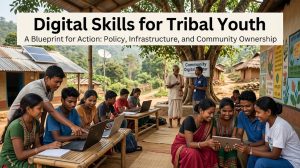
A Blueprint for Action: Policy, Infrastructure, and Community Ownership
To dismantle these systemic roadblocks, national governments, international aid agencies, educational institutions, and private industry must abandon short-term hardware giveaways in favor of an integrated, community-led framework for digital empowerment.
       Integrated Architecture for Tribal Digital Empowerment
┌─────────────────────────────────────────────────────────────────┐
│                    COMMUNITY STEWARDSHIP                        │
│   Indigenous-governed councils; cultural curriculum clearance   │
├───────────────────────────────┬─────────────────────────────────┤
│    RENEWABLE INFRASTRUCTURE   │    SOVEREIGN LOCAL NETWORKS     │
│   Decentralized solar-battery │   Mesh topologies, community    │
│   microgrids for classrooms   │   ISPs, low-orbit satellite     │
├───────────────────────────────┼─────────────────────────────────┤
│     PEDAGOGICAL REALISM       │       CIRCULAR HARDWARE         │
│   Vernacular-first interfaces │   Hardware repair certifications│
│   Contextual, practical apps  │   Self-sufficient repair kiosks │
└───────────────────────────────┴─────────────────────────────────┘
1. Mandating Indigenous Data Sovereignty (IDS) and Community Governance
Digital literacy projects should never be imposed by external actors without the free, prior, and informed consent (FPIC) of tribal governing councils:
-
Tribal communities must retain full legal ownership, copyright, and control over all cultural, spatial, and linguistic data generated through digital literacy programs.
-
Elder councils and local youth committees must hold veto authority over how community archives, spatial boundaries, and oral histories are digitized, stored, and shared online.
-
External technology companies must not be allowed to treat indigenous populations as testing grounds for unproven algorithms or as captive markets for proprietary software platforms.
2. Investing in Decentralized, Solar-Powered Digital Hubs
Infrastructure must be re-engineered around the realities of rural geography:
-
Deploy low-cost, offline-first digital learning caches—such as Rachel (Remote Area Community Hotspot for Education and Learning) servers. These localized intranet boxes broadcast an entire digital library (Wikipedia, Khan Academy, open-source textbooks, coding sandboxes) over a localized Wi-Fi signal across an entire village, requiring zero cellular data or active internet connection.
3. Vocationalizing Hardware Repair and Systems Engineering
Digital skilling initiatives must balance software training with hands-on mechanical and electronic instruction:
-
Youth should be certified in low-level electronics repair, circuit soldering, screen replacement, and battery rebuilding.
-
Establishing locally owned, youth-run hardware repair kiosks ensures that village computing infrastructure remains operational for years after initial procurement.
-
Training local teams to install, orient, and maintain community mesh networks and satellite transceivers creates high-wage technical employment within the village, ending perpetual dependence on external urban technicians.
4. Co-Designing Contextual, Vernacular Curricula
Educational materials must be contextualized to indigenous realities:
-
Curricula must be translated into indigenous languages, pairing visual, audio-led instructions with local allegories and culturally familiar metaphors.
-
Practical training should focus directly on local empowerment: teaching students how to run automated irrigation sensors, manage inventory for agricultural self-help groups, fly drones for pest monitoring, and navigate digital government transparency portals.
-
Advanced technical subjects—such as Python coding, cloud database architecture, and cybersecurity—should be introduced systematically, paired with remote mentorship programs connecting students with experienced indigenous technologists from around the world.
5. Institutionalizing Public Procurement and Corporate Commitments
The corporate world and public administrations must transition from patronizing charity models to commercial integration:
-
Governments should establish legal mandates allocating a dedicated percentage of national IT outsourcing, data digitization, and archival contracts exclusively to certified indigenous youth enterprises.
-
Tech corporations must expand targeted apprenticeships, remote paid internships, and localized scholarship pipelines specifically reserved for indigenous applicants.
-
Telecommunications regulatory bodies must enforce aggressive universal service fund (USF) mandates, requiring private telecom operators to deploy real high-speed infrastructure across underserved tribal geographies as an absolute condition of maintaining their lucrative urban spectrum licenses.
Realizing the Vision: A Call for Generational Investment
The digital revolution is the most transformative economic, cultural, and political force of our era. Left unguided, it risks deepening historic disparities, reducing marginalized indigenous communities to disconnected observers in an automated, hyper-connected world.
Equipping tribal youth with digital skills is not about homogenization, nor is it an attempt to draw indigenous youth away from their ancestral lands, traditions, and families. When executed with respect, systemic commitment, and indigenous leadership, technology serves as an instrument of cultural resilience, economic sovereignty, and environmental stewardship.
Historic Reality:                     Modern Sovereign Vision:
[Geographic & Digital Isolation]  ──> [Digitally Connected Indigenous Hubs]
             │                                     │
   Marginalized Economy               Autonomous Sustainable Enterprises
   Language & Cultural Loss            Digital Archiving & Living Lexicons
   Bureaucratic Gatekeeping            Direct Citizen Empowerment & Rights
By providing tribal youth with reliable digital tools, durable renewable infrastructure, and practical training, the global community does not simply check off a corporate social responsibility objective. It restores agency to a generation of young leaders uniquely positioned to bridge deep ancestral wisdom with cutting-edge innovation—securing their rightful place as equal architects of our shared global future.
