
Traditional Tribal Food of India: Heritage, Ecology, and Culinary Diversity
Across dense deciduous forests, windswept high-altitude plateaus, riverine valleys, and sun-baked hill tracts, traditional tribal food of India has been shaped by direct relationships with local landscapes. For centuries, India’s Adivasi and Indigenous peoples have gathered wild foods, cultivated ancestral heirloom grains, harvested seasonal river fish, and preserved ingredients without artificial chemicals or modern industrial equipment.
Food in these communities is rarely viewed as a mere commodity. It represents an intricate living archive of ecological observation, cultural history, family memory, and social solidarity. What grows on a steep terrace, what flowers in a Sal forest after early rains, and what settles into an earthen pot during an autumn festival are bound to the rhythms of the earth. These culinary practices preserve local seed heritage, support biodiversity, and celebrate communal resilience.
In a globalised world grappling with monoculture farming, soil exhaustion, and climate disruptions, the traditional food of Indian tribes offers vital lessons. Exploring these culinary traditions helps us recognise Indigenous knowledge as sophisticated science and living cultural heritage. Understanding these meals allows us to appreciate a richer, more diverse narrative of Indian cuisine, moving beyond restaurant menus to celebrate the communities that have nourished the subcontinent’s ecological foundations.
Understanding Traditional Tribal Food in India
India is home to over 705 officially recognised Scheduled Tribe communities, comprising roughly 8.6 percent of the nation’s total population. Each group maintains distinct linguistic, cultural, and geographic roots. Because of this vast geographic distribution—stretching from the snowbound trans-Himalayan ridges to the tropical rainforests of the Western Ghats—there is no single, uniform “tribal cuisine” in India.
Instead, Indigenous food culture in India reflects hyper-local ecologies. The daily diet of an Irula family living in the Nilgiri foothills has little in common with that of an Angami Naga farmer in the hills of Nagaland or a Baiga household in the Maikal Range of Madhya Pradesh. Food practices are shaped by soil chemistry, rainfall, elevation, forest rights, customary laws, and ancestral agricultural systems.
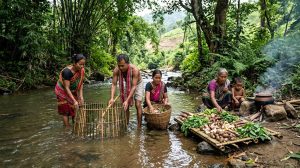
Traditional livelihoods have historically balanced shifting cultivation (swidden or jhum), settled terrace farming, pastoralism, and foraging. Hunting and trapping, where documented historically, were practiced under strict customary guidelines, though modern wildlife laws and environmental conservation frameworks have substantially altered these practices. Gathering forest foods—such as shoots, tubers, leafy greens, wild mushrooms, and medicinal herbs—remains an indispensable part of life for forest-dwelling communities. Riverine and wetland tribes rely heavily on fishing, employing handcrafted bamboo traps, natural plant-based fish stupefacients, and tidal barriers.
Local Ecosystem: Forests, Foothills, River Valleys |
||
Gathered Forest Foods |
Cultivated Crops |
Seasonal Waters |
Wild tubers & shoots |
Millets & coarse grains |
River fish & crabs |
Uncultivated greens |
Heirloom rice varieties |
Wetland snails |
Flowers & wild fruits |
Native legumes & beans |
Leaf-steamed foods |
Traditional Household Table |
||
Guided by seasonal cycles, kinship, and preservation |
||
Food habits also shift within communities based on seasonal rhythms, religious ceremonies, family means, and nearby open-air weekly markets (haats). A rainy monsoon evening brings fresh wild greens, mushrooms, and tender bamboo shoots. In contrast, dry winter and summer months require sun-dried grains, dehydrated vegetables, fermented pastes, and smoked meats. Viewing Indigenous food traditions through a single lens misrepresents their depth. Tribal cuisine of India is best understood as a mosaic of resilient regional food cultures.
Major Ingredients in Tribal Food
The ingredients found in Indigenous kitchens reflect self-reliance and intimate botanical knowledge. Unlike industrial food systems that rely heavily on a small handful of genetically uniform crops, tribal diets draw from an astonishingly broad range of cultivated grains, domestic livestock, river catches, and uncultivated wild plants.
Category |
Documented Regional Ingredients |
Millets & Small Grains |
Mandia / Ragi (Finger millet), Kodo, Kutki (Little millet), Sanwa (Barnyard millet) |
Forest Greens & Shoots |
Chakod, Kanda bhaji, Koilar leaves, Bathua,Tender bamboo shoots (fresh, dried, fermented) |
Tubers & Uncultivated Forest Roots |
Tarro, Dioscorea yam varieties (Kanda/Alu), Mahua flowers, Sal seeds, Char/Chironji nuts |
Legumes & Seeds |
Kurthi (Horse gram), Rice beans, Perilla seeds (Bhangjeera), Niger seeds (Ramtil) |
Millets and Coarse Grains
Millets represent the historical backbone of food security across central, western, and southern Indigenous belts. These hardy, drought-tolerant C4 crops thrive in poor, rain-fed soils without synthetic fertilizers. Ragi (finger millet, known locally as mandia in Eastern India), kodo millet, kutki (little millet), jowar (sorghum), and bajra (pearl millet) have supplied sustained energy for generations. They are traditionally ground on stone slabs and turned into thick porridges, steamed cakes, unleavened flatbreads, and fermented gruels.
Rice and Native Cereals
Rice serves as the staple grain in high-rainfall regions across Eastern, Central, and Northeastern India. Indigenous farmers have safeguarded hundreds of heirloom landraces of paddy. Many of these varieties offer natural resistance to flooding, drought, and pests, alongside distinct aromas, colors, and nutritional profiles. In upland communities, sticky (glutinous) rice, red rice, and black rice are steamed in bamboo tubes, wrapped in broad leaves, or pounded into breakfast cakes. In hilly tracts, maize (corn) complements rice, cooked on open embers or milled into coarse meal.
Pulses, Native Beans, and Oilseeds
Plant proteins come from locally adapted legumes, such as horse gram (kulthi), black gram (urad), cowpeas, pigeon peas (arhar), and native rice beans. These pulses are prepared as light, comforting broths tempered with minimal spices. Cold-pressed or stone-crushed oils from niger seeds (ramtil), mustard seeds, wild mahua seeds (tora), and perilla seeds (bhangjeera) provide vital fats while imparting earthy flavors to cooked greens and vegetable curries.
Forest Foods, Wild Greens, and Edible Flowers
Uncultivated forest foods bridge seasonal hunger periods and add crucial micronutrients to the plate. Women often identify dozens of wild leafy greens (saag or bhaji), such as chakod (Cassia tora), kanda bhaji, gandhari, koilar (Bauhinia purpurea), and wild amaranth.
Edible flowers are seasonal treasures. The pale cream blossoms of the Mahua tree (Madhuca longifolia) are celebrated across central and eastern India. Collected at dawn, dried under the sun, and eaten raw, roasted, or boiled with grains, mahua is also brewed into a customary spirit central to community life. In the eastern forests, the fleshy calyx of the red silk cotton flower (semal) and the sour leaves of wild roselle (kudrum) lend bright, tart notes to soups and chutneys.
Tubers, Roots, and Wild Mushrooms
Underground storage organs—such as wild yams (Dioscorea species), colocasia (arbi), and tapioca—are gathered using digging sticks from forest floors and riverbanks. Many wild tubers carry bitter toxins or high levels of calcium oxalate crystals. To make them safe and tender, communities use generational processing knowledge: peeling, soaking in running streams for hours, boiling repeatedly with wood ash, and roasting over glowing coals. During the warm, humid monsoon, diverse wild mushrooms (chhatu) emerge around termite mounds and rotting Sal wood, valued as seasonal delicacies.
Animal Foods and Aquatic Life
Where geographically and culturally documented, animal proteins supplement the diet. Communities living near rivers, mountain streams, and wetlands catch freshwater fish, tiny stream shrimps, river snails, and freshwater crabs. In Northeastern states, along with parts of Central and Southern India, farm-raised pork, wild game birds (historically), free-range poultry, and backyard goats are prepared during gatherings. Pastoral communities in the western and Himalayan regions weave sheep, goat, and yak milk, along with clarified butter and dried cheese curds, into their daily bread and tea.
Traditional Tribal Foods Across Different Regions
Traditional tribal dishes differ dramatically as one journeys across the Indian subcontinent. The natural surroundings, seasonal weather patterns, and heritage of each community shape its unique culinary identity.
REGIONAL HIGHLIGHTS OF INDIGENOUS FOOD CULTURES |
|
Himalayan Region |
Gujjar, Bakarwal, Bhotia
|
Western India |
Bhil, Warli, Rathwa
|
Central India |
Baiga, Gond, Maria
|
Eastern India |
Santhal, Munda, Oraon, Ho
|
Northeastern |
Angami, Ao, Khasi, Garo, Mizo
|
Southern India |
Toda, Irula, Kurumba, Soliga
|
Eastern India: The Forest Plateaus of Jharkhand, Odisha, and West Bengal
Eastern India’s Chota Nagpur Plateau and adjoining hill tracts are home to communities including the Santhal, Munda, Oraon, Ho, and Kondh. Here, culinary traditions draw from deciduous Sal and Mahua forests alongside rain-fed paddy lands.
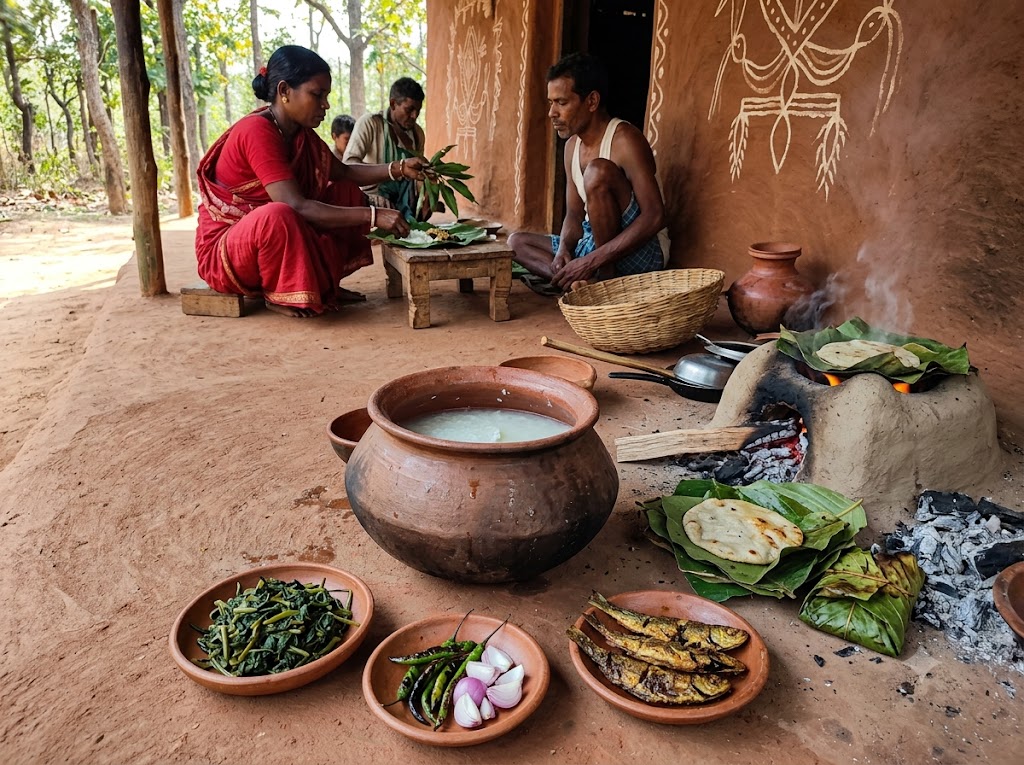
A cornerstone of daily nutrition is fermented rice gruel, known as pakhala in Odisha or diku dak mandi in Santhali. Cooked rice is submerged in clean water and allowed to ferment overnight in an unglazed earthenware vessel. By morning, the natural lactic acid fermentation cools the dish, enriches its B-vitamin profile, and provides steady hydration for farmers working long hours in summer heat. It is served with pan-roasted wild leafy greens, charred green chilies, raw onions, and roasted river fish.
Another iconic preparation is the Pitha, a steamed or roasted cake made from freshly pounded rice flour or finger millet paste. During harvest festivals, Santhal and Munda households fill pithas with roasted Mahua flowers, lentils, or grated coconut before wrapping them in sal leaves and steaming them over open pots.
Cooking within green leaves—a widespread technique known as patra puda or jhoro jhori—preserves moisture and flavor without commercial cookware. Fresh catches of small stream fish or uncultivated mushrooms are seasoned with wild mustard paste, salt, and crushed green chilies. The mixture is wrapped inside multiple layers of Sal (Shorea robusta) or Siali (Bauhinia vahlii) leaves, tied with plant fibers, and buried beneath hot wood embers. The leaves char slowly, infusing the contents with a deep, woodsy aroma.
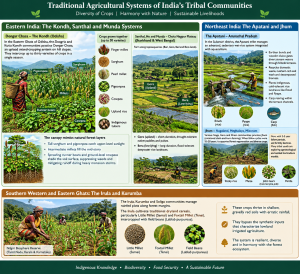
Forest foraging remains essential for the Kondh of southern Odisha. Kondh women harvest dozens of wild food varieties throughout the year, including forest tubers, wild jackfruit seeds, and kandul (local pigeon peas), showing how community food habits flow directly from seasonal forest cycles.
Central India: The Heartlands of Madhya Pradesh and Chhattisgarh
The hill tracts and river basins of Central India are home to the Gond, Baiga, Korku, and Bhil. The Baiga, traditionally semi-nomadic shifting cultivators who identify as caretakers of the earth, have preserved extensive knowledge of wild tubers, forest roots, and rain-fed millets.
A signature element of Central Indian tribal cuisine is Pej, a nourishing, drinkable porridge cooked from broken rice, kodo millet, or kutki (little millet). Water left over from boiling the grains is whipped with the cooked cereal into a light, warm soup, seasoned simply with a pinch of rock salt. Baiga and Gond workers drink a large bowl of pej at sunrise before heading into the fields, carrying extra in dried bottle gourds (tumba) to stay energized until late afternoon.
Edible forest flowers are central to this regional diet. Mahua blossoms are gathered in early spring, dried on swept earth, and cooked with roasted sal seeds, parched gram, or ground millets to make a sweet, restorative dish called lata. When summer draws near and grain bins run low, Mahua provides a dependable, calorie-rich safety net.
In the Bastar district of Chhattisgarh, the Maria and Muria Gond communities prepare Chaprah, a pungent, sour chutney made from red weaver ants (Oecophylla smaragdina) and their protein-rich eggs. Collected carefully from high tree canopies, the ants are crushed with ginger, garlic, salt, and fiery red chilies. The natural formic acid in the ants lends a sharp, tart kick, creating a condiment valued for its punchy flavor and digestive qualities.
Northeastern India: Mountain Valleys, Smoked Meats, and Fermentation
The mountainous expanses of Northeast India host hundreds of distinct ethnic communities, including the diverse Naga groups (such as the Angami, Ao, Sumi, and Konyak), the Khasi, Garo, and Jaintia of Meghalaya, and the Mizo of Mizoram.
Fermentation stands at the core of northeastern Indigenous cooking. It preserves perishable harvests across humid summers and cool winters while developing savory umami profiles. In Nagaland, the Sumi Naga prepare Akhuni (or axone), made by boiling local soybeans, wrapping them in banana leaves, and setting them beside the hearth to ferment for several days. Once aged, the darkened, pungent beans are mashed into cakes and added to slow-simmered stews featuring garden vegetables, smoked pork, and the fiery Bhut Jolokia (ghost pepper).
Similarly, the Khasi and Jaintia communities of Meghalaya make Tungrymbai, a fermented soybean preparation cooked with crushed black sesame seeds, ginger, garlic, and pieces of pork to yield a thick, hearty stew. The Garo community prepares Nakham Bichi, a warming, light soup made from sun-dried or fire-smoked fish, boiled with vegetables, chilies, and kachi—a natural alkaline liquid filtered through the ashes of dry banana peels.
Tender bamboo shoots (bastanga in Nagaland, soidon in Manipur) are harvested during the monsoon, sliced thin, and fermented in large wooden or bamboo vats. The resulting sour shoots are added to vegetable broths, fish curries, and wild greens.
Cooking directly inside fresh, hollow bamboo culms is widely practiced. Sticky rice, river fish, or chicken pieces seasoned with mountain herbs are packed into green bamboo tubes plugged with wild leaves and laid horizontally over glowing embers. As the green bamboo heats, its interior juices steam the food, imparting a delicate, sweet aroma that metal cookware cannot match.
Southern India: The Forests and Slopes of the Western and Eastern Ghats
The hilly, biodiverse ranges of southern India are home to ancient communities, including the Toda, Irula, and Kurumba of the Nilgiris, alongside the Soliga of the Biligirirangana Hills in Karnataka.
The Toda, an indigenous pastoral community residing on the high Nilgiri plateau, maintain a unique vegetarian food tradition centered entirely on water buffalo herds. Buffalo milk is transformed through sacred dairy practices into curd, buttermilk, and rich clarified butter (ghee). Toda daily meals feature rice boiled in fresh buffalo milk, accompanied by thick buttermilk curries and wild vegetables gathered from the surrounding shola grasslands.
In contrast, the neighboring Irula and Kurumba communities have long held deep expertise as forest foragers, herbalists, and traditional honey harvesters. Irula food traditions highlight small millets—especially finger millet (ragi)—ground by hand and cooked into smooth, dense dumplings known as ragi mudde or kali. These nutritious dumplings are paired with broths made from field crabs, river snails, or foraged greens like pannai keerai (Celosia argentea).
The Soliga people of Karnataka live alongside the wildlife of dry deciduous and evergreen forests. They collect wild tubers (nodi kanda) and harvest wild fruits like Indian gooseberry (amla). A traditional Soliga meal features wild greens stewed with horse gram (kulthi) and seasoned with tamarind and crushed bird’s eye chilies. Soliga families are renowned for gathering wild comb honey, consuming it fresh alongside coarse, comforting millet porridge.
Western India: The Coastal and Arid Foothills of Maharashtra and Gujarat
In Western India, across the Sahyadri mountains and arid plains of Maharashtra, Gujarat, and southern Rajasthan, dwell the Warli, Bhil, Kokna, and Rathwa communities.
The Warli, famous for their ritual wall paintings that celebrate nature spirits and harvest cycles, rely on coarse cereals, wild tubers, and seasonal vegetables. A core staple of Warli cuisine is Nagli Bhakri, an unleavened, thick flatbread made from red finger millet flour (nagli or nachni). Kneaded with warm water and patted out entirely by hand, it is baked on a shallow earthenware griddle (tava) over a wood fire until lightly blistered.
Warli meals pair bhakri with simple preparations of wild seasonal vegetables like shevla (Amorphophallus commutatus), an uncultivated aroid that appears only during the first monsoon showers. Because fresh shevla contains throat-irritating calcium oxalate crystals, it is traditionally cooked with the sour pod of the kakad tree (Garuga pinnata), whose natural acids neutralize the sting and leave the vegetable savory and tender.
Himalayan and Sub-Himalayan Regions: High Valleys and Mountain Passes
In the sub-Himalayan hills and trans-Himalayan highlands of Jammu & Kashmir, Himachal Pradesh, Uttarakhand, and Sikkim, Indigenous communities such as the Gaddi, Bakarwal, Bhotia, and Lepcha have adapted their diets to high altitudes and severe winter cold.
The semi-nomadic Gaddi and Bakarwal pastoralists cross high mountain passes with their flocks of sheep and goats. Their traditional diet leans on portable, energy-dense staples: parched barley flour (sattu), unrefined sheep-milk cheeses, and thick buckwheat flatbreads (kuttu ki roti). Gaddi herders make simple open-fire breads kneaded with goat milk and salt, paired with wild mountain greens like bicchu buti (stinging nettle), which is safely gathered with wooden tongs and boiled into a restorative, iron-rich soup.
In Ladakh and parts of Sikkim, Bhotia and trans-Himalayan communities depend on Chhurpi, a dense, naturally dried cheese made from the milk of yaks or mountain cows (dzos). Fresh curd is pressed dry in wooden frames and hung above cooking hearths to cure in fragrant woodsmoke. Once fully hardened, chhurpi can be stored for months without spoiling. Herders chew small cubes slowly on long treks to ward off cold and hunger, or simmer the cheese in vegetable soups seasoned with mountain garlic.
In Sikkim and northern West Bengal, the Lepcha prepare wild ferns (linguda), stinging nettles, and buckwheat groats, pairing them with homemade fermented soybean condiments and fermented finger millet beverages (chhang) served in tall, warm bamboo flagons during snowbound winter evenings.
Traditional Cooking Methods and Food Preservation
Traditional cooking methods in Indigenous communities are models of resourcefulness and ecological harmony. Using little or no industrial machinery, these techniques maximize flavor, conserve firewood, protect vital nutrients, and preserve seasonal surpluses for leaner months.
Cooking Method |
Process & Implements |
Primary Purpose |
Boiling & Porridge (*Pej*, *Rabdi*) |
Unglazed clay pots, hollow bamboo, simmering in water/buttermilk |
Retains complex B-vitamins and preserves hydration |
Leaf Wrapping(Patra Puda) |
Enclosed in Sal, Siali, or banana leaves; buried in live coals |
Retains moisture, eliminates need for commercial fats |
Bamboo Steaming |
Green bamboo tubes plugged with leaves, placed over embers |
Imparts subtle resinous wood aroma; even steaming |
Solid Fermentation (Soybeans, Bamboo) |
Natural microbial wild inoculation inside leaf packs beside hearths |
Builds umami, preserves proteins, aids digestion |
Smoking & Curing (Fish, Meats, Curds) |
Suspended on wooden racks above continuous domestic hearth fires |
Dries meats/cheeses; wards off mold and insects |
Clay, Wood, and Embers: Gentle, Low-Fuel Cooking
The primary cookware of traditional tribal kitchens is the unglazed earthenware pot (handi). Porous clay distributes heat slowly and evenly, allowing tough tubers, coarse pulses, and whole millets to soften gently without burning. Because clay is naturally alkaline, it interacts with acidic ingredients, yielding mellow, well-balanced flavors without requiring heavy oils or rich spices.
Steaming and roasting in broad forest leaves—such as the glossy leaves of the Sal, broad wild banana leaves, or the leathery foliage of the Siali creeper—eliminates the need for metal pans or processed cooking oils. The natural waxy coatings of these leaves trap steam inside, keeping fish, pounded tubers, and spiced rice exceptionally tender while infusing the meal with subtle forest aromas.
Fermentation: Living Microbes as Natural Preservatives
Fermentation is an essential, highly refined biotechnology developed by Indigenous cultures worldwide. In tropical and subtropical tribal regions where high humidity spoils fresh foods within hours, natural microbial transformation preserves precious calories.
Whether it is the overnight lactic acid fermentation of rice in Eastern India’s pakhala, the fungal and bacterial breakdown of soybeans into akhuni in Nagaland, or the sour aging of bamboo shoots in earthen jars across Northeast India, these processes rely on wild microorganisms.
Fermentation does far more than preserve shelf life: it hydrolyzes stubborn plant carbohydrates, neutralizes bitter anti-nutritional compounds (like tannins and phytates), synthesizes natural B-complex vitamins, and creates savory, complex umami flavors without artificial seasonings.
Dehydration, Hearth-Smoking, and Cold Storage
When summer flushes and autumn harvests bring bounty, Indigenous communities preserve the excess for dry, unproductive seasons:
-
Sun-Drying: Ripe tomatoes, wild mushrooms, leafy greens, Mahua flowers, and small river fish are spread out across hand-woven bamboo mats (chatai) on rooftops or swept courtyards. Dried until crisp, they are stored in hand-woven cane baskets lined with insect-repelling neem leaves.
-
Hearth-Smoking: In hilly, humid climates, domestic hearths are kept burning day and night. Suspended directly above the fireplace is a tiered, slatted wooden or bamboo drying rack. Meats, river fish, seed stocks, and dried cheese curds (chhurpi) are arranged on these shelves. Rising warmth and gentle woodsmoke slowly dehydrate the foods, creating a protective surface barrier that repels insects, prevents mold growth, and deepens flavor.
Food, Festivals, and Community Life
In Indigenous traditions, food is inseparable from spiritual and social life. It bridges the human world with the spirits of ancestors, forest guardians, and the earth itself. Meals serve as expressions of gratitude to nature and symbols of kinship that strengthen communal harmony.
Sacred Nature & Ancestors |
|
Offerings of first |
|
Communal Celebrations |
Strengthened Bonds |
• Sarhul (Sal blossom festival) |
• Cooperative village labor |
• Karma (Branch & dance rite) |
• Kinship & shared meals |
• Wangala (Post-harvest drums) |
• Generational knowledge |
Distributed feast, rice-beer, |
|
Agricultural and Seasonal Festivals
Tribal festivals coincide with seasonal milestones: the arrival of early rains, the clearing of forest terraces, the blooming of sacred trees, and the gathering of golden grain.
During Sarhul, celebrated by the Oraon, Munda, and Santhal communities of Jharkhand, Odisha, and West Bengal, villagers mark the flowering of the sacred Sal tree in early spring. No community member harvests, eats, or gathers new forest produce until the village priest (Pahan) performs sacred rites honoring the earth goddess and distributes fresh sal blossoms. Families cook special batches of sarhul pitha, boiled mahua flowers, and rich broths made from newly emerged field greens.
In Central India, the Karma festival celebrates life, youth, and agricultural growth. Men and women dance hand-in-hand through the night around a planted branch of the sacred Karma tree (Haldina cordifolia), pausing to share steaming bowls of fresh rice-beer, roasted mahua sweets, and comforting millet porridges.
In Meghalaya, the Garo people celebrate Wangala, a post-harvest thanksgiving honoring Misi Saljong, the deity of fertility. Alongside booming two-sided drums, feasts feature fresh sticky rice, spiced pork cooked in bamboo, and cooling gourds of freshly brewed rice wine.
Collective Labor, Hospitality, and Intergenerational Learning
Food traditions play a direct role in maintaining community solidarity through cooperative labor networks. When an Indigenous family clears a hillside terrace, repairs a thatched roof, or transplants a paddy field, neighbors join in without cash payment. Instead, the host family prepares a shared meal: a large copper cauldron of boiled grain, a spicy stew of garden beans or river fish, and freshly tapped toddy or home-brewed rice-beer. This tradition of shared labor and dining ensures that even the most vulnerable households can cultivate their fields.
Culinary knowledge is transmitted through daily participation. Young children walk with their mothers and grandmothers along forest paths, learning to tell delicious wild mushrooms from poisonous varieties, safely dig deep-rooted yams, and strip fibrous bamboo shoots.
Cooking around evening hearth fires provides a natural setting for storytelling, passing down ancestral ethics of conservation: never take more wild yams than the family needs, leave small tubers behind so the vine may regrow next season, and always return thanks to the forest before picking its bounty.
Nutrition and the Value of Indigenous Food Knowledge
Modern nutritional science is discovering that traditional diets often hold remarkable nutritional wisdom. While traditional diets should not be romanticized as complete cures, their wide diversity provides balanced nutrition and natural protection against climate shocks.
Nutritional Asset |
Physiological / Ecological Benefit |
Low-Glycemic Complex Carbohydrates |
Slow carbohydrate release; reduces the risk |
High Dietary Fiber |
Supports healthy gut microbiomes; aids natural digestive motility of rapid blood-glucose spikes |
Wild Micronutrient Density |
Deep-rooted plants draw iron, zinc, and calcium naturally from undisturbed soils |
Uncultivated Biodiversity & Agro-Resilience |
Natural insurance against crop failures, droughts, and sudden climate shifts |
Dietary Diversity and Micronutrient Wealth
Unlike urban food systems that rely heavily on polished white rice, refined wheat flour, and refined sugars, traditional tribal diets incorporate diverse whole grains, wild-foraged leafy greens, and native legumes.
Millets like ragi contain high levels of plant-based calcium, vital for bone health where dairy access is limited. Small millets such as kodo, kutki, and barnyard millet offer low glycemic index values, releasing carbohydrates slowly into the bloodstream and providing sustained energy for physical labor without causing rapid blood sugar spikes.
Wild-harvested forest vegetables and leafy greens (saag) are rich in essential micronutrients, including iron, beta-carotene (provitamin A), folate, and bioavailable calcium. Because these wild plants grow in deep, undisturbed forest soils, they often absorb higher mineral concentrations than commercial vegetables raised with synthetic fertilizers in worn agricultural soils.
Traditional fermentation techniques further enhance this nutritional profile by breaking down anti-nutrients like phytic acid—which otherwise limits iron and zinc absorption—making these vital minerals much easier for the human digestive tract to take in.
Climate Resilience and Agricultural Diversity
Indigenous food systems represent a living library of climate-resilient agriculture. Heirloom paddy varieties preserved by tribal farmers can survive unexpected droughts, resist common pests, or withstand days submerged under monsoon floods.
By growing diverse polycultures—often mixing several varieties of millets, native corn, climbing beans, oilseeds, and garden gourds in a single plot—Indigenous farmers spread their environmental risk. If unpredictable weather ruins one crop, others survive to feed the family. This agricultural diversity is an invaluable shield against the growing uncertainties of global climate change.
Challenges Facing Traditional Tribal Food Systems
Despite their cultural and nutritional richness, India’s traditional tribal foodways face intense pressures. Rapid industrialization, environmental shifts, and shifting economic policies have weakened these ancient food pathways.
PRESSURES ON INDIGENOUS FOOD SYSTEMS |
|
Deforestation & Enclosure |
Loss of access to customary wild foods |
Monoculture Cash Cropping |
Displacement of native millets & pulses |
Changing Livelihoods |
Generational loss of botanical memory |
Ultra-Processed Foods |
Spread of refined sugars, oils, & salts |
Diminished Forest Access and Land-Use Changes
The disruption of traditional forest gathering is a major blow to Indigenous food security. Large-scale infrastructure projects, open-cast mining, commercial timber plantations, and changing forest policies have limited community access to ancestral foraging grounds.
When wild Sal and Mahua forests are cleared for commercial eucalyptus or teak monocultures, forest floors lose the rich biodiversity of wild yams, mushrooms, and seasonal greens that families have relied on for generations.
Loss of Heirloom Seeds and Agricultural Shifts
State-sponsored agricultural programs over the past half-century have heavily subsidized hybrid varieties of white rice and wheat, nudging farmers away from hardy traditional grains. Millions of tribal farmers have replaced complex, biodiverse millet and legume plots with monoculture cash crops like commercial cotton, soy, or hybrid corn.
This transition has accelerated the loss of irreplaceable heirloom seeds and made farming families vulnerable to volatile market prices, expensive synthetic inputs, and unpredictable crop failures.
The Double Burden of Malnutrition
The transition away from traditional foodways has contributed to a double burden of malnutrition across many tribal areas:
-
Persistent Deficiencies: The loss of nutrient-dense wild greens, forest fruits, and diverse millets has fueled ongoing iron-deficiency anemia among women and under-five child stunting.
-
Rise of Lifestyle Diseases: Subsidized refined white rice, cheap palm oil, and store-bought ultra-processed snacks have entered everyday diets. This sudden influx of refined carbohydrates, trans fats, and sodium has driven a steep rise in modern lifestyle diseases—including type 2 diabetes, hypertension, and cardiovascular issues—among communities whose metabolisms developed on high-fiber, low-glycemic, natural diets.
Cultural Erosion and Generational Gaps
As younger generations leave rural homelands for urban work and schooling, the oral transmission of food traditions is breaking down. City life often carries social biases that mislabel traditional forest foods and millets as “backward” or “poor,” encouraging youth to adopt convenient, heavily marketed processed diets.
Without ongoing practice, intricate botanical knowledge—knowing how to locate, harvest, detoxify, and prepare wild forest foods—can fade away in a single generation.
Preserving and Celebrating Traditional Tribal Food
Safeguarding India’s Indigenous culinary heritage requires active, respectful collaboration that honors the communities who created it. Preservation is not about freezing communities in time; it means empowering Indigenous people to protect their cultural knowledge, land rights, and dietary health on their own terms.
Indigenous Food Sovereignty |
||
Community-Led Archives |
Agroecological Support |
Market Autonomy |
• Participatory mapping |
• Seed-saving libraries |
• Fair value chains |
• Consent-based records |
• Inclusion in school meals |
• Community-owned brands |
• Protection of IP rights |
• Millet revival missions |
• Protection from piracy |
Community-Led Documentation and Ethical Research
Food research must center on the consent, agency, and dignity of Indigenous communities. Too often, outside researchers and commercial brands collect traditional recipes, medicinal knowledge, and local seed varieties without returning benefits to the original knowledge-holders.
Documentation projects should be led by community members, using local languages and participatory methods to create open community archives. Indigenous intellectual property rights must be rigorously protected against biopiracy and unauthorized commercial exploitation.
Reviving Millets and Supporting Sustainable Farming
Government and grassroots initiatives are beginning to recognize the incredible value of traditional grains. Policies like the National Millet Mission and state-level initiatives—such as the Odisha Millets Mission—demonstrate how public policy can support Indigenous agriculture.
These programs provide fair procurement prices for finger millet and small grains, reintroduce them into public distribution systems (PDS), and include nutritious millet-based hot meals in state primary schools and child-care centers (Anganwadis).
By establishing community seed banks managed by village women’s collectives (Self-Help Groups), farming communities can reclaim control over their seeds, improve soil health, and revive family nutrition.
COMMUNITY SEED BANKS: A VIRTUOUS CYCLE
Native seed saving ──► Zero chemical costs ──► Resilient harvest ──► Seed surplus for bank
Supporting Ethical, Community-Owned Markets
Urban interest in organic, heritage, and functional foods offers promising economic opportunities for tribal farmers, provided they control the value chain.
When Indigenous cooperatives process, package, and market their own products—such as cold-pressed niger seed oil, wild forest honey, sun-dried mahua blossoms, and stone-ground ragi flour—the profits stay in the village.
Urban consumers can support this movement by buying directly from verified tribal cooperatives and fair-trade initiatives, learning about the cultures behind these ingredients, and viewing traditional food not as an exotic novelty, but as a living model of ecological sustainability.
The Living Heritage of Tribal Food
The traditional tribal food of India is far more than an assortment of recipes; it is a philosophy of balance, reciprocity, and respect for nature. From the fermented soybean hearths of Nagaland to the nutrient-rich millet flatbreads of the Western Ghats and the fragrant leaf-wrapped fish of the Chota Nagpur forests, these culinary traditions show that human health is linked directly to the health of the surrounding ecosystem.
Indigenous communities have shown that a food culture can be diverse, delicious, and deeply nourishing without degrading the earth. As we confront widespread environmental shifts, soil exhaustion, and dietary health challenges, the ancestral wisdom held within tribal foodways offers valuable guidance for a more sustainable future.
Honoring this food heritage requires protecting the living forests, clean rivers, and ancestral lands of India’s Indigenous peoples, while respecting their fundamental rights to steward their cultures, diets, and destinies with pride.
