
Evolution and Future of Indigenous Festivals in India: Tradition, Modernity, and Cultural Survival
To discuss the evolution and future of indigenous festivals in India, we need to go back a bit further. For millennia, the indigenous communities of India—known collectively as the Adivasis and comprising hundreds of distinct ethnic groups across the subcontinent—have lived in intimate communion with the land.
Their worldviews, cosmologies, and social structures are mirrored in their festivals: cyclical, vibrant gatherings that celebrate agricultural cycles, seasonal transitions, forest bounties, and ancestral spirits. From the deep sal and mahua forests of central India to the lush, mist-draped hills of the Northeast, indigenous festivals have never been mere spectacles or passive entertainment. They are living systems of ecological knowledge, spiritual reciprocity, and community solidarity.
Yet, contemporary India is undergoing unprecedented socioeconomic transformations. Rapid economic expansion, deep structural urbanisation, digital technology penetration, internal migration, and globalisation are transforming the country’s rural hinterlands. As roads, electricity, consumer culture, and smartphones arrive in remote hamlets, indigenous communities stand at a historic crossroads.
How are centuries-old tribal rituals adapting to modern living rooms, urban housing colonies, and smartphone screens? Are ancient sacred traditions fading away into memory, or are they finding radical new expressions through digital activism and cultural revivalism?
1. The Core Philosophy of Evolution and Future of Indigenous Festivals in Modern India
To understand how tribal festivals are changing, we must first understand what they represent in their authentic, ancestral context. Unlike many mainstream, pan-Indian festivals that centre on codified theological texts or temple-centric idolatry, indigenous celebrations are deeply rooted in:
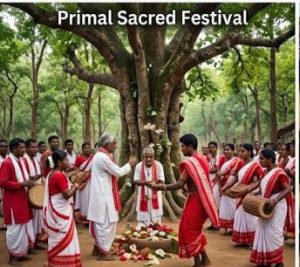
- Ecological Reciprocity: Indigenous festivals are synchronised with nature’s rhythms. The Santal, Munda, Ho, and Oraon communities celebrate Sarhul and Baha Parab when the sal trees (Shorea robusta) blossom in spring, offering the first blooms to the earth spirit (Jaher Era) before anyone is permitted to harvest or wear them. The festival is not merely a social gathering; it is an environmental contract preventing premature deforestation or over-foraging.
- Animism and Sacred Topography: For groups like the Dongria Kondh of Odisha, festivals such as Niyamraja Parab honour the mountain god who protects their sacred hills, streams, and biodiversity. Natural features—hills, rivers, groves (Sarna), and rocks—are treated not as resources to be exploited but as living ancestors and guardians.
- Egalitarianism and Communal Ownership: Traditional celebrations lack rigid hierarchical clergy. Ritual leaders such as the Pahan or Naike operate as community elders rather than exclusive mediators of divine grace. Singing, dancing, food preparation, and ritual offerings involve entire hamlets regardless of wealth, gender, or status.
- Sensory and Oral Epistemology: Knowledge is transmitted through song-poems (durang), oral epics, communal circle dances, handcrafted percussion (such as the tumdak, tamak, and dhol), and indigenous fermentation arts (such as rice beer or handia / apong).
When modern forces interact with this socio-ecological fabric, the ripple effects touch every dimension of tribal life.
2. How Modernisation Has Changed Tribal Festivals
Modernisation in India is not a singular event; it is a complex bundle of formal state education, market capitalism, infrastructure development, religious re-categorisation, and linguistic homogenisation. Each of these forces has left an indelible mark on indigenous festival life.
VECTORS OF MODERNIZATION |
||
Market Economy |
Institutional Education |
Religious Acculturation |
• Cash transactions |
• Youth boarding schools |
• Sanskritization & Proselytism |
• Synthetic goods |
• Disconnect from soil |
• Shifting sacred narratives |
• Sponsored stages |
• Loss of oral fluency |
• Abandonment of animist rites |
The Shift from Subsistence to Cash Economies
Historically, indigenous festivals operated completely outside monetary systems. Communities pooled grains, hunted or foraged communally, brewed traditional beverages using seasonal forest yields, and crafted ornamentation from wild grasses, feathers, and seeds.
Today, the monetised economy has permeated tribal belts:
- Commercial Decorations and Goods: Handwoven plant dyes and handmade leafy garlands are frequently replaced with cheap plastic decorations, synthetic banners, and mass-manufactured artificial flowers.
- Synthetic Beverages: The communal preparation of traditional rice beer or millet brew (chhaang, handia, laopani), which carried sacred ancestral connotations and rich nutritional value, is increasingly substituted or supplemented by commercially bottled alcohol, bringing new public health and domestic challenges into rural spaces.
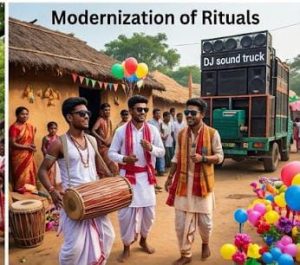
- Hired Sound Systems: The hypnotic, acoustic resonance of ancestral drums made from clay, hollowed wood, and animal hides is frequently displaced by hired diesel-powered generators driving high-decibel “DJ sound trucks.” While youth often welcome these sounds, older elders lament the erosion of subtle, polyrhythmic tribal drumming traditions that historically signalled specific ritual phases.
Ideological Encounters: Sanskritisation and Proselytisation
Tribal communities have historically faced external pressures to assimilate into dominant religious frameworks:
- Sanskritisation: Mainstream religious groups often incorporate tribal deities into regional pantheons, recasting animist spirits as avatars of mainstream deities. Over decades, this gradual transformation has led some communities to introduce idol worship, Brahminical rituals, and vegetarian offerings into celebrations that traditionally centred on blood sacrifices and formless nature spirits.
- Proselytisation and Missionisation: Conversely, widespread conversions to Christianity across parts of the Northeast, central India, and southern tribal belts led to historical periods where traditional animistic rites, trance rituals, and seasonal festivals were discouraged as superstitious or incompatible with newly adopted creeds.
- Modern Re-Negotiation: Today, indigenous communities are actively resisting total erasure. In places like Nagaland, Meghalaya, and Mizoram, contemporary Christians celebrate modified forms of festivals like Moatsü, Wangala, and Chapchar Kut as secular, cultural heritages, preserving the dances, folk attire, and languages while shedding ancestral ritual sacrifices.
3. The Impact of Urbanisation on Traditional Celebrations
Urbanisation represents one of the most visible structural disruptions to tribal lifestyle. As industrial mining, mega-infrastructure projects, ecological degradation, and agrarian distress compress rural livelihoods, millions of indigenous youths migrate toward tier-one and tier-two cities—Ranchi, Bhubaneswar, Kolkata, Delhi, Bengaluru, Mumbai, and Guwahati—seeking education and wage labor.
The Challenge of the Urban Apartment and Factory Floor
In cities, the spatial and natural foundations of tribal festivals vanish:
- Absence of the Sacred Grove (Jaher Than or Sarna): Traditional festivals cannot be divorced from their geographical setting. How does an Oraon or Ho youth observe a tree-worshipping festival when living in a dense, concrete tenement in Surat or Delhi?
- Time Poverty and Industrial Work Calendars: Tribal festivals are traditionally multi-day, open-ended events regulated by the moon, rainfall, and harvest completion. Factory shifts, corporate schedules, and modern labour codes provide no leave for localised, non-gazetted indigenous festival dates. Consequently, rituals spanning a week are compressed into a single Sunday evening programme.
The Rise of Diasporic and Institutionalised Festivals
Despite spatial displacement, urbanisation has not simply extinguished tribal celebrations; it has forced their institutional evolution.
- Community Parks and Rented Auditoriums: In metropolitan hubs, tribal welfare associations, student unions, and migrant collectives rent civic stadiums, community centres, or university grounds to stage collective celebrations of Karam, Sohrai, Rongali Bihu, or Losar.
- Standardisation of Rituals: Because urban attendees hail from different villages with localised dialectal variations, urban celebrations tend to homogenise. A standardised, “pan-tribal” version of songs, choreographies, and symbols emerges to foster broader solidarity in an alien urban landscape.
- Festivals as Political Counter-Publics: In cities, indigenous festivals take on a defiant, assertive political dimension. Celebrating Sarhul in an urban park in Ranchi or New Delhi is not just an act of piety; it is an assertion of indigenous identity, a public demand for land rights (Jal, Jangal, Zameen), and an insistence on indigenous visibility within the nation-state.
4. Digital Technology and Social Media: Reshaping Tribal Festivals
No contemporary force is altering the texture of indigenous life faster than affordable mobile broadband and smartphones. From the Nilgiri hills to the forested tracts of Bastar, the digital revolution is a two-edged sword—simultaneously accelerating cultural erosion and powering unprecedented cultural preservation.
THE DUAL IMPACT OF THE DIGITAL AGE |
|
RISKS & EROSION |
EMPOWERMENT & RESURGENCE |
• Spectatorship over participation
|
• Grassroots digital archiving
|
The “Instagrammable” Ritual: Aesthetics and Spectacle
On social media platforms like Instagram, YouTube, and Facebook, visual aesthetics take precedence over ritual substance:
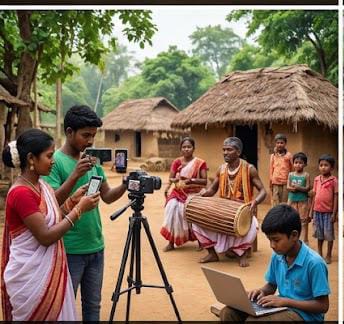
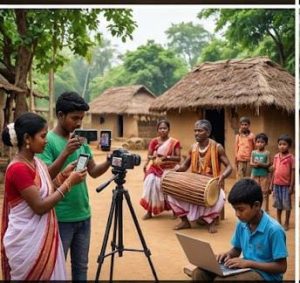
- Performance for the Camera: Historically, indigenous celebrations were fully participatory; there was no division between “audience” and “performers”. Everyone sang, drummed, or danced in spiralling concentric circles. Today, ritual spaces are often cordoned off to facilitate photography, selfie-taking, and livestreaming. The inner devotional focus can easily shift outward toward performative display.
- Algorithmic Flattening: Long, meditative, multi-hour chants or day-long animal sacrifices do not fit social media algorithms. Instead, 15-to-30-second vertical video clips highlight visually striking, dynamic moments—colorful feathered headgear, face paint, acrobatic jumps—stripping the ritual of its linguistic nuance, cosmological significance, and philosophical context.
Digital Archives and Cultural Pride
Conversely, digital tools offer indigenous youth unprecedented agency to document and safeguard their heritage:
- Youth-Led Archival Initiatives: Armed with smartphones, indigenous creators, researchers, and vernacular musicians are building self-curated digital archives. YouTube channels in Santhali, Gondi, Kurukh, Mizo, and Nagamese feature folk song lyrics, elder interviews, musical instrument tutorials, and high-definition recordings of vanishing rites.
- Linguistic Reclamation: Mobile messaging apps have spurred the digitization of indigenous scripts. The Ol Chiki script (for Santhali), Varang Kshiti (for Ho), and Tolong Siki (for Kurukh) are now encoded in Unicode, enabling youth to exchange festival poetry, invitations, and prayers in their native written tongues across global networks.
- Cross-Regional Solidarity: Digital connectivity enables indigenous communities in different states—and even across international borders (such as indigenous groups in neighboring Bangladesh, Nepal, and Myanmar)—to exchange knowledge, coordinate advocacy, and build collective cultural pride.
5. Are Traditional Tribal Festivals at Risk of Disappearing?
To offer a simplistic “yes” or “no” obscures a nuanced cultural reality. Tribal festivals are not vanishing uniformly, but they are undergoing asymmetrical attrition. While prominent, visually spectacular festivals flourish, more vulnerable, localized, and esoteric traditions face acute peril.
What Is Thriving vs. What Is Disappearing
| Thriving / Expanding Dimensions | Endangered / At-Risk Dimensions |
| High-profile, state-backed cultural festivals (e.g., Nagaland’s Hornbill, Meghalaya’s Cherry Blossom, national tribal expos). | Micro-local, village-level agricultural ceremonies that lack political patronage or tourist appeal. |
| Secularized, performative dance traditions tailored for urban stages and television reality shows. | Sacred oral cosmologies, lengthy ritual epics, and secret chants known only to aging ritual specialists. |
| Commercial craft and fashion markets that sell tribal-inspired patterns to urban buyers. | Traditional material culture, such as hand-carved ritual masks, animist totems, and earthen drums made with indigenous tools. |
| Pan-tribal identity celebrations that serve as political rallies and ethnic unification platforms. | Deep forest pilgrimage walks and seasonal taboos regulating wild game hunting, foraging, and botanical cycles. |
The true crisis of disappearance does not lie in the physical disappearance of dancing bodies; it lies in the hollowing out of epistemological meaning. A festival can survive as an external dance show long after its underlying animist theology, botanical knowledge, and communal ethics have dissolved.
| Thriving / Expanding Dimensions | Endangered / At-Risk Dimensions |
| High-profile, state-backed cultural festivals (e.g., Nagaland’s Hornbill, Meghalaya’s Cherry Blossom, national tribal expos). | Micro-local, village-level agricultural ceremonies that lack political patronage or tourist appeal. |
| Secularized, performative dance traditions tailored for urban stages and television reality shows. | Sacred oral cosmologies, lengthy ritual epics, and secret chants known only to aging ritual specialists. |
| Commercial craft and fashion markets that sell tribal-inspired patterns to urban buyers. | Traditional material culture, such as hand-carved ritual masks, animist totems, and earthen drums made with indigenous tools. |
| Pan-tribal identity celebrations that serve as political rallies and ethnic unification platforms. | Deep forest pilgrimage walks and seasonal taboos regulating wild game hunting, foraging, and botanical cycles. |
6. Systemic Challenges Tribal Communities Face in Preserving Traditions
Preserving ancestral festivals is not merely a matter of sentimental devotion. Indigenous communities face profound, structural headwinds that threaten their cultural continuity:
STRUCTURAL CRISES IN CULTURAL TRANSMISSION |
|||
Ecological Displacement (Mining/Dams) |
Generational Alienation (Boarding Schools/Jobs) |
Linguistic Erosion (Loss of Dialects) |
Economic Vulnerability (Poverty/Exploitation) |
1. Ecological Displacement and Habitat Loss
Indigenous culture cannot exist without its native ecology. When mining concessions, hydroelectric dams, industrial corridors, and commercial timber plantations displace tribal villages, the sacred landscape is permanently destroyed:
- A displaced community relocated to a concrete rehabilitation colony loses access to its ancestral burial grounds (Sasandiri), sacred groves (Sarna / Jaher), and medicinal forests.
- Without the specific hill, stream, or grove, the rituals attached to those geographical markers lose their anchor. Culture cannot simply be transplanted into suburban concrete without undergoing catastrophic structural damage.
2. Generational Alienation and Educational Disconnect
Mainstream institutional education in India has long operated through an assimilationist lens:
- Residential Ashrams and Boarding Schools: Millions of tribal children attend state or private residential schools where the medium of instruction is Hindi, English, Bengali, Odia, or other dominant regional languages.
- Cultural Stigmatization: School curricula routinely portray indigenous customs, attire, animist beliefs, and dietary habits as “backward,” “primitive,” or “superstitious.” As a result, educated tribal youth frequently experience internalized shame, leading them to abandon their traditional songs, attire, and ritual roles in an effort to blend into mainstream society.
3. Linguistic Erosion
Festival rituals, incantations, and oral chants are encoded in native tribal tongues, many of which lack official state recognition under the Eighth Schedule of the Indian Constitution.
As regional state languages dominate primary education, administration, and mass media, younger generations are losing fluency in their native languages. When language dies, the complex cosmological metaphors, botanical names, and oral histories contained in festival songs inevitably follow.
4. Severe Economic Vulnerability
Sustaining traditional cultural practices requires leisure time, material resources, and communal peace. When tribal families are trapped in cycles of chronic rural debt, agrarian collapse, seasonal migrant labor, and land alienation, community festivals become difficult economic burdens. An impoverished family may choose to abandon costly communal rites simply to survive the winter.
7. How Schools, Museums, and Cultural Organizations Can Help
Halting the attrition of indigenous heritage requires urgent, collaborative action from educational, cultural, and institutional gatekeepers. Rather than treating indigenous traditions as exotic curiosities, these institutions must champion decolonial preservation models that place indigenous communities at the center of authority.
Transforming Educational Curricula
- Mother-Tongue-Based Multilingual Education (MTB-MLE): State education departments must systematically implement native language instruction in primary schools within scheduled tribal areas. When children learn to read, write, and sing in their mother tongues, cultural knowledge transfers naturally across generations.
- Integrating Indigenous Ecological Knowledge: Schools should invite village elders, shamans, and traditional artisans into classrooms as recognized knowledge holders. Curricula in biology, agriculture, and environmental studies should formally incorporate indigenous seasonal calendars, plant uses, and festive conservation taboos.
- Decolonizing Textbooks: Educational boards (NCERT, SCERT) must actively purge derogatory colonial-era characterizations of indigenous communities, framing tribal festivals not as relics of a primitive past, but as sophisticated traditions of ecological stewardship.
Rethinking Museums: From Cabinets of Curiosities to Living Cultural Centers
Traditional ethnographic museums in India have historically preserved tribal heritage in static, sterile glass cabinets—displaying dusty spears, feathered headdresses, and musical instruments frozen in time.
- Community-Curated Living Museums: Museums must transition toward participatory, indigenous-managed community heritage centers. Instead of shipping sacred artifacts to distant capital cities, regional eco-museums should be established within tribal territories, managed and curated by the communities themselves.
- Repatriation and Sacred Respect: Museums must recognize that certain ritual objects are living ancestral beings, not art pieces. Sacred drums, totems, and ceremonial regalia should remain accessible to communities for seasonal festive use rather than permanently sequestered in vaults.
COLONIAL / STATIC MODEL |
DECOLONIAL / LIVING MODEL |
• Glass cabinets in distant cities
|
• Community-owned eco-museums in villages
|
Institutional and NGO Interventions
- Ethnomusicological Archiving: Cultural organizations must partner with tribal youth to systematically document vanishing acoustic techniques, drum rhythms, and seasonal chants using high-fidelity audio-visual equipment, returning open-access copies directly to village councils.
- Legal Protections for Cultural Expressions: Legal organizations must assist indigenous groups in securing Geographical Indications (GI tags) and intellectual property protections for traditional festival attire, shawls, jewelry, and ritual art forms (e.g., Warli painting, Sohrai murals) to prevent commercial appropriation by fast-fashion corporations.
8. Responsible Tourism vs. Cultural Exploitation: Walking the Tightrope
In recent decades, ethnic and tribal cultural tourism has expanded exponentially across India. From the Hornbill Festival in Nagaland and the Bastar Dussehra in Chhattisgarh to the Tawang Festival in Arunachal Pradesh and rural tourism circuits in Jharkhand and Odisha, thousands of domestic and international travelers arrive seeking “authentic tribal encounters.”
Yet, cultural tourism operates along a fragile razor’s edge. At its worst, it devolves into unbridled exploitation; at its best, it offers dignified economic livelihoods and renewed cultural pride.
THE TOURISM SPECTRUM |
|
EXTRACTIVE / VOYEURISTIC |
COMMUNITY-SOVEREIGN |
• "Human Zoo" dynamics
|
• Direct revenue to village councils
|
The Perils of Cultural Commodification and “Human Zoos”
- The External Monopolization of Profits: In many popular ethnic tourism destinations, the primary financial beneficiaries are luxury travel companies, outside hoteliers, and urban tour guides. Indigenous villagers are frequently relegated to low-wage service roles—cleaners, drivers, or token background performers.
- Trivialization of Sacred Realities: When sacred rituals are staged three times a day for rotating busloads of tourists, their spiritual core is stripped away. Ancient trances, protective rites, and ancestral invocations are reduced to decorative floor shows.
- Voyeurism and Boundary Violations: Unregulated tourist crowds routinely violate community boundaries: sticking cameras into private home kitchens, filming sacred moments where photography is explicitly taboo, and introducing litter, plastic waste, and unmanaged commercialism into pristine forested zones.
Principles for Authentic, Responsible Community-Based Tourism (CBT)
To safeguard indigenous dignity while leveraging tourism for economic sustainability, destinations must adhere to non-negotiable principles of cultural sovereignty:
1. Prior Free, Prior, and Informed Consent (FPIC)
No tourism initiative, cultural festival, or village trail should be introduced without the explicit consent and collective governance of the traditional village assembly (Gram Sabha under PESA – Panchayat Extension to Scheduled Areas Act, or customary village councils).
2. Community Financial Ownership
Tourism operations should run through cooperative community homestay models and village trusts. Revenue from entry fees, cultural performances, local culinary offerings, and handicraft sales must flow directly into community bank accounts, funding local healthcare, schooling, and heritage conservation.
3. Strict Spatial and Ritual Zoning
Indigenous communities must retain absolute authority to declare specific ritual spaces, days, or ceremonies strictly off-limits to outside cameras, casual tourists, and commercial filming. If a ritual requires silence and privacy, that boundary must remain inviolable.
4. Pre-Visit Tourist Education and Codes of Conduct
Visitors should undergo mandatory cultural orientation before entering sensitive tribal areas. Tour operators must enforce strict behavioral codes regarding modest dress, photography bans, plastic elimination, and respectful social interaction.
9. Case Studies: Indigenous Festivals Navigating the Modern Era
Examining real-world examples illustrates the complex strategies indigenous communities deploy to negotiate the forces of modernization.
Case Study A: Sarhul and Sohrai in Central India (Jharkhand)
- The Urban Resurgence: In Ranchi, Sarhul has grown into an immense cultural spectacle. Tens of thousands of young Adivasis take to the streets wearing traditional red-and-white bordered handloom attire (Panchi Parhan), playing traditional drums alongside brass bands, and waving the sacred religious flag of the Sarna faith.
- The Sarna Code Movement: Far from dying out, these festivals have become the focal point of the mass political movement demanding a separate Sarna Religion Code in the official Indian Census. Celebrating Sarhul is framed as an assertion that indigenous animism is distinct from dominant state-sanctioned religions.
- Artistic Global Reach: Sohrai mural art, traditionally painted by women using natural earthen clays and charcoal onto mud huts during the festival, has received Geographical Indication (GI) status and is now showcased in international contemporary art galleries from Paris to Tokyo.
Case Study B: The Hornbill Festival of Nagaland
Organized annually in December by the State Government of Nagaland at Kisama village, the Hornbill Festival brings together all sixteen recognized Naga tribes into a single mega-cultural showcase.
- The Triumphs: The festival has brought immense global visibility to Naga music, culinary traditions, traditional architecture (Morungs), and weaving arts. It has stimulated a vibrant tourism economy, sparking deep pride among younger urban Naga generations who now enthusiastically embrace their ancestral textiles and warrior dances.
- The Critiques: Anthropologists and local community elders point out that Hornbill is a modern state-curated spectacle rather than an organic, traditional festival. Sixteen tribes, each possessing distinct agricultural calendars and disparate ancestral festival dates, perform simultaneously on a manicured amphitheater stage. It is a commercial, secular celebration of heritage—vital for identity and the economy, yet entirely distinct from the ancient animistic agrarian rhythms of village life.
Case Study C: Bhagoria Haat of Madhya Pradesh
Celebrated by the Bhil and Bhilala communities in the Malwa-Nimar region of Madhya Pradesh ahead of Holi, Bhagoria is an ancient market-fair festival celebrating agricultural prosperity, matchmaking, and community commerce.
- Modern Adaptations: While historically characterized by flute music, earthen pottery, and traditional exchange, modern Bhagoria markets feature electronic toys, sunglasses, jeans paired with traditional silver jewelry, and mobile-charging stalls.
- Resilient Substance: Despite the conspicuous influx of consumer goods, the fundamental social heart of Bhagoria—the assembly of clans, the traditional dances around massive kettle-drums, and the matchmaking customs of young adults—remains intensely vibrant and self-directed.
10. The Future of Ancient Tribal Rituals and Traditions
As India approaches the mid-twenty-first century, what lies ahead for ancient tribal traditions? Will they dissolve into the monoculture of consumer capitalism, or will they forge a dynamic new synthesis?
The future will likely not be a binary choice between pristine ancient preservation and total cultural extinction. Instead, we are entering an era of hybrid survival and indigenous cultural reclamation.
TRAJECTORIES FOR THE 21ST CENTURY |
1. ECOLOGICAL INDIGENISM: Traditional rites reframed as climate solutions.
|
1. Ecological Indigenism and Climate Consciousness
As the global climate crisis deepens, the world is increasingly recognizing what indigenous communities have taught for millennia: sustainable human survival requires sacred ecological reciprocity.
- Future tribal festivals will increasingly step into the global spotlight as models of ecological philosophy. The taboos against over-hunting, the protection of sacred groves (Deorais in Maharashtra, Orans in Rajasthan, Sarnas in Jharkhand), and the celebratory worship of uncultivated forest foods (Rani Parab) will transition from perceived “superstitions” to internationally recognized methods of biodiversity conservation.
2. Vernacular Digital Citizenship
The emerging generation of indigenous leaders, artists, coders, and scholars will not abandon modern technology; they will weaponize it to defend their heritage:
- We can anticipate indigenous-language mobile applications, augmented reality (AR) educational tools mapping oral song histories onto sacred geographies, and blockchain-based provenance systems protecting indigenous handloom designs from corporate counterfeiters.
- The internet will continue to serve as a decentralized campfire where diasporic tribal youths reconstitute identity, share translated oral texts, and organize collective festival celebrations irrespective of geography.
3. Re-Indigenization and Ancestral Pride
Across many indigenous societies worldwide, generational trajectories often follow a three-stage curve:
- First Generation: Immersed entirely in ancestral village culture.
- Second Generation: Moves to cities, experiences cultural shame or alienation, and strives to assimilate into mainstream culture.
- Third Generation: Cosmopolitan, formally educated, secure in their modern identity, and driven to reclaim their lost ancestral heritage.
India’s tribal youth are entering this crucial third phase. Highly educated indigenous scholars, civil servants, poets, and visual artists are deliberately returning to their ancestral villages, learning vanishing oral epics from village elders, reviving forgotten instrument-making techniques, and proudly observing seasonal festivals with renewed intellectual and spiritual commitment.
Conclusion: Honoring the Living Roots of the Land
The indigenous festivals of India are not museum artifacts destined to collect dust behind the velvet ropes of history. Nor are they quaint, exotic diversions staged for tourist amusement or modern consumer appropriation. They are living, breathing civilizational architectures. They carry the oldest, most resilient ecological memories of the Indian subcontinent—reminding us that human beings are not the masters of nature, but humble participants in a vast, interconnected living world.
Modernity, urbanization, and technology will continue to alter the external accouterments of these celebrations. Modern sound stages will mingle with ancient flutes; synthetic fibers will weave alongside forest tussar silk; and smartphone cameras will capture dances once witnessed only by the moon and the sal trees.
Yet, so long as the seed of cultural sovereignty remains firmly planted in indigenous hands—so long as communities retain control over their ancestral lands, their sacred groves, their native languages, and their right of self-determination—these ancient festivals will not die. They will adapt, evolve, and continue to celebrate the blossoming of the earth, offering contemporary humanity an indispensable map for living harmoniously upon this shared planet.
