
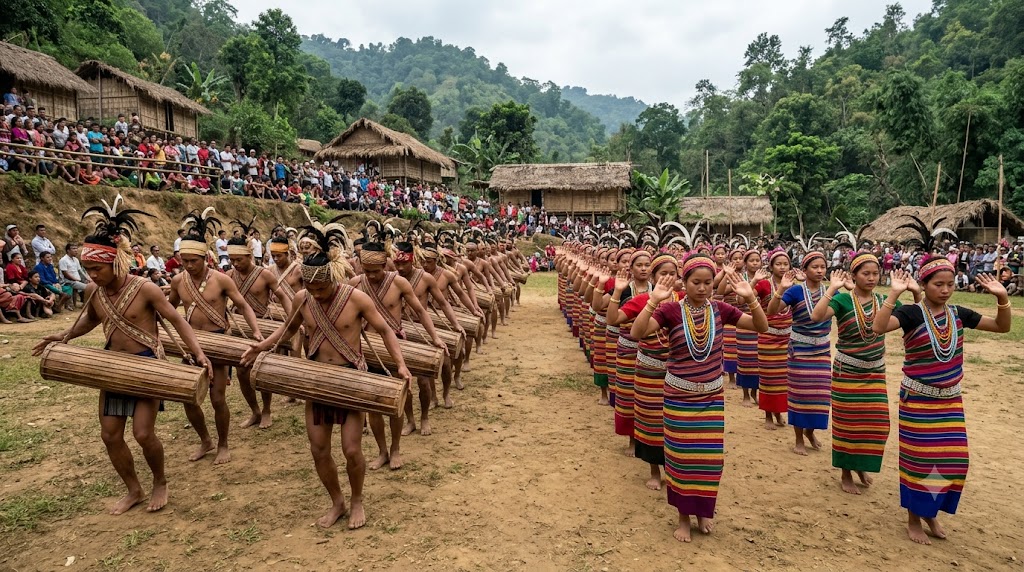
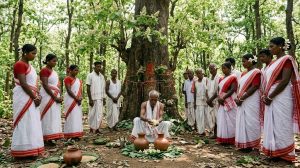
Sarhul Mahotsav
Echoes of the Earth: The Living Spirit, Ecology, and Survival of Tribal Festivals in India
Discussing the festivals of tribal festivals in India might test the reader’s patience. India is home to more than 705 distinct ethnic groups officially recognised as Scheduled Tribes, comprising over 104 million indigenous people known colloquially as Adivasis—the earliest inhabitants.
At the center of their collective survival, spiritual identity, and philosophy lies the festival. Far from being simple days of leisure or commercialised spectacles, tribal festivals are cosmic renewals, sacred treaties signed between human communities and the natural universe.
While mainstream urban festivities often celebrate mythical scriptural milestones, tribal celebrations turn toward the immediate earth: the burst of fresh blossoms on a Sal tree, the clearing of forest mist before sowing, the first grain stored inside a bamboo granary, and the eternal debt owed to ancestral spirits dwelling in the hilltops.
To explore the tribal festivals of India is to journey into an ecological worldview where music is prayer, dance is communal democracy, food is seasonal communion, and every living tree possesses a soul.
1. What Are Tribal Festivals in India and Why Are They Important?
Tribal festivals in India are community-wide observances marked by ritual ceremonies, seasonal transitions, ancestral worship, dynamic folk performances, and sacred ecological offerings. Unlike the codified liturgical calendars of metropolitan areas, tribal festivals operate on an indigenous epistemology.
They are guided by lunar rhythms, the blooming cycles of endemic flora, the behaviour of migratory birds, and the vital duties of shifting or sedentary subsistence farming.
The Foundation of Indigenous Philosophy
To understand these celebrations, one must unpack the philosophy of animism and pantheism that forms the backbone of indigenous belief systems. To most Adivasi and indigenous groups—such as the Santhals, Gonds, Bhils, Mundas, Oraons, Nagas, and Khasis—the sacred cannot be separated from the landscape. Divinity does not exist in an abstract, distant heaven; it resides in:
-
Sacred Groves (Jaher Than or Sarna): Virgin patches of primary forest strictly protected from axe or clearing, dedicated to woodland deities and maternal creator spirits.
-
Living Rivers and Springs: Honoured as life-giving maternal currents that quench the thirst of both wild fauna and village herds.
-
Ancestral Spirits (Bonga or Pen): The departed elders who guard boundaries, guide hunters, heal sickness, and demand regular remembrance through libations of rice water and earth offerings.
In this worldview, human beings are not the masters of creation. They are humble kin within an interconnected forest kinship. Festivals serve as periodic agreements where the community seeks permission from the spirits before harvesting a plant, clearing a patch of soil, hunting game, or consuming new wine.
Why Tribal Festivals Are Invaluable
The importance of tribal festivals operates simultaneously across several spiritual, ecological, and psychological dimensions:
                          ┌─────────────────────────────┐
                          │   INDIAN TRIBAL FESTIVALS   │
                          └──────────────┬──────────────┘
                                         │
        ┌──────────────────┬─────────────┴─────────────┬──────────────────┐
        ▼                  ▼                           ▼                  ▼
┌───────────────┐  ┌───────────────┐           ┌───────────────┐  ┌───────────────┐
│ Oral History  │  │ Ecological    │           │ Communal      │  │ Psychosocial  │
│ Transmission  │  │ Stewardship   │           │ Egalitarianism│  │ Healing       │
│ & Lore        │  │ & Conservation│           │ & Governance  │  │ & Solidarity  │
└───────────────┘  └───────────────┘           └───────────────┘  └───────────────┘
-
Oral Repositories of Unwritten History: Because many tribal communities traditionally maintained an oral rather than a written script, epic poetry, tribal migrations, clan lineages, and medicinal knowledge are encoded directly within festival songs (Karam Geed, Chhur, or Hao chant). Forgetting the festival means losing the historical library of the tribe.
-
Systemic Ecological Conservation: Many festivals set binding dates for resource extraction. For instance, among central Indian tribes, wild forest produce, tender bamboo shoots, or seasonal fruits like Mahua cannot be plucked or consumed before the performance of a village blessing. This traditional embargo guarantees that forest species reach reproductive maturity without suffering premature foraging.
-
Egalitarian Redistribution: Traditional tribal celebrations dismantle strict socio-economic hierarchies. Feasting is collective. The village headman (Manjhi, Gaonbura, or Patel) eats the same milled grain and drinks from the same leaf cup (dona) as the humblest tiller. Resources accumulated by wealthier households are channeled into communal feasts, keeping sharp wealth inequality in check.
-
Community Catharsis and Healing: Living close to nature brings vulnerability—monsoon failures, animal raids, illnesses, and gruelling physical labour. Festivals offer therapeutic relief through days of sustained dancing, drum therapy, communal humour, theatrical clowning, and spirit reconciliation, restoring the emotional well-being of the village.
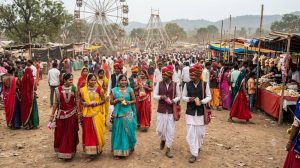
Bhagoria Festival
2. What Are the Most Famous Tribal Festivals in India?
Across India’s diverse geographical terrain, several indigenous celebrations stand out for their visual splendor, deep historical lineage, and massive community mobilisation.
+--------------------+-----------------------------+-----------------------+-----------------------------+
| Festival           | Primary Tribe / Group       | State / Region        | Core Theme                  |
+--------------------+-----------------------------+-----------------------+-----------------------------+
| Sarhul             | Oraon, Munda, Ho, Santhal   | Jharkhand, Odisha     | Sal Tree / Earth-Sun Union  |
| Hornbill Festival  | 17 Naga Tribes              | Nagaland              | Inter-tribal Unity & Lore   |
| Bhagoria           | Bhil, Bhilala, Pateliya     | Madhya Pradesh        | Spring Harvest & Courtship  |
| Bastar Dussehra    | Maria, Muria, Bhatra, Halba | Bastar, Chhattisgarh  | Goddess Danteshwari & Forest|
| Wangala            | Garo                        | Meghalaya, Assam      | 100-Drum Sun-God Gratitude  |
| Baneshwar Fair     | Bhil                        | Rajasthan             | Sacred River Immersion      |
| Losar              | Monpa, Bhutia, Sherpa       | Arunachal, Sikkim     | Indigenous Himalayan New Yr |
| Sekrenyi           | Angami Naga                 | Nagaland              | Purification & Renewal      |
| Dree Festival      | Apatani                     | Arunachal Pradesh     | Agricultural Pest Guard     |
| Tarpa Festival     | Warli, Kokna, Katkari       | Dadra & Nagar Haveli  | Harvest Circle Celebration  |
+--------------------+-----------------------------+-----------------------+-----------------------------+
Sarhul (Jharkhand, Odisha, Chhattisgarh, West Bengal)
Sarhul—literally translating to the “Worship of the Sal Tree” (Sar means Sal, and Hul means blossom or revolution)—is celebrated during the Chaitra month when the deciduous forests shed their winter brown and burst into pale, fragrant Sal blossoms (Champa flowers). Celebrated primarily by the Oraon, Munda, Ho, and Santhal communities, Sarhul is an elemental wedding.
Leaving them overnight, the village elders assemble at dawn to inspect the water level. If the water remains stable, abundant rains are predicted; if it drops, drought threatens. Only after the Sal flowers are offered to the ancestors and woven into the hair of young men and women do village families scatter seed across their dry terraced fields.
       [ Sun God (Singbonga) ]  ═════ Wedding Ritual ═════  [ Earth Mother (Dharti Maa) ]
                                            │
                                            ▼
                           Sacred Sarna Grove Ceremony
                     (Water-level forecast by village Pahan)
                                            │
                                            ▼
                    Sal Blossoms Distributed to Every Household
                                            │
                                            ▼
                     Agricultural Season Declared Open
The Hornbill Festival (Nagaland)
Before this platform existed, inter-tribal feuds and the lingering trauma of colonial and post-colonial conflicts kept many of these communities physically and emotionally separated. At the Hornbill Festival, each tribe builds its distinct architectural Morung (the traditional youth dormitory and learning hall) on the terraced hillside.
Bhagoria Haat Festival (Madhya Pradesh and Gujarat)
Celebrated in the week leading up to the spring festival of Holi across the Nimar and Jhabua hills, Bhagoria is a cultural fair of the Bhil, Bhilala, and Pateliya tribes. Historically misunderstood by colonial ethnographers as merely a “runaway marriage bazaar”, Bhagoria is actually an agricultural thanksgiving and community reunion.
The fairgrounds fill with the rhythmic clatter of towering hand-turned wooden ferris wheels, the blast of brass trumpets, and the hum of thousands of villagers dressed in identical, brilliant yellow, crimson, and turquoise fabrics tailored specifically for their clan.
Bastar Dussehra (Chhattisgarh)
Spanning 75 continuous days from Shravan Amavasya to Ashwin Shukla Trayodashi, the Bastar Dussehra celebrated by the Gond, Maria, Muria, Dhurwa, and Halba tribes is one of the longest festivals in the world. Significantly, this festival has nothing to do with the epic defeat of the demon king Ravana featured in mainstream Indian texts.
Instead, it is an elaborate tribute to Ma Danteshwari, the chief protective mother goddess of the Bastar forests, and an exercise in shared governance. Every stage of the festival depends on a designated tribal community:
-
The Saora gather wild lianas and sacred wood from deep within the sal forests.
-
The Dhurwa constructs a monumental, eight-wheeled chariot (Rath) using only traditional hand-chisels, entirely without iron nails.
-
The Bhatra pulls the thick ropes of the chariot during the grand procession through Jagdalpur.
-
The Muria youth guard the sanctum with ornamental wooden staves.
The festival peaks with the Muria Darbar, a historic forest assembly where village headmen air grievances, settle territorial issues, and communicate directly with administrative guardians.
Wangala: The Hundred Drums Festival (Meghalaya and Assam)
Wangala marks the end of the agricultural cycle for the matrilineal A-chik (Garo) people of the Garo Hills. Dedicated to Misi Saljong, the Sun and Fertility God who blesses the terraced fields with life, Wangala signals the clearing of granaries and the first taste of freshly processed millet and rice.
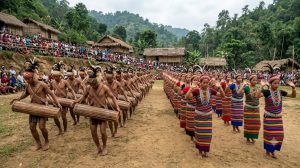
The defining visual of the festival is the Hundred Drums performance. Rows of fifty to one hundred men, holding cylindrical wooden drums (dama) slung over their shoulders, walk in lockstep. Beside them, rows of women—decorated in striped handwoven Dakmanda skirts and feathered headpieces called Kotip—dance forward with graceful, swaying gestures that mimic the bending of grain stems in the autumn wind.
The percussive resonance shakes the valley soil, an auditory offering acknowledging that the earth has provided for its children for another year.
3. How Are Tribal Festivals Connected to Nature and Forests?
While modern societies often frame environmentalism as a series of policies, technologies, and carbon goals, tribal festivals express ecology as an innate way of life. The natural environment is neither an inert resource to be mined nor an empty playground; it is a sacred community of non-human persons.
Deification of the Sacred Grove: The Sarna System
Central to the Munda, Santhal, Ho, and Kurukh peoples of east-central India is the institution of the Sarna Sthal (Jaher Than). A Sarna is an untouched patch of primeval forest left deliberately uncleared on the village perimeter. These groves protect ancient specimens of Sal (Shorea robusta), Mahua (Madhuca longifolia), and Karam (Nauclea parvifolia).
                                  VILLAGE PERIMETER
                      ┌───────────────────────────────────────┐
                      │          THE SACRED SARNA GROVE       │
                      │                                       │
                      │   [Sal Tree]            [Mahua Tree]  │
                      │   (Masculine Spirit)    (Sweetness)   │
                      │             \          /              │
                      │              [Karam Tree]             │
                      │               (Prosperity)            │
                      │                    │                  │
                      │            Uncut Primeval Canopy      │
                      │         (Protects Village Aquifer)    │
                      └───────────────────┬───────────────────┘
                                          │
                      ┌───────────────────┴───────────────────┐
                      │          CULTIVATED FIELDS            │
                      │      (Terraced Paddy / Millets)       │
                      └───────────────────────────────────────┘
During the Sarhul, Karam, and Baha festivals, religious rites are performed solely within these groves. Logging, foraging, or defecating within the Sarna is considered a profound sacrilege that draws the displeasure of the spirit world. In ecological terms, these groves serve as:
-
Micro-refuges for endangered seedbanks, pollinators, and medicinal undergrowth.
-
Natural windbreaks shielding thatched village settlements from harsh seasonal gales.
-
Infiltration basins that replenish local aquifers and sustain village wells downstream.
The Karam Tree: The Philosophy of Mutual Care
The Karam Festival, celebrated by communities throughout Jharkhand, West Bengal, Odisha, and Madhya Pradesh, honors the sacred Kadamb or Karam branch. Young villagers venture into the deep jungle with song and rhythmic clapping, cut three pristine branches from a healthy tree, and carry them reverently into the village square without letting them touch bare soil.
Community Entry into Jungle  ──>  Respectful Cutting of 3 Karam Branches
                                              │
Communal Dancing around Branch  <──  Erection of Branches in Village Square
              │
Dawn Farewell Ritual  ──>  Submersion in River Waters  ──>  Nutrient Return
The branches are planted in the center of the dancing ground, wrapped in red threads, and adorned with sprouted yellow legume shoots known as Jawa. The festival celebrates Karma—which in the tribal lexicon translates to diligence, kinship, and reciprocal protection.
At dawn, the branches are not discarded into the dust; they are carried in a celebratory procession to the nearest river and submerged, symbolically returning the botanical essence to the aquatic lifeblood of the forest.
Seasonal Harvesting Embargoes: The Baha Um
Among the Santhal community, the Baha (Flower) festival sets a strict ecological boundary: no Santhal may pluck, smell, or use newly sprouted Sal blossoms, wild forest blossoms, or sweet Mahua flowers until the village Naike (priest) has dedicated them to the Bongas. Violating this rule risks social reprimand and ritual cleansing.
This practice acts as a community-wide ecological safeguard. By waiting for the official festival day, the tribe guarantees that early spring flowers are left undisturbed during their peak pollination window, allowing forest flora to set seed and fruit without human interference. Nature is approached with patience; humans gather only when the forest gives its blessing.
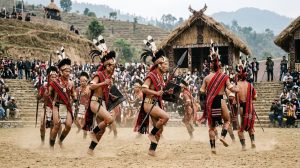
Hornbil Festival
4. How Do Tribal Festivals Reflect Agricultural Life and Food Traditions?
The seasonal calendar of an Indian tribal community matches the work of subsistence agriculture. Every phase of the farming journey—clearing hillsides, checking soil texture, dropping seeds, weeding shoots, driving off pests, and threshing dry stalks—has a festival that offers psychological relief and sacred meaning to daily toil.
Season        Stage of Agriculture       Festival Example        Tribe / Region
─────────────────────────────────────────────────────────────────────────────────
Spring        Clearing & Field Prep      Sarhul / Baha           Santhal, Oraon
Early Monsoon Sowing of Seeds            Rongker / Obyok         Karbi / Monpa
Late Monsoon  Weeding & Pest Defense     Dree / Hiriye           Apatani / Gond
Autumn        Harvesting of Grain        Wangala / Nuakhai       Garo / Western Odisha
Winter        Post-Harvest Threshing     Poush Sankranti / Maghi Bhumij, Ho
From Clearing to Pest Resistance: The Rhythms of Cultivation
-
Field Preparation and Sowing: Before a single iron blade turns the soil, festivals like the Karbi Rongker in Assam are held to purify the land and clear malicious spirits from the village borders. The earth is treated gently, almost apologetically, because cultivation cuts the soil’s surface. Prayers are offered to the wild creatures displaced by the hoe, asking them to feast safely in the deeper woodlands.
-
Growth and Pest Protection: The Dree Festival of the Apatani valley in Arunachal Pradesh, celebrated in early July, focuses on crop protection. The Apatanis, known worldwide for their sophisticated paddy-cum-fish agro-ecosystems, gather at their seasonal shrines (Dree Lapang).
-
Here, offerings of cucumber, poultry, and local wine are made to spirits like Tamu, Metii, and Danyi Pilo. The prayers do not ask for miraculous excess; they ask simply that locusts, stem-borers, and fungal blights spare the green fields, and that the seasonal monsoon waters remain calm and predictable.
-
On the appointed Nuakhai day, the eldest family member cooks the freshly picked grains into a rich porridge with cow’s milk and wild unrefined jaggery. This sweet Prasad is offered first to the household ancestors and village deities before the family partakes. This deliberate act of collective patience transforms the first meal of the harvest into an act of thankfulness.
Indigenous Foodscapes and Fermentation Traditions
Tribal festivals showcase an extraordinary indigenous food culture, based on wild foraging and sustainable fermentation that stands apart from standard commercial agriculture.
                          ┌───────────────────────────┐
                          │   FESTIVAL FOODWAYS       │
                          └─────────────┬─────────────┘
                                        │
        ┌───────────────────────────────┴───────────────────────────────┐
        ▼                                                               ▼
┌───────────────────────────────┐               ┌───────────────────────────────┐
│ FERMENTED RICE WINES          │               │ INDIGENOUS CROPS & WILD FOODS │
│ • Hadia (Santhal/Munda/Ho)    │               │ • Little Millet (Kutki/Kodo)  │
│ • Apong (Mishing/Adi)         │               │ • Bamboo Shoot (Mesua/Khorisa)│
│ • Judima (Dimasa)             │               │ • Roasted Field Crickets      │
│ • Zutho (Angami Naga)         │               │ • Mahua Blossom Spirits       │
└───────────────────────────────┘               └───────────────────────────────┘
Fermented Elixirs (Hadia, Apong, Judima, Zutho)
Central to every gathering across central and northeastern India is the preparation of ceremonial, wild-yeast-fermented rice or millet ales.
-
Hadia (Central India): Among the Santhals and Mundas, Hadia is brewed using a sacred fermentation cake called Ranu Ranu Dawa, compounded from over twenty distinct forest roots and barks. These wild roots regulate ethanol levels, add micronutrients, and act as natural preservatives. Hadia is cooling, nourishing, and ceremonial; ancestors are invited to sip its clear drops (Rasi) before any human touches a bowl.
-
Apong and Judima (Northeast India): In Assam and Nagaland, the Dimasa prepare Judima, an aromatic, amber-colored brew made from glutinous rice and the bark of the Thembra plant. The Mishing prepare Poro Apong, characterized by an inky color derived from the filtered ashes of roasted rice straw and husks. The ash imparts a smoky flavor profile along with essential minerals. Fermented ales are considered living foods; they balance gut health, steady the pulse after long days of field labor, and ease collective inhibitions during festival dances.
Forest Foraging: Millets, Tubers, and Mahua
Festival spreads celebrate the biodiversity of non-cultivated foods. Instead of relying on polished white rice and hybrid wheat, tables are filled with traditional staples:
-
Lesser Millets (Kodo, Kutki, Ragi): Steamed into earthy porridges or baked into griddle cakes (Pitha) wrapped in broad Sal leaves.
-
Mahua Wine and Savories: The fallen, fleshy petals of the Madhuca longifolia are sun-dried, roasted with parched gram, or fermented into clear, floral spirits that fuel festive night vigils across central India.
-
Wild Greens (Saag) and Tubers: Dozens of uncultivated leafy forest greens (Kandra, Koilari, Gethi tubers) are gathered from the edges of fields and tossed with cold-pressed mustard or Niger-seed oil, preserving ancestral foraging knowledge across generations.
Medaram Jatara
5. What Roles Do Traditional Dance, Music and Costumes Play in Tribal Festivals?
In indigenous Indian society, dance, music, and body ornamentation are not commodified entertainment staged for an audience. They are an embodied language—a dynamic web of physical rhythm and community solidarity. There are no passive observers at a tribal festival; every person present is an active participant in maintaining cosmic balance.
     DRUMMERS (Inner Ring)                  WOMEN DANCERS (Outer Circle)
   Sets the tempo, pulse, and           Linked arms, interlocking hands,
 accelerating rhythms of the earth      synchronized sweeping footwork
               │                                       │
               └───────────────> [ THE EMBODIED ] <─────┘
                                   EXPRESSION
                                       ▲
                                       │
                             SONG LEADERS / ELDERS
                          Narrates historical epics,
                           lineages, and oral memory
The Geometry of Dance: Circular Solidarity and Natural Mimicry
The spatial choreography of tribal dance rarely relies on the separated, forward-facing stages typical of Western proscenium theater. Instead, it moves in sweeping circles, serpentine spirals, or long, interconnected parallel lines.
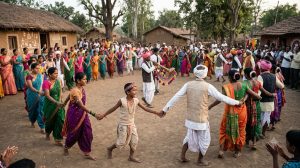
In the Tarpa dance of the Warli community of Maharashtra and Gujarat, hundreds of dancers join hands in a massive spiral around the Tarpa player. They step together, never turning their backs to the musician, looping inward and outward like the coils of an expanding snake or the cyclical passage of the solar seasons.
Among the Santhals and Oraons, the women link arms behind one another’s waists or hook fingers in an unbreakable chain. Their bodies bend in unison toward the earth, then rise back toward the sky. The choreography imitates:
-
The rhythmic ripples of wind blowing through a field of ripe paddy.
-
The delicate hunting hop of the forest quail.
-
The collective swing of farm implements during seed-sowing.
-
The dynamic charge of an elephant herd clearing a wooded pass.
This circular, interlocking formation carries a clear social message: no individual dancer steps forward to outshine the rest. The movement celebrates complete coordination; if one person trips or loses the rhythm, the entire line gently supports them until harmony is restored.
Indigenous Musical Instruments: Resonators of the Earth
The instruments played at tribal festivals are crafted from natural materials sourced from the surrounding forests, riverbeds, and herds. They are tuned not to sterile studio frequencies, but to the deep acoustical dynamics of open river valleys and wooded hills.
+------------------+-----------------------------+------------------------------------+
| Instrument Name  | Materials Used              | Sonic & Cultural Purpose           |
+------------------+-----------------------------+------------------------------------+
| Mandar / Tumdak  | Fired clay, monitor lizard  | The deep heartbeat drum of central |
|                  | or goat leather, hide cord  | Indian Santhal and Munda festivals |
+------------------+-----------------------------+------------------------------------+
| Tarpa            | Dried bottle gourd, bamboo, | Wind instrument of the Warli;      |
|                  | wild beeswax, palmyra leaves| imitates the drone of forest gales |
+------------------+-----------------------------+------------------------------------+
| Dhol & Nagara    | Hollowed logs, bullock hide,| Booming, reverberating kettle-drum |
|                  | iron rims, thick sticks     | for alarms, marches, and hunts     |
+------------------+-----------------------------+------------------------------------+
| Pena             | Bamboo flute, coconut body, | Monochord lute of Manipur used to  |
|                  | horsehair bow, tiny bells   | narrate delicate cosmological epics|
+------------------+-----------------------------+------------------------------------+
| Log Drum         | Monolithic hollowed hardwood| Massive Naga wooden drum struck    |
| (Khel / Morung)  | trunks carved like beasts   | by 30 warriors to sound warnings   |
+------------------+-----------------------------+------------------------------------+
The master of this soundscape is the drum. To the Santhal, the Tumdak is not merely wood and parchment; it possesses a spirit voice. The booming, low-frequency resonance travels miles across forest valleys, inviting neighboring villages to cross ridges and join the celebration. The drummer leads the footwork, calling out rhythmic shifts with changes in stroke technique, moving the assembly from gentle sway to energetic celebration as the evening deepens.
Costumes, Tattoos, and Sacred Adornments
Attire worn during tribal festivals is an open manuscript detailing a person’s community affiliation, ancestral home, clan identity, and social transitions.
       [ Headpieces & Feathers ]   ──> Totemic spirits, courage, and air
                   │
       [ Handwoven Natural Textiles ] ──> Clan geometry, clan colors, and loom mastery
                   │
       [ Heavy Metal & Bell Ornaments ] ──> Rhythmic acoustics and lightning protection
                   │
       [ Godna / Facial Tattoos ]  ──> Unperishing spiritual identity beyond death
-
Textiles of Identity: From the geometric red-white-black shawls of the Ao Nagas (Tsungkotepsu—traditionally earned through valor and hospitality) to the vibrant wrap-around skirts (Langa) of the Lambani nomads embroidered with shards of mirrored glass, textiles are woven on indigenous backstrap or pit looms using naturally dyed wild cotton, hemp, and Eri silk.
-
The Forest Crown: Dancers crown their heads with feathers of the Indian hornbill, peacock, or jungle fowl, alongside quills of the porcupine, dried seed pods, and brass pins. These crowns represent the balance between human intellect and the wild instincts of woodland birds.
-
Godna (Permanent Tattoo Art): Among Baiga and Gond women, the skin is inscribed with detailed Godna patterns—lines, triangles, footprints of birds, and depictions of the Karam tree. In traditional Baiga belief, worldly jewels and wealth are stripped away at death; Godna is the only ornament an individual carries intact into the spiritual realm. During festivals, these tattoos, highlighted with Mahua oil, link living bodies to ancestral lineages.
Tarpa Festival
6. How Do Tribal Festivals Strengthen Community Bonds and Cultural Identity?
In an increasingly fragmented world, tribal festivals serve as essential community glue. They are living demonstrations of unity, community accountability, and the reaffirmation of traditions that have survived displacement, colonial hostility, and economic marginalization.
The Morung System and Intergenerational Storytelling
Among the hill tribes of northeastern India, such as the Nagas and the Karbis, the festival functions alongside the traditional youth dormitory system—the Morung or Jirkyam. The Morung was the community university: young boys and girls lived together, learning warfare, woodcraft, weaving, governance, folklore, and ethical responsibilities from village elders.
During festivals, the Morung takes center stage. Elders sit by open wood hearths, drinking tea or rice ale, teaching the youth the intricate, unwritten verses of long epic ballads. Young people learn:
-
The exact vocal inflections needed to sing ancient ritual laments.
-
The precise manual technique required to carve totemic clan posts.
-
The diplomatic protocols governing marriages, land boundaries, and neighboring village treaties.
This ensures that the storehouse of indigenous knowledge does not wither away in aging memories. It is transferred directly to the next generation through active, hands-on participation.
                           THE MORUNG CONVERGENCE
             ┌─────────────────────────────────────────────────┐
             │       ELDERS & TRADITIONAL STORYTELLERS         │
             │   (Epic Genealogies, Forest Laws, Sacred Arts)  │
             └────────────────────────┬────────────────────────┘
                                      │
                     Festival Rehearsals & Joint Feasting
                                      │
                                      ▼
             ┌─────────────────────────────────────────────────┐
             │         YOUTH DANCERS, CRAFTSMEN, HUNTERS       │
             │     (Active Apprenticeship & Cultural Memory)   │
             └─────────────────────────────────────────────────┘
Conflict Resolution and the Village Council
Tribal festivals frequently double as community assemblies. When all clan members, including those working in distant valleys or cities, return home, the traditional village council (Panchayat, Parha, or Hoh) gathers to resolve persistent disputes.
Under the shade of sacred trees, complaints regarding boundary demarcations, marital disagreements, and property divisions are heard openly. The mood of the festival encourages reconciliation; the shared meal and sacred rice wine break down bitterness. An errant village member is rarely punished with social exile. Instead, penalties traditionally take the form of providing a shared meal or a jar of brew for the village assembly. Once eaten and drunk together, the slight is forgiven, restoring social harmony.
Solidarity Against Assimilation
For centuries, indigenous communities across India have faced intense assimilation pressures from dominant cultural spheres, colonial systems, and modern administrative structures. Festivals offer a creative, defiant assertion of selfhood.
When thousands of indigenous youth assemble in the heart of Ranchi for Sarhul or gather in the Garo hills for Wangala, dancing through the streets in their traditional dress with drums held high, they send an unmistakable message: We endure.
These gatherings transform marginalization into cultural pride, assuring indigenous youth that their heritage, languages, and philosophies are vibrant, dignified, and enduring contributions to world culture.
Wangala Festival
7. How Do Tribal Festivals Differ Across Indian States and Communities?
Because India encompasses an immense range of ecological environments—from glacial Himalayan heights to dense tropical monsoons, and from arid salt flats to central river plateaus—tribal festivals vary widely in spirit, ritual focus, and daily rhythm.
    Himalayan & Sub-Himalayan (North/Northeast)
    • High-altitude agro-pastoralism & valley wet-rice systems
    • Buddhism, animism, and ancestor worship blends
    • Masks, hornpipes, log-drums (e.g., Losar, Dree, Wangala)
                           │
                           ▼
    Central & Eastern Forest Plateaus (Jharkhand, MP, Odisha)
    • Sal & Mahua deciduous forest lifeways
    • Deep animism, sacred groves (Sarna), collective hunts
    • Clay drums, leaf cups, circular floor-sweeping dances (e.g., Sarhul, Karma)
                           │
                           ▼
    Western Arid, Hilly, & Coastal Belts (Rajasthan, Gujarat, Western Ghats)
    • Scrub forest, river confluences, pastoral nomadism
    • Spirited trade, archery, river immersion, courtship
    • Wind pipes (Tarpa), vibrant textiles, brass jewelry (e.g., Bhagoria, Baneshwar)
                           │
                           ▼
    Southern Peninsular Hills (Kerala, Tamil Nadu, Andhra)
    • Tropical evergreen canopies, tea-plantation frontiers, coastal hills
    • Ancient hunting-gathering balance, clan-spirit invocation
    • Trance rituals, bamboo instruments, sacred canopy shrines (e.g., Medaram Jatara)
The Eastern Forest Heartlands: Jharkhand, Odisha, and Chhattisgarh
The festivals of the Chota Nagpur plateau and adjacent ranges (Santhal, Munda, Ho, Kharia, Gond, Oraon) are deeply rooted in the seasonal rhythms of deciduous Sal forests.
-
Key Celebrations: Sarhul, Karam, Sohrai, Maghe Parab, Bastar Dussehra.
-
Distinctive Signature: A primary focus on sacred Sarna groves, animist spirit worship (Bongaism), clay kettle-drums (Tumdak, Tamuk), and communal line-dancing where men drum while women form unbroken, linked chains. Cattle and draft animals are honored with hand-painted herbal murals during post-harvest celebrations like Sohrai.
The Northeastern Highlands: Nagaland, Meghalaya, Arunachal, Assam
Northeast India features a remarkable mosaic of indigenous cultures shaped by sub-Himalayan valleys, wet-rice engineering, and highland rain-forests (Naga, Khasi, Garo, Mizo, Apatani, Bodo, Karbi).
-
Key Celebrations: Hornbill, Wangala, Chapchar Kut, Dree, Rongker, Ali-Aye-Ligang.
-
Distinctive Signature: Elaborate structural dormitories (Morungs), massive communal log-drums carved like mythical forest dragons, intricate geometric woven shawls, and bamboo dances (Cheraw). The harvest spirit is tied closely to shifting hills (Jhum) or delicate river-valley terrace farming. Celebrations often conclude with athletic trials—high-kick balancing, spear throwing, and wrestling.
The Western Hills and Arid Scrublands: Rajasthan, Gujarat, Madhya Pradesh
Among the Bhil, Bhilala, Meena, Garasia, and Warli communities living across the Aravalli, Satpura, and Vindhya ranges, festivals are marked by trade, courtship, and rhythmic energy.
-
Key Celebrations: Bhagoria, Baneshwar Fair, Tarpa Festival, Gavari.
-
Distinctive Signature: The Baneshwar Fair is an indigenous gathering at the confluence of the sacred Mahi, Som, and Jham rivers in Rajasthan, where thousands of Bhils submerge the ashes of ancestors and perform community business. The Gavari of the Bhils is a 40-day dramatic cycle of itinerant forest theatre, wandering from village to village to honor the goddess Gorja. Costumes are brilliant, with skirts edged in brass bells, heavy hand-beaten silver neckpieces, and sweeping wind instruments like the gourd-based Tarpa.
The Southern Ghats and Forests: Kerala, Tamil Nadu, Andhra Pradesh, Telangana
In the Nilgiri hills and southern forests (Irula, Toda, Kurumba, Chenchu, Koya), festivals center around ancient hunting-and-gathering heritage, honey collection, and pastoral traditions.
-
Key Celebrations: Sammakka Saralamma Jatara (Medaram Jatara), Toda Modhweth.
-
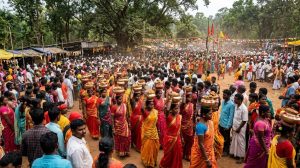
Distinctive Signature: The Medaram Jatara in Telangana, held by the Koya tribe, is widely recognized as one of the largest gatherings of indigenous people in the world, regularly welcoming several million pilgrims to a small forest clearing. It honors a mother and daughter, Sammakka and Saralamma, who died fighting against unjust imperial taxation and drought levies. Worship centers on sacred platforms under trees rather than stone temple enclosures, and offerings are made in raw jaggery (Bangaram—symbolic gold), followed by spiritual cleansings in wild streams.
8. How Are Modernisation and Globalisation Changing Tribal Festivals?
The rush of modern economic development, satellite connectivity, digital media, and transport infrastructure has brought both positive connectivity and cultural disorientation to indigenous communities. Tribal festivals have not remained untouched; they are experiencing significant changes in meaning, performance, and intent.
Traditional Tribal Celebration             Modernised Tribal Festival
───────────────────────────────             ──────────────────────────
• Enacted for Ancestral Spirits             • Performed for Audiences & Tourists
• Rooted in Living Forests & Groves         • Staged on Urban Podiums & Grounds
• Homebrewed Ales, Shared Cooking           • Commercial Concessions & Fast Foods
• Communal, Open Participation              • Ticketed Seats, VIP Enclosures
• Deep, Unhurried Rhythms                   • Compressed into Timed Spectacles
From Sacred Obligation to Stage Spectacle: Folklorisation
One of the most noticeable impacts of globalization is folklorisation—the transformation of sacred communal rituals into packaged, photogenic entertainment for outsiders, cultural tourists, and digital cameras.
When dances like the Warli Tarpa, the Hmar bamboo dance, or the Maria bison-horn performance are moved from their sacred grounds onto urban festival stages or luxury hotel courtyards:
-
Choreography is Shortened: Night-long rituals that build slow psychological trance and sacred presence are compressed into frantic, ten-minute competitive dance routines tailored for impatient audiences.
-
Spiritual Context is Cleared Away: The village priest’s preliminary prayers, water offerings, and tree blessings are quietly set aside. What was once an elemental conversation between human beings and the earth becomes a colorful dance performance, detached from the ecological obligations that created it.
-
Economic Inequality Arrives: Traditional festivals functioned on gifts of grain, shared firewood, and open kitchens. Modern staged festivals introduce cash gates, VIP passes, vendor fees, and commercial sponsorships, creating social divides unknown to the traditional collective village assembly.
Digital Technology and Youth Reinterpretation
The explosion of budget smartphones and social media across rural India has altered the visual landscape of tribal celebrations. Young people often dance while recording content for Instagram, Facebook, and YouTube:
  Traditional Sacred Circle ────> Digital Documentation ────> Pan-Tribal Pride
             │                                                         │
             ▼                                                         ▼
  Fragmented Attention & Selfie Focus               New Online Indigenous Solidarities
This dynamic brings mixed blessings:
-
Loss of Immediate Presence: The unhurried communion of all-night singing is broken by bright LED ring lights, phone flashes, and requests to restage spontaneous steps for a lens.
-
A Resurgence of Indigenous Self-Expression: On the other hand, indigenous youth now produce their own media. Instead of having their cultures filtered through the perspectives of urban filmmakers, young Adivasi and Naga creators broadcast their original languages, poetry, and fashion directly to the world, creating fresh pride in indigenous identities among their peers.
Synthetic Encroachment on Sacred Crafts
Industrial mass production has introduced cheap synthetic alternatives to indigenous, hand-harvested festival materials:
-
Factory-produced nylon textiles with screen-printed tribal motifs frequently replace delicate backstrap-loomed home weaves that take months to spin, dye, and assemble.
-
Cheap plastic beadwork and aluminum spangles replace hand-carved bone, porcupine quills, and beaten silver ornaments.
-
Commercial bottled liquor, often brought in from nearby urban distilleries, edges out traditional herbal rice wines like Hadia and Apong. This transition erodes the communal gathering of medicinal forest roots and increases social problems like addiction, without offering the nutritional value of traditional slow-fermented grains.
9. What Challenges Threaten the Survival of Tribal Festivals in India?
The growing challenge to the survival of tribal festivals runs deeper than stylistic changes. Indigenous communities are fighting against serious environmental, economic, and institutional pressures that threaten their survival as distinct cultural groups.
                           PRESSURES ON TRIBAL SURVIVAL
                                        │
        ┌───────────────────────────────┼───────────────────────────────┐
        ▼                               ▼                               ▼
┌───────────────────────────────┐┌───────────────────────────────┐┌───────────────────────────────┐
│ Ecological Destruction        ││ Cultural & Religious          ││ Economic Migration            │
│ • Open-cast Mining            ││ Assimilation                  ││ • Youth Rural Flight          │
│ • Deforestation & Dams        ││ • Erasure of Sarna Identity   ││ • Seasonal Construction Work │
│ • Sarna Grove Desecration     ││ • Fundamentalist Conversions  ││ • Loss of Oral Languages      │
└───────────────────────────────┘└───────────────────────────────┘└───────────────────────────────┘
Ecological Destruction and Habitat Displacement
Because tribal festivals are grounded in specific landscapes, environmental destruction immediately weakens their cultural heritage. The eastern tribal belt—Jharkhand, southern West Bengal, northern Odisha, and Bastar—rests on some of the largest iron ore, coal, bauxite, and mica deposits in South Asia.
-
When a village Sarna grove is bulldozed for an open-cast coal pit, or a pristine river is blocked by industrial dams, the spiritual landscape of the festival disappears.
-
When whole villages are relocated to sterile concrete resettlement camps on urban outskirts, the ancient relationships between clans, sacred springs, and gathering paths are broken.
-
A family cannot celebrate Sarhul without the living Sal forest; they cannot perform the Karam rites without the green tree; they cannot mark the harvest festival when their fields have been replaced by industrial sprawl. The destruction of the forest environment remains the fastest way to end tribal ceremonial life.
Religious Assimilation and Conversion Pressures
Tribal animism has long faced assimilation pressure from larger institutional religions:
-
Assimilation into Mainstream Fringes: Outside cultural groups frequently incorporate tribal deities into regional polytheistic pantheons, recasting them as avatars of mainstream mythological figures. In this process, the egalitarian, casteless structure of tribal ritual is dismantled, and traditional village priests are slowly sidelined in favor of external religious hierarchies.
-
Christian Conversion: In several tribal regions, especially across parts of northeastern India and isolated plateaus of central India, conversion to various Christian denominations has historically offered access to literacy, modern healthcare, and institutional education. However, early mission approaches often banned traditional drums, rice ales, circular courtship dances, and ancestral invocations, labeling them as unchristian superstitions. While some modern indigenous churches now incorporate native instruments, decades of historic music and oral traditions were lost along the way.
-
The Struggle for the “Sarna Code”: In response, millions of indigenous people across Jharkhand and neighboring states are currently organizing democratic campaigns demanding an independent Sarna Religious Code in the national census. They seek legal recognition as an autonomous spiritual tradition that is neither Hindu, Christian, nor Muslim, fighting to keep their ancestral, nature-based heritage distinct on official records.
Economic Migration and Rural Depopulation
Subsistence agriculture on degraded, climate-stressed land no longer provides year-round security for young tribal families. As a result, millions of indigenous youth migrate to distant metropolises—working long hours in brick kilns, on construction sites, as domestic workers, or inside low-wage service industries.
-
Living in crowded, unfamiliar urban slums, young migrant workers cannot easily return home for month-long village preparation cycles.
-
They miss the seasonal learning, the language exposure, and the drum rhythms of the festivals.
-
The elder storytellers and master instrument builders find fewer apprentices to pass their craft down to. When an elder who knows the complete twenty-verse epics passes away in an underpopulated village, an unwritten library disappears forever.
10. What Is the Future of Tribal Festivals in India?
Despite intense outside pressures, the future of India’s tribal celebrations is not one of passive decline. Indigenous communities are actively adapting, organizing, and reclaiming their cultural heritage. The path ahead requires balancing traditional community continuity with modern legal safeguards and self-determined economic models.
                             THE WAY FORWARD
                                    │
    ┌───────────────────────┬───────┴───────┬───────────────────────┐
    ▼                       ▼               ▼                       ▼
Legal Title over        Community-Led   Intergenerational       Institutional
Forests & Groves       Responsible      Oral Language Labs     Curricula Inclusion
(FRA 2006 Action)      Tourism Models   & Native Schools       & Cultural Respect
Community-Controlled Eco-Cultural Tourism
Tourism cannot be completely stopped, but it can be placed firmly under indigenous community control. Instead of leaving tribal lands vulnerable to outside commercial tour operators who profit from native heritage while leaving little behind for the village, communities are beginning to design Community-Based Tourism (CBT) models.
Under this self-determined approach:
-
The traditional village council (Gram Sabha) decides which ceremonies are sacred and private, and which dances may be shared publicly.
-
Travelers live directly in community-managed, eco-friendly homestays, eating local seasonal foods and paying fees directly to the village development fund.
-
Photography guidelines are set by village elders, prohibiting intrusive cameras inside sacred groves and ritual spaces.
-
Tourism shifts from an intrusive spectacle to an educational cultural exchange where visitors learn respectful ways of caring for the natural world from their indigenous hosts.
Legal Empowerment: The Forest Rights Act (FRA)
The most important shield for preserving tribal festivals is not cultural performance, but legal land security. The Scheduled Tribes and Other Traditional Forest Dwellers (Recognition of Forest Rights) Act, 2006 (FRA) provides communities with vital legal mechanisms:
-
Community Forest Rights (CFR): Empowers the Gram Sabha to legally manage, preserve, and regenerate their communal forest boundaries, protecting them from unauthorized industrial clearance.
-
Protection of Sacred Sites: Grants legal recognition to traditional cultural and religious areas, including Sarna groves, sacred hill summits, burial grounds (Sasandiri), and ancestral water sources.
When an indigenous community holds legal ownership of its ancestral forests, its festivals survive naturally. The drums continue to echo because the trees that nurture them remain standing.
Reviving Indigenous Languages and Knowledge in Education
To bridge the gap between elders and modern youth, grassroots community leaders and cultural centers are establishing native-language schools and youth workshops:
-
Mother-Tongue Education: Introducing scripts like Ol Chiki (for Santhali), Varang Kshiti (for Ho), and Gondi into primary education ensures that children learn their mother tongues, enabling them to comprehend the complex poetic metaphors used in festival songs.
-
Living Heritage Camps: Elder craftsmen, master drummers, and traditional healers are invited into community-run seasonal workshops to instruct young adults in making traditional instruments, harvesting medicinal plants, and leading traditional steps.
-
Digital Archives Maintained by Tribes: Indigenous youth are using accessible recording equipment to compile video archives of their community elders, logging genealogies, and preserving rare festival rituals on their own terms.
The Enduring Flame of Indigenous Wisdom
Tribal festivals across India are far more than colorful, celebratory relics of an ancient past. They are living demonstrations of how human societies can live in balance with the natural earth.
In a modern world shaken by accelerating climate change, deforestation, and social isolation, the core philosophy behind India’s tribal celebrations offers a vital, alternative path forward. They show us that:
-
The forest is not merely wood and real estate; it is a community of living kin to be treated with care.
-
Human wealth is not measured by individual bank balances, but by shared meals, shared laughter, and community support.
-
A society is truly healthy only when it honors its ancestral memory and dances together in an unbroken circle of shared respect.
When the clay drums begin their heartbeat roll, when the Sal branches bloom white in spring, when the hundred drums of the Garo hills rumble across the autumn mist, and when human hands link together beneath the sacred grove, the ancient spirit of the earth speaks clearly. The survival of these festivals is not just important for the tribal communities who carry them—it is essential for keeping our shared human connection to the living earth alive.
