
Unique Cultural Traditions of Indian Tribes: Custodians of Earth, Memory, and Ritual
India is home to one of the largest and most diverse indigenous populations in the world. Officially designated as Scheduled Tribes under Article 342 of the Indian Constitution, these communities—often referred to natively as Adivasis (original inhabitants)—comprise 104.3 million people according to the Census of India, representing 8.6% of the country’s total population.
Spread across 705 distinct ethnic groups, with 75 classified as Particularly Vulnerable Tribal Groups (PVTGs), these societies represent living archives of human adaptation, ecological wisdom, and artistic expression.
Centuries before modern environmental ethics, restorative justice frameworks, or community forestry took root in contemporary discourse, India’s indigenous communities had already developed sophisticated systems that bound the human lifecycle directly to the rhythm of the soil, the canopy, and ancestral memory.

1. Cultural Identity: Language, Folklore, and Sacred Cosmologies
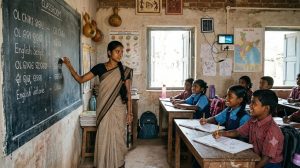
The Linguistic Mosaic and Endangered Voices
The cultural identity of India’s tribes is anchored in an extraordinary linguistic diversity spanning four distinct language families: Austroasiatic (such as Santhali, Mundari, and Ho), Dravidian (including Gondi, Kurukh, and Toda), Tibeto-Burman (spoken widely across Northeast India, including Bodo, Mizo, and Ao), and Indo-Aryan (such as Bhili and Halbi).
Language serves as an ecological dictionary for these communities. For instance, the Gondi language holds distinct botanical and ecological words for micro-stages of forest growth that have no direct single-word equivalent in English or standard Hindi. According to the People’s Linguistic Survey of India (PLSI), India has lost over 220 languages over the past five decades, with tribal and nomadic tongues being the most vulnerable.
Efforts toward structural preservation have yielded milestone achievements. The Santhali language, spoken by over 7 million people across Jharkhand, West Bengal, Odisha, and Assam, achieved recognition under the Eighth Schedule of the Indian Constitution in 2003 via the 92nd Constitutional Amendment Act.
Its script, Ol Chiki, invented in 1925 by Pandit Raghunath Murmu, stands as a symbol of indigenous literary autonomy. Instead of adopting the Bengali, Devanagari, or Roman scripts, Murmu designed letterforms based on natural shapes: hills, rivers, open hands, and tools, embedding indigenous physical reality directly into the orthography.
Oral Literature as Living Archive
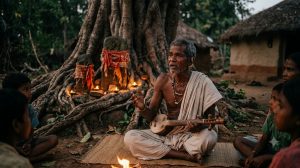
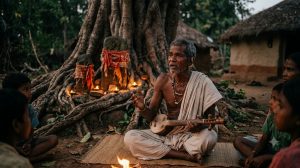
Tribal histories are rarely chiseled into monumental stone; they are spoken, sung, and recalled through oral literature. Among the Mundas of the Chota Nagpur Plateau, the Sosobonga is an epic oral ballad recited over consecutive nights during harvest season. Accompanied by the rhythmic burning of wild incense, the elder recites the creation of the cosmos, the trial of fire and rain, and the moral covenants established between humanity and Singbonga (the Sun God and Supreme Spirit).
Similarly, among the tribes of the Nilgiri Hills, such as the Toda, elaborate oral songs called Tsik document migratory paths, sacred pastures, and the life histories of ancestral water buffaloes. These oral libraries do not simply preserve aesthetic verse; they serve as customary legal frameworks, boundary deeds, and ethical codes passed from one generation to the next without a single drop of ink.
Sacred Cosmologies: Beyond Organised Religion
Indigenous spirituality across central and eastern India centres on Sarnaism (the religion of the holy grove). Distinct from mainstream canonical religions, Sarnaism does not worship anthropomorphic idols housed in concrete temples. Instead, the locus of faith is the Jaherthan or Sarna Sthal—a virgin patch of Sal (Shorea robusta) and Mahua (Madhuca longifolia) forest where the protective spirit Bonga or Gram Devi resides.
In these cosmologies, nature is not a resource pool to be exploited; it is an active kin network:
-
The Sun (Singbonga or Dharmesh) provides life energy.
-
The Earth (Dharti Aayo) sustains physical bodies.
-
The Forest Spirits (Biras) protect the community from disease and calamity.
In the Western Ghats, the Warli community worships Narayan Dev and Hirva (the god of green fields), alongside Waghya (the Tiger God).
The tiger is not viewed as a predator to be eliminated, but as a sovereign protector of the forest canopy whose presence guarantees water, game, and balance. Ancestor worship (Pitru Puja or Mahan) ensures that deceased forebears remain active members of the extended family, consulted through shamans during harvest distributions, marriages, and disputes.
2. Festivals and Arts: The Celebration of Natural Cycles and Visual Expression
Rhythms of Celebration: From Sarhul to Hornbill
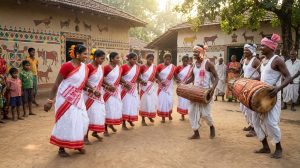
Festivals in tribal India mark cosmic, agricultural, and seasonal milestones. They occur when seasons shift, when the soil prepares for seeds, or when the granary fills after winter.
| Festival | Primary Tribe(s) | Region / State | Core Significance |
| Sarhul | Oraon, Munda, Santhal | Jharkhand, Odisha, West Bengal | Welcoming spring; ritual wedding of Sun and Earth; blooming of Sal flowers. |
| Bhagoria | Bhil, Bhilala | Madhya Pradesh, Maharashtra | Pre-Holi festival of agricultural gratitude, community fairs, and courtship. |
| Wangala | Garo | Meghalaya, Assam | The “100 Drums Festival”; thanksgiving to Misi Saljong (Sun God of Fertility). |
| Hornbill Festival | 16 Naga Tribes (Angami, Ao, Konyak, etc.) | Nagaland | Inter-tribal solidarity, martial games, indigenous preservation, winter harvest. |
| Danda Nata / Chhau | Bhumij, Santhal, Ho | Odisha, Jharkhand, West Bengal | Folk-tribal martial dance and penance celebrating the vernal equinox. |
Sarhul: The Wedding of Earth and Sun
Celebrated during the Hindu month of Chaitra (March–April), Sarhul marks the exact moment the Sal tree bursts into white and pale yellow blossoms. Tribal priests (Pahans) perform animal sacrifices at the sacred grove and inspect clay water vessels kept overnight.
If the water level remains stable, it indicates adequate monsoon rainfall for the approaching paddy cycle; if it drops, drought is anticipated.
No Munda or Oraon farmer will till the soil or gather new Sal leaves before Sarhul is concluded. The ceremony culminates in the Pahan distributing fresh Sal blossoms to every home, which women weave into their oiled hair as an emblem of fertility and ecological obedience.
Bhagoria Haat: Joy, Trade, and Autonomy
Observed by the Bhil and Bhilala communities across the Malwa and Nimar regions of Madhya Pradesh, Bhagoria combines a seasonal market with community matchmaking. Villagers travel miles on foot, bullock carts, and tractors to reach designated market towns.
Adorned in silver jewelry, vibrant turbans (Pheta), and embroidered ghagras, youth gather around towering wooden Ferris wheels and massive brass Mandal drums. Historically, if a young man offered sweet paan or applied gulal (red powder) to a woman and she accepted, it signified mutual consent for marriage, prompting an elopement that the village elders would subsequently regularize through community dialogue. Bhagoria reflects an autonomous, egalitarian social structure where youthful agency is embraced within community festivities.
Visual Arts: Painting the Cosmos on Mud and Canvas
Tribal visual art is fundamentally non-commercial in its origins. It serves as devotional prayer, house insulation, and domestic storytelling.
       ┌────────────────────────────────────────────────────────┐
       │             Indigenous Visual Traditions               │
       └───────────────────────────┬────────────────────────────┘
                                   │
         ┌─────────────────────────┼─────────────────────────┐
         ▼                         ▼                         ▼
   Warli Painting            Gond Art                  Sohrai & Khovar
  (Maharashtra)          (Madhya Pradesh)                (Jharkhand)
  • Geometric forms       • Fine lines & dots           • Mud-relief walls
  • White rice paste      • Charcoal & clay             • Comb-cut stencils
  • Circle, triangle,     • Mythological trees,         • Matrimonial & harvest
    and square motifs       spirits, and birds            fertility motifs
-
Warli Painting (Maharashtra): Utilizing a minimalist visual vocabulary of circles (representing the sun and moon), triangles (derived from mountains and pointed trees), and squares (denoting sacred enclosures or Chauk), Warli art bypasses linear perspective.
-
Painted on red-ochre mud walls using a paste of ground rice flour, water, and gum, these murals document daily life: hunting, fishing, sowing seeds, and the famous Tarpa dance. In the Tarpa dance, musicians stand at the center while dozens of men and women link hands and spiral outward, mirroring the circular path of life and cosmic time.
-
Gond Art (Madhya Pradesh): Gond painters create intricate lines, dots, dashes, and scales that fill bold animal and arboreal silhouettes. Practiced originally by the Pradhan Gonds, this art transcribes oral epics onto paper, canvas, and home walls. The legendary Gond artist Jangarh Singh Shyam elevated this tradition onto the global stage in the late 20th century, proving that tribal aesthetics carry contemporary philosophical depth.
-
Sohrai and Khovar (Jharkhand): Awarded the Geographical Indication (GI) tag in 2020, these twin mural traditions are practised exclusively by indigenous women (such as Kurmi, Santhal, and Oraon). During Khovar (the wedding season), brides’ homes are coated with black manganese mud, followed by a layer of creamy white clay (Dhudhi mitti).
-
Using broken combs, split bamboo sticks, or four fingers, the women scrape away the top layer to reveal bold, contrasting black silhouettes of tigers, peacocks, and fertility plants. Sohrai, performed during the winter harvest, honours domestic cattle through expansive, stylised earthen murals.
3. Daily Life: Attire, Sustenance, and Social Organisation
Attire, Ornaments, and Body Markings
Tribal clothing across India prioritizes climate adaptation, physical utility, and community identity. Rather than following transient fashion trends, traditional attire communicates an individual’s marital status, community, and social standing.
In Northeast India, handloom weaving is an essential domestic skill. Among the Nagas, the geometric patterns, colors, and stripes of a shawl identify the wearer’s specific community (e.g., the Tsungkotepsu shawl of the Ao Nagas, historically reserved for accomplished warriors and generous community leaders).
In the southern peninsula, the Toda of the Nilgiris embroider thick, unbleached white cotton blankets called Poothkuli. Using red and black woolen threads, Toda women construct reversible, geometric patterns that mirror buffalo horns, celestial bodies, and sacred stone pens.
Body adornment extends beyond fabric into indelible body art:
-
Godna (Tattooing): Practiced widely among Baiga, Gond, and Bhil women of central India, Godna serves social, aesthetic, and spiritual roles. The Baiga believe that while material possessions remain behind on Earth, Godna markings are the only treasures that accompany the soul into the afterlife. Tattoos across the forehead, chest, and arms identify family lineage, ward off ailments, and mark physiological transitions from puberty to elderhood.
-
Nose Plugs and Facial Tattoos of the Apatani: In the Ziro Valley of Arunachal Pradesh, elder Apatani women carry large dark wooden plugs (yaping hullo) inserted into the sides of their nostrils, accompanied by vertical blue-black facial tattoos running from the forehead down the nose to the chin. While local lore suggests the practice originally made women less vulnerable to abduction by neighboring raiding tribes, it evolved into an enduring symbol of community resilience and feminine distinction.
Indigenous Gastronomy: Foraged, Fermented, and Nutritious
Traditional tribal cuisine stands in stark contrast to industrialized diets. It avoids hyper-processed sugars, commercial oils, and synthetic additives, leaning instead on wild-foraged leafy greens, native millets, tubers, river fauna, and fermented preparations.
       ┌────────────────────────────────────────────────────────┐
       │             Indigenous Food Systems                    │
       └───────────────────────────┬────────────────────────────┘
                                   │
         ┌─────────────────────────┼─────────────────────────┐
         ▼                         ▼                         ▼
  Wild Millets & Tubers      Fermented Drinks           Entomophagy
  • Ragi, Kodo, Kutki       • Handia (Rice Beer)      • Kai Chutney (Red Ant)
  • Air-potatoes, Dioscorea • Mahua Spirit            • Eri Silkworm Pupae
  • Drought-resistant fiber • Cooling, ceremonial     • High-protein, seasonal
-
Ancient Millets and Forest Starches: In the arid belts of southern Rajasthan and Madhya Pradesh, Bhil diets rely on Kodo, Kutki, and Ragi (finger millet), consumed as thick unleavened flatbreads (roti) alongside broths made from tender bamboo shoots and wild drumstick leaves. The Chenchus of Andhra Pradesh dig for wild Dioscorea tubers, using wooden digging sticks to preserve the mother root for future regeneration.
-
Fermentation Science: Across the eastern tribal belt, Handia (or Diang / Apong in the Northeast) is a mild, nutrient-dense rice beer brewed using a fermenting cake made from over 20 wild medicinal roots and herbs (Ranu dabai). Handia serves as a hydration source during manual field work, a digestive tonic, and an obligatory offering during ancestral worship.
-
Entomophagy (Insect Consumption): In Mayurbhanj, Odisha, the indigenous Santhal, Bhumij, and Bathudi communities collect weaving weaver ants and their larvae from Sal canopies to make Kai Chutney.
-
Awarded a Geographical Indication (GI) tag in January 2024, this sharp paste—pounded with wild chilies, garlic, and salt—is rich in proteins, vitamin B12, iron, calcium, and zinc, serving both as an everyday nutritional supplement and an indigenous treatment for joint pain and seasonal fevers.
Matrilineal Structures and Egalitarian Kinship
While the majority of Indian societies follow strictly patriarchal and patrilineal systems, several indigenous communities maintain matrilineal and gender-egalitarian social frameworks.
The Khasi, Garo, and Jaintia tribes of Meghalaya operate under one of the world’s most enduring matrilineal systems. Among the Khasis:
-
Lineage, clan titles, and ancestral property pass from mothers to their daughters.
-
The youngest daughter, known as the Khun Khadduh, becomes the primary custodian of the ancestral hearth and family property.
-
Children take the mother’s surname, and husbands move into their wives’ maternal homes upon marriage (matrilocal residence).
Even in patriarchal tribes like the Gond, Munda, and Ho, women exercise significant economic autonomy. They retain full control over minor forest produce sales, take active roles in agricultural tasks, and preserve customary rights to initiate divorce or seek widow remarriage through village councils without social stigma.
The Ghotul: Youth Autonomy and Social Apprenticeship
Among the Muria Gonds of the Bastar region (Chhattisgarh), the Ghotul represents a unique community institution. The Ghotul is a communal dormitory and village academy where adolescents (cheliks and motiaris) live together, away from parental oversight.
Within the Ghotul, young people manage community activities, organize agricultural working groups for the village, learn tribal songs, master folklore, and study social etiquette. The institution fosters egalitarian gender interactions, demystifies sexuality through consensual peer relationships, and instills community responsibility, mutual respect, and civic duty long before formal marriage.
4. Nature and Traditional Knowledge: Sacred Ecology and Sustainable Living
Sacred Groves: Ancient Protected Areas
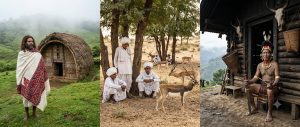
Centuries before the Indian Forest Act or global wildlife sanctuaries were formulated, tribal communities maintained autonomous conservation zones known as Sacred Groves. Known locally as Sarna or Jaherthan in Jharkhand, Devrai in Maharashtra, Kavu in Kerala, and Law Kyntang in Meghalaya, these ecosystems are protected by strict customary taboos.
Ecological studies indicate that these micro-sanctuaries preserve rare, relict flora, safeguard medicinal plants that have disappeared from adjoining forests, protect local watersheds, and sustain native pollinator populations. They serve as living gene banks maintained through spiritual reverence rather than armed forest guards.
Living Root Bridges: Bio-Engineering of the Khasi and Jaintia
In the southern Khasi and Jaintia Hills of Meghalaya—one of the wettest places on Earth—floollen monsoonal rivers routinely wash away conventional timber or bamboo bridges. In response, indigenous communities developed the Jingkieng Jri (Living Root Bridges).
   1. Guide Aerial Roots ────► 2. Hollow Betel Canes ────► 3. Root Weaving & Anchoring
      (Ficus elastica)           (Directs roots across)     (Intertwines into riverbanks)
                                                                      │
   5. Century-Long Durability ◄──── 4. Self-Strengthening ────────────┘
      (Grows stronger with age)       (Pebbles, stones, living bark)
-
Elders locate young aerial roots of the Ficus elastica (Indian rubber tree) growing along riverbanks.
-
The roots are guided across river gorges using hollowed-out trunks of the Areca catechu (betel nut) palm.
-
The roots reach the opposite bank, where they are anchored into the soil and allowed to take firm root.
-
Over decades, secondary roots are woven together with stones, pebbles, and fallen wood, forming living decks that handle foot traffic.
The Sacred Buffaloes of the Toda Tribe
High in the Nilgiri plateau of Tamil Nadu, the life, faith, and economy of the pastoral Toda community revolve around their long-horned water buffaloes (Bubalus bubalis). The Toda do not keep buffaloes for slaughter or industrial meat; they revere them as divine manifestations.
Toda dairy temples, called Mu or Palikartpol, are modeled on cone-shaped thatch architecture. Only ordained priests (Poojaris or Palol), who observe rigorous isolation, vegetarian diets, and ritual purity, are permitted to milk the sacred herd and churn the milk into butter and ghee. The Toda’s carefully planned rotational grazing patterns have preserved the high-altitude Shola grassland ecosystems for generations, preventing woody scrub from encroaching upon the indigenous montane pastures.
Ethnobotany: Pharmacopeias of the Canopy
India’s indigenous forest communities hold profound knowledge of botanical medicine. According to the All India Coordinated Research Project on Ethnobiology (AICRPE), indigenous communities utilize over 7,500 species of wild plants for medicinal purposes, 3,900 for sustenance, and several hundred for organic pesticides, natural dyes, and veterinary treatments.
-
Kani Tribe and Arogyapacha: In the Agasthyamala hills of Kerala, the Kani community uses the leaves of Trichopus zeylanicus (locally called Arogyapacha) to combat fatigue and bolster physical endurance during strenuous mountain expeditions. In the 1990s, Indian scientists worked with the Kani to formulate the herbal drug “Jeevani,” establishing an early model of benefit-sharing under the framework of the Convention on Biological Diversity (CBD).
-
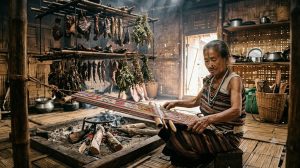
Baiga Healers (Gunias): The Baiga of Madhya Pradesh, celebrated as the “sons and daughters of the earth,” refuse to use iron plows, believing that tearing into the soil wounds the Earth Mother. Instead, they historically relied on Bewar (rotational slash-and-burn shifting cultivation) combined with extensive foraging.
5. Regional Examples: Unique Profiles of Indigenous Communities
To appreciate the vast scope of tribal India, one must examine specific communities across its geographic spectrum:
                  ┌────────────────────────────────────────┐
                  │   Geographic Diversity of Traditions   │
                  └───────────────────┬────────────────────┘
                                      │
       ┌─────────────────┬────────────┴───────┬──────────────────┐
       ▼                 ▼                    ▼                  ▼
 Bishnoi (West)     Santhal (East)       Chenchu (South)    Sentinelese (Islands)
 Thar Desert, Raj.  Jhk, WB, Odisha      Nallamala Hills    North Sentinel, A&N
 • Animal sanctity  • Democratic Manjhi  • Ancient foraging • Complete isolation
 • Khejri protection  Than councils      • Forest symbiotic • Pre-Neolithic tools
The Western Arid Zone: The Bishnoi of Rajasthan
While the Bishnoi community are technically followers of the 29 principles laid down by Guru Jambheshwar in the 15th century, their lifestyle, cultural worldview, and deep environmental ethics mirror indigenous tribal philosophies.
Residing in the arid Thar Desert, the Bishnoi protect all plant and animal life. They revere the Khejri tree (Prosopis cineraria) and hold wild blackbucks, chinkaras, and peacocks in deep sanctity. Bishnoi families treat abandoned blackbuck fawns like their own infants, with women regularly breastfeeding young animals left behind by poachers or dogs.
The community’s commitment to nature protection was historically proven in the Khejarli Massacre of 1730. Led by an indigenous woman named Amrita Devi Bishnoi, 363 men, women, and children clung to Khejri trees to shield them from the axes of the Maharaja of Jodhpur’s royal woodcutters, sacrificing their lives before the felling was halted. This ultimate sacrifice served as the philosophical blueprint for the modern Chipko Movement of the 1970s.
The Eastern Heartlands: The Santhal of Jharkhand and Bengal
The Santhal are the third-largest Scheduled Tribe in India, with an integrated social structure guided by customary councils. Every Santhal village operates under a local democratic system centered around the Manjhi Than (a sacred village platform) and directed by five traditional officials:
-
Manjhi Haram: The village headman who oversees governance and resolves disputes.
-
Paranik: The deputy headman, managing administrative duties.
-
Jog Manjhi: The youth supervisor and guardian of social ethics.
-
Jog Paranik: The assistant to the youth supervisor.
-
Naike: The village priest who performs sacred sacrifices to the Bongas.
Decisions concerning land distributions, family separations, and seasonal festivals are resolved through consensus during open village assemblies (Panchayats), without reliance on formal police or external courts. The Santhal also maintain a vibrant artistic identity, manifested in their Chadar Badar puppetry—a traditional, mechanized wooden puppet system used to teach moral folklore—and the Sohrai-Khovar painting traditions.
The Southern Ghats: The Chenchu of Andhra Pradesh and Telangana
The Chenchu hold a symbiotic relationship with local wildlife, particularly tigers. Living alongside the Nagarjunsagar-Srisailam Tiger Reserve—the largest tiger reserve in India—the Chenchu consider the big cat a brother and guardian spirit (Pedda Puli).
Customary norms restrict over-extraction from the forest: Chenchu collectors will only take half the honey combs from a rock bee hive (Apis dorsata), leaving the remainder intact to ensure the colony survives. Their tracking skills, footprint identification, and deep canopy navigation are so acute that state forestry departments routinely employ Chenchu trackers for wildlife census operations and anti-poaching patrols.
The Isolated Frontiers: The Sentinelese of the Andaman Islands
Located in the remote Bay of Bengal, the Sentinelese of North Sentinel Island represent one of the last truly uncontacted, pre-Neolithic societies on Earth. Living in absolute isolation for an estimated 30,000 to 50,000 years, the Sentinelese have actively rebuffed all external incursions using longbows and javelins.
Recognizing their extreme vulnerability to modern diseases—for which they lack immunological defenses—the Government of India strictly enforces the Andaman and Nicobar Islands (Protection of Aboriginal Tribes) Regulation of 1956.
6. Modern Challenges: Pre
ssures of Modernity, Dislocation, and Preservation
Despite their rich cultural foundations, India’s indigenous communities face severe socio-economic, environmental, and demographic pressures in the modern era.
       ┌────────────────────────────────────────────────────────┐
       │             Key Contemporary Vulnerabilities           │
       └───────────────────────────┬────────────────────────────┘
                                   │
         ┌─────────────────────────┼─────────────────────────┐
         ▼                         ▼                         ▼
   Developmental             Linguistic &            Climate Change &
    Displacement            Cultural Erosion         Ecological Stress
 • Mining, dams, & roads   • Mother tongues lost    • Erratic monsoons
 • Severed connection to   • Transition to regional • Drying streams and
   sacred forest landscapes  dialects in schools      unpredictable blooms
The Trauma of Development-Induced Displacement
Over the past seven decades, large-scale industrial projects—including open-cast mines, mega-hydroelectric dams (such as the Sardar Sarovar project on the Narmada River), and linear infrastructure corridors—have displaced millions of indigenous families. When a tribal community is uprooted from its forest habitat, the loss goes far beyond economic land:
-
Sacred groves are leveled, severing ties to ancestral spirits.
-
Customary medicinal knowledge is rendered obsolete as native plants are destroyed.
-
Traditional self-reliance collapses, often reducing autonomous forest stewards to migrant daily-wage laborers on urban margins.
Legislative Interventions: PESA and the Forest Rights Act
To correct historic injustices and protect indigenous autonomy, the Indian Parliament enacted two key legislative measures:
-
The Provisions of the Panchayats (Extension to Scheduled Areas) Act, 1996 (PESA): Designed to extend local self-governance to Fifth Schedule tribal areas across ten Indian states, PESA legally empowers the Gram Sabha (village assembly) to manage natural resources, resolve local disputes via customary traditions, approve development plans, and give mandatory consent prior to land acquisitions.
-
The Scheduled Tribes and Other Traditional Forest Dwellers (Recognition of Forest Rights) Act, 2006 (FRA): A landmark piece of legislation that formally recognizes:
-
Individual Forest Rights (IFR): Providing secure land titles to forest-dwelling families for cultivation and housing.
-
Community Forest Rights (CFR): Empowering villages to protect, manage, and sustainably utilize local forests, as well as collect and sell Minor Forest Produce (MFP) like bamboo, tendu leaves, and lac.
-
While both laws are progressive in design, their practical implementation faces challenges, including bureaucratic delays, conflicting state industrial policies, and incomplete land titling processes.
Cultural Erosion and Linguistic Shifts
With increasing economic integration, youth migration to urban centers, and exposure to mainstream media, several indigenous traditions face generational decline. In formal schooling systems, tribal children are often educated exclusively in regional state languages (such as Hindi, Bengali, Telugu, or Odia), bypassing their mother tongues. This dynamic breaks the oral chain of inheritance, distancing youth from their communities’ traditional folklore, proverbs, and ecological vocabulary.
Contemporary Revival and Digital Documentation
In response to these challenges, a new wave of indigenous leadership, community archiving, and collaborative preservation has emerged:
-
Digital Archiving and Mother-Tongue Pedagogy: Projects like the Digital District Repository and indigenous language software platforms are cataloging disappearing oral epics and folk songs. In Odisha, the state government launched Mother Tongue-Based Multilingual Education (MTB-MLE) programs, employing tribal teachers to instruct primary school students in native languages like Kui, Saora, and Ho, with learning materials written in custom scripts.
-
GI Tags and Economic Self-Reliance: By securing Geographical Indication (GI) tags for traditions like Bastar Iron Craft, Warli Painting, Mayurbhanj Kai Chutney, and Sohrai Murals, indigenous artisans are establishing intellectual property rights over their crafts. Initiatives led by the Tribal Cooperative Marketing Development Federation of India (TRIFED) and the “Van Dhan Vikas Yojana” help artisans and gatherers package, brand, and sell forest goods directly to national and global markets, bypassing exploitative middlemen.
7. Conclusion: The Contemporary Relevance of Indigenous Wisdom
The unique cultural traditions of India’s tribes are far more than aesthetic relics; they represent sustainable ways of living developed across thousands of years of continuous interaction with the natural world.
| Domain | Modern Industrial Paradigm | Indigenous Tribal Paradigm |
| Ecology & Nature | Resource to be extracted, dominated, and monetized. | Living kin network; reciprocal responsibility; sacred groves. |
| Social Governance | Centralized, bureaucratic, litigious, and punitive. | Consensus-based, restorative, and grounded in community elderhood. |
| Material Culture | Disposable, mass-produced, and carbon-heavy. | Biodegradable, locally foraged, functional, and community-crafted. |
| Knowledge Transfer | Institutional, proprietary, transactional, and text-bound. | Oral, intergenerational, experiential, and shared across the collective. |
Protecting the languages, sacred lands, artistic heritage, and legal autonomy of India’s Adivasis is not simply a matter of historical preservation. It is a vital investment in our shared ecological future. As the Santhal proverb reminds us:
“Dharti aayo menaya, tabe geyabo menaya”
(“Only as long as Mother Earth lives, do we live.”)
