
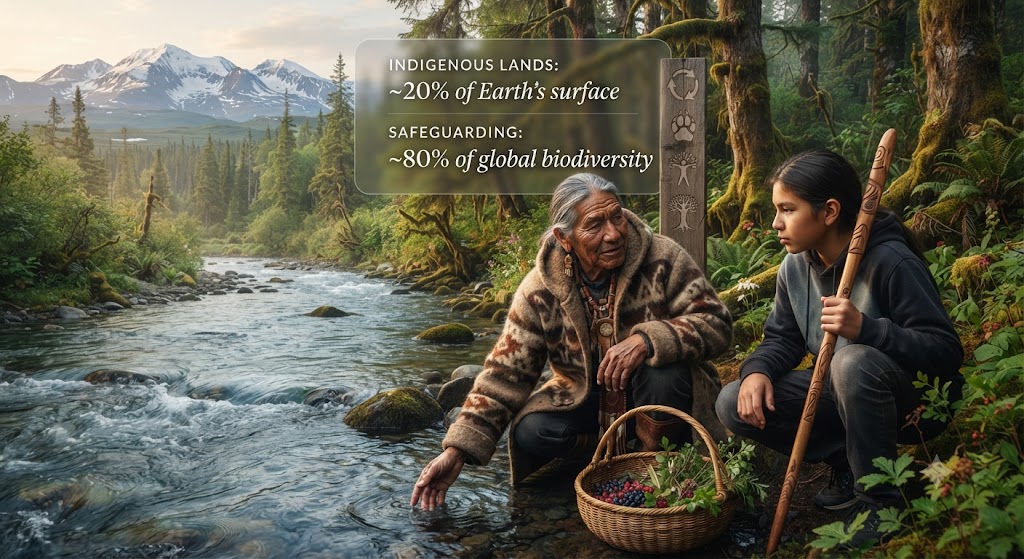
Indigenous medicinal plants: traditional knowledge and benefits have been passed down in our country through the ages. Empirical data underscores the conservation success of this relational perspective. According to assessments by the Intergovernmental Science-Policy Platform on Biodiversity and Ecosystem Services (IPBES), Indigenous territories encompass approximately 20 percent of the Earth’s terrestrial surface yet safeguard around 80 per cent of the planet’s remaining biodiversity.
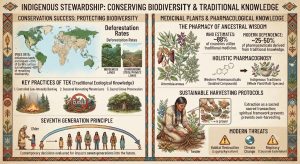
These landscapes exhibit rates of deforestation and ecological degradation significantly lower than those found in surrounding state-managed or privately owned lands. This ecological resilience is not accidental; it is driven by centuries of accumulated traditional ecological knowledge (TEK). TEK is empirical, cumulative, and dynamic, representing generations of systematic observation, hypothesis testing, and adaptive management.
Practices such as controlled low-intensity burning, seasonal harvesting moratoriums, and sacred grove preservation maintain ecological succession, prevent catastrophic wildfires, and enhance species richness.http://Practices such as controlled low-intensity burning, seasonal harvesting moratoriums, and sacred grove preservation maintain ecological succession, prevent catastrophic wildfires, and enhance species richness.
Furthermore, Indigenous resource management operates on temporal scales that transcend short-term political or economic cycles. The Seventh Generation principle, historically rooted in Haudenosaunee philosophy, dictates that contemporary decisions must be evaluated by their impacts seven generations into the future.
This intergenerational accountability fosters a stewardship ethic built on restraint, reciprocity, and long-term ecological balance. When nature is viewed as an extended family, overexploitation becomes a violation of social and cosmic law.
MEDICINAL PLANTS
The pharmacy of traditional Indigenous knowledge represents an extraordinary archive of pharmacological discovery, refined over millennia through meticulous experimentation, observation, and transmission.
According to World Health Organization (WHO) estimates, roughly 88 per cent of all countries utilize traditional medicine systems, and a significant proportion of the global population relies on plant-based therapeutics for primary healthcare.
Classic examples include aspirin (derived from willow bark, utilized by various Indigenous North American and Eurasian cultures), quinine (from the cinchona tree bark, discovered by Andean peoples to treat malaria), and artemisinin (from Artemisia annua, rooted in traditional Chinese herbalism).
The efficacy of traditional medicine lies not merely in isolated chemical constituents but in holistic pharmacognosy. While Western pharmaceuticals frequently isolate single active compounds, Indigenous healing traditions frequently utilize whole plant extracts or multi-species concoctions.
In these preparations, secondary compounds act synergistically—enhancing bioavailability, mitigating adverse side effects, or stabilising active molecules. For instance, Amazonian healers combine the bark of certain trees with specific vine exudates to treat complex inflammatory and parasitic conditions, utilizing biochemical interactions that modern high-throughput screening struggles to replicate.
AGRICULTURE
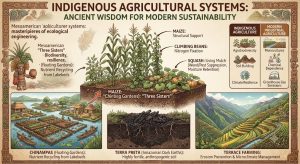
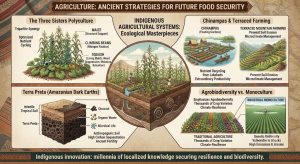
Indigenous agricultural systems are masterpieces of ecological engineering, developed through thousands of years of localised plant domestication, soil management, and microclimate adaptation. Long before the advent of industrial monocultures and synthetic chemical inputs, Indigenous farmers invented sophisticated food production systems that enhanced biodiversity, optimised nutrient cycling, and secured food sovereignty against climatic shocks.
In this arrangement, the tall corn stalks provide structural support for the nitrogen-fixing bean vines, while the sprawling, prickly leaves of the squash plant create a living mulch that suppresses weeds, retains soil moisture, and deters herbivores. This tripartite synergy minimises the need for external fertilisers or artificial irrigation while maximising caloric yield per unit area.
Other remarkable models include the chinampas (floating gardens) of the Aztec civilisation, which achieved extraordinary agricultural productivity through nutrient recycling from lakebeds, and the terraced mountain farming systems of the Andes and Southeast Asia, which prevent soil erosion on steep slopes while managing micro-altitudinal thermal belts.
Indigenous soil management practices also involve the creation of Terra Preta (Amazonian Dark Earths)—ancient, highly fertile anthropogenic soils created by adding charcoal, organic waste, and nutrient-rich biomass to nutrient-poor tropical soils.
In contrast to modern industrial agriculture—which occupies roughly 38 per cent of Earth’s ice-free land surface, accounts for a massive share of global greenhouse gas emissions, and drives severe topsoil erosion—traditional agriculture emphasises agrobiodiversity.
Indigenous peoples have domesticated and maintained thousands of distinct crop varieties, and landraces adapted to local pests, droughts, and salinity. By cultivating genetic diversity rather than genetic uniformity, traditional agricultural systems provide essential genetic reservoirs necessary to breed climate-resilient crops for a warming planet, proving that ancient cultivation strategies hold the keys to future global food security.
ORAL TRADITIONS
In the absence of widespread written alphabets among many Indigenous groups, oral traditions served—and continue to serve—as the primary archives of history, law, science, ecology, and cosmology. Oral literature is far more than casual storytelling or folklore; it is a rigorous, highly structured methodology for encoding, verifying, and transmitting complex knowledge across generations.
Through epic narratives, genealogical chants, songs, riddles, and performance art, Indigenous communities preserve precise data regarding animal behavior, weather patterns, medicinal plant properties, astronomical events, and geological history over immense time horizons.
The accuracy and longevity of oral traditions frequently astonish modern scientists. For instance, oral accounts from Indigenous coastal communities in the Pacific Northwest of North America and parts of Japan meticulously describe cataclysmic megathrust earthquakes and ensuing tsunami waves that occurred centuries prior to written historical records.
Modern geological investigations, tree-ring (dendrochronological) analysis, and marine sediment cores have repeatedly validated these oral testimonies down to the exact decade and geological mechanism. Similarly,
Aboriginal Australian dreamtime narratives preserve astonishingly accurate geographic descriptions of coastline configurations, sea-level rises, and drowned islands dating back over 10,000 years to the end of the last Ice Age—historical ecological shifts preserved entirely through spoken word and ritual performance.
The mechanics of oral transmission rely on mnemonic devices, strict recitation protocols, and communal verification. Because a mistake in a gene line or a medicinal formula could prove catastrophic, communities employ designated knowledge keepers who undergo rigorous, lifelong training under the supervision of elders.
Rhythm, metre, and rhyme are utilized as cognitive scaffolding to prevent data corruption. However, oral traditions remain acutely vulnerable to disruption. Forced assimilation policies, the systematic removal of Indigenous children to residential and boarding schools, linguistic imperialism, and the rapid death of elderly native speakers threaten to silence these living libraries before their contents can be fully understood, respected, or transcribed under community-led terms.
SOCIAL VALUES
The architecture of Indigenous societies is anchored by a robust framework of social values centred on cooperation, egalitarianism, communitarianism, and radical reciprocity, standing in stark contrast to hyper-individualistic and consumer-driven modern paradigms. At the core of these value systems is the foundational ethos that wealth is measured not by accumulation but by generosity and the capacity to give.
Practices such as the Northwest Coast Potlatch ceremony—where chiefs and families demonstrate their status by distributing vast amounts of accumulated wealth and property to community members—institutionalize economic redistribution and prevent extreme wealth polarization within the society.
Decision-making processes in traditional Indigenous governance structures are typically consensual, deliberative, and inclusive. Rather than majoritarian democracy, which can marginalize minority factions, traditional councils—such as the Grand Council of the Iroquois Confederacy, which heavily influenced early democratic models—engage in extensive discourse until a collective consensus is achieved.
Responsibility toward the collective extends across species boundaries and temporal dimensions. Children are raised to understand that they belong to the land, rather than the land belonging to them. Elders occupy a position of supreme reverence, serving as living archives of wisdom, ethical guides, and emotional anchors for the youth.
This intergenerational bridge ensures that historical memory, cultural pride, and moral accountability remain intact. In an era marked by rising social alienation, mental health crises, and community fragmentation, the relational values embedded in Indigenous worldviews offer a profound blueprint for building more empathetic, sustainable, and cohesive human societies.
THE ROLE OF WOMEN
Women occupy foundational, often central roles within traditional Indigenous societies, serving as primary economic producers, ecological stewards, political decision-makers, and spiritual leaders.
Far from the patriarchal assumptions historically projected onto Indigenous cultures by early Western anthropologists, many traditional societies operated—and continue to operate—under matrilineal or egalitarian structures where lineage, property, and clan identities are traced through the maternal line. In matrilineal societies such as the Cherokee,
Haudenosaunee, and various West African and Melanesian cultures, women historically held absolute authority over agricultural production, food distribution, and land tenure, alongside veto power over tribal warfare and governance.
Ecologically, women are frequently the primary custodians of agrobiodiversity and ethnobotanical knowledge. Because of their traditional responsibilities in gathering wild foods, tending home gardens, and preparing medicinal remedies, women possess granular, expert-level knowledge of plant phenology, soil chemistry, seed preservation, and ecological succession.
They act as seed keepers, maintaining the genetic integrity of native crop varieties through meticulous selection and seasonal storage rituals. This specialized knowledge makes women critical actors in climate change adaptation, food sovereignty initiatives, and community health maintenance.
Spiritually and ceremonially, women are often recognized as the direct earthly mirrors of creative forces, embodying the life-giving properties of Mother Earth and water. Among Indigenous nations surrounding the Great Lakes and various river systems across the globe, women are designated as “Water Protectors,” holding ceremonial and legal responsibilities to guard watersheds against pollution and over-extraction.
Despite the historical disruption of these roles through colonial imposition, patriarchal legal systems, and the dispossession of land, Indigenous women continue to lead global environmental movements, human rights campaigns, and cultural revitalization efforts, demonstrating that gender equity and ecological preservation are inextricably linked.
INTEGRATION WITH MODERN SCIENCE
The artificial dichotomy that once separated traditional Indigenous knowledge from Western science is rapidly dissolving, giving way to a new paradigm of intercultural dialogue, participatory research, and methodological integration often termed “Two-Eyed Seeing” (coined by Mi’kmaw Elder Albert Marshall).
This approach encourages scholars and practitioners to view the world through one eye with the strengths of Indigenous knowledge, and through the other eye with the strengths of Western science, using both eyes together for the benefit of all.
Rather than viewing traditional knowledge as primitive superstition or unverified folklore, modern scientific institutions increasingly recognize TEK as a sophisticated, empirical baseline that enhances ecological modeling, wildlife management, and climate forecasting.
In contemporary climate science, Indigenous observations are frequently integrated into Arctic sea-ice monitoring, meteorological modeling, and permafrost degradation studies.
Because Indigenous hunters, fishers, and herders occupy fragile polar and tropical ecosystems year-round, their real-time observations of shifts in ice thickness, animal migration corridors, and marine salinity provide high-resolution empirical data that satellite remote sensing alone cannot capture.
Collaborative research partnerships between Indigenous communities and academic institutions have also revolutionized conservation biology, leading to co-managed national parks, marine protected areas, and species recovery programs where traditional ecological protocols guide scientific conservation targets.
Furthermore, modern pharmacology and biotechnology increasingly rely on ethnobotanical leads to accelerate drug discovery pipelines, though this interaction requires strict ethical safeguards to prevent exploitation.
True integration mandates that Indigenous peoples are treated not merely as informants or subjects of study, but as equal research partners, co-investigators, and intellectual property rights holders.
By combining the long-term observational depth of Indigenous wisdom with the analytical precision and technological tools of modern laboratory science, humanity gains a vastly superior, multi-dimensional understanding of complex planetary systems and public health challenges.
THE CHALLENGES OF PRESERVING THIS KNOWLEDGE
Despite its proven ecological efficacy, therapeutic value, and cultural richness, traditional Indigenous knowledge faces an unprecedented crisis of survival and erasure. The primary driver of this loss is the rapid destruction and fragmentation of Indigenous habitats caused by industrial resource extraction, deforestation, mining, dam construction, and aggressive land-grabbing.
When an ancestral forest is clear-cut or an entire watershed is poisoned by industrial runoff, not only is biodiversity eradicated, but the physical classroom in which traditional knowledge is practiced, tested, and transmitted is permanently destroyed. As habitats vanish, the ecological contexts that give meaning to Indigenous vocabulary, oral history, and medicinal plant identification disappear with them.
Compounding environmental destruction is the severe linguistic and cultural erosion fueled by globalization, forced assimilation policies, and the digital divide. Languages are disappearing at an alarming rate; linguists estimate that a human language dies every two weeks, with the vast majority being Indigenous tongues.
Because Indigenous knowledge is intricately encoded within unique linguistic structures, grammatical nuances, and specific nomenclature, the death of a language represents the catastrophic loss of a distinct cognitive library.
Furthermore, younger generations in Indigenous communities are frequently drawn away from traditional lands toward urban centers by economic pressures, modern education systems that devalue traditional ways of knowing, and the pervasive cultural influence of global media.
