
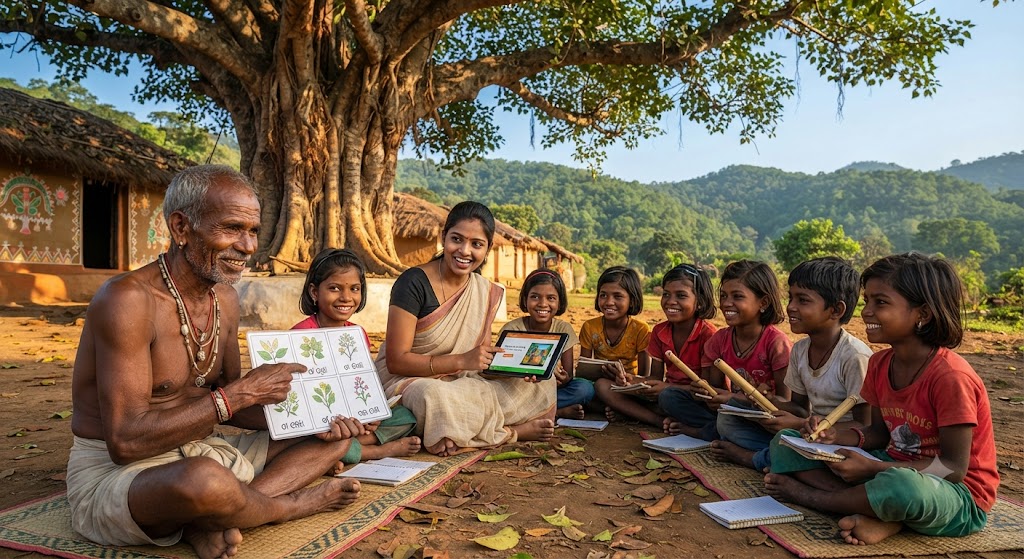
1. Introduction: Tribal Education in India: Progress and Challenges
India’s tribal communities, constitutionally designated as Scheduled Tribes (STs), represent one of the richest cultural mosaics on the planet. Comprising 8.6% of the country’s population according to the 2011 Census—numbering roughly 104.2 million individuals across more than 705 distinct ethnic groups—these indigenous peoples are custodians of ancient ecological wisdom, sophisticated oral traditions, distinct dialects, and egalitarian community structures. From the dense Sal canopies of central India to the high-altitude trans-Himalayan valleys and the tropical forests of the Andaman and Nicobar Islands, tribal life is intimately bound to land, forest, and ancestral memory.
Thank you for reading this post, don't forget to subscribe!Despite this profound heritage, the historical integration of tribal communities into modern institutional frameworks has been fraught with structural asymmetry. Education stands at the centre of this tension. On paper, modern education is the ultimate democratic equaliser, offering marginalised groups the technical, legal, and conceptual tools needed to assert their civil rights, attain economic self-reliance, and participate fully in democratic governance. In practice, however, schooling has often functioned as an assimilative instrument or a bureaucratic checkbox, failing to respect the worldview, epistemology, and socioeconomic realities of the communities it purports to serve.
The fundamental purpose of tribal education cannot merely be the mechanical expansion of literacy rates. While basic numeracy and literacy are indispensable, an empowering educational paradigm must preserve indigenous identity while expanding external opportunity. It must honour ancestral ecological sciences, traditional art forms, and indigenous value systems without trapping tribal youth in structural underdevelopment or denying them access to global scientific, technological, and professional disciplines.
Over the past few decades, the discourse around tribal education has shifted from basic physical access to holistic learning quality, linguistic equity, and institutional dignity. The expansion of statutory provisions—such as the Right of Children to Free and Compulsory Education (RTE) Act of 2009 and the targeted mandates of the National Education Policy (NEP) 2020—demonstrates growing policy awareness. Yet persistent structural gaps demand rigorous interrogation. Examining the evolution, achievements, persistent bottlenecks, and emerging possibilities of tribal education is essential to realising an equitable, inclusive India.
2. Historical Background of Tribal Education
Pre-Colonial Epistemologies and Community Pedagogy
Prior to colonial intervention, tribal communities sustained mature, organic educational systems embedded within daily social, cultural, and ecological practices. Learning was neither commodified nor restricted to physical classrooms. Instead, it was experiential, continuous, and intergenerational.
A prime historical example of this organic pedagogy is the Ghotul among the Muria and Gond communities of central India, as well as the Dhumkuria among the Oraon and the Morung systems found across various Naga communities in the Northeast. These indigenous youth dormitories served as dynamic community academies:
-
Senior members and peers instructed younger generations in oral history, clan genealogies, customary law, and civic ethics.
-
Youth mastered practical forest ecology, medicinal botany, tracking, sustainable agriculture, shelter building, handloom weaving, music, and ritual performance.
-
These institutions instilled collective responsibility, gender equality, and communal solidarity long before formalised schooling reached these interiors.
Because these societies were predominantly oral, their epistemologies were dismissed by outside observers as primitive or nonexistent. However, these systems succeeded in preserving civilisational memory, maintaining ecological equilibrium, and equipping young people with every tool necessary to flourish within their immediate environments.
The Colonial Era: Disruption, Marginalisation, and Proselytisation
The advent of British colonial rule dismantled the material, ecological, and institutional foundations of tribal societies:
-
The enactment of draconian forestry legislation—notably the Indian Forest Acts of 1865 and 1878—nationalised forests, converted tribal homelands into state property, and criminalised customary resource gathering.
-
Traditional livelihood systems collapsed, pushing self-reliant forest-dwelling communities into debt, bonded labor, and extreme poverty.
Formal education during this period was not designed to empower indigenous populations. British educational policy, guided by Thomas Babington Macaulay’s 1835 Minute on Education, explicitly sought to create an Anglicised administrative elite to staff the colonial bureaucracy. Tribal regions were largely neglected by state administrative budgets, designated instead as “Excluded” or “Partially Excluded” areas.
Into this administrative vacuum entered Christian missionary organizations, particularly across the Chota Nagpur plateau and the Northeastern hill tracts. In regions such as modern-day Nagaland, Mizoram, and Meghalaya, missionaries established formal schools, codified indigenous oral dialects into the Roman script, and laid the foundations for formal literacy:
+---------------------------------------------------------------------------------------+| Colonial & Missionary Educational Impacts |+------------------------------------+--------------------------------------------------+| Positive Outcomes | Critical Trade-Offs |+------------------------------------+--------------------------------------------------+| • Introduction of modern literacy | • Estrangement from ancestral cosmologies || • Codification of tribal dialects | • Devaluation of oral histories and rituals || • Foundations for early leadership | • Cultural fracturing and alienation from roots |+------------------------------------+--------------------------------------------------+
While missionary schools provided access to modern linguistic and administrative skills, they often framed indigenous animist and customary practices as backward or pagan. The resulting cognitive tension forced young tribal learners to choose between modern formal schooling and their cultural roots.
Post-Independence Ideological Formulations: Assimilation vs. Isolation
Following independence in 1947, the founding leaders of the Indian Republic confronted a profound policy dilemma regarding tribal development, crystallised in two contrasting viewpoints:
┌────────────────────────────────────────────────────────┐│ Post-Independence Tribal Policy Dilemma │└───────────────────────────┬────────────────────────────┘│┌───────────────────────┴───────────────────────┐▼ ▼┌───────────────────────────┐ ┌───────────────────────────┐│ Assimilationist Approach │ │ Isolationist Approach ││ (G.S. Ghurye) │ │ (Verrier Elwin) │├───────────────────────────┤ ├───────────────────────────┤│ Argued tribes were merely │ │ Warned that unfettered ││ "backward Hindus" who │ │ modern encroachment would ││ should be absorbed into │ │ destroy indigenous art, ││ the civilizational │ │ culture, and egalitarian ││ mainstream. │ │ autonomy. │└───────────────────────────┘ └───────────────────────────┘
Prime Minister Jawaharlal Nehru, guided by Verrier Elwin, sought a synthesis that rejected both extremes, formulating the famous Tribal Panchsheel (Five Principles) in the late 1950s:
-
Tribal people should develop along the lines of their own genius, avoiding the imposition of alien values.
-
Tribal rights in land and forests should be respected.
-
Indigenous teams should be trained for administration and development, avoiding over-administration by non-tribal personnel.
-
Schemes should work through, rather than rival, traditional social and cultural institutions.
-
Success should be judged by the quality of human character developed, not by abstract statistics or expenditure volumes.
Despite the philosophical brilliance of the Panchsheel, mainstream administrative execution defaulted to a top-down, non-tribal bureaucratic model. Schools built in tribal tracts mirrored non-tribal rural schools, using alien regional languages, insensitive curricula, and teachers unfamiliar with local dialects. This early post-colonial architecture inadvertently entrenched high dropout rates and widespread educational alienation for generations.
3. Present Status of Tribal Education in India
Literacy Trajectories Across Census Decades
A careful examination of decadal census data illustrates both undeniable absolute progress and an enduring structural deficit between Scheduled Tribes and the broader national population.
Comparative Literacy Growth in India: 1961–2011 (%)100 ┌────────────────────────────────────────────────────────┐│ │80 │ 73.0 ││ 64.8 * │60 │ 52.2 * 59.0 ││ 43.6 * 47.1 # │40 │ 34.5 * 29.6 # ││ 28.3 * 16.4 # │20 │ * 11.3 # ││ 8.5 # │0 └───────────#────────────────────────────────────────────┘1961 1971 1981 1991 2001 2011Legend: [*] All India [#] Scheduled Tribes
Data Source: Office of the Registrar General & Census Commissioner, India.
The historical trajectory demonstrates an extraordinary expansion: tribal literacy rose from an alarming 8.5% in 1961 to 59.0% in 2011. Data from the National Family Health Survey (NFHS-5, 2019–21) and the Periodic Labour Force Survey (PLFS) suggest that overall tribal literacy has crossed the 68% threshold.
Yet, the absolute gap between the national average and the tribal average remains stubbornly persistent, hovering between 14 and 18 percentage points over the past half-century.
Deep Demographic Fractures: Gender Disparities
Aggregated literacy metrics mask an acute internal challenge: the compounded marginalisation of tribal women.
| Census / Survey Year | All-India Male (%) | All-India Female (%) | ST Male (%) | ST Female (%) | ST Gender Gap (% points) |
| 1961 | 34.4 | 13.0 | 13.8 | 3.2 | 10.6 |
| 1971 | 39.5 | 18.7 | 17.6 | 4.9 | 12.7 |
| 1981 | 46.9 | 24.8 | 24.5 | 8.0 | 16.5 |
| 1991 | 64.1 | 39.3 | 40.7 | 18.2 | 22.5 |
| 2001 | 75.3 | 53.7 | 59.2 | 34.8 | 24.4 |
| 2011 | 80.9 | 64.6 | 68.5 | 49.4 | 19.1 |
| NFHS-5 (2019-21) | 84.4 | 71.5 | 77.2 | 61.3 | 15.9 |
Data Sources: Census of India (1961–2011); Ministry of Health and Family Welfare (NFHS-5).
In 1961, barely 3 out of every 100 tribal women in India could read or write. While the tribal female literacy rate climbed to nearly 50% by 2011 and past 61% in NFHS-5, tribal girls remain among the most structurally vulnerable demographics in the country.
The gender gap expanded dramatically between 1981 and 2001 as male literacy surged ahead, only narrowing modestly in recent years. In geographically remote belts, particularly among Particularly Vulnerable Tribal Groups (PVTGs), female literacy routinely dips below 35%.
Enrolment Metrics and the Retention Funnel
The Unified District Information System for Education Plus (UDISE+) provides granular insights into the educational funnel for tribal students. The critical systemic challenge is no longer initial access or enrolment; it is sustained retention across transition points.
UDISE+ Gross Enrolment Ratio (GER) Structural Drop-Off110% ┌────────────────────────────────────────────────────────┐100% │ Primary (Grades I-V) GER: ~101.5% │└───────────────────────────┬────────────────────────────┘│▼90% ┌────────────────────────────────────────────────────────┐│ Upper Primary (Grades VI-VIII) GER: ~98.2% │└───────────────────────────┬────────────────────────────┘│▼70% ┌────────────────────────────────────────────────────────┐│ Secondary (Grades IX-X) GER: ~78.4% │└───────────────────────────┬────────────────────────────┘│▼50% ┌────────────────────────────────────────────────────────┐│ Higher Secondary (Grades XI-XII) GER: ~52.1% │└───────────────────────────┬────────────────────────────┘│▼20% ┌────────────────────────────────────────────────────────┐│ Higher Education (Tertiary / College) GER: ~18.9% │└────────────────────────────────────────────────────────┘
The data reveals a stark attrition pattern:
-
At the primary level, near-universal enrolment has been achieved, driven by mandatory mid-day meals (PM-POSHAN), targeted cash incentives, and the statutory requirements of the RTE Act.
-
The moment tribal children complete Grade V, attrition accelerates.
-
By Grade IX and X (secondary stage), more than one-fifth of enrolled tribal students drop out.
-
By Grade XI and XII (senior secondary stage), almost half of the initial cohort has disappeared from the formal school register.
-
At the tertiary level, the ST Gross Enrolment Ratio falls to 18.9% (AISHE 2021–22), compared to the national average of 28.4%.
This attrition funnel means that millions of tribal children enter the school gate, but only a fraction exit with the credentials required for meaningful participation in the modern formal economy.
4. Major Government Initiatives for Tribal Education
Over successive Five-Year Plans and recent administrative reforms, the Union Government and various State administrations have deployed targeted policy interventions to eliminate structural disparities.
+-----------------------------------------------------------------------------------------------+| Key Government Initiatives in Tribal Education |+------------------------------------+----------------------------------------------------------+| Scheme / Policy | Core Strategic Focus |+------------------------------------+----------------------------------------------------------+| Eklavya Model Residential Schools | Fully funded, modern residential education (Grades VI-XII)|| (EMRS) | modeled on Navodaya Vidyalayas for tribal blocks. |+------------------------------------+----------------------------------------------------------+| Ashram Schools | State-run residential primary/upper primary schools in || | remote forest terrains; provides food, boarding, books. |+------------------------------------+----------------------------------------------------------+| Pre & Post-Matric Scholarships | Targeted Direct Benefit Transfers (DBT) to mitigate out- || | of-pocket expenditure and distress dropouts. |+------------------------------------+----------------------------------------------------------+| National Fellowship & Scholarship | Financial support for M.Phil, Ph.D., and elite global || for Higher Education (ST Students) | master's degrees (National Overseas Scholarship). |+------------------------------------+----------------------------------------------------------+| PM-JANMAN Tribal Mission | Dedicated multi-sector package for 75 PVTG communities, || (Launched 2023) | building remote hostels, roads, and digital centers. |+------------------------------------+----------------------------------------------------------+| Kasturba Gandhi Balika Vidyalayas | Residential girls' schools addressing gender deficits in || (KGBV) | educationally backward blocks with dense ST populations. |+------------------------------------+----------------------------------------------------------+
Eklavya Model Residential Schools (EMRS)
Modeled on the Jawahar Navodaya Vidyalayas, the Eklavya Model Residential School initiative—launched in 1997–98 and comprehensively overhauled after 2018—is the flagship intervention of the Ministry of Tribal Affairs (MoTA).
-
The scheme establishes high-quality, fully funded residential institutions for Grades VI through XII in every sub-district/block where the ST population exceeds 50% and comprises at least 20,000 tribal individuals.
-
Each school provides free tuition, boarding, uniforms, textbooks, digital laboratories, sports infrastructure, and dedicated coaching for competitive examinations (such as NEET and JEE).
-
Under the revamped policy, the National Education Society for Tribal Students (NESTS) was constituted as an autonomous body to oversee centralized teacher recruitment, standardized academic frameworks, and administrative accountability across the more than 690 sanctioned schools.
Ashram Schools and Residential Hostels
Long preceding the EMRS, state-level Tribal Welfare Departments operated network hubs known as Ashram Schools.
-
Designed specifically for sparsely populated forest tracts where building a standard primary or middle school within every small settlement (pada or tola) is physically impractical, Ashram Schools combine basic academic instruction with state-subsidized lodging and boarding.
-
Furthermore, hundreds of dedicated Post-Matric Tribal Hostels operate in district headquarters and metropolitan hubs, offering rural students subsidized accommodation so they can attend conventional collegiate institutions.
Scholarship Ecosystems: Pre-Matric, Post-Matric, and Overseas
Direct financial support remains central to preventing dropout cascades caused by seasonal household insolvency:
-
Pre-Matric Scholarships for ST Students: Awarded to parents of students studying in Grades IX and X to bridge the critical transition from upper primary to secondary school.
-
Post-Matric Scholarship Scheme (PMS-ST): A centrally sponsored Direct Benefit Transfer (DBT) scheme covering mandatory institutional fees and monthly living allowances for post-secondary education.
-
National Fellowship and Overseas Scholarships: The National Fellowship and Scholarship for Higher Education of ST Students supports meritorious candidates pursuing M.Phil and Ph.D. research in Indian universities. Concurrently, the National Overseas Scholarship for ST Students funds competitive postgraduate and doctoral scholars admitted to accredited institutions abroad.
PM-JANMAN (Pradhan Mantri Janjati Adivasi Nyaya Maha Abhiyan)
Launched in late 2023 with an outlay exceeding ₹24,000 crore, PM-JANMAN is an intensive convergence mission aimed at 75 Particularly Vulnerable Tribal Groups (PVTGs) living in isolated forest habitations across 18 States and Union Territories. Recognising that standard institutional models fail to reach these hyper-isolated groups, the mission focuses on:
-
Constructing dedicated hostels in PVTG habitations.
-
Opening community-managed primary learning centers.
-
Connecting isolated hamlets via all-weather roads and electrification to make schools physically accessible.
5. Major Challenges Facing Tribal Education
Despite substantive policy efforts and capital expenditure, significant systemic bottlenecks continue to impair the educational outcomes of tribal youth.
Multidimensional Challenges in Tribal Education┌─────────────────┐│ Structural Gaps │└────────┬────────┘┌────────────────┬───────┴────────┬────────────────┐▼ ▼ ▼ ▼┌───────────┐ ┌─────────────┐ ┌─────────────┐ ┌─────────────┐│Linguistic │ │ Geographic │ │Pedagogical │ │Socioeconomic││Alienation │ │ Isolation │ │Biases │ │Vulnerabilities└───────────┘ └─────────────┘ └─────────────┘ └─────────────┘
The Linguistic Chasm and Epistemic Invalidation
The most immediate, damaging barrier facing a young tribal child entering Grade I is the language barrier. India’s tribal populations speak hundreds of distinct, linguistically sophisticated dialects—such as Santhali, Gondi, Bhili, Kurukh, Mundari, and Kui.
When a six-year-old child from a monolingual tribal home enters a state-run primary school, they are often confronted by:
-
Textbooks, classroom instructions, and commands delivered exclusively in an unfamiliar regional dominant tongue (such as standard Hindi, Odia, Telugu, Marathi, or Bengali).
-
Teachers who rarely speak the indigenous mother tongue and may dismiss the child’s home dialect as broken or unrefined.
-
A sudden environment of profound confusion and cognitive dissonance.
Unable to comprehend the instruction or express basic needs, the child retreats into silence, is incorrectly labeled as an unmotivated or slow learner, and quietly leaves school within twelve to twenty-four months. This linguistic disconnect turns the classroom into an exclusionary space rather than an inviting one.
Geographic Remoteness and Physical Infrastructure
Tribal geography in peninsular and central India is defined by hills, forested tracts, ravines, and riverine belts. Populations are not clustered into large, contiguous villages; they reside in scattered, dispersed hamlets known as tolas, padas, or bastis, each housing 10 to 30 families.
+---------------------------------------+| Hamlets (Tolas/Padas) |+-------------------+-------------------+|Walking distance: 3 to 7 km acrossunpaved terrain, forests, and streams|v+---------------------------------------+| Central Regional School |+---------------------------------------+
-
Physical Commute Barriers: Establishing a fully staffed, well-equipped formal school in every micro-hamlet is fiscally and administratively difficult under current norms. Consequently, children must walk 3 to 7 kilometers along dirt tracks, through dense forests, across railway tracks, or over unbridged seasonal streams to reach the nearest middle or secondary school.
-
Monsoon Disruptions: During heavy monsoon seasons, remote schools become entirely inaccessible for months at a time, disrupting academic continuity.
-
Structural Deficits in Existing Schools: Many remote schools lack basic physical amenities. UDISE+ indicators show that schools in predominantly tribal areas lag behind national averages in electricity access, dedicated functional toilets for girls, secure boundary walls, computer labs, and broadband internet connectivity.
Severe Socioeconomic Distress and Distress Migration
Poverty in tribal corridors is not merely income deprivation; it is systemic livelihood insecurity compounded by ecological degradation and land alienation.
+-----------------------------------------------------------------------------------------------+| The Seasonal Distress Migration Cycle |+-----------------------------------------------------------------------------------------------+| 1. Rainfed agricultural harvest concludes (October / November). || 2. Household experiences localized unemployment and zero cash flow. || 3. Entire family migrates to brick kilns, sugarcane fields, or construction sites (6-8 mos). || 4. Children are pulled from school registers; academic continuity is broken. || 5. Family returns at monsoon onset; children are grade-incompetent and drop out permanently.|+-----------------------------------------------------------------------------------------------+
In the rainfed agricultural belts of southern Rajasthan, western Madhya Pradesh, southern Odisha, and eastern Gujarat, families migrate seasonally for six to eight months every year to work in urban construction sites, brick kilns, or commercial agricultural fields. When parents migrate, they face a difficult choice:
-
Take their children with them, pulling them out of school and putting them to work in hazardous environments.
-
Leave them behind with elderly, frail grandparents who cannot support them or oversee their schooling.
This seasonal disruption breaks the academic calendar. Children who miss six continuous months of the foundational curriculum fall behind, become discouraged, and drop out permanently.
Teacher Absenteeism, Vacancies, and Socio-Cultural Apathy
A school building is only as effective as the educators inside it. In tribal tracts across the country, instructional delivery is undermined by:
-
High Vacancy Rates: Posts for science, mathematics, and English instructors often sit vacant for years because non-tribal teachers avoid postings to remote areas.
-
Chronic Teacher Absenteeism: Many non-tribal educators view assignments to interior tribal belts as punitive punishments. They often commute from distant urban centers, attend erratically, or rely on informal, unauthorized local stand-ins (proxy teachers).
-
Subconscious Cultural Biases: Teachers from non-tribal backgrounds may hold deep-seated paternalistic or prejudiced views. They may view tribal children as incapable of mastering abstract mathematics or modern scientific concepts, assuming they are fit only for physical labor or basic vocational trades. These low teacher expectations become self-fulfilling prophecies, demotivating young learners.
The Hostile Curriculum: Epistemic Erasure
The standard state-sanctioned textbook curriculum often alienates tribal students by completely ignoring their lived realities.
Mainstream textbooks describe urban, caste-stratified, consumerist, middle-class environments:
-
Lessons illustrate multi-story apartment complexes, traffic lights, supermarkets, and mythological or historical figures entirely disconnected from the tribal experience.
-
The names of trees, animals, seasonal cycles, local medicinal flora, ancestral heroes, and historical uprisings (such as the Santhal Hul, the Kol Uprising, or the Munda Ulgulan) are largely absent or relegated to passing footnotes.
-
Indigenous worldviews—which treat nature as a living, sacred partner rather than a resource to be exploited—are treated as primitive folklore.
This curriculum implicitly signals to the tribal child that their home language, community history, and ancestral knowledge hold no intellectual value, creating an acute sense of inferiority and cultural alienation.
6. Progress and Achievements in Tribal Education
Despite these stubborn challenges, targeted interventions over the past three decades have yielded measurable structural gains.
Scheduled Tribe Gross Enrolment Ratio (GER) Across Educational Stages120% ┌────────────────────────────────────────────────────────┐│ 101.5% │100% ├─────────── 98.2% ─────────────────────────────────────┤│ │80% ├──────────────────────── 78.4% ─────────────────────────┤│ │60% ├──────────────────────────────────────── 52.1% ─────────┤│ │40% ├────────────────────────────────────────────────────────┤│ 18.9% │20% ├────────────────────────────────────────────────────────┤│ │0% └────────────────────────────────────────────────────────┘Primary Upper Primary Secondary Higher Sec. Higher Ed.(Grades I-V) (Grades VI-VIII)(Grades IX-X)(Grades XI-XII)(Tertiary)
Expanding Enrolment Footprints
The passage of the RTE Act (2009) and the nationwide implementation of Sarva Shiksha Abhiyan (now Samagra Shiksha) have made universal primary access a reality in tribal regions. The Gross Enrolment Ratio (GER) at the primary level has consistently remained above 100%, indicating that nearly all tribal children now enter formal schools at the primary gate.
Simultaneously, the physical footprint of secondary and higher secondary institutions has expanded into remote blocks, closing the historical distance gap and ensuring that transition rates from Grade V to Grade VIII show steady year-on-year improvements.
The Growth of Eklavya Model Residential Schools (EMRS)
The institutional rollout of the Eklavya network has provided thousands of meritorious tribal children with educational facilities comparable to elite private and central schools:
-
Hundreds of thousands of first-generation tribal learners reside in these state-of-the-art residential academies, receiving balanced nutrition, modern healthcare, computer education, and specialized academic instruction.
-
EMRS institutions are increasingly producing successful candidates in competitive examinations, including the Joint Entrance Examination (JEE Main and Advanced), the National Eligibility cum Entrance Test (NEET), and state civil service exams.
-
These schools provide an institutional pathway out of intergenerational poverty, proving that tribal students excel across complex academic disciplines when provided with comparable infrastructure and supportive mentors.
Institutionalization of Mother-Tongue-Based Multilingual Education (MTB-MLE)
States such as Odisha, Andhra Pradesh, and Jharkhand have pioneered structured frameworks for Mother-Tongue-Based Multilingual Education (MTB-MLE):
-
In Odisha, for instance, early-grade curricula have been developed in 21 distinct indigenous languages, paired with the recruitment of native-language-speaking Shiksha Sahayaks (education volunteers).
-
Children complete Grades I and II entirely in their mother tongue while gradually learning regional and national languages.
-
This dual-language bridge prevents early cognitive shock, keeps young learners engaged, boosts daily attendance, and significantly reduces primary dropouts in participating experimental blocks.
The Emergence of a Confident Tribal Intelligentsia
Decades of educational interventions, affirmative action (reservations in higher education and public employment), and scholarship support have cultivated an articulate, confident tribal middle class and intellectual community:
-
Tribal scholars, university professors, authors, legal advocates, civil servants, and medical practitioners are reshaping national policy discourse.
-
Rather than accepting paternalistic narratives, this emerging leadership uses academic, constitutional, and legal tools to defend indigenous autonomy, advocate for language preservation, and challenge exclusionary administrative practices.
7. Tribal Education Across Different Indian States
The landscape of tribal education in India is highly heterogeneous. Regional histories, administrative arrangements, and socio-political dynamics create distinct outcomes across different parts of the country.
+-----------------------------------------------------------------------------------------------+| Cross-Regional Comparative Matrix of Tribal Education |+-------------------+-----------------------------+---------------------------------------------+| Region / State | Literacy Profiles | Systemic Character, Strengths, & Barriers |+-------------------+-----------------------------+---------------------------------------------+| The Northeast | High (Mizoram ~91.5%, | Characterized by early missionary schooling || (Mizoram, | Nagaland ~80.0%, | and high English literacy. Faces structural || Nagaland, etc.) | Meghalaya ~75.5%) | deficits in higher technical education. |+-------------------+-----------------------------+---------------------------------------------+| Central Tribal | Moderate to Low | High population densities, deep linguistic || Belt (MP, CG, | (MP ~50.6%, Odisha ~52.2%, | barriers, widespread distress migration, || Odisha, Jharkhand)| Jharkhand ~57.1%) | and legacy governance deficits. |+-------------------+-----------------------------+---------------------------------------------+| Western Belt | Moderate (Gujarat ~62.5%, | Better physical infrastructure, but severe || (Gujarat, | Rajasthan ~52.8%, | seasonal distress migration disrupts basic || Rajasthan, Maha) | Maharashtra ~65.7%) | schooling cycles. |+-------------------+-----------------------------+---------------------------------------------+| Southern States | Highly Polarized (Kerala | High macro literacy in Kerala; deep social || (Kerala, AP, | ~74.4% vs. Andhra Pradesh | isolation and low enrolment among PVTGs || TN, Karnataka) | ~49.2%) | (Chenchus, Irulas, Kattunayakkans). |+-------------------+-----------------------------+---------------------------------------------+
The Northeast: Autonomous Trajectories and High Attainment
The states of the Northeast—such as Mizoram, Nagaland, and Meghalaya—present an educational landscape fundamentally different from mainland India:
-
High Literacy Levels: Tribal literacy rates in Mizoram exceed 90%, ranking among the highest in the country.
-
The Missionary Footprint: Early codification of local dialects into the Roman script, combined with widespread English-medium missionary schooling, established a robust culture of formal education generations ago.
-
Structural Limitations: The region still faces an acute shortage of premier technical, medical, and scientific research institutions. As a result, ambitious tribal students must migrate to metropolitan hubs such as Delhi, Bengaluru, and Guwahati to pursue advanced higher education and career opportunities.
The Central Tribal Belt: Ground Zero of Educational Vulnerability
Comprising Madhya Pradesh, Chhattisgarh, Jharkhand, and Odisha, this contiguous belt contains the largest concentration of Scheduled Tribes in India. It also faces the most complex educational bottlenecks:
-
Linguistic Diversity: Populated by major ethnic groups (including the Santhal, Gond, Ho, Munda, and Oraon), this region experiences the country’s most acute classroom language disconnect.
-
Governance and Geography: Despite rich mineral deposits, these rural areas struggle with extreme poverty, historical administrative neglect, and conflict.
-
State Innovations: In response, states like Odisha have implemented landmark educational experiments, including large-scale Mother-Tongue-Based Multilingual Education (MTB-MLE) programs and the expansion of the Anwesha scheme, which places rural ST children into English-medium private schools with full state sponsorships.
The Western Belt: Industrial Growth vs. Distress Migration
In the western corridor spanning Gujarat, Rajasthan, and Maharashtra, the primary challenge is the structural tension between industrial development and seasonal displacement:
-
The Migration Trap: Millions of Bhil and Garasia families migrate seasonally across state borders to work in agro-industries and urban centers, causing their children to miss months of school.
-
Promising Interventions: Non-governmental organizations and state departments have piloted seasonal residential hostels and mobile learning centers to ensure children can remain in their home villages while their parents migrate.
Southern India: High Macro Averages, Marginalized Micro-Populations
In the southern states (Kerala, Tamil Nadu, Karnataka, and Andhra Pradesh), tribal populations constitute small percentages of the total state population, often leading to their issues being overlooked:
-
Contrasting Realities: Kerala boasts a tribal literacy rate above 74%—bolstered by state literacy campaigns and accessible welfare systems. However, remote PVTGs, such as the Paniyas and Kattunayakkans of Wayanad, still face high dropout rates and socio-cultural alienation.
-
Andhra Pradesh and Telangana: The integrated ITDA (Integrated Tribal Development Agency) framework has successfully built sports schools and residential centers, yet tribal female literacy in several interior Agency areas remains below 50%.
8. Role of Tribal Languages and Culture in Education
Language is not merely a tool for communication; it is a repository of culture, ecological wisdom, philosophical concepts, and collective identity. When a child’s mother tongue is banned or ignored in school, their sense of self-worth is systematically undermined.
Mother Tongue vs. Dominant Language Trajectory in Classrooms┌────────────────────────────────────────────────────────────────────────┐│ Mother Tongue Medium (Grades I-III) ││ • Immediate cognitive comprehension and classroom participation ││ • Cultural validation, confidence building, and emotional safety ││ • High early attendance and low early-grade dropout rates │└───────────────────────────────────┬────────────────────────────────────┘│Pedagogical Language Bridge│▼┌────────────────────────────────────────────────────────────────────────┐│ Transition to Regional & Global Languages (Grades IV+) ││ • Natural, confident transfer of conceptual and literacy skills ││ • Additive bilingualism/multilingualism without loss of mother tongue ││ • Long-term retention, academic resilience, and competitive readiness │└────────────────────────────────────────────────────────────────────────┘
Mother-Tongue-Based Multilingual Education (MTB-MLE)
Global research, supported by UNESCO, demonstrates that children acquire foundational literacy and numeracy far more effectively when taught in their mother tongue during their early formative years.
-
The Transition Bridge: MTB-MLE does not reject mainstream languages. Instead, it uses the indigenous language as the medium of instruction in Grades I through III, introducing the dominant state language and English as secondary subjects.
-
Additive Multilingualism: Once foundational reading, writing, and arithmetic concepts are securely established, instruction gradually shifts toward the regional and national languages across Grades IV and V.
-
Cognitive Benefits: This approach prevents the cognitive shock that leads to early dropouts, enabling children to become confident, additive multilinguals who master regional and global languages without abandoning their mother tongue.
Preserving Indigenous Culture Through Curricular Design
Education must validate the lived realities of indigenous communities by weaving tribal culture directly into school life:
-
Ethno-Science and Ecology: Tribal children possess rich knowledge of native trees, medicinal herbs, animal behaviors, hydrology, and seasonal weather patterns. Integrating this community-based knowledge into formal environmental science curricula validates their background while enriching modern ecological science.
-
Oral Literature and Living Arts: Documenting tribal folklore, proverbs, creation stories, and historical oral narratives creates vibrant supplementary readers. Bringing tribal musical instruments, visual arts (such as Warli, Pithora, and Gond painting), and woodcarving into school art curricula affirms that indigenous aesthetics are valued alongside classical traditions.
-
Calendar Flexibility: Standard school calendars often clash with critical tribal cultural markers. Aligning academic breaks with key harvest and cultural festivals (such as Sarhul, Karma, Baha, or Madai) reduces unexplained absenteeism and respects community traditions.
National Education Policy (NEP) 2020: Directives and Possibilities
The National Education Policy (NEP) 2020 explicitly recognizes the importance of mother-tongue instruction, mandating that the medium of instruction wherever possible should be the mother tongue, local language, or regional dialect until at least Grade V, and preferably through Grade VIII:
-
The policy advocates for the recruitment of local teachers and the creation of bilingual textbooks and learning materials.
-
It recommends incorporating Indian Knowledge Systems (IKS)—including tribal ethno-botanical, agricultural, and conservation knowledge—into the national curriculum.
-
Translating these policy intentions into actual classrooms requires sustained political commitment, dedicated state funding, and extensive teacher training.
9. Higher Education and Career Opportunities
While foundational and secondary schooling provide essential basic skills, access to higher education and professional careers determines whether tribal communities can secure economic autonomy and participate fully in policy decision-making.
+-----------------------------------------------------------------------------------------------+| Structural Funnel: Primary Entry to Tertiary Exit |+-----------------------------------------------------------------------------------------------+| [100% Primary Entry] ───► [78% Secondary] ───► [52% Sr. Secondary] ───► [18.9% Higher Ed]+-----------------------------------------------------------------------------------------------+| Attrition Driven By: || • Out-of-pocket costs and lack of regional college infrastructure || • Social alienation and institutional caste/tribal discrimination in elite universities || • Absence of English proficiency, digital tools, and professional mentoring networks |+-----------------------------------------------------------------------------------------------+
The Tertiary Chasm: AISHE Insights
The All India Survey on Higher Education (AISHE) highlights persistent disparities at the tertiary level. While absolute tribal enrolment in universities and colleges has risen over the past decade, the Gross Enrolment Ratio (GER) for ST students in higher education sits at approximately 18.9%, trailing well behind the national overall average of 28.4%.
This deficit is driven by compounding barriers:
-
High out-of-pocket costs for professional course fees, urban rent, and learning materials.
-
The physical absence of colleges in remote tribal-majority districts, forcing students to move to distant cities.
-
A lack of structured academic support to help first-generation learners navigate competitive entrance examinations.
Institutional Barriers: Language, Discrimination, and Alienation
When a tribal student navigates these hurdles and enters a premier university, medical college, or engineering institute, they often encounter an exclusionary institutional culture:
-
The English Language Divide: Most professional courses are taught exclusively in English. Students from rural, vernacular-medium government schools struggle to follow lectures, participate in seminars, and complete exams, leading to severe academic anxiety.
-
Subtle Discrimination: Prejudices surrounding reservation policies persist in elite institutions. ST students are sometimes stereotyped as lacking merit, facing subtle social exclusion from peer groups and study circles.
-
Mental Health Crises: Without institutional mentorship, empathetic psychological counseling, or supportive cultural communities, first-generation tribal students experience heightened feelings of alienation, leading to elevated dropout rates in professional degree programs.
Affirmative Action and Diversifying Career Pathways
Constitutional reservations in public sector employment and state-funded higher education have served as an indispensable tool for tribal mobility, creating an essential cadre of indigenous civil servants, doctors, engineers, and educators.
However, as the public sector shrinks and the modern economy pivots toward private industry, services, and technology, traditional reservation pathways are no longer sufficient on their own.
Emerging Modern Career Pathways for Tribal Youth┌──────────────────┐│ Tribal Horizons │└────────┬─────────┘┌────────────────┬───────┴────────┬────────────────┐▼ ▼ ▼ ▼┌───────────┐ ┌─────────────┐ ┌─────────────┐ ┌─────────────┐│Modern Tech│ │Sustainable │ │Sports & │ │Legal & Civil││& Software │ │Forest Entrp.│ │Athletics │ │Rights Adv. │└───────────┘ └─────────────┘ └─────────────┘ └─────────────┘
-
Technology and Coding: Programs that introduce tribal youth to computer programming, data literacy, and digital design are opening opportunities within the global digital economy.
-
Forest-Based Social Enterprise: Education in business management, sustainable agriculture, and value-addition supply chains enables tribal youth to commercialize non-timber forest products (such as Mahua, Tendu, Lac, and wild honey) on their own terms.
-
Sports Excellence: Dedicated sports academies in tribal belts (particularly in archery, hockey, football, and athletics) combine academic education with elite athletic training, producing national champions and professional athletes.
-
Legal and Human Rights Advocacy: An increasing number of young tribal law graduates are entering the legal profession, using constitutional law, public interest litigation, and the Forest Rights Act (FRA, 2006) to defend ancestral lands and advance community rights.
10. Role of Parents, Communities and NGOs
Realizing sustainable educational progress requires active, daily collaboration between state institutions and the tribal community itself.
+-----------------------------------------------------------------------------------------------+| Community-Led Educational Triad |+-----------------------------------+-----------------------------------------------------------+| Stakeholder Group | Primary Transformative Intervention |+-----------------------------------+-----------------------------------------------------------+| Parents & Elders | • Overcoming historical distrust of state institutions || | • Passing down oral traditions, history, and mother tongue|| | • Providing foundational emotional and cultural security |+-----------------------------------+-----------------------------------------------------------+| School Management Committees | • Direct oversight of teacher attendance and mid-day meals|| (SMCs) & Panchayats | • Contextualizing local school operational calendars || | • Enforcing PESA statutory rights over local schools |+-----------------------------------+-----------------------------------------------------------+| Non-Governmental Organizations | • Developing contextual multilingual learning materials || (Civil Society) | • Operating seasonal hostels during distress migration || | • Offering bridge schooling, coaching, and advocacy |+-----------------------------------+-----------------------------------------------------------+
Navigating Parental Distrust and Economic Pressures
Illiterate or semi-literate tribal parents are often unfairly blamed for being indifferent to their children’s education. In reality, parental hesitation usually stems from clear socioeconomic factors and historical experience:
-
Parents who send their children to distant residential schools often find that their children return estranged from their families, embarrassed by their ancestral lifestyle, and ill-equipped for traditional livelihoods.
-
For struggling families living at subsistence level, an older child provides critical labor: caring for younger siblings, grazing livestock, collecting forest produce, or working for wages.
-
When parents see educated local youth sitting unemployed because they lack the social capital to secure modern jobs, they question the economic return of formal schooling. Overcoming this skepticism requires schools to demonstrate immediate practical value and treat parents with dignity.
Empowering Community Institutions: SMCs and PESA
Under the RTE Act, every government school must maintain a School Management Committee (SMC) composed predominantly of parents. Concurrently, the Panchayats (Extension to Scheduled Areas) Act (PESA) of 1996 grants Gram Sabhas in Fifth Schedule areas statutory authority over local social sectors, including primary education:
-
In communities where Gram Sabhas and SMCs are actively mobilized, teacher absenteeism falls sharply. Parents directly monitor classroom attendance, review mid-day meal quality, and maintain school grounds.
-
When institutional control is decentralized to the community, the school shifts from being an alien outpost of state power into a valued, responsive community space.
Civil Society and Grassroots Innovations
Non-governmental organizations (NGOs) have played a pioneering role in developing progressive, context-sensitive models of tribal education across the country:
-
Eklavya (Madhya Pradesh): Revolutionized science education in rural and tribal schools through inquiry-based, experiential learning, replacing rote memorization with hands-on experiments using local materials.
-
Kalinga Institute of Social Sciences (KISS, Odisha): Operates the world’s largest fully free residential educational institution for indigenous children, providing schooling, housing, healthcare, and vocational training to tens of thousands of tribal students.
-
Agragamee (Odisha): Developed foundational mother-tongue literacy models for tribal girls in Rayagada and Koraput, demonstrating how community-managed learning centers prevent early attrition.
-
Jan Vikas Samiti and Gramin Shiksha Kendra: Created flexible bridge schooling and mobile learning centers in seasonal migration belts, ensuring children continue their education even when their families are forced to move for work.
11. Solutions: How Can Tribal Education Improve?
Transforming tribal education from a fragile, exclusionary pipeline into an empowering, inclusive system requires targeted, structural reforms.
Strategic Blueprint for Systemic Reform┌──────────────────┐│ Reforms Roadmap │└────────┬─────────┘┌────────────────┬───────┴────────┬────────────────┐▼ ▼ ▼ ▼┌───────────┐ ┌─────────────┐ ┌─────────────┐ ┌─────────────┐│Pedagogy & │ │Infra & Log- │ │Teacher Cadre│ │Economic & ││Curriculum │ │istical Reach│ │Development │ │Nutritional │└───────────┘ └─────────────┘ └─────────────┘ └─────────────┘
1. Curricular Decolonization and Universal MTB-MLE Expansion
-
Scale Mother-Tongue Learning: Expand Mother-Tongue-Based Multilingual Education (MTB-MLE) to all tribal-majority districts nationwide. Early childhood education (Anganwadi) and Grades I through III must run in the child’s native language, using standardized bilingual textbooks that introduce state and national languages gradually.
-
Contextualize Curricula: Overhaul state textbooks to include indigenous history, heroic freedom fighters (such as Birsa Munda, Tilka Manjhi, Rani Gaidinliu, and Komaram Bheem), local ecological knowledge, and traditional arts.
-
Flexible School Calendars: Empower local School Management Committees to align holidays and breaks with critical harvesting seasons and local cultural festivals.
2. Infrastructure Expansion and Safe Transport Networks
-
Overcome Geographic Isolation: Provide free, safe school transportation (such as mini-bus networks or bicycle vouchers) for children living in dispersed tolas and hamlets, removing long, dangerous walking commutes.
-
Bridge the Digital Divide: Equip every tribal middle and secondary school with solar panels, reliable satellite or broadband internet, and localized digital learning materials.
-
Upgrade Ashram Schools: Undertake comprehensive infrastructural repairs of all existing Ashram Schools and residential hostels, guaranteeing private, safe sanitation facilities for girls, clean drinking water, secure boundary walls, and dedicated medical support.
3. Establishing a Dedicated, Culturally Competent Teaching Cadre
-
Preferential Local Recruitment: Create a localized cadre of educators by prioritizing the recruitment of qualified tribal youth from within local districts. Local teachers understand the mother tongue, share the community’s culture, and reside in the village.
-
Mandatory Cultural Sensitivity Training: Require all non-tribal teachers assigned to Scheduled Areas to undergo intensive orientation in the local dialect, cultural customs, and history, helping dismantle unconscious prejudices and fostering empathy.
-
Rural Incentives: Provide hardship allowances, quality residential housing, and clear career-advancement pathways for teachers who serve long tenures in remote tribal schools, eliminating the perception that rural postings are punitive.
4. Mitigating Distress Migration and Bolstering Nutrition
-
Seasonal Residential Hostels: Establish decentralized, safe, well-funded seasonal hostels in migration-heavy blocks, allowing children to stay in their home schools with guaranteed meals and secure housing while their parents migrate for work.
-
Inter-State Migration Tracking: Develop digital tracking cards that allow children of migrating parents to enroll temporarily in schools near work destinations (such as brick kilns or urban worksites) without bureaucratic delays.
-
Enhance PM-POSHAN: Expand school nutrition programs to include regionally preferred traditional foods (such as millets, eggs, pulses, and locally grown leafy greens), tackling high rates of childhood stunting and anemia.
12. Future of Tribal Education in India
As India navigates an economy shaped by artificial intelligence, renewable energy, and rapid technological transformation, the education of its indigenous youth stands at a critical historical juncture.
The Dual-Horizon Paradigm of Tribal Education┌────────────────────────────────────────────────────────────────────────┐│ Roots & Identity ││ • Deep knowledge of ancestral dialects and oral literature ││ • Stewardship of biodiverse ecosystems and medicinal flora ││ • Communal ethics, participatory democracy, and cultural dignity │└───────────────────────────────────┬────────────────────────────────────┘│Equitable, Empowering Educational Nexus│▼┌────────────────────────────────────────────────────────────────────────┐│ Wings & Global Tools ││ • Fluency in advanced coding, computational logic, and technology ││ • Professional mastery of modern law, medicine, sciences, and commerce ││ • Global advocacy capabilities across international platforms │└────────────────────────────────────────────────────────────────────────┘
The future of tribal education cannot be built on the false choice between cultural preservation and technological advancement. A child in an Eklavya school should not have to sacrifice their indigenous language, heritage, and philosophy to become an expert software engineer, climate scientist, or constitutional jurist.
Emerging digital tools present unprecedented opportunities to bridge historical divides:
-
AI-Assisted Translation and Learning: Language models and speech-synthesis tools can generate interactive learning materials in unwritten or endangered tribal dialects, allowing children to learn foundational concepts in their mother tongue even where printed textbooks are scarce.
-
Digital Archives of Indigenous Knowledge: Smart classrooms can store community-developed digital archives of indigenous botany, forest ecology, oral histories, and musical traditions, positioning local culture as a subject of serious study alongside modern science.
-
Decentralized Clean Energy: Micro-grid solar energy systems and satellite connectivity are bringing digital classrooms, coding bootcamps, and tele-mentoring directly to remote forest schools without waiting for traditional utility lines.
True educational equity means recognizing that modern society has as much to learn from indigenous communities as tribal youth have to learn from modern schools. In an era marked by accelerating climate change and biodiversity loss, the indigenous ethos—rooted in living within ecological limits, managing resources collectively, and respecting the natural world—offers vital insights for global survival.
The tribal school of the future must be an exchange where modern science and ancestral wisdom meet as equals, creating self-confident, globally capable indigenous leaders who can advocate for their communities on the world stage.
13. Conclusion
The story of tribal education in post-independence India is defined by both measurable achievements and unresolved systemic barriers. The journey from an 8.5% literacy rate in 1961 to near-universal primary school enrolment shows the transformative power of targeted public policy, dedicated civil society efforts, and the resilience of tribal families who strive for a better future despite extreme economic vulnerability.
Yet, as current data demonstrates, our work is far from complete. As long as half of all tribal students leave school before completing Grade XII, as long as young children sit alienated in classrooms where their native language is silenced, and as long as residential hostels fail to provide basic dignity and safety, the promise of educational equality remains unfulfilled.
Constitutional Mandate to Transformative Reality┌────────────────────────────────────────────────────────┐│ Constitutional Promise ││ Articles 15, 21A, 46, and the 5th & 6th Schedules │└───────────────────────────┬────────────────────────────┘│Systemic Gap Requiring Sustained:• Mother-Tongue-Based Instruction• Decentralized Community Control• High-Standard Infrastructure│▼┌────────────────────────────────────────────────────────┐│ Transformative Reality ││ Indigenous youth equipped with modern tools to lead, ││ innovate, and protect ancestral heritage with dignity │└────────────────────────────────────────────────────────┘
Fulfilling the constitutional promise made to India’s indigenous peoples (enshrined in Articles 15, 21A, and 46, as well as the Fifth and Sixth Schedules) requires moving beyond a mindset of paternalistic charity. Tribal communities do not need cultural erasure in the name of modernization; they deserve an educational architecture that respects their linguistic, cultural, and ecological heritage while providing access to modern academic and professional opportunities.
By decolonizing curricula, expanding mother-tongue instruction, decentralizing school oversight to local communities, and investing in high-quality school infrastructure, India can dismantle historical barriers. Education can then fulfill its true promise: not as an engine of assimilation, but as a path to genuine liberation, dignity, and self-determination for every tribal child in the country.
