
THE LIVING CANOPY: UNVEILING THE PROFOUND SIGNIFICANCE OF FORESTS IN TRIBAL LIFE
For tens of thousands of years before the rise of industrial metropolises, concrete highways, and automated assembly lines, human existence unfolded in rhythm with the wilderness. Today, in an era dominated by rapid urbanisation, artificial intelligence, and digital landscapes, that primal bond has been largely severed for the vast majority of the global population.
Thank you for reading this post, don't forget to subscribe!Yet, across the misty valleys of the Western Ghats, the sprawling river basins of the Amazon, the dense equatorial belts of the Congo, and the boreal woodlands of North America, indigenous and tribal communities continue to maintain an unbroken, symbiotic communion with the natural world.
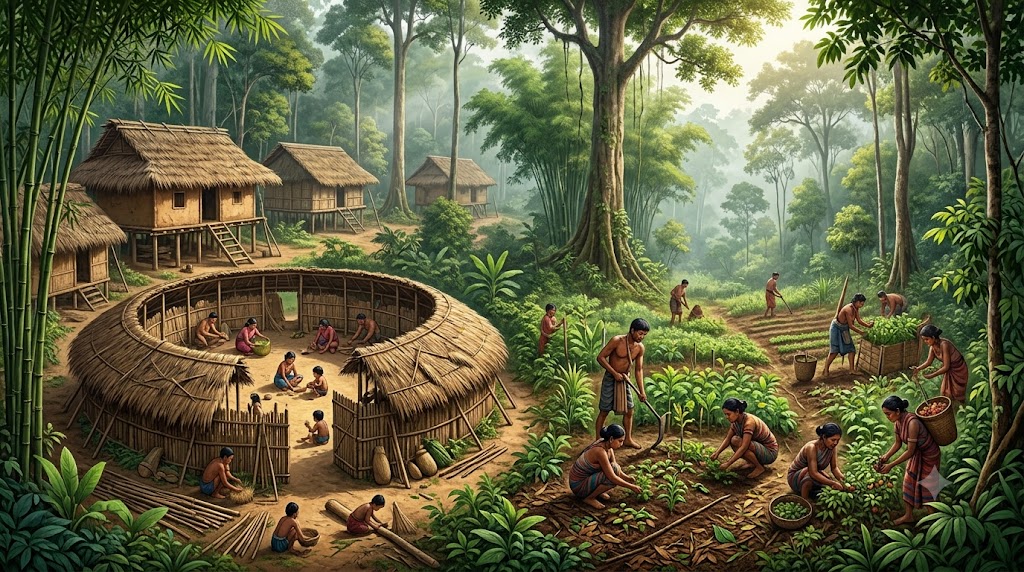
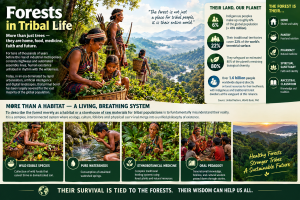
To describe the forest merely as a habitat or a storehouse of raw materials for tribal populations is to fundamentally misunderstand their reality. The forest is their home, their pantry, their pharmacy, their spiritual sanctuary, and their ancestral classroom. It represents a living, breathing tapestry where ecology, culture, folklore, and physical survival merge into a unified philosophy of existence.
According to data compiled by the United Nations and the World Bank, indigenous peoples make up roughly 6 per cent of the global population—amounting to approximately 476 million individuals—yet their traditional territories encompass an astounding 22 per cent of the world’s terrestrial surface and safeguard an estimated 80 per cent of the planet’s remaining biological diversity.
Understanding the significance of forests in tribal life requires stripping away romanticised, pastoral myths and taking an analytical, empathetic, and multi-dimensional look at the operational realities of indigenous survival. From the collection of wild edible species that cannot thrive in domesticated soil to the consumption of untainted watershed springs, and from complex ethnobotanical medical systems to generational oral pedagogy, forests represent an irreplaceable foundation for tribal life.
THE ANTHROPOLOGICAL AND ECOLOGICAL SYMBIOSIS: HOW TRIBAL COMMUNITIES UTILISE THE FOREST
The relationship between indigenous populations and forest ecosystems is neither purely exploitative nor passively detached; it is a meticulously calibrated, mutually reinforcing ecological partnership developed over millennia.
In modern macroeconomic discourse, human utilisation of land is frequently categorised under extractive parameters: logging, mining, clear-cutting for monoculture agriculture, and industrial real estate development. For tribal societies, however, utilisation is defined through the lens of stewardship, rotational harvesting, and systemic equilibrium.
Tribal communities interact with their forested environments across multiple distinct operational layers:
SHELTER AND SPATIAL DOMICILE ARCHITECTURE
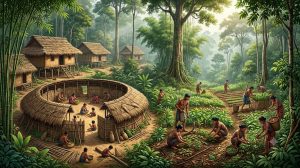
Forest-dwelling communities construct their shelters entirely from organic, biodegradable materials gathered in a sustainable manner from surrounding stands. Unlike industrial timber extraction, which levels entire tracts of old-growth woodland, tribal extraction is selective.
-
In the tropical rainforests of South America, the Yanomami build vast, communal circular dwellings known as shabonos, constructed from structural poles, vine lashings, and palm thatch (Geonoma deversa). These communal structures, designed to house up to 400 individuals, disintegrate naturally after several years, leaving zero toxic residue and encouraging natural vegetative succession when the village shifts its settlement.
SUSTAINABLE SUBSISTENCE CULTIVATION AND FORAGING : SIGNIFICANCE OF FORESTS IN TRIBAL LIFE
Far from being passive wanderers, indigenous communities practice sophisticated, low-impact agroforestry and rotational shifting cultivation (often known as Swidden, Jhum, or Milpa).
-
Modern industrial agriculture relies heavily on petroleum-based synthetic fertilisers, chemical insecticides, and monoculture seeding that strips topsoils of microbial biodiversity.
-
By contrast, tribal rotational farming allows land parcels to lie fallow for periods ranging from 7 to 20 years. This rotational cycle mimics natural forest disturbance, triggering secondary ecological succession, replenishing nitrogenous organic matter, and preventing parasitic insect blooms.
-
According to agroecological assessments by the International Union for Conservation of Nature (IUCN), traditional swidden plots contain significantly higher levels of soil organic carbon and floral heterogeneity than commercial agricultural plots situated on comparable clear-cut terrains.
NON-TIMBER FOREST PRODUCTS (NTFPs) AS AN ECONOMIC AND CULTURAL LIFELINE
Beyond self-consumption, tribal communities utilize Non-Timber Forest Products (NTFPs) as a primary mechanism for interfacing with local rural economies. The harvesting of NTFPs represents a vital economic bridge that does not necessitate tree felling.
-
In India, the Ministry of Tribal Affairs identifies that over 100 million forest dwellers depend directly on minor forest produce (MFP) for sustenance and supplementary cash income.
-
Key harvest commodities include Mahua flowers (Madhuca longifolia), used for nutrient-dense food preparations and fermented beverages; Tendu leaves (Diospyros melanoxylon), collected by millions of tribal women for rolling bidis; natural wild resins such as lac and gum karaya; and wild honey gathered by specialized communities like the Kattunayakan and Jenu Kuruba.
-
Globally, the World Bank estimates that NTFPs contribute up to 25 to 40 percent of total household income for forest-dependent communities, functioning as an essential financial safety net against agricultural crop failure or economic shocks.
TRI-PARTITE MODEL OF INDIGENOUS RESOURCE UTILIZATION |
1. SELECTIVE EXTRACTION
|
2. AGROECOLOGICAL SUCCESSION
|
3. NTFP VALUE CHAINS
|
The fundamental philosophy governing tribal resource utilisation is the avoidance of systemic depletion. Customary taboos, seasonal extraction moratoria, and totemic beliefs dictate that taking more than what the forest can regenerate within a single seasonal cycle invites ecological collapse and spiritual retribution. Consequently, forests managed under recognised community forest rights display deforestation rates that are 50 to 80 per cent lower than in state-managed protected areas or private lands, as consistently demonstrated by data from the World Resources Institute (WRI).
ESSENTIAL SURVIVAL RESOURCES ABSENT IN URBAN ECOSYSTEMS
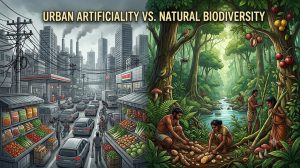
Modern urban landscapes are triumphs of civil engineering, yet they are structurally fragile synthetic habitats. Urban survival is entirely contingent on long, fossil-fuel-dependent global supply chains, cold-storage logistics, municipal processing plants, and commercial monetisation.
These resources are not luxury goods; they are foundational elements of physical survival that indigenous communities harvest directly from the living forest canopy.
WILD UNMODIFIED GENETIC DIVERSITY AND HERITAGE FOODS
Urban food supplies are dangerously homogenised. The FAO notes that while humanity has cultivated more than 6,000 plant species for food throughout history, fewer than 200 species contribute substantially to global food output today, with just nine crops—primarily sugarcane, maize, rice, wheat, potatoes, soybeans, oil palm fruit, sugar beet, and cassava—accounting for over 66 percent of all crop production.
In sharp contrast, forest ecosystems yield thousands of wild, un-hybridised, and genetically pristine edible plants that are functionally absent from urban retail systems:
-
Wild Tubers and Rhizomes: Indigenous forest dwellers across the tropics harvest hundreds of varieties of wild yams (Dioscorea spp.), aroids, and forest lilies. These tubers contain dense reserves of complex carbohydrates, prebiotic dietary fibers, and micronutrients like selenium and zinc. They persist underground through severe droughts, providing famine-proof sustenance when conventional surface crops wither.
-
Forest Greens and Ephemeral Shoots: Young shoots of wild bamboo, uncultivated wild ferns (such as Diplazium esculentum), and forest-canopy herbs deliver concentrated loads of polyphenols, carotenoids, and chlorophyll. These wild greens lack the synthetic pesticide, herbicide, and chemical fertilizer residues ubiquitous in commercially farmed produce sold in urban supermarkets.
-
Canopy Fruits and Wild Nuts: Species such as the wild mangosteen, African bush mango (Irvingia gabonensis), Brazil nuts (Bertholletia excelsa), and Mahua seed kernels yield exceptionally dense lipid, protein, and amino acid profiles. The Brazil nut tree, for instance, cannot be effectively cultivated in monoculture plantations; it relies exclusively on complex ecological pollination networks involving native Euglossine orchid bees found only in undisturbed Amazonian forest canopies.
NATURAL BINDING FIBRES, TENSIONAL VINES, AND RESINS
-
Lianas and Rattan Vines: Lianas and climbable forest vines possess immense tensile strength, allowing indigenous communities to weave suspension bridges across raging mountain rivers, tie complex housing frameworks, and construct durable fishing weirs. Rattan (Calamus spp.) provides an ultra-light, flexible, and shock-absorbent material for domestic utility.
-
Natural Glues and Waterproofing Resins: The sap of various species within the Dipterocarpaceae family yields natural dammar resins, while trees of the genus Hevea and Castilla provide wild latex. When blended with charcoal ash or pulverized limestone, these wild resins form impermeable sealants for canoes, water-carrying gourds, and roof structures, enduring extreme weather conditions without releasing endocrine-disrupting microplastics into the surrounding environment.
| ESSENTIAL SURVIVAL RESOURCE | PRIMARY FOREST SOURCE | OPERATIONAL FUNCTION | WHY IT CANNOT EXIST IN URBAN ENVIRONMENTS |
| Wild Edible Tubers (Dioscorea spp.) | Undisturbed forest understory and sub-surface root mats | Emergency drought-resistant food reserve, prebiotic energy source | Requires deep, undisturbed, unpaved woodland humus and mycological networks to grow |
| Wild Canes & Lianas (Calamus, woody vines) | Primary tropical and subtropical canopies | Structural binding, bridge construction, heavy-load hauling | Dependent on mature host trees and multi-tiered forest canopy structures |
| Natural Resins & Gums (Dammar, Copal, Lac) | Trunk fissures of wild Shorea, Acacia, and parasitic insect colonies | Waterproofing, non-toxic wood sealing, organic tool bonding | Requires mature, unmanaged forest flora and hyper-specific insect-host ecosystems |
| Non-Synthetic Fibers (Sisal, Palm fronds, Bark cloth) | Wild palm understories, inner bark of Ficus species | Clothing, woven burden baskets, sleeping mats, cordage | Urban agriculture lacks the continuous physical biomass yield and species variety |
| Organic Mineral Salts | Salt-rich ash of specific burnt riverine plants, mineral earth licks | Metabolic maintenance, food curing, electrolyte balance | Urban environments isolate residents from natural salt licks, forcing dependence on refined iodized factory salt |
SELF-SUSTAINING COMBUSTIBLE BIOMASS AND TINDER
For urban populations, warmth and cooking energy are dependent on municipal gas pipelines, centralized electrical grids, or propane delivery. For tribal peoples, the forest floor provides an endless, carbon-neutral harvest of dry fallen wood, combustible pitch, and specialized fungus tinder (such as Fomes fomentarius, the tinder bracket).
Because indigenous collection concentrates strictly on fallen deadwood rather than felling green living wood for fuel, the energetic cycle of the community remains naturally integrated into the carbon cycle of the forest floor, avoiding the catastrophic pollution metrics of urban-industrial fossil fuel infrastructures.
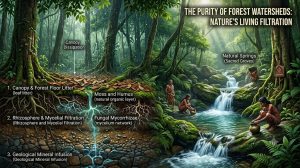
THE PURITY OF FOREST WATERSHEDS: NATURE’S LIVING FILTRATION APPARATUS
Clean water is the fundamental prerequisite of mammalian life. In contemporary cities, access to potable water requires multi-million-dollar municipal infrastructure projects: concrete reservoirs, chemical coagulation tanks using aluminum sulfate, chlorine gas injection systems, fluoridation units, and thousands of miles of pressurized, deteriorating subterranean pipes. Even with this technological apparatus, municipal tap water frequently suffers from heavy metal contamination, pipe-corrosion byproducts, pharmaceutical residues, and microplastics.
Tribal communities residing in unfragmented forest ecosystems drink directly from natural springs, forest rivulets, and rock-face cascades. This water displays a degree of chemical and biological purity that modern engineering struggles to replicate consistently without costly synthetic intervention.
THE ARCHITECTURE OF NATURAL WATER PURIFICATION
The forest functions as a colossal, living hydrological filtration sponge. When rainfall hits an old-growth forest, it does not scour the earth as devastating surface runoff. Instead, the hydrological cycle operates through a four-part natural purification system:
-
Canopy Dissipation: The multi-tiered canopy—composed of emergent trees, intermediate canopies, and shrub layers—absorbs the kinetic energy of falling raindrops. Water gently drips down leaves and branches or flows down trunks via stemflow, preventing the physical erosion of topsoil and keeping local streams free of suspended clay turbidity.
-
The Forest Litter and Humus Matrix: The forest floor is blanketed with a thick layer of decomposing leaf litter, mosses, and organic humus. This organic blanket functions as an ultra-fine mechanical sieve that catches suspended particulate matter, dust, and organic debris.
-
Biological Rhizosphere and Mycelial Filtration: As water percolates past the surface, it traverses a dense web of root systems and fungal mycorrhizae. These subterranean living networks actively extract dissolved nitrates, ammonia, and heavy minerals from the percolating water to fuel their metabolic growth. Fungal mycelia produce specialized enzymes and antimicrobial compounds that deactivate harmful bacterial colonies such as Escherichia coli, immobilizing pathogens before they enter groundwater streams.
-
Geological Mineral Infusion: Finally, the water passes through deep layers of quartz sands, gravel beds, volcanic basalt, and subterranean limestone aquifers. This slow, low-pressure gravity transit filters out microscopic contaminants and infuses the water with trace minerals: calcium, magnesium, potassium, and silica.
HYDROLOGICAL STEWARDSHIP AND SACRED SPRINGS
Indigenous groups do not merely use this water; they actively protect its sources through strict customary regulations and spiritual demarcations.
-
Throughout the Western Ghats and the Northeast hills of India, tribal communities designate specific forest patches surrounding natural water springs as Sacred Groves (known locally as Devrai, Kavu, or Law Kyntang). In these designated zones, human settlements, hunting, tree felling, and defecation are prohibited by unwritten tribal laws.
-
According to research published by the Central Ground Water Board (CGWB) of India, aquifers recharged within dense sacred forest groves maintain significantly lower levels of total dissolved solids (TDS), absence of heavy metal runoff, and optimal alkaline pH levels (typically 7.2 to 7.8) compared to unprotected agricultural or peri-urban catchments.
-
Forest water represents “living water”—naturally oxygenated by turbulent flow across rocks and moss beds, cooled by perpetual canopy shade that inhibits harmful cyanobacterial and algal blooms, and enriched with balanced trace minerals. For the forest dweller, this water is not an industrial utility billed by a municipal water board; it is a sacred, free-flowing life source that maintains the gastrointestinal and physiological health of the entire community.
THE FOREST AS A LIVING APOTHECARY: INDIGENOUS HEALTHCARE AND ETHNOMEDICINE
In large urban metropolises, healthcare is institutionalized within hospitals, specialty clinics, pharmacies, and synthetic pharmaceuticals. However, for vast populations of indigenous peoples dwelling in remote highlands, deep river valleys, and isolated woodlands, these facilities are physically inaccessible, prohibitively expensive, or separated by hundreds of miles of impassable terrain.
The United Nations Permanent Forum on Indigenous Issues (UNPFII) highlights that indigenous peoples globally experience worse access to state-sponsored health services than non-indigenous populations, often living in regions where the physician-to-patient ratio drops below 1 per 10,000 individuals.
Under these conditions, the forest serves as an expansive, reliable, and sophisticated living pharmacy. Rather than being unscientific superstition, tribal ethnomedicine is an empirical science developed across hundreds of generations of systematic observation, trial, refinement, and botanical cataloging.
ETHNOPHARMACOLOGICAL CONTINUUM IN TRIBAL HEALTHCARE |
1. ACCUTE TRAUMA & HEMOSTASIS
|
2. FEBRILE, PARASITIC & VECTOR-BORNE MANAGEMENT
|
3. GASTROINTESTINAL & METABOLIC REGULATION
|
4. MATERNAL, NEONATAL & PREVENTATIVE CARE
|
THE EMPIRICAL POWER OF INDIGENOUS PHARMACOPEIAS
The World Health Organization (WHO) estimates that up to 80 percent of the population in some developing nations, particularly within indigenous and rural communities, relies primarily on traditional medicine for basic healthcare needs. Far from being crude, traditional plant remedies utilize sophisticated bioactive phytochemicals:
-
Anti-Malarial Alkaloids: The bark of the Cinchona tree, long utilized by the Quechua peoples of the Andean slopes for controlling fevers, gave global medicine Quinine, the foundational template for modern anti-malarial therapies. Similarly, traditional Chinese herbalists learned from forest texts the power of Sweet Wormwood (Artemisia annua), which yielded Artemisinin, the contemporary frontline defense against drug-resistant Plasmodium falciparum.
-
Hemostatic and Wound-Healing Agents: In equatorial rainforests, minor lacerations can quickly become fatal septic infections due to elevated ambient temperatures and moisture levels. Indigenous hunters employ the sap of the Dragon’s Blood tree (Croton lechleri), rich in the alkaloid taspine and high concentrations of proanthocyanidins, which forms an antibacterial, wound-sealing biological film over open lacerations within minutes.
-
Anthelmintic and Gastrointestinal Protectors: Tribal communities consume preparations derived from Holarrhena antidysenterica (Kurchi bark) and Butea monosperma (Palash seeds) to treat acute amoebic dysentery and eradicate parasitic intestinal nematodes, ensuring the nutritional viability of children and working adults without reliance on laboratory synthetic antiparasitics.
| PLANT SPECIES (SCIENTIFIC NAME) | COMMON / INDIGENOUS NAME | ACTIVE CHEMICAL CLASS | TRADITIONAL THERAPEUTIC APPLICATION |
| Croton lechleri | Sangre de Drago (Amazon) | Taspine, Proanthocyanidins | Rapid topical wound healing, mechanical tissue sealing, internal ulcer protection |
| Azadirachta indica | Neem (South Asia) | Azadirachtin, Nimbin | Broad-spectrum antimicrobial, dental protection, dermatological therapies |
| Rauvolfia serpentina | Sarpagandha (India/Indochina) | Reserpine, Ajmaline | Sedative, relief from neurosis, treatment for severe hypertension and venomous snakebites |
| Harpagophytum procumbens | Devil’s Claw (Kalahari) | Harpagoside (Iridoid glycoside) | Treatment of debilitating joint pain, arthritis, lumbar musculoskeletal inflammation |
| Catharanthus roseus | Madagascar Periwinkle | Vinblastine, Vincristine | Traditional anti-diabetic and tonic; subsequently developed into critical oncological chemotherapies |
THE HOLISTIC, PREVENTATIVE PHILOSOPHY OF HEALING
Unlike modern allopathic systems, which often operate reactively by intervening after acute pathological symptoms manifest, the tribal healthcare framework is deeply preventative and holistic:
-
Medicine is integrated into daily culinary preparations. Wild tubers are boiled with anti-inflammatory curcuma and wild ginger roots; immune-modulating bitter leaves are consumed as regular broths; digestive tree barks are infused into everyday drinking water.
-
Indigenous medicine recognizes the indissoluble link between psychological equilibrium, community harmony, and physiological vitality. Healing ceremonies led by traditional practitioners (such as the Shamans of the Amazon, the Bhumkas of Central India, or the Sangomas of Southern Africa) mobilize community support networks, relieving the chronic psychological isolation, stress, and depressive disorders that run rampant in modern urban environments.
-
Modern pharmaceuticals owe an immense, often unacknowledged debt to this tribal apothecary. The Convention on Biological Diversity (CBD) notes that more than 25 percent of all modern prescription drugs sold globally are derived directly or indirectly from plants initially discovered, tested, and utilized by indigenous forest communities. Without the botanical knowledge preserved by tribal healers, modern pharmacology would lose its most fertile discovery frontier.
THE FOREST AS AN OPEN-AIR CLASSROOM: SURVIVAL PEDAGOGY AND ANCESTRAL KNOWLEDGE
In the contemporary world, education is overwhelmingly conceptual, abstract, and institutionalized. Children sit inside enclosed classrooms for decades, memorizing standardized curricula, viewing digitized representations of the world via computer displays, and acquiring skills tailored toward bureaucratic or technical specialization.
In this urban-industrial educational framework, practical biological survival skills are rarely taught, leaving urban populations helpless if their synthetic support infrastructure fails.
For tribal communities, the forest serves as an expansive, interactive, lifelong university. The survival of an indigenous child does not depend on standardized testing scores; it depends on developing an intimate, accurate, and real-time comprehension of the surrounding ecosystem. This pedagogy is experiential, cross-generational, and rooted in the survival needs of human life.
TRI-LEVEL INDIGENOUS PEDAGOGICAL SYSTEM
LEVEL 1: TACTILE BIOLOGICAL TAXONOMY (Ages 4-10) |
─ Reading subtle tracking signs: broken twigs, crushed leaves, scat decay rates. |
─ Understanding climatic phenology: timing flower blooms with migratory fish runs. |
─ Mastering the mechanical physics of bow-making, vine-rigging, and shelter weaving. |
|
─ Reading subtle tracking signs: broken twigs, crushed leaves, scat decay rates. |
─ Understanding climatic phenology: timing flower blooms with migratory fish runs. |
─ Mastering the mechanical physics of bow-making, vine-rigging, and shelter weaving. |
LEVEL 3: TACTILE BIOLOGICAL TAXONOMY (Ages 4-10) |
─ Learning to identify edible versus toxic fungi, roots, and berries. |
─ Mimicking bird songs and warning calls. |
─ Developing directional orientation using moss growth, wind patterns, and the sun. |
DEVELOPMENT OF SENSORY ACUITY AND FINE MOTOR SKILLS
From early childhood, an indigenous forest dweller’s sensory apparatus is honed to an extraordinary degree of sensitivity, contrasting sharply with the sensory desensitization induced by urban sensory overload and digital screen interfaces:
-
Auditory Differentiation: A tribal child learns to distinguish between the alarm calls of distinct bird species, instantly understanding whether an approaching predator is a terrestrial leopard, an arboreal snake, or a harmless raptor flying high above the canopy.
-
Micro-Visual Tracking: Forest trackers do not look for obvious footprints alone. They identify the slight displacement of a single pebble, the faint scrape of a claw upon tree bark, the degree of moisture loss along the torn edge of a broken leaf, or the direction toward which dew has been brushed off forest grass.
-
Olfactory Recognition: Indigenous hunters can detect the scent of distant wild peccaries, the pheromone markers of wild bees nesting high in a hollow trunk, or the subtle mineral odor of approaching subterranean water tables long before surface signs appear.
PHENOLOGY: READING THE NATURAL CLOCK AND CALENDAR
Without clocks, digital calendars, or weather apps, tribal individuals track the passage of time through phenology—the observation of recurring biological events:
-
The flowering of a specific woodland orchid indicates the exact arrival of pre-monsoon rains.
-
The appearance of a certain species of cicada announces the time to harvest mature bamboo before wood-boring beetles begin their seasonal lifecycle.
-
The ripening of wild riverine figs signals the arrival of large migratory fish in river shallows, opening a short, nutrient-rich fishing window.
This pedagogical curriculum connects the individual directly to their environment. It creates an ecological literacy that modern society is only now attempting to reconstruct under the scientific disciplines of systems biology, ecological modeling, and climatology.
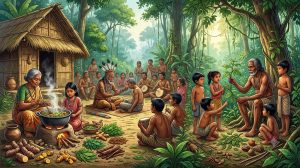
ORAL LITERATURE, METAPHOR, AND SUSTAINABLE VALUES
Because many tribal societies possess oral rather than written linguistic traditions, ecological knowledge is encoded into epics, folktales, song-lines, and spiritual metaphors.
-
A myth warning that a particular mountain forest is guarded by a fierce, vengeful spirit often protects a fragile watershed whose deforestation would destroy the village’s water supply.
-
Taboos prohibiting the hunting of pregnant animals or the cutting of fruit-bearing trees during specific lunar cycles are, in reality, sophisticated sustainable resource management rules disguised as sacred moral duties.
-
The forest classroom teaches an unbending moral philosophy: humans are not the dominant masters of creation, but equal participants in a vast, interconnected community of living beings. This educational paradigm fosters humility, minimizes gratuitous ecological destruction, and ensures that knowledge is passed down with a sense of protective duty toward future generations.
CULTURAL, SPIRITUAL, AND TOTEMIC DIMENSIONS OF FOREST DWELLING
To examine the forest solely as an economic storehouse of food, timber, water, and medicine is to ignore the deepest dimension of the indigenous worldview. For tribal groups, the forest is a sacred realm, an ancestral cathedral where every tree, stone, river, and animal species is imbued with metaphysical value.
TOTEMISM AS AN ECOLOGICAL PROTECTION CHARTER
Totemism is a foundational pillar of tribal social structure across Africa, the Americas, Australia, and Asia. In totemic systems, clans trace their lineage back to a mythical ancestral relationship with a specific wild plant, bird, reptile, or mammal:
-
A clan whose totem is the Great Hornbill (Buceros bicornis) or the Indian Leopard (Panthera pardus fusca) holds an inviolable sacred vow never to harm, kill, or consume that species.
-
Totemic affiliation transforms conservation from an abstract legal policy into an intimate, non-negotiable family responsibility. To destroy the forest habitat of one’s totem is equivalent to desecrating the resting place of one’s own biological parents.
SACRED GROVES: RESIDENTIAL ARCHIVES OF DEITIES AND ANCESTORS
Across nearly every indigenous territory worldwide, one finds designated forest enclosures where all human extraction is strictly forbidden.
-
In India, these are the Devarakadus of Kodagu, the Sarnas of Jharkhand, and the U Umang of Meghalaya. Anthropological estimates indicate there are over 100,000 such sacred groves preserved across India alone, functioning as botanical islands of untouched ancient forest.
-
In these zones, deadwood is left to rot where it falls, supporting rare saproxylic insects, fungi, and amphibians that cannot survive in managed forests or human settlements.
-
Tribal elders teach that these groves are the physical residences of regional deities and ancestral spirits who walk the earth. From a modern scientific perspective, these sacred groves serve as vital biodiversity gene banks, preserving critically endangered, ancient-growth flora that have been systematically wiped out in surrounding transformed landscapes.
IDENTITY, LANGUAGE, AND LOSS OF THE WOODLAND SOUL
The linguistic structures of indigenous peoples are deeply intertwined with their local forest landscapes. The Dayak languages of Borneo or the indigenous tongues of the Amazon contain hundreds of specific terms for micro-variations of canopy moisture, soil smell, root behaviors, and animal vocalizations that have no equivalent in modern languages like English, Spanish, or Mandarin.
When a forest is clear-cut for industrial mining, cattle ranching, or palm oil monocultures, tribal communities suffer an existential tragedy that extends far beyond the loss of their physical homes.
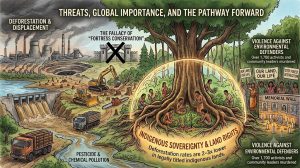
THREATS, GLOBAL IMPORTANCE, AND THE PATHWAY FORWARD
Despite their demonstrably superior ecological stewardship, indigenous peoples today face relentless, unprecedented existential threats. The global economic appetite for timber, rare earth minerals, agricultural commodities, industrial cattle feed, and fossil fuels pushes frontiers deeper into the world’s last remaining pristine primary forests.
THE DRIVERS OF INDIGENOUS AND FOREST DISPLACEMENT |
1. AGRIBUSINESS MONOCULTURES |
- Massive clear-cutting for soy, palm oil, and commercial cattle ranching. |
- Chemical pesticide and herbicide runoff poisoning downstream tribal waters. |
2. EXTRACTIVE INFRASTRUCTURE |
- Open-cast mining for bauxite, gold, iron ore, lithium, and fossil fuel reserves. |
- Mega-hydroelectric dams flooding thousands of hectares of ancestral territories. |
3. MISGUIDED "FORTRESS CONSERVATION" |
- Eviction of indigenous populations to create uninhabited tourist parks. |
- Strips the forest of its human defenders, allowing illegal loggers to infiltrate. |
4. VIOLENCE AGAINST ENVIRONMENTAL DEFENDERS |
- Over 1,700 environmental activists murdered globally over the past decade. |
- Disproportionate casualties borne by frontline indigenous community leaders. |
THE REALITY OF DEFORESTATION AND DISPLACEMENT
-
Unprecedented Deforestation Rates: According to Global Forest Watch, the tropics lost approximately 3.7 million hectares of primary rainforest in recent benchmark years—equivalent to losing 10 football pitches of primary forest every minute. This systematic destruction is directly encroaching on recognized and contested indigenous homelands.
-
Violence Against Indigenous Defenders: Defending ancestral forests has become one of the world’s most perilous activities. Data compiled by Global Witness consistently reveals that over 1,700 land and environmental defenders were murdered across the globe between 2012 and 2022. Disproportionately, more than 35 to 40 percent of these murdered defenders belonged to indigenous communities, targeted by illegal logging syndicates, wildcat miners, and corrupt commercial interests.
-
The Fallacy of “Fortress Conservation”: Historically, modern conservation models embraced the concept of “fortress conservation”—the flawed belief that to protect biodiversity, humans must be systematically evicted to create pristine, unpeopled national parks.
-
Decades of ecological research have definitively refuted this approach: when traditional indigenous guardians are forcefully removed, protected forests often experience sharp increases in poaching, illegal extraction, and catastrophic wildfires due to the loss of traditional fire-management practices.
CLIMATE CHANGE MITIGATION AND INDIGENOUS LAND TITLING
The scientific consensus is increasingly clear: the battle against global catastrophic climate change cannot be won without the preservation of forest ecosystems, and those ecosystems cannot be defended without indigenous sovereignty.
-
Research published in Nature Sustainability and confirmed by the Rights and Resources Initiative (RRI) demonstrates that deforestation rates within legally titled indigenous lands are between two to three times lower than in adjacent lands managed under conventional state or private regimes.
-
The Intergovernmental Panel on Climate Change (IPCC) explicitly notes in its special reports on climate change and land that formal recognition of indigenous land tenure is one of the most cost-effective and ecologically robust climate mitigation investments on earth. Forests under indigenous management sequester billions of metric tons of atmospheric carbon annually, functioning as indispensable thermal regulators for the planet’s atmospheric dynamics.
CARBON DENSITY AND CONSERVATION IMPACT MATRIX
LAND MANAGEMENT REGIME |
AVERAGE ANNUAL DEFORESTATION RATE |
CARBON SEQUESTRATION STABILITY |
Private Monoculture Forestry |
High (Clearcutting cycles) |
Low (Re-released on harvest) |
State Parks (Under-enforced) |
Moderate to High (Illegal logging) |
Moderate (Vulnerable to poaching) |
Privately Held Ranches/Farms |
Severe (Continuous deforestation) |
Extremely Low (Net emitter) |
LEGALLY TITLED INDIGENOUS LAND |
Extremely Low (<0.5% annually) |
Exceptional (Long-term sink) |
A ROADMAP FOR SUSTAINABLE COEXISTENCE
To preserve the sacred, irreplaceable bond between forests and tribal communities, the modern international community must move past tokenistic acknowledgments and enact systemic political, economic, and legal reforms:
-
Uncompromising Recognition of Land Rights: Global governments must honor and accelerate the implementation of legal mechanisms such as the United Nations Declaration on the Rights of Indigenous Peoples (UNDRIP) and progressive national laws like India’s Forest Rights Act (FRA), 2006. Granting full communal property titles over ancestral lands directly empowers the most effective conservationists on Earth.
-
Mandating Free, Prior, and Informed Consent (FPIC): No extractive commercial project, highway, or conservation park should be permitted to break ground without authentic, transparent, non-coerced consent negotiated with the traditional governing councils of affected tribal communities.
-
Decolonizing Conservation Paradigms: The global conservation establishment must permanently abandon the failed fortress model. Protected areas should be co-managed directly by indigenous peoples, integrating traditional ecological knowledge with contemporary remote-sensing and ecological technologies.
-
Economic Fair-Trade Valuation for Forest Products: Fair-trade economic networks must be established to purchase Non-Timber Forest Products directly from tribal harvesting collectives, bypassing predatory middlemen. This ensures that traditional forest harvesting provides long-term prosperity without requiring indigenous families to abandon their lifestyle.
-
Preserving Ethnobotanical Intellectual Property: Global pharmaceutical, cosmetic, and agricultural corporations must be held accountable to the access-and-benefit-sharing protocols established under the Nagoya Protocol. The intellectual property rights of tribal healers who discover and safeguard botanical remedies must be legally protected, with fair financial returns channeled directly into community-run health, clean water, and cultural preservation trusts.
CONCLUSION: THE ENDURING LESSON OF THE CANOPY
The significance of the forest in tribal life is not a historic curiosity from an ancient era; it is an enduring lesson for the future of our civilization.
While the modern urban world isolates itself in steel towers, concrete developments, and digital spaces, it remains entirely dependent on ecological foundations it frequently degrades: breathable air, drinkable water, stable climatic regimes, and biological diversity.
In their intimate, thousands-of-years-old dialogue with the wilderness, indigenous communities have proved that it is possible for human societies to thrive without exhausting the biosphere. They have preserved a way of life that views nature not as a dead resource to be mined to exhaustion, but as a living ancestor to be treated with gratitude, humility, and care.
When the forest stands, the tribal community stands. When the tribal community stands, the forest is defended against industrial destruction. And when the ancient forests of this planet are defended, the entire human species retains its most powerful, irreplaceable buffer against ecological collapse.
To protect the forest and to fiercely defend the rights, sovereignty, and dignity of its tribal guardians is to preserve the living foundations of the Earth itself.
