
The Resilient Tapestry of the Thadou: Culture, Customary Law, and the Struggle for Identity in Northeast India
Introduction: Unveiling the World of the Thadou People
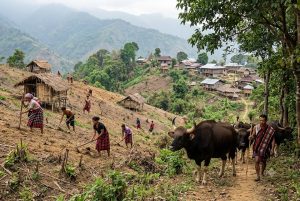
In the misty highlands and dense evergreen hills stretching across Northeast India and northwestern Myanmar lives an indigenous society whose cultural bedrock has weathered centuries of colonial intervention, missionary shifts, administrative reorganisations, and contemporary socio-political friction. Recognised officially under the Scheduled Tribes list in India, the Thadou people represent one of the most prominent, linguistically cohesive, and culturally distinct indigenous communities within the larger Zo/Kuki-Chin ethno-linguistic continuum.
Spread predominantly across the hill districts of Manipur—including Churachandpur, Kangpokpi (Sadar Hills), Senapati, Chandel, Tengnoupal, and Pherzawl—with sizable populations in Assam, Nagaland, Mizoram, and across the international border in Myanmar’s Chin State and Sagaing Division, the Thadou embody a story that is at once ancient and urgently modern. They are a community defined by their egalitarian communal ethos on one hand, and a rigid, hereditary patriarchal hierarchy on the other; by poetic folklore sung around village hearths, and by acute geopolitical vulnerability in twenty-first-century India.
For readers, scholars, and advocates invested in indigenous cultures, human rights, and tribal development, understanding the Thadou is essential to understanding the complexities of India’s northeastern frontier. This comprehensive study examines their oral histories, administrative customs, artistic traditions, economic transitions, human development metrics, and ongoing struggles for identity and security.
Ethno-Linguistic Roots and the Great Migration: Tracing Oral Origins
The Legend of Khul: Emergence from the Womb of the Earth
Like many indigenous groups inhabiting the Indo-Burma biodiversity and cultural hotspot, the Thadou do not trace their beginnings to imperial conquest or maritime trade. Instead, their cosmogony begins deep within the subterranean earth.
Oral tradition holds that the ancestors of the Thadou emerged from a mythical subterranean cavern known as Khul (or Chhinlung/Sinlung among cognate groups). According to ancestral lore, humanity once lived under the ground until heroic ancestors cleared the stone slab covering the exit of the cave. The mythical progenitor, Chongthu, along with companions and protectors, led the people out into the sunlit world. Upon emerging, they encountered supernatural beings, ferocious beasts, and the untamed natural elements, which they overcame through courage, sacred pacts, and spiritual rituals (Doitho).
This foundational myth is more than a bedtime story; it functions as an indigenous charter of common ancestry and existential resilience. It reminds the community that regardless of clan dispersion or geographical borders, their umbilical connection links back to a shared ancestral point of emergence.
The Linguistic Anchor: Tibeto-Burman Heritage
Linguistically, the Thadou tongue belongs to the Kuki-Chin-Mizo sub-branch of the broader Tibeto-Burman language family. It is a tonal, agglutinative language rich in idioms, metaphorical couplets, and expressive phonology.
The spoken language served as the primary archive of their history for centuries before the introduction of the Roman script by Christian missionaries in the late nineteenth and early twentieth centuries. Genealogy (Inndongta and clan ancestral recitations) was transmitted orally from father to son through intricate mnemonics known as Phungsim. Through Phungsim, an elder can recite dozens of generations without a single written note, establishing genealogical legitimacy, marriage protocols, and customary obligations.
Sub-Family: Tibeto-Burman
 └── Branch: Kuki-Chin-Mizo
      └── Group: Northern Kuki-Chin
           └── Language: Thadou (Thadou-Pao)
The language features diverse regional accents and sub-dialects, yet remains mutually intelligible across different hill ranges, acting as a vital social glue that unites urban emigrants in Delhi, Guwahati, and Bengaluru with remote hill hamlets.
The Pillars of Traditional Governance: Chieftainship and Village Republics
The Institution of the Haosa (Hereditary Chief)
To understand traditional Thadou society, one must analyze the institution of the Haosa (the village chief). Unlike neighboring indigenous communities such as the Ao Nagas or the Tangkhuls, who historically practiced varying forms of participatory village councils or elder gerontocracies, the traditional Thadou political structure is intrinsically aristocratic and hereditary.
The Haosa is not merely an administrative figurehead; he is the custodian of the land, the high judge in disputes, and historically, the spiritual protector of the community. In classical Thadou philosophy, the land belongs to the Chief, who holds it in sacred trust for his people. The villagers, traditionally referred to as Upas and Mipis, cultivate plots allocated to them under the chief’s authority.
Key responsibilities and privileges of the Haosa historically included:
-
Changseo: A customary paddy tribute paid annually by each household to the Chief in recognition of his stewardship over the community’s land.
-
Saliang: A customary tribute consisting of the hind leg or shoulder of any wild game hunted within the village territory.
-
Dispute Arbitration: Presiding over civil, marital, and minor criminal matters using codified customary jurisprudence (Thadou Dan).
The Upas (Council of Elders) and Democratic Counterweights
While the chief possesses supreme executive and judicial authority, his rule is not an unchecked absolute tyranny. Customary law dictates that the chief must govern in consultation with the Upas (village elders/councillors) and the Semang-Pachong (court ministers and messengers).
| Governance Role | Traditional Designation | Primary Societal Function |
| Supreme Executive | Haosa | Land stewardship, final judicial verdicts, inter-village diplomacy |
| Chief Minister/Advisor | Semang | Advises the chief, represents public sentiment, manages trials |
| Village Crier/Bailiff | Pachong | Disseminates royal decrees, organizes youth work brigades |
| Priest/Shaman | Thempu | Performs sacred propitiations, heals sickness, interprets omens |
| Blacksmith | Thik-khepu | Forges agricultural tools and weapons, honored with agrarian tributes |
Decisions regarding shifting cultivation cycles, forest clearances, defense against external raids, or communal welfare are debated within the village council. If a chief acts excessively tyrannical or violates customary taboos, historical precedents allowed entire clans to pack their belongings and pledge allegiance to a fairer, more compassionate chief elsewhere—a mechanism that provided a structural check against autocracy.

Social Architecture: Kinship, Marriage, and the Hearth
Clan Stratification and Patrilineal Descent
Thadou society is staunchly patrilineal and patrilocal. Descent, inheritance, and social status pass directly through the male lineage. The community is bifurcated into major clans, which trace their roots back to ancestral brothers and patriarchs, including:
-
Doungel
-
Sitlhou
-
Kipgen
-
Haokip
-
Singson
-
Chongloi
-
Hangshing
-
Touthang
-
Guite (closely aligned through historical ties)
Customary Marriage: Man and the Alliance of Families
Marriage in Thadou culture is not a private contract between two individuals; it is an economic, spiritual, and social treaty between two extended kinship systems.
Historically, Thadou marriage practices emphasized matrilateral cross-cousin marriage—a man ideally marrying his mother’s brother’s daughter (Neinu). This stabilized clan alliances, ensured that the bride moved into an already familiar family environment, and kept customary wealth circulating within known networks.
A central feature of the marriage process is the negotiation of Man (bride price or marriage gifts). Contrary to external colonial misunderstandings that viewed this as the “purchasing” of a bride, Man functions as a structural token of deep respect and compensation to the bride’s clan for the loss of a valuable member:
-
Mankhang: The primary wealth presented to the bride’s parents (traditionally evaluated in mithun, gongs, or ancestral beads).
-
Longman: Gifts given to the maternal uncle (Pu) of the bride, reinforcing the enduring lifelong bond between an individual and their mother’s lineage.
-
Tucha-Becha Relationship: A network where maternal uncles (Pu) hold spiritual authority to bless, while sisters’ husbands and children (Tucha) render voluntary physical assistance during rites of passage, funerals, and community feasts.
Women maintain a complex position within this structure. While traditional customary inheritance laws preclude women from inheriting ancestral land or holding the chieftainship, their informal authority within the household (Innsung) is immense. They oversee domestic granaries, manage the production of complex handloom textiles, and play decisive roles in hospitality networks.
Agrarian Economy and Traditional Ecology: The Rhythms of Jhum
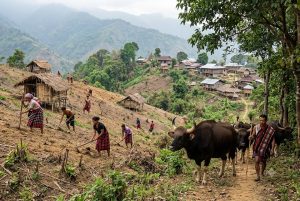
The Cycle of Lou-voh (Shifting Cultivation)
Unlike industrial monoculture, traditional Jhum was practiced with an acute ecological rhythm:
[Winter: Clearing]
Slash undergrowth on chosen hill slope; leave fallen biomass to dry under dry-season sun.
        │
        ▼
[Early Spring: Controlled Burn]
Burn dried vegetation carefully; ash enriches acidic mountain soil naturally.
        │
        ▼
[Spring: Sowing / Tuh]
Use digging sticks & hoes to sow mixed crops: mountain rice, maize, millet, yams, chilies.
        │
        ▼
[Summer: Weeding / Lou-voh ho]
Weed plots continuously through heavy monsoon rains; build temporary field huts (Buh-in).
        │
        ▼
[Autumn: Harvest / Buh-at]
Communal harvest of paddy; transport grains up steep slopes to village granaries.
The multi-crop nature of Jhum served as indigenous insurance against famine. If an untimely pestilence destroyed the dry rice crop, hardier tubers, millets, or squash still provided sustenance.
The Sacred Significance of the Mithun (Siel)
In the Thadou economic universe, the bovine species Bos frontalis—known locally as the Mithun or Siel—is the apex symbol of wealth, prestige, and ritual sanctity. The Mithun is neither a beast of burden used for plowing nor an industrial dairy animal; it roams semi-wild in community forests, recognized by distinct ear-notches carved by its owner.
A Thadou leader’s standing was historically measured not by gold or paper currency, but by how many head of Siel he owned. The sacrifice of a Mithun marked pivotal life events:
-
Securing marriage treaties.
-
Paying major legal restitutions for inter-village blood feuds.
-
Hosting the prestigious Chon feast—a multi-day merit feast where an affluent individual slaughtered multiple Mithun to feed the entire countryside, earning eternal honor in this life and spiritual prestige in the ancestral afterlife (Mithi-khua).
Festivals, Music, and Artistic Expression
Chavang Kut: The Autumn Harvest Extravaganza
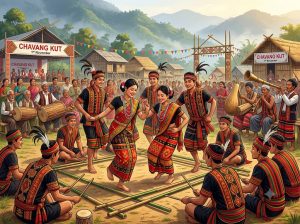
Of all the cultural expressions of the Thadou people, none shines brighter than Chavang Kut, celebrated annually on the 1st of November. It is a thanksgiving festival marking the end of grueling agricultural labor and the safe gathering of crops into the granaries.
During Chavang Kut:
-
The village elders offer thanks to the Almighty for an abundant harvest and pray for communal peace.
-
Youth don their finest traditional attire—the distinctive black, red, and yellow woven shawls known as Saipikhup and Thangnang.
-
Communal rice beer was historically consumed, accompanied by songs, traditional wrestling, and community feasts.
-
Today, Chavang Kut has transformed into a major state-recognized cultural spectacle in Manipur, featuring beauty pageants (Miss Kut), contemporary musical performances, and intellectual symposiums, while remaining an anchor of indigenous solidarity.
          ┌─────────────────────────────────────────────────────┐
          │             PRIMARY TRADITIONAL ATTIRE              │
          ├──────────────────────────┬──────────────────────────┤
          │         SAIPIKHUP        │        THANGNANG         │
          ├──────────────────────────┼──────────────────────────┤
          │ Motif: Fish scale/       │ Traditional black, red,  │
          │ elephant knee pattern    │ and green striped cloth  │
          │ Reserved historically    │ Worn universally as a    │
          │ for royalty & warriors   │ cultural identifier      │
          └──────────────────────────┴──────────────────────────┘
Traditional Dances: Harmony in Motion
Thadou choreography mirrors nature, war, and the rhythm of manual harvest. Key dances include:
-
Suhta Lam: The intricate bamboo dance, requiring swift, precise footwork as performers hop between rhythmically clapped bamboo poles without getting trapped.
-
Vailhung Lam: A victory dance historically performed to celebrate returning warriors or the successful completion of an inter-village treaty.
-
Gal Lam: A dramatic, martial dance where men armed with shields (Phei-chawm) and spears execute leaps and parries to celebrate ancestral military valor.
Folk Instruments
Traditional music relies on organic mountain materials:
-
Khuang: A large, hollow wooden drum covered with cowhide or deerhide that sets the primal heartbeat of all dances and church hymns.
-
Goshem: A wind instrument crafted from dried gourd and multiple bamboo pipes, producing a distinct polyphonic sound reminiscent of a bagpipe.
-
Pengkul: A long trumpet-like horn made of brass or wood, blown to signal emergency warnings, the arrival of esteemed guests, or village festivals.
The Spiritual Metamorphosis: From Animism to Christianity
The Ancient Worldview: Spirits, Omen, and the Afterlife
Before the arrival of British colonial administrators and Western missionaries, the Thadou practiced an indigenous animism centered on the supreme creator known as Pathen.
However, while Pathen was viewed as a distant, benevolent creator god who lived above the skies, daily reality was dominated by an array of environmental spirits called Thilha and Doi. These spirits inhabited primeval forests, water springs, unusual rock formations, and mountain passes:
-
Gam-laisen: Malicious spirits that brought sudden illnesses, madness, or hunting accidents.
-
Innpung-thilha: Household spirits that required regular offerings of poultry or pigs to prevent domestic misfortunes.
The mediator between this spirit realm and mortal humans was the Thempu (village priest/healer). The Thempu read omens in chicken entrails (A-ngak thil), brewed herbal medicines, and chanted poetic incantations to placate angry mountain spirits and guide lost souls back to ailing bodies.
When a person died, their spirit traveled along the winding road to Mithi-khua (the village of the dead), where they lived an existence mirroring their earthly deeds.
The Missionary Encounter and Social Transformation
The entry of Christian missionaries into the hill tracts of Manipur and Assam during the early twentieth century—particularly American Baptists and Welsh Presbyterians like William Pettigrew and his successors—altered Thadou society permanently.
The conversion process gained immense momentum in the aftermath of the Anglo-Kuki War (1917–1919). Exhausted by colonial warfare and seeking tools to engage with the modern world, the Thadou embraced Christianity en masse between the 1920s and 1960s.
IMPACT OF CHRISTIANIZATION ON THADOU SOCIETY:
├── Spiritual: Replacement of ancestral animal sacrifices with Christian liturgical worship.
├── Educational: Introduction of the Roman alphabet; translation of the Bible into Thadou-Pao.
├── Healthcare: Establishment of western clinics, reducing mortality from infectious diseases.
└── Cultural Dilemmas: Gradual decline of indigenous musical instruments and traditional feasts.
Today, over 95% of the Thadou population identifies as Christian, primarily belonging to Baptist, Presbyterian, and Seventh-day Adventist denominations. The local church has become the center of modern community life, organizing youth fellowships, social welfare services, and humanitarian relief during crises.
Anti-Colonial Resistance: The Anglo-Kuki War (1917–1919)
No history of the Thadou is complete without analyzing their fierce resistance to British imperialism. The defining epoch of their modern political consciousness is the Anglo-Kuki War of 1917–1919 (historically documented in colonial records as the Kuki Rising or Kuki Rebellion).
Causes of the War
In 1917, during the height of World War I, the British Empire faced critical labor shortages on the Western Front in France. The British Political Agent in Manipur, alongside the colonial administration in Assam, ordered the hill chiefs to recruit young men for the Labour Corps to dig trenches, construct roads, and carry munitions in Europe.
For the Thadou and cognate hill chiefs, this decree was an intolerable insult to their sovereignty:
-
Cultural and Physical Taboos: Crossing the ocean (Kala-pani) was viewed with deep dread, and abandoning families to the uncertainties of hill survival during harvest was economically unviable.
-
Sovereign Defiance: The hereditary chiefs held that they were independent sovereigns who had never submitted to British overlordship. They refused to send their young men to fight in a distant, incomprehensible European war.
The Guerrilla Campaign: Indigenous Warfare in Rugged Terrain
When the British issued ultimatums, the chiefs met in secret war councils (Thingkho-le-Malcha), sending around charred wood and fiery dried chilies to signify the outbreak of war and the call for total solidarity.
Led by legendary chiefs such as Chengjapao Doungel of Aisan, Tintong Haokip of Laijang, and Enjakhup Kholhou, the Thadou waged a two-year asymmetric guerrilla war against the British Empire:
-
They constructed ingenious hillside stockades reinforced with stone traps (Song-vum).
-
They utilized indigenous leather cannons (Pumpi) forged from hollowed-out tree trunks wrapped tightly in wet rawhide and packed with black powder.
-
They engaged British military columns in ambushes across steep jungle valleys, frustrating seasoned imperial regiments including the Assam Rifles and Burma Military Police.
The Aftermath and Historical Significance
It took the British Empire two years, thousands of troops, scorched-earth campaigns, and the burning of dozens of hill villages to subdue the rebellion. The prominent chiefs were arrested and exiled to cellular jails in Sadiya and the Andaman Islands.
Today, this war is commemorated by the community as a foundational chapter of their anti-colonial freedom struggle—a testament to an indigenous society that fought to protect its ancestral soil and self-determination against the British Empire.
Human Development Realities: Education, Health, and Livelihoods
While the Thadou possess a rich historical memory and vibrant cultural identity, their modern socioeconomic realities present serious developmental challenges.
The Educational Landscape
Over the last half-century, literacy among the Thadou has risen significantly, driven by Christian church institutions and community-funded private schools. The general literacy rate among the community is above 70%, surpassing several other remote tribal groups across central India.
However, a closer look at the educational infrastructure reveals stark inequalities:
-
The Rural-Urban Divide: While families residing in town hubs like Churachandpur or Kangpokpi have access to reputable schools, hill villages often rely on single-teacher government schools plagued by infrastructure deficits, lack of science laboratories, and high teacher absenteeism.
-
Higher Education Deficit: A lack of quality collegiate institutions, technical training centers, and engineering/medical universities across the hill districts forces youth to migrate to major mainland Indian cities (Guwahati, Delhi, Shillong, Kolkata) for higher education. This brain drain depletes human capital from their home regions.
Healthcare Vulnerabilities
Healthcare access across Thadou-dominated areas remains deeply concerning:
HEALTHCARE INFRASTRUCTURE CHALLENGES IN HILL REGIONS:
├── Primary Health Centres (PHCs) are chronically understaffed and lack emergency power backups.
├── Life-saving surgical care or complex obstetrics require hazardous 4-to-8 hour road journeys.
├── High Out-of-Pocket Expenditure (OOPE) drives low-income tribal families into debt traps.
└── Monsoon road disruptions isolate hamlets during seasonal disease spikes (malaria, typhoid).
Institutional maternal deliveries have improved thanks to national initiatives like the Accredited Social Health Activist (ASHA) program, yet infant mortality and maternal mortality rates in the interior hills remain higher than national averages.
Economic Stagnation and Agrarian Fragility
The contemporary Thadou economy remains tied to vulnerable sectors:
-
Declining Jhum Yields: Due to environmental degradation, deforestation, and population growth, the fallow cycle of Jhum has shrunk from a sustainable 15–20 years down to an alarming 3–5 years. This gives the forest insufficient time to regenerate, leading to severe topsoil erosion, lower crop yields, and agrarian distress.
-
Lack of Industrialization: The hill tracts feature virtually zero secondary manufacturing industries. Aside from small-scale handloom weaving and timber processing, there are few non-farm manufacturing jobs.
-
Overdependence on Public Employment: For educated youth, employment in state government service or the Indian Armed Forces/paramilitary remains almost the sole pathway to stable middle-class economic status. The resulting scarcity of government jobs fuels high unemployment rates, leaving thousands of young people frustrated and vulnerable to recruitment by local armed groups.
The Complex Matrix of Identity: The Kuki-Zo Continuum and Nomenclature Politics
One of the most nuanced aspects of Thadou society today is the politics of ethnic nomenclature and pan-tribal identity.
Who are the Thadou, and How Do They Relate to the “Kuki” Identity?
The terms Thadou and Kuki are intertwined, often causing confusion for outside observers and fueling internal ideological debates within the community itself:
                    ETHNOLOGICAL TAXONOMY
                    ┌────────────────────────────────────────┐
                    │      ZO / KUKI-CHIN FAMILY TREE        │
                    └───────────────────┬────────────────────┘
                                        │
             ┌──────────────────────────┴──────────────────────────┐
             ▼                                                     ▼
     PAN-ETHNIC UMBRELLA                                    SPECIFIC TRIBE
    "KUKI" or "ZO" IDENTITY                               "THADOU" (Scheduled Tribe)
  (Broad regional classification                        (Distinct linguistic & lineage
   used historically by colonial                         entity with its own dialect,
      officials and scholars)                             clan councils, and traditions)
Historically, colonial British administrators utilized the umbrella exonym “Kuki” to classify a large group of hill tribes sharing similar customs, languages, and physical features across the Chittagong Hill Tracts, Lushai Hills, Assam, and Manipur (distinguishing between “Old Kuki” and “New Kuki”).
The Thadou formed the core linguistic and demographic weight of the groups labeled as “New Kuki” during the nineteenth century.
The Modern Nomenclature Debate
In contemporary times, a sensitive ideological friction exists regarding self-identification:
-
The Pan-Kuki/Zo Vision: Many intellectuals, politicians, and civil society actors argue that the various related tribes (Thadou, Hmar, Paite, Vaiphei, Zou, Gangte, Simte) must unite under a single collective pan-ethnic identity—such as Kuki or Zo—to secure political bargaining power, administrative unity, and collective protection within the Indian federal framework.
-
The Distinct Thadou Sovereignty Camp: Conversely, organizations like the Thadou Inpi (the apex customary body) emphasize that Thadou is an independent, distinct ethnic community recognized under the Indian Constitution’s Scheduled Tribe order since 1956. Proponents argue that subsuming their unique language, customary chieftainship traditions, and historic identity under an amorphous umbrella risks erasing their distinct heritage, sidelining their numerical weight, and generating internal political discord.
Navigating this delicate line between preserving specific clan-based identities and maintaining broader indigenous solidarity remains one of the greatest socio-political tests facing modern Thadou intellectuals and community leaders.
Modern Struggles: Ethnic Conflicts, Displacement, and Geopolitics
The Scars of the 1990s: The Naga-Kuki Clash
The Thadou people have lived through some of the most traumatic episodes of ethnic conflict in modern Indian history.
During the 1990s, fierce ethnic clashes erupted between Naga groups (principally the NSCN-IM) and Kuki groups (of which the Thadou formed the largest population) across the hill tracts of Manipur. Driven by competing territorial claims, demands for separate homelands, and control over crucial economic transit corridors like the Moreh border trade route, the conflict resulted in:
-
The destruction of hundreds of peaceful villages.
-
The loss of over a thousand lives.
-
The internal displacement of over 100,000 tribal villagers, forcing entire communities into makeshift refugee settlements around district headquarters.
The psychological, economic, and geographic scars of this 1990s violence continue to shape inter-tribal relations and land tenure policies in the hills of Manipur.
The 2023–2024 Manipur Ethnic Conflict: A Devastating Crisis
More recently, starting in May 2023, the hill and valley populations of Manipur were plunged into unprecedented ethnic violence between the valley-dwelling Meitei majority and the hill-dwelling Kuki-Zo tribal communities (including the Thadou).
         CHRONOLOGY OF ESCALATING ETHNIC FRICTION
         ┌────────────────────────────────────────────────────────┐
         │ 1. Structural Land Tensions                            │
         │    Disputes over forest reserves, hill land protection │
         │    laws, and demographic shifts.                       │
         └──────────────────────────┬─────────────────────────────┘
                                    │
         ┌──────────────────────────▼─────────────────────────────┐
         │ 2. The ST Status Recommendation                        │
         │    High Court directive on Meitei ST inclusion sparks  │
         │    intense alarm among hill tribal populations.       │
         └──────────────────────────┬─────────────────────────────┘
                                    │
         ┌──────────────────────────▼─────────────────────────────┐
         │ 3. May 3, 2023 Solidarity March                        │
         │    Peaceful protests spark clashes; rapid descent into │
         │    widespread communal arson and gun violence.         │
         └──────────────────────────┬─────────────────────────────┘
                                    │
         ┌──────────────────────────▼─────────────────────────────┐
         │ 4. Total Demographic Separation                        │
         │    Complete ethnic partitioning of valley and hills;   │
         │    tens of thousands displaced into relief camps.      │
         └────────────────────────────────────────────────────────┘
The human cost for the Thadou community has been catastrophic:
-
Mass Displacement: Tens of thousands of families were driven out of mixed urban settlements in the Imphal valley, losing homes, schools, churches, and businesses built over decades.
-
Relief Camp Crises: Displaced families continue to live in overcrowded relief shelters across Churachandpur, Kangpokpi, and neighboring states like Mizoram and Assam, facing shortages of clean water, heating, and hygiene supplies.
-
Educational Interruption: A generation of Thadou children and university students has had their schooling abruptly interrupted, with colleges closed, university records lost, and internet blackouts preventing remote learning.
-
Complete Demographic Separation: The conflict has etched an unyielding geopolitical fault line across the state, creating a complete physical separation of populations where hills and valleys are now strictly divided by heavily guarded security buffer zones.
The Path Forward: Human Rights, Development, and Cultural Preservation
Addressing the struggles of the Thadou people requires looking beyond short-term political fixes to implement systemic, human-centered solutions.
                    FRAMEWORK FOR RECONSTRUCTION
                    ┌────────────────────────────┐
                    │  PATHWAYS TO TRANSFORMATION│
                    └─────────────┬──────────────┘
                                  │
         ┌────────────────────────┼────────────────────────┐
         ▼                        ▼                        ▼
  REHABILITATION &         INSTITUTIONAL            SUSTAINABLE HILL
   PEACE-BUILDING            AUTONOMY                  ECONOMIES
 • Safe resettlement      • Democratic hill         • Transition from
 • Mental health support    councils                  Jhum to horticulture
 • Restored education     • Clear land rights       • Handloom cooperatives
1. Comprehensive Rehabilitation and Trauma-Informed Healing
The immediate priority must be the dignified resettlement, safe housing, and economic compensation of internally displaced families living in relief camps. Restoring educational access for displaced youth through admissions accommodations and regional academic hubs is vital to protect their long-term potential.
Equally important is trauma counseling and mental health infrastructure to help children and families process the grief and violence they have experienced.
2. Reforming and Modernizing Hill Governance
The historic tension between traditional chieftainship (Haosa) and democratic aspirations must be navigated with care:
-
Traditional governance bodies like the Thadou Inpi must be engaged respectfully by state and central governments as legitimate cultural stakeholders.
-
Simultaneously, traditional leadership should be encouraged to modernize, incorporating educated youth and women into local decision-making and land stewardship councils.
-
Strengthening the powers of the Autonomous District Councils (ADCs) under the Indian Constitution is essential to ensure that hill communities maintain direct democratic control over local development, healthcare budgets, and natural resources.
3. Sustainable Agrarian and Economic Transition
To break the cycle of poverty and land degradation:
-
State agricultural departments must support communities in transitioning gradually from destructive short-cycle Jhum to perennial horticulture, organic spice cultivation (such as ginger, turmeric, and king chili), and terrace farming.
-
Traditional weaving practices—such as the creation of Saipikhup shawls—should be organized into village-level cooperative enterprises linked with fair-trade platforms, allowing female artisans to earn steady incomes.
-
Eco-tourism and cultural tourism initiatives can provide meaningful employment while creating avenues for the wider world to engage respectfully with the beauty of their hills and traditions.
4. Digital Archiving of Oral Literature and Linguistic Heritage
With modernization, migration, and the passing of older generations, centuries of oral poetry (Hla), folk remedies, and genealogical lineages (Phungsim) are at risk of being lost forever.
Universities, cultural foundations, and indigenous youth collectives must undertake extensive digital documentation projects:
-
Recording elderly storytellers and musicians playing the Goshem and Pengkul.
-
Publishing bilingual dictionaries and digital databases of classical Thadou literature.
-
Supporting contemporary Thadou literature, indigenous cinema, and digital media to keep the language vibrant for future generations.
A Living Heritage Seeking Peace and Dignity
The Thadou tribe is far more than a statistic in administrative reports or a headline in reports of northeastern unrest. They are an enduring people whose history bridges ancient subterranean myths, fierce anti-colonial resistance, and rich artistic expressions of harmony with nature.
Their current position in twenty-first-century India is defined by profound ironies: they are an educated, resilient community possessing ancestral natural wealth, yet they remain vulnerable to political marginalization, conflict, and economic precarity.
To honor the Thadou is to recognize their right to live with peace, dignity, and autonomy on the ancestral hills they have tended for generations. As India moves forward, integrating the aspirations of its tribal communities is not merely a constitutional responsibility—it is the ultimate measure of the republic’s commitment to social justice and human rights. The story of the Thadou continues to be written, not only in historical records, but in their courage, their cultural pride, and their quiet determination to flourish against all odds.
