
Echoes of the Earth: The Undiscovered Tribal Food Heritage of India
1. Introduction & The Philosophy of Indigenous Nutrition
Long before agriculture became a tool for wealth accumulation—and before land began to be measured in hectares or harvests in metric quintals—the food traditions of indigenous communities across the Indian subcontinent were, in essence, a continuous dialogue with nature. For India’s Adivasi and indigenous communities—numbering over 104 million people belonging to more than 700 distinct tribes—food has never existed as an isolated commodity packaged, preserved, and traded away from its living context. It is the sensory articulation of an ancient triad: Jal, Jangal, and Zameen (water, forest, and land).
Thank you for reading this post, don't forget to subscribe!To step into an indigenous kitchen in Bastar, the forested folds of the Nilgiri Biosphere, or the damp hill slopes of Nagaland, is to witness a culinary philosophy where the boundaries between wilderness and domesticity collapse. Nutrition is not derived from controlled monocultures; it is gathered through an intimate literacy of the landscape.
The forest floor, the sub-canopy, the river silt, and the rain-softened termite mounds are living larders. Within this foraging ethos, the forest is not exploited; it is solicited.
       [ Canopy Layer ]  --> Wild fruits, figs, Mahua blossoms, bird peppers
              │
    [ Sub-Canopy/Stems ] --> Bamboo shoots, tender creepers, wood-rotted fungi
              │
       [ Forest Floor ]  --> Leafy greens (Saag), fallen nuts, wild herbs
              │
    [ Subterranean Silt ] --> Dioscorea tubers, rhizomes, root vegetables
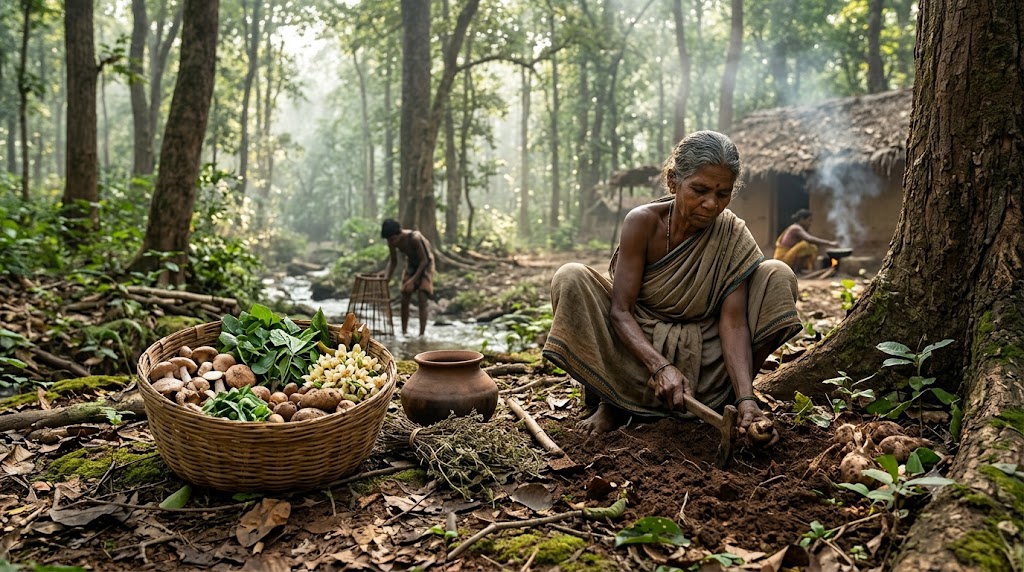
This relationship is governed by an unwritten moral economy of restraint. A Baiga elder in the Maikal Hills of Madhya Pradesh will never harvest the entirety of a wild yam patch. When digging for Dioscorea bulbifera (Karukanda) or Dioscorea pentaphylla, the harvesting stick (khanta) cuts cleanly into the earth, liberating the starch-heavy tuber while deliberately severing and re-burying the crown with a handful of loosened humus. The soil is addressed with reverence; to take without leaving the seed of return is an act of spiritual and ecological sacrilege.
Seasonality is not a lifestyle trend here—it is an absolute law of survival and regeneration. Tribal gastronomy follows the rhythm of the monsoon break, the dry spring drop of timber leaves, and the subterranean swelling of tubers during the post-monsoon chill:
-
Spring: Forest floors blaze with the pale cream blossoms of Madhuca longifolia (Mahua) and the scarlet petals of Bombax ceiba (Semal), gathered at dawn to be dried, pounded into breads, or distilled.
-
Monsoon: The rains bring a flush of wild mushrooms (Boda, Puttu, and Rugda), emerging from the moist symbiotic mycorrhizae around the roots of Sal trees (Shorea robusta). These are harvested before dawn while the skins remain taut and unruptured.
-
Winter: Streams run clear, and attention shifts to river crustaceans, freshwater bivalves (gugli), fermented small hill-stream fish, and winter-hardy millets.
Every element harvested adheres to a strict zero-waste paradigm. When a wild boar, fowl, or semi-domesticated Mithun (Bos frontalis) is prepared in the Eastern Himalayas, or when an animal is ritually offered during Central Indian hunts (Paradh), no tissue is cast away. Intestines are scrubbed with ash and wood charcoal, coiled, and smoked; skin is cured over hearth-fires to yield unctuous gelatin for winter broths; bones are cracked for marrow or reduced until their calcium fortifies wild bitter greens.
Even plant refuse has an afterlife: the ash water (Khar or Kolakhar) filtered through the burnt corms of wild bananas provides a natural alkaline tenderiser and preservative, bypassing modern chemical food processors.
This is not the romanticised “primitive” diet imagined by urban health subcultures. It is a sophisticated, deeply reasoned system of biocultural survival. It recognises human digestion as merely one step in an unbroken nutrient cycle linking the mycorrhizal network of the forest to the human microbiome.
2. Historical Heritage & Centuries-Old Traditions
The material culture of indigenous Indian cookery is rooted in natural geology and botany. Metal utensils—brass, copper, and iron—are relatively late arrivals, long preceded by stoneware, unglazed earthenware, hollowed-out gourds, and green leaves.
TRADITIONAL COOKING ARTIFACTS |
|
Utensil / Vessel |
Material Source & Cultural Role |
Hollowed Bamboo Internode (Sungat Diya / Utonga) |
Fresh green bamboo for steaming meats & sticky rice without oil |
Dried Bottle Gourd (Lauki Tumba) |
Lagenaria siceraria shell for storing & cooling rice beers |
Earthen Steamer (Dhukruti / Pitha pot) |
Perforated clay bowl over boiling pot for coarse millet cakes |
Iron Digging Stick (Khanta / Kudali) |
Hand-forged tip on hardwood pole for extraction of deep tubers |
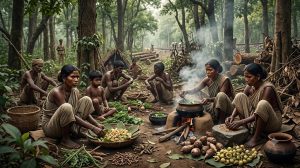
Long before the modern pressure cooker, indigenous groups mastered pressurised steam using the green bamboo internode (bhoronga or sungat diya). Freshly cut bamboo stalks contain internal moisture; when stuffed with soaked sticky rice, wrapped in wild turmeric leaves (Curcuma aromatica), and placed directly over an open fire, the wood heats up without burning through. The trapped moisture steams the grains, infusing them with delicate bamboo silica, sweetness, and earthy volatile oils.
Preservation among India’s tribes serves as a bulwark against lean seasons. Without refrigeration, communities rely on three ancient preservation techniques:
-
Sun-Drying (Sukhwa): The desiccation of seasonal gluts—tender wild bamboo shoots, uncultivated greens like chench and kanda saag, river crabs split open and dusted with wood ash, and Mahua blossoms laid across swept clay courtyards.
-
Hearth Smoking: Hanging game meats, river fish, or animal lard on bamboo racks (para) suspended directly above the family cooking hearth (chulha). Day and night, aromatic smoke from woods like sal, mahua, and wild oak dries the meat, depositing phenolic compounds that inhibit bacterial colonisation and impart a deep, resinous flavour.
-
Pit and Vessel Fermentation: Lactic acid and fungal fermentations transform bitter, cyanogenic, or perishable raw staples into stable, deeply umami seasonings.
To chart these culinary methodologies across India’s geographical expanse is to reveal a rich tapestry of micro-regional food cultures:
Central India: Gond, Baiga, and Santhal
The Sal and teak forests of Jharkhand, Odisha, and Chhattisgarh form the heartland of an uncultivated foraging tradition. Here, the Santhal, Gond, and Baiga communities practice a cuisine that balances bitterness, astringency, and pure mineral earthiness.
A quintessential staple is Pakhala (or Panta Bhat among the Santhal)—boiled rice steeped in water and fermented overnight in porous earthenware pots. The light lactic fermentation cools the body during sweltering summers, releasing bound micronutrients, iron, and zinc while generating an effervescent, cooling sourness.
Perhaps no preparation highlights this ecology better than chapra (known as kai chutney in the Mayurbhanj district of Odisha). Harvested from the canopies of Sal and mango trees, red weaver ants (Oecophylla smaragdina) and their milky pupae are collected using long bamboo poles tipped with cloth nets.
The ants are rich in formic acid, zinc, calcium, and protein. Ground in stone mortars with raw garlic, wild ginger, sea salt, and fiery green chillies, chaparral yields a sharp, citrussy, and deeply pungent paste. It serves as both a condiment and a home remedy against seasonal fevers, respiratory congestion, and heat exhaustion.
Alongside it stands the Mahua flower (Madhuca longifolia). Far more than an intoxicating liquor base, the fleshy corollas of Mahua are eaten fresh, boiled down into a molasses-like syrup (lata), or mixed with roasted sal seeds (sarguja) to produce dense, energy-rich cakes that sustain hunter-gatherers during long treks through forest corridors.
Northeast India: Naga, Khasi, and Garo
In the rain-drenched montane ecosystems of Northeast India, fermentation and smoking replace the need for cooking oils and commercial spices. The culinary grammar here is built around smoke, heat, and complex, funky microbial transformations.
In Nagaland, across the Ao, Angami, Sema, and Konyak territories, two ingredients define the plate: smoked pork (Akibishi) and Axone (pronounced ah-zho-nay). Axone is produced by boiling native soybeans, draining them, and packing them into banana leaf parcels kept beside the fire or buried in warm hearth ash for three to five days. The resulting sticky, gray, strongly ammonia-scented cake is high in free glutamates, providing deep umami to wild greens, broths, and roasted meats.
Further west in Meghalaya, the Khasi and Garo peoples rely on Tungrymbai—a fermented soybean paste cooked with ground black sesame seeds (nei-lieh), wild garlic, and pork fats. Bamboo shoots, locally known as Eup or Bastenga, are stripped of their fibrous sheaths, shredded, and submerged in airtight bamboo cylinders or ceramic crocks to undergo wild lactic fermentation. The resulting acidic, pungent liquid and fermented pulp cut through the rich lipids of pork, duck, and stream-caught eels, tenderising tough proteins without modern marinades.
Western and Southern Ghats: Bhil, Toda, and Irula
The Toda people of the high Nilgiri grasslands maintain a cuisine anchored in water buffalo dairying. Their diet is lacto-vegetarian, centred on clotted creams, clarified butter (ghee), and butter-steamed wild barley or millet preparations. The Toda dairy temple is itself a sacred culinary site, where the processing of milk is a priestly rite performed with strict spatial hygiene.
Down in the lower foothill scrubs, the Irula are masters of subterranean harvesting and honey hunting. Scaling 300-foot granite cliffs on vines and hand-woven rope ladders at night, Irula honey hunters gather the comb of the giant rock bee (Apis dorsata). They calm the swarms using smoke generated from wild medicinal herbs, carefully leaving brood combs intact.
This wild honey—dark, bitter-sweet, and rich in medicinal pollens—is often paired with fire-roasted wild yams (Dioscorea oppositifolia, locally called Valli kizhangu). The yams are buried in embers until the fibrous, toxic skin chars away, revealing a moist, sweet, starch-rich core.
To the west, across the scrub-forests of the Aravalli and Satpura ranges, the Bhil build their seasonal meals around Makkai ki Roti (stone-ground yellow and white flint maize) accompanied by Rabdi—maize or sorghum flour fermented overnight in sour buttermilk and simmered with unrefined sea salt and bruised cumin into a restorative gruel.
3. Resistance, Isolation, & External Influences
However, tribal gastronomy stands apart from this culinary homogenization. It represents an enduring site of resistance. The rejection of heavy fats, complex tempering (tadka), and cloying spices was not born of ignorance, but of an intentional cultural choice to preserve the natural flavors of the ingredients and retain biological vitality.
CULINARY TAXONOMY CONTRAST |
|
Mainstream / Courtly |
Indigenous / Forest-Dwelling |
Base: Clarified Butter,(Deep, prolonged frying) |
Base: Mountain Spring Water, Wood Ash Filtrate, Rendered Fat |
Technique: Bhunao (Deep, prolonged frying) |
Technique: Steaming, Boiling, Pit-Charring, Direct Smoking |
Spicing: Layered Garam Masala, Dried Aromatics |
Spicing: Minimalist, Herbal, Fresh Wild Alliums, Bird Chiles |
Primary Grains: Polished White Rice, Maida Flour |
Primary Grains: Coarse Millets, Sticky Upland Rice, Wild Tubers |
The imposition of colonial rule disrupted this ecological and culinary equilibrium. The British Indian Forest Acts of 1865, 1878, and 1927 criminalized the foundations of tribal subsistence:
-
Criminalization of Shifting Cultivation: Traditional swidden practices (Jhum, Bewar, or Podu)—which sustained multi-crop agroforestry containing dozens of millet, bean, and green varieties—were banned to harvest timber like Teak and Sal for imperial railway expansion.
-
Severing the Foraging Commons: Foraging for wild tubers, fallen deadwood, and Mahua flowers was reclassified as theft of state property, turning indigenous communities into trespassers in their ancestral lands.
-
The Mutilation of the Mahua Economy: Under the Mhowra Act of 1892 in the Bombay Presidency and similar excise legislations across Central India, the collection and distillation of Mahua blossoms was criminalized. The British colonial state sought to eliminate competition for its licensed, heavily taxed colonial country spirits, pathologizing a sacred food and beverage as illicit intoxication.
These legal incursions triggered catastrophic shifts in diet and health. Deprived of wild tubers, small riverine proteins, and indigenous millets, many tribes were pushed toward chronic caloric deficits. Yet, their culinary knowledge often meant the difference between survival and extinction during colonial famines.
During the devastating Orissa Famine of 1866 and the Great Bengal Famine of 1943, while settled agricultural populations perished along road corridors awaiting grain shipments, forest-dwelling Santhal and Ho populations turned to forest tubers, pith, and uncultivated greens:
-
The bitter pith of the Sago palm (Caryota urens) was felled, dried, and pounded into a dense flour (tapioca-like sago).
-
Tuberous roots of Pueraria tuberosa (Bidari kanda) were harvested from dry stream beds.
-
The seeds of forest grasses like Coix lacryma-jobi (Job’s Tears) were collected, boiled, and consumed as famine-resilient staples.
Tribal food systems preserved an indigenous balance: minimal processing, high biodiversity, and natural preservation. Where mainstream Indian food grew increasingly dependent on groundnut, sesame, and refined hydrogenated vegetable oils (Dalda), tribal cookery held firm to boiling, smoking, pit-steaming, and wood-ash extraction.
The primary fat, when used, was rarely refined; it was extracted fresh from wild tree seeds like Madhuca latifolia (Mahua ka tel), Schleichera oleosa (Kusum oil), or Celastrus paniculatus (Malkangni). These wild oils carried distinct bitter and pungent notes, functioning simultaneously as culinary lubricants, digestive stimulants, and antiparasitics.
4. Ecology, Geography, & Micro-Climates
Indigenous food across India is shaped by the land. Every tribal menu is a culinary expression of its surrounding soil, hydrology, elevation, and forest canopy.
High-Altitude and Cold Arid Zones: Kinnaur, Ladakh, and Arunachal Pradesh
In the high valleys of Kinnaur, Spiti, and the wind-swept plateaus of Ladakh, the human body battles extreme cold and hypoxic conditions. Here, the pastoral Changpa and Brokpa, as well as the Monpa of Arunachal Pradesh, depend on high-fat, calorie-dense foods:
-
Tsamba (Roasted Barley Flour): Barley is parched over sand, stone-ground into a fine flour, and kneaded into small dough cakes with salted, churned tea made from yak butter (Gur-gur chai). This provides complex carbohydrates and lipids that metabolize slowly, sustaining internal core temperatures.
-
Chhurpi: A hard, sun-dried cheese derived from the buttermilk of yaks (dzo). Smoked over rhododendron branches, Chhurpi can be kept for years. Chewed slowly over hours as it softens, it yields an enduring source of protein and calcium during barren alpine winters when all vegetation is trapped beneath ice.
-
Buckwheat (Fagopyrum esculentum): In Arunachal’s Tawang and West Kameng, the Monpa turn the bitter and sweet varieties of buckwheat into flatbreads (khura) served with fermented chilies and curd broths (chamin), delivering rich flavonoids (notably rutin) to support vascular resilience against frostbite.
Arid and Scrub Environs: Rabari and Raika of Thar
At the opposite ecological extreme, in the Thar Desert of Rajasthan and the salt scrub of Kutch, water is scarce and rainfall unpredictable. The nomadic pastoral Rabari and Raika build their food culture around uncultivated desert trees and the livestock that browse them:
-
Camel Milk: Rich in protective immunoglobulins and vitamin C, and low in lactose, camel milk is consumed fresh or fermented into sour curd (khatta), sustaining herders who walk for days without leafy greens.
-
The Kair-Sangri Axis: Prosopis cineraria (Khejri) yields Sangri—slender, astringent seed pods. Capparis decidua (Kair) produces small, tart, berry-like fruits. Picked green and cured in curd or mustard oil with wild desert salt and whole chilies, they offer deep mineral notes, gut-friendly fiber, and shelf-stable nutrition without requiring irrigated cultivation.
UNCULTIVATED FOREST FOODS (UFFs) |
|
Botanical Name |
Vernacular Name / Edible Feature |
Shorea robusta |
Sal (Fleshy tender seeds, boiled into porridge; resin as incense) |
Dioscorea bulbifera |
Karukanda (Air-potatoes/tubers; complex starch, bitter defense) |
Madhuca longifolia |
Mahua (Sugar-rich floral canopy; seeds pressed for cooking oil) |
Bauhinia vahlii |
Siyal / Mahul (Roasted seeds; large tough leaves for platters) |
The Forest Canopy and the Soil Web
Consider the Rugda or Boda mushroom. These small, spherical, puffball-like mycorrhizal fungi cannot be cultivated. They emerge exclusively beneath the roots of the Sal tree for a few brief weeks following the first monsoonal lightning strikes and soaking rains:
            Dense Monsoon Thunderstorms
                        │
                        ▼
    Subsurface activation of Sal mycorrhizae
                        │
                        ▼
   Firm, rubbery Rugda/Boda subterranean buttons
                        │
                        ▼
    Bursts in mouth with mineral-earth liquor
Women forage for them by detecting subtle cracks in the forest floor, using their fingers to dislodge the earth-coated spheres. Encased in a tough, rubbery black outer skin, the center contains an earthy, mineral-rich liquid that thickens into a savory paste when simmered with bruised mustard, garlic, and wild coriander.
Complementing these uncultivated forest foods are the indigenous millets:
-
Kodo (Paspalum scrobiculatum)
-
Kutki (Panicum sumatrense)
-
Ragi (Eleusine coracana)
These small millets require minimal rainfall, thrive in poor, rocky, and acidic soils without chemical fertilizers, and can be stored in hand-woven granaries (dhol) for over two decades without succumbing to weevils. They form an ecological foundation: high in calcium, rich in slowly digestible dietary fiber, and naturally drought-resistant, they represent the original climate-resilient grains of the Indian subcontinent.
5. Socio-Economic Dynamics & Forest Economies
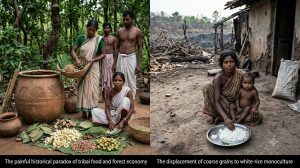
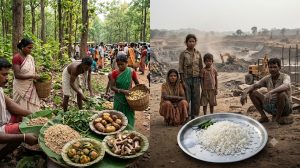
The political economy of tribal food reveals a painful historical paradox: communities living amidst some of the world’s most biodiverse forest systems often face severe nutritional insecurity.
The introduction of the modern Public Distribution System (PDS) provides a clear case study. While intended as a social safety net, the PDS has historically operated as an agent of dietary homogenization:
-
Displacement of Coarse Grains: For decades, the PDS distributed polished, subsidized white rice and refined wheat at the expense of indigenous millets (kodo, kutki, mandia) and wild greens.
-
The Malnutrition Paradox: As communities shifted from a diverse, micronutrient-rich diet of foraged wild foods and coarse grains to a high-carbohydrate white-rice monoculture, malnutrition rates worsened. Studies across tribal belts in southern Rajasthan, northern Karnataka, and Odisha show high rates of stunting, wasting, and anemia, even when gross caloric requirements are met.
-
Loss of Foraging Grounds: Open-cast coal mining, iron ore extraction, and hydroelectric dams in Jharkhand and Chhattisgarh have leveled Sal forests, destroying critical habitats for wild tubers, forest mushrooms, and medicinal plants.
NON-TIMBER FOREST PRODUCTS (NTFPs) VALUE |
|
Forest Product |
Economic & Nutritional Lifeline |
Tendu Leaves (Diospyros melanoxylon) |
Forest floor gathering; primary cash generation during lean May |
Mahua Flowers (Madhuca longifolia) |
Household subsistence sweetener; excess sold to local distillers |
Sal Seeds (Shorea robusta) |
Oil source for domestic lighting and cooking; fat exported |
Wild Honey (Apis dorsata / cerana) |
High-value trade commodity; traditional medicine & nutrition |
Where the FRA has been implemented, as in parts of Gadchiroli in Maharashtra or the BR Hills in Karnataka, forest-dwelling communities have revived wild seed collection, protected bamboo groves, and regulated the commercial harvesting of Non-Timber Forest Products (NTFPs).
NTFPs are vital to both the kitchen and the local economy. In tribal India, NTFPs generate up to 40% of household cash income and supply essential seasonal food security:
-
Tendu leaves (Diospyros melanoxylon) provide seasonal employment during the dry months, bridging the lean gap before the monsoon.
-
Sal seeds and Chironji (Buchanania lanzan) nuts are harvested, cleaned, and brought to weekly tribal markets (haats). The proceeds fund the purchase of unrefined sea salt, dried fish, iron sickles, and earthenware pots.
-
Wild Indian gooseberries (Aonla / Emblica officinalis) and Haritaki (Terminalia chebula) are gathered not only for commercial ayurvedic supply chains, but are pickled in brine, charred in hot embers, and consumed as natural digestive aids.
When an indigenous community loses access to its forest commons, it loses both its local economy and its cultural heritage. The transition from a self-sufficient forest harvester to an indebted wage laborer on commercial farms is mirrored on the dinner plate: nutrient-rich broths of uncultivated tubers and wild greens are replaced by plates of broken white rice tossed with little more than raw salt and market chilies.
6. Everyday Sustenance vs. Ceremonial/Ritualistic Feasts
The daily rhythm of an indigenous household is grounded in nutritional minimalism: clean, unpretentious sustenance designed to fuel hard physical labor without exhausting resources.
[ Daily Sustenance ] Minimalist, Fuel-Oriented |
[ Ceremonial Feast ] Communal, Sacred, Ecstatic |
• Millet gruel (Pej/Ambali)
|
• Roasted whole-animal offerings
|
During agricultural and spiritual celebrations, however, this functional plate gives way to communal, ritualistic feasting. Festivals such as Sarhul (the celebration of the blossoming Sal tree among the Oraon, Munda, and Santhal), Hornbill and post-harvest feasts among the Naga, Karma in Central India, and Baha Parab are occasions of sacred abundance:
                      The Sarna Grove
               (Sacred, untouched forest virgin)
                            │
               Home to protective deities
               (Singbonga / Chandi Bonga)
                            │
              Seasonal wild harvests first offered
              before human consumption:
             ┌───────────────────────────────┐
             │ • Young Sal blossoms          │
             │ • First-fermented Rice Brew   │
             │ • Tenderest Tuber extractions │
             └───────────────────────────────┘
At the core of these rituals are the sacred fermented beverages. These drinks are woven into tribal identity, acting as social bonds, ceremonial offerings, and medicinal tonics. They bear little resemblance to modern, industrial alcohol:
1. Handia / Diang (The Rice Brew)
Brewed by the Santhal, Munda, Ho, and Oraon, Handia is produced using Ranu Dabai—a starter culture made from the roots, barks, and leaves of up to twenty wild medicinal forest plants (such as Clerodendrum serratum and Cissampelos pareira).
These dried herbal cakes are ground and dusted over boiled rice, which is left to ferment inside sealed clay vessels in a cool, dark corner of the home.
  Boiled Rice + [Ranu Dabai (20+ wild medicinal root/bark starters)]
                                │
                                ▼  Ferment 3-5 days in clay urn
         Low-ABV, Probiotic, Enzymatic Handia Elixir
2. Apong
Brewed by the Mishing and Adi communities of Assam and Arunachal Pradesh, Apong comes in two primary varieties: Nogin Apong (pale, sweet, effervescent) and Poro Apong.
Poro Apong is distinct: sticky rice is blended with the ash of burnt rice straw and husks (Eepop), giving it a rich charcoal color, a deep smokiness, and an infusion of trace minerals, before being fermented with wild herbs.
  Glutinous Rice + Burnt Rice-Straw Ash (Eepop) + Wild Herbal Yeast Cake
                                │
                                ▼
         Poro Apong (Smoky, Jet-Black, Alkaline Brew)
3. Chhang
Prepared across high-altitude Himalayan communities (Ladakh, Spiti, Sikkim), Chhang is brewed from boiled highland barley (semi) or finger millet, packed into tall, brass-bound wooden flagons (dhungro), and brewed with boiling spring water. It is drunk warm through a slender, perforated bamboo straw called a piping, offering comfort against freezing Himalayan winds.
These communal meals are anchored by sacred groves—the Sarna or Devrai. These are patches of untouched, old-growth forest preserved through generations, believed to be the dwelling places of protective deities and ancestral spirits. No tree may be felled, no wild animal hunted, and no green leaf pulled within the grove without ritual consent.
During harvest festivals, the first fruits, the earliest tapped sap, the first shoots of bamboo, and the tenderest tubers must be brought to the Sarna, offered on clean Sal leaves, and consecrated before the community may consume the harvest.
                   TOTEMIC FOOD RESTRICTIONS
  ┌─────────────────────────────────────────────────────────────┐
  │ Clan Totem        │ Dietary Taboo                           │
  ├───────────────────┼─────────────────────────────────────────┤
  │ Kachhap (Tortoise)│ Absolute ban on killing, handling,      │
  │                   │ or consuming freshwater turtles         │
  ├───────────────────┼─────────────────────────────────────────┤
  │ Tirkey (Bird)     │ Prohibits eating certain sparrows,      │
  │                   │ snipes, and small marshland fowls       │
  ├───────────────────┼─────────────────────────────────────────┤
  │ Hansda (Wild Duck)│ Complete prohibition on consuming       │
  │                   │ wild ducks and water fowl               │
  └───────────────────┴─────────────────────────────────────────┘
These spiritual traditions are supported by totemic food taboos. Tribal communities are organized into exogamous clans (kilis or gotras), each named after a natural entity—an animal, a bird, a fish, or an uncultivated tree. A member of the Kachhap (Tortoise) clan is forbidden from ever harming or eating a turtle; those whose totem is the Nag (Cobra) will not consume eel-like river fish that evoke the serpent; members of clans bearing plant totems protect their patron trees from harm.
Far from being superstitious relics, these prohibitions represent an ancient form of species conservation, preventing the overharvesting of vulnerable wildlife and plants.
7. Modern Threats, Revival Movements, & Future Outlook
India’s tribal culinary heritage faces severe modern pressures. The expansion of industrial mono-crop farming, broad infrastructure corridors cutting through indigenous lands, and real-estate sprawl have fragmented the forest canopies that sustain wild foraging.
Concurrently, climate volatility disrupts the fragile fruiting, flowering, and fungal rhythms of the forest:
-
Unpredictable rainfall patterns reduce the brief seasonal flushes of wild mycorrhizal fungi like Rugda.
-
Soil erosion and industrial runoff alter the pH of mountain streams, threatening populations of freshwater crabs, native snails, and small river greens.
Compounding this environmental degradation is a generational shift. With youth migrating from rural hills and forests toward urban industrial centers, centuries of oral foraging knowledge are under threat:
  Traditional Knowledge Ecosystem (Elder Women / Hunters)
          │  Names of 100+ wild plants, seasonal rhythms,
          │  safe non-toxic harvesting, herbal starters
          ▼
     Industrial Migration & Cultural Shaming
          │  (Mainstream bias against wild, funky,
          │   fermented, or insect foods)
          ▼
  Risk of Irreversible Erasure of Sub-continental Memory
When an elder passes away without transmitting their mental catalog of tubers, bitter shoots, and fermentation herbs, a complete ecological database built over generations disappears.
Yet, a grassroots culinary renaissance is beginning to take root. A renewed sense of cultural pride is emerging among younger indigenous generations, indigenous chefs, and conscientious anthropologists who are reframing tribal gastronomy not as “primitive survival fare,” but as a masterclass in regenerative gastronomy.
These small millets require minimal rainfall, thrive in poor, rocky, and acidic soils without chemical fertilizers, and can be stored in hand-woven granaries (dhol) for over two decades without succumbing to weevils. They form an ecological foundation: high in calcium, rich in slowly digestible dietary fiber, and naturally drought-resistant, they represent the original climate-resilient grains of the Indian subcontinent.
5. Socio-Economic Dynamics & Forest Economies
The political economy of tribal food reveals a painful historical paradox: communities living amidst some of the world’s most biodiverse forest systems often face severe nutritional insecurity.
The introduction of the modern Public Distribution System (PDS) provides a clear case study. While intended as a social safety net, the PDS has historically operated as an agent of dietary homogenization:
-
Displacement of Coarse Grains: For decades, the PDS distributed polished, subsidized white rice and refined wheat at the expense of indigenous millets (kodo, kutki, mandia) and wild greens.
-
The Malnutrition Paradox: As communities shifted from a diverse, micronutrient-rich diet of foraged wild foods and coarse grains to a high-carbohydrate white-rice monoculture, malnutrition rates worsened. Studies across tribal belts in southern Rajasthan, northern Karnataka, and Odisha show high rates of stunting, wasting, and anemia, even when gross caloric requirements are met.
-
Loss of Foraging Grounds: Open-cast coal mining, iron ore extraction, and hydroelectric dams in Jharkhand and Chhattisgarh have leveled Sal forests, destroying critical habitats for wild tubers, forest mushrooms, and medicinal plants.
NON-TIMBER FOREST PRODUCTS (NTFPs) VALUE |
|
Forest Product |
Economic & Nutritional Lifeline |
Tendu Leaves (Diospyros melanoxylon) |
Forest floor gathering; primary cash generation during lean May |
Mahua Flowers (Madhuca longifolia) |
Household subsistence sweetener; excess sold to local distillers |
Sal Seeds (Shorea robusta) |
Oil source for domestic lighting and cooking; fat exported |
Wild Honey (Apis dorsata / cerana) |
High-value trade commodity; traditional medicine & nutrition |
Where the FRA has been implemented, as in parts of Gadchiroli in Maharashtra or the BR Hills in Karnataka, forest-dwelling communities have revived wild seed collection, protected bamboo groves, and regulated the commercial harvesting of Non-Timber Forest Products (NTFPs).
NTFPs are vital to both the kitchen and the local economy. In tribal India, NTFPs generate up to 40% of household cash income and supply essential seasonal food security:
-
Tendu leaves (Diospyros melanoxylon) provide seasonal employment during the dry months, bridging the lean gap before the monsoon.
-
Sal seeds and Chironji (Buchanania lanzan) nuts are harvested, cleaned, and brought to weekly tribal markets (haats). The proceeds fund the purchase of unrefined sea salt, dried fish, iron sickles, and earthenware pots.
-
Wild Indian gooseberries (Aonla / Emblica officinalis) and Haritaki (Terminalia chebula) are gathered not only for commercial ayurvedic supply chains, but are pickled in brine, charred in hot embers, and consumed as natural digestive aids.
When an indigenous community loses access to its forest commons, it loses both its local economy and its cultural heritage. The transition from a self-sufficient forest harvester to an indebted wage laborer on commercial farms is mirrored on the dinner plate: nutrient-rich broths of uncultivated tubers and wild greens are replaced by plates of broken white rice tossed with little more than raw salt and market chilies.
WHAT MODERN CIVILIZATION MUST RELEARN |
1. Radical Diversification: Move away from global monoculture (wheat/corn/soy) toward uncultivated greens, tubers, and resilient, drought-hardy ancient millets. |
2. The Preservation Principle: Prioritize smoking, wood-ashes alkaline curing, and wild fermentation over industrial synthetic chemical preservatives. |
3. Restorative Foraging: Leave the root, take the leaf; never harvest more than the forest can naturally return; treat the food web as an ecological conversation. |
As the modern industrial world grapples with climate crises, depleted soils, industrial lifestyle diseases, and water shortages, the lessons written into the tribal hearths of India become urgently clear. The tribal plate is an indictment of modern monoculture: it shows that human survival, pleasure, and longevity do not require dominating nature.
