
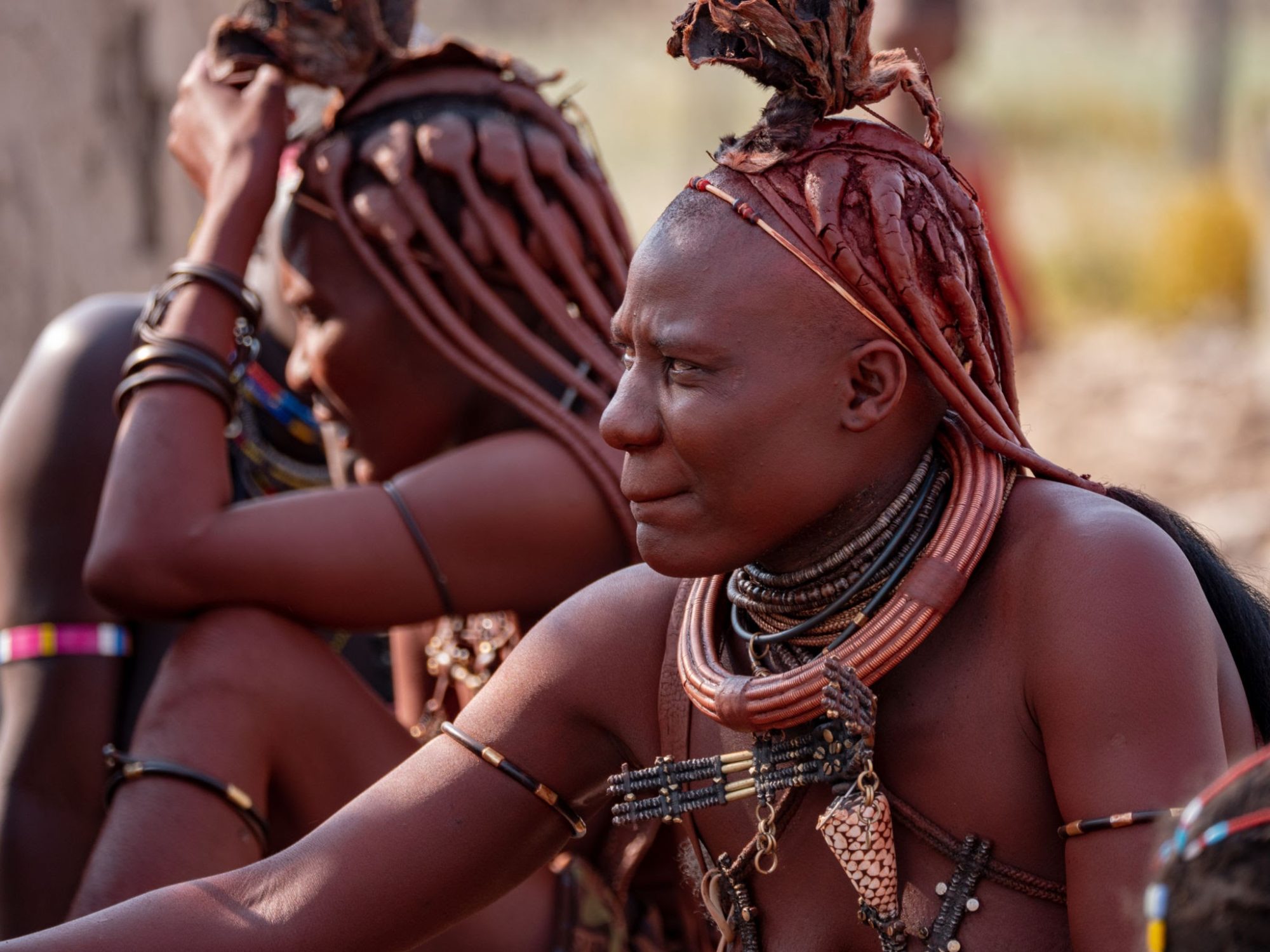
The Himba are indigenous peoples with an estimated population of about 50,000 people living in northern Namibia, in the Kunene Region (formerly Kaokoland) and on the other side of the Kunene River in Angola. … The Himba are considered the last semi-nomadic people of Namibia.
INTRODUCTION: BEYOND THE RED OCHRE STEREOTYPE
Thank you for reading this post, don't forget to subscribe!When ethnographers speak of the OvaHimba—more commonly recognized globally as the Himba people—popular media frequently reduces their complex sociological framework to a singular striking visual: terracotta-toned skin coated in otjize, a fragrant paste of butterfat and red ochre. However, beneath this iconic aesthetic lies an intricate indigenous civilization that has resisted total assimilation into modern southern African states. Inhabiting the arid, unforgiving expanse of the Kunene Region (historically known as Kaokoland) in northwestern Namibia and southern Angola, the Himba represent one of the last true semi-nomadic pastoralist societies on the African continent.
Academic literature concerning the Himba—rooted in extensive fieldwork by anthropologists such as David Crandall, Michael Bollig, and Priscilla Meyer—reveals a society governed by profound ecological adaptations, dual-descent kinship systems, and sophisticated semiotics embedded in everyday life. This comprehensive monograph explores the nuanced, lesser-known empirical realities of Himba culture, drawing from anthropological monographs, ecological surveys, and demographic datasets that rarely surface in standard travel writing or superficial digital media.
DEMOGRAPHIC REALITIES AND ETHNOGRAPHIC BOUNDARIES
POPULATION DISTRIBUTION AND GEOGRAPHIC ISOLATION
Demographic estimates place the total OvaHimba population between 45,000 and 55,000 individuals, with the vast majority residing across the rugged, mountainous terrain of Namibia’s Kunene Province. Unlike sedentary ethnic groups that occupy fertile agricultural basins, the Himba thrive in an hyper-arid environment where annual rainfall rarely exceeds 150 millimeters and is highly erratic.Historically, their geographical isolation was fiercely protected by the sheer inaccessibility of Kaokoland. Devoid of paved highways, permanent rivers, or industrialized infrastructure for much of the 20th century, this region served as a natural fortification. Anthropological field notes from the mid-20th century document how the Himba successfully resisted incursions during German colonial expansion and South African apartheid administration rules—most notably through strategic nomadism, seasonal transhumance, and deep knowledge of hidden water sources deep within dry riverbeds (omuramba).
LINGUISTIC AND HISTORICAL AFFINITIES WITH THE HERERO
Linguistically, the Himba speak OtjiHerero, a Bantu language mutually intelligible with the language of the Herero people of central and eastern Namibia. Historically, the Himba and Herero shared a unified cultural trajectory. However, a series of catastrophic historical events forged an indelible schism between the two groups.During the late 19th century and the devastating rinderpest epizootic of the 1890s, which wiped out up to 90% of indigenous cattle, many Herero pastoralists lost their herds entirely. Those who migrated south sought wage labor in German-controlled towns, gradually adopting Western dress and European religious practices. Conversely, those who retreated northward into the rugged, mountainous redoubt of Kaokoland retained their pastoral lifestyle, continuing to rely entirely on cattle and goats for sustenance. These northern refugees became known as the OvaHimba—derived from the Herero word himbwa, meaning “to beg,” reflecting the destitute state in which they initially arrived among the local hunter-gatherer populations (such as the Twa and Zemba). Over generations, however, their fortunes reversed as they rebuilt immense pastoral wealth.
DUAL-DESCENT KINSHIP: THE COGNATIC AND MATRILINEAL ARCHITECTURE
POPULATION DISTRIBUTION AND GEOGRAPHIC ISOLATION
Demographic estimates place the total OvaHimba population between 45,000 and 55,000 individuals, with the vast majority residing across the rugged, mountainous terrain of Namibia’s Kunene Province. Unlike sedentary ethnic groups that occupy fertile agricultural basins, the Himba thrive in an hyper-arid environment where annual rainfall rarely exceeds 150 millimeters and is highly erratic.Historically, their geographical isolation was fiercely protected by the sheer inaccessibility of Kaokoland. Devoid of paved highways, permanent rivers, or industrialized infrastructure for much of the 20th century, this region served as a natural fortification. Anthropological field notes from the mid-20th century document how the Himba successfully resisted incursions during German colonial expansion and South African apartheid administration rules—most notably through strategic nomadism, seasonal transhumance, and deep knowledge of hidden water sources deep within dry riverbeds (omuramba).
LINGUISTIC AND HISTORICAL AFFINITIES WITH THE HERERO
Linguistically, the Himba speak OtjiHerero, a Bantu language mutually intelligible with the language of the Herero people of central and eastern Namibia. Historically, the Himba and Herero shared a unified cultural trajectory. However, a series of catastrophic historical events forged an indelible schism between the two groups.
During the late 19th century and the devastating rinderpest epizootic of the 1890s, which wiped out up to 90% of indigenous cattle, many Herero pastoralists lost their herds entirely. Those who migrated south sought wage labor in German-controlled towns, gradually adopting Western dress and European religious practices. Conversely, those who retreated northward into the rugged, mountainous redoubt of Kaokoland retained their pastoral lifestyle, continuing to rely entirely on cattle and goats for sustenance. These northern refugees became known as the OvaHimba—derived from the Herero word himbwa, meaning “to beg,” reflecting the destitute state in which they initially arrived among the local hunter-gatherer populations (such as the Twa and Zemba). Over generations, however, their fortunes reversed as they rebuilt immense pastoral wealth.
DUAL-DESCENT KINSHIP: THE COGNATIC AND MATRILINEAL ARCHITECTURE
Pastoralism and cattle management
THE CONCEPT OF EHUVA AND ORUNDO
To truly understand Himba social organization, one must look beyond Western patrilineal or matrilineal models. The Himba operate under a complex dual-descent system (kandela), where every individual simultaneously belongs to two distinct kinship networks that govern inheritance, ritual obligations, social status, and marriage.
1. The Matrilineal Clan (Ehuva): An individual’s biological lineage, spiritual identity, and bodily substance are inherited through the maternal line. There are approximately six major matrilineal clans (omature). The ehuva determines ritual status, taboos regarding certain foods, and specific burial rites. However, property and cattle are not inherited through the ehuva.
2. The Patrilineal Lineage (Orundo): Inherited strictly through the paternal line, the orundo governs the inheritance of physical wealth, particularly cattle, livestock enclosures, and homestead leadership. An individual belongs to one of several patrilineal descent groups, each maintaining a sacred ancestral fire (okuruwo).
This dual framework creates a dynamic social equilibrium. While a man inherits his father’s cattle and ritual authority, his deepest spiritual allegiance and moral obligations remain tied to his mother’s kin group. Anthropologists note that this dual structure acts as a vital risk-mitigation strategy in an unpredictable arid environment: if drought decimates a father’s herd, maternal kin networks provide alternative social safety nets and resource sharing across distant ecological zones.
MARRIAGE, BRIDEWEALTH (ROVORA), AND POLYGYNY
Himba marriage customs are deeply interwoven with pastoral economics. Marriages are traditionally arranged by family elders, often when children are young, though modern youth exercise greater autonomy. The union is sealed through the transfer of bridewealth, known as rovora, which typically consists of carefully selected breeding cattle and small stock (goats and sheep) transferred from the groom’s patriline to the bride’s family.Polynygy is socially accepted and practiced by men of high status who possess substantial herds capable of supporting multiple wives. In a Himba polygynous household (onganda), each wife maintains her own distinct hut, hearth, and livestock management responsibilities arranged in a precise hierarchical circle around the central cattle corral (kraal). The senior wife (mukazendu mukuru) holds significant administrative authority over domestic production and resource allocation.
THE SACRED GEOMETRY OF THE HOMESTEAD (ONGANDA)
SPATIAL ORGANIZATION AND COSMOLOGYA
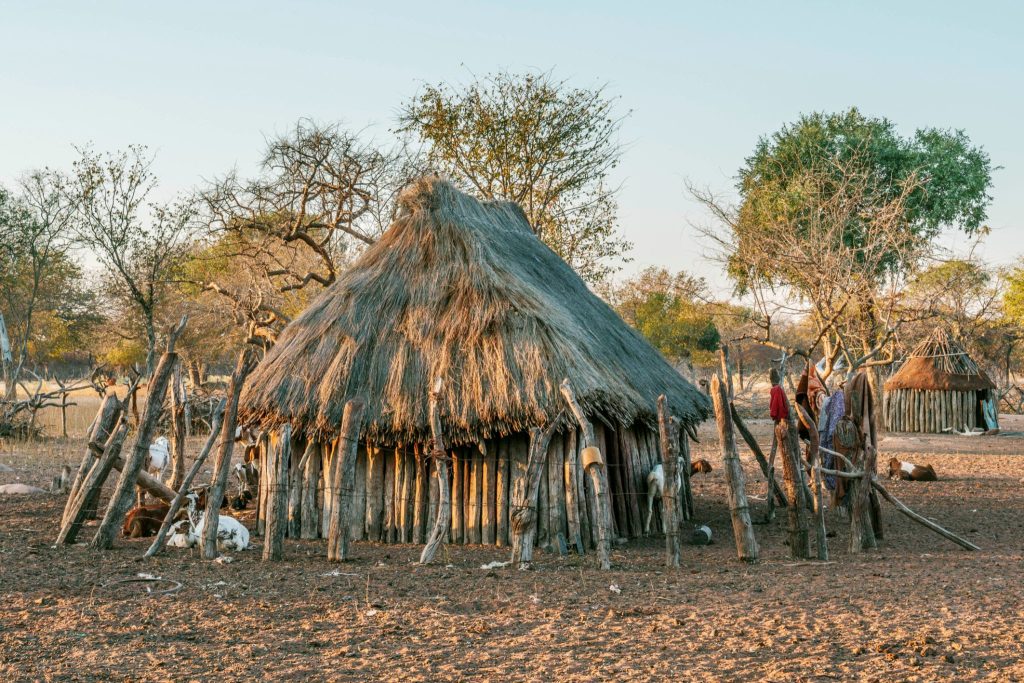
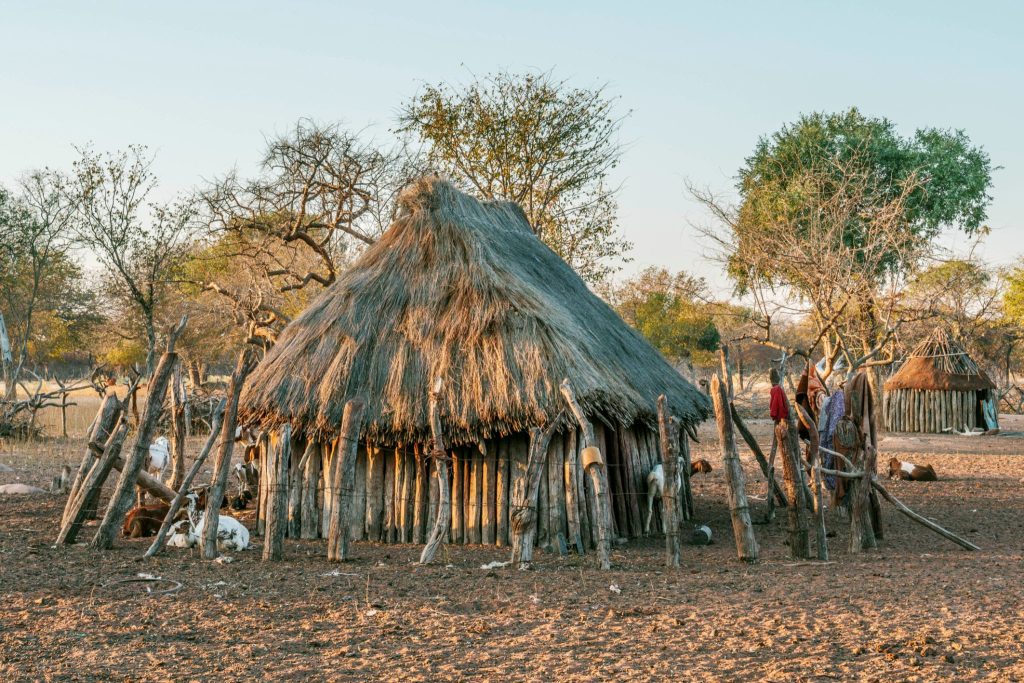
Himba village (onganda) is not merely a collection of dwellings; it is a sacred cosmological map reflecting the community’s relationship with ancestors, livestock, and the divine creator, Mukuru.
The settlement is built in a circular perimeter enclosed by thorny acacia branches designed to protect livestock from predators such as leopards and hyenas during the night. Within this circle, every architectural element holds profound symbolic weight:
The Cattle Corral (Kraal): Situated precisely at the center of the onganda, the corral is the economic and spiritual heartbeat of the village. Cattle represent living wealth, direct links to deceased ancestors, and the primary medium of exchange.
The Sacred Ancestral Fire (Okuruwo): Located directly west of the cattle corral, the okuruwo is kept burning continuously day and night. It serves as the physical conduit between the living family members and their ancestral spirits (omuru</i>).
The Holy Line (Eha) and Thresholds: An invisible sacred line connects the okuruwo to the primary hut of the homestead head (Inene). Crossing this line without permission or approaching the fire without proper ritual protocol is strictly forbidden for outsiders and uninitiated members.
DAILY PASTORAL ROUTINES AND TRANSHUMANCE
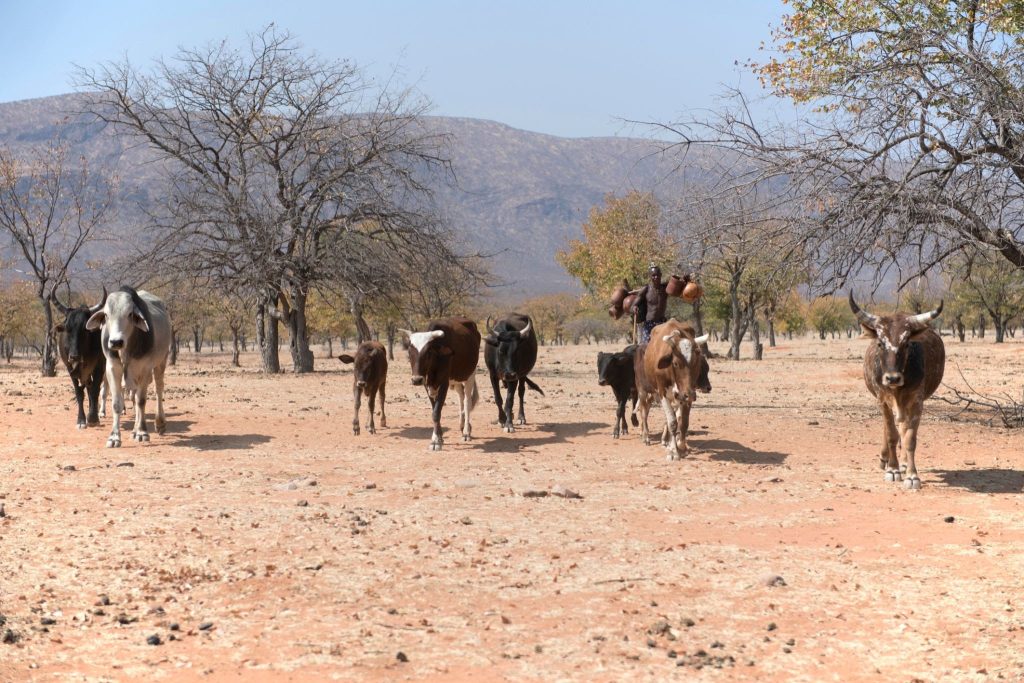
Himba subsistence economy is built upon pastoralism—primarily cattle (ovara), fat-tailed sheep, and goats (ozohi). Cattle are prized not just for meat, but for milk, blood, leather, and dung used in construction.
Because rainfall is seasonal and erratic, Himba herdsmen practice sophisticated transhumance. During the dry season, younger men and boys take the cattle on long treks into remote mountain ranges and riverbeds where subterranean water and perennial grasses persist, while women, children, and elders remain at the permanent base homestead managing dairy goats and small gardens.
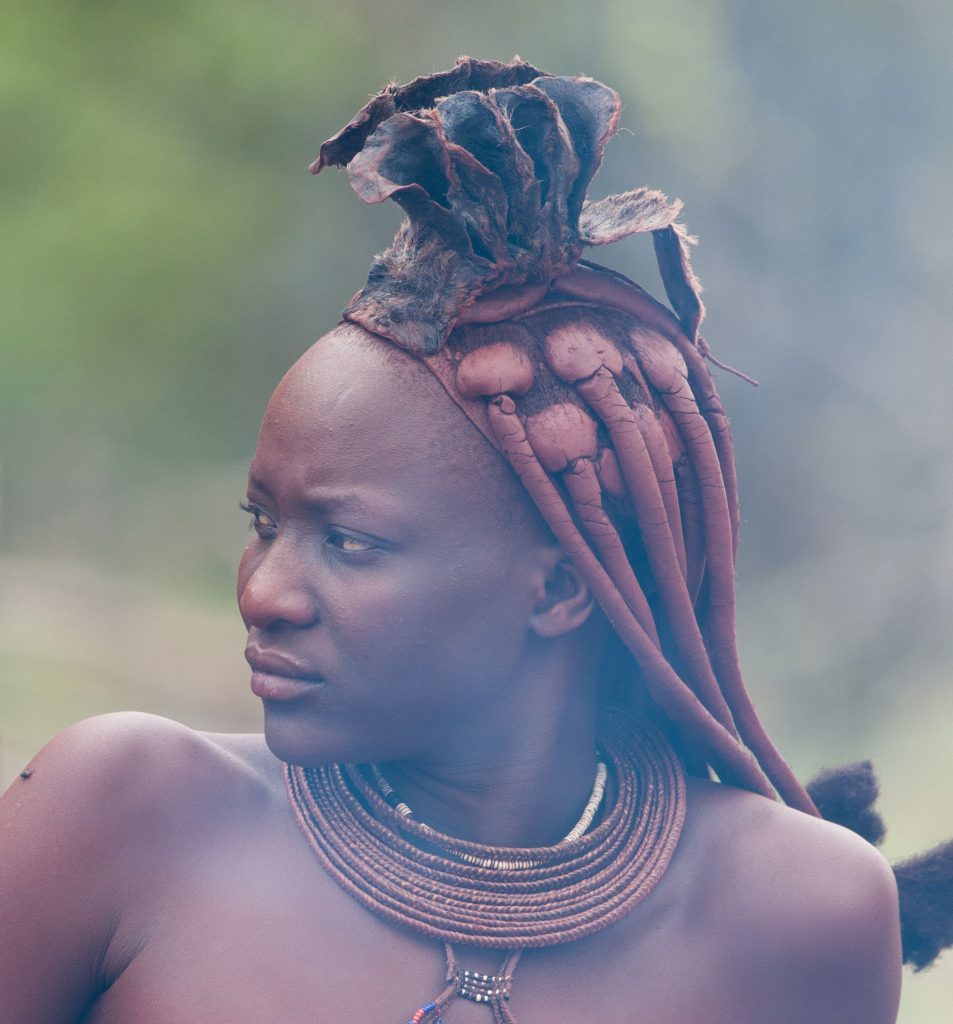
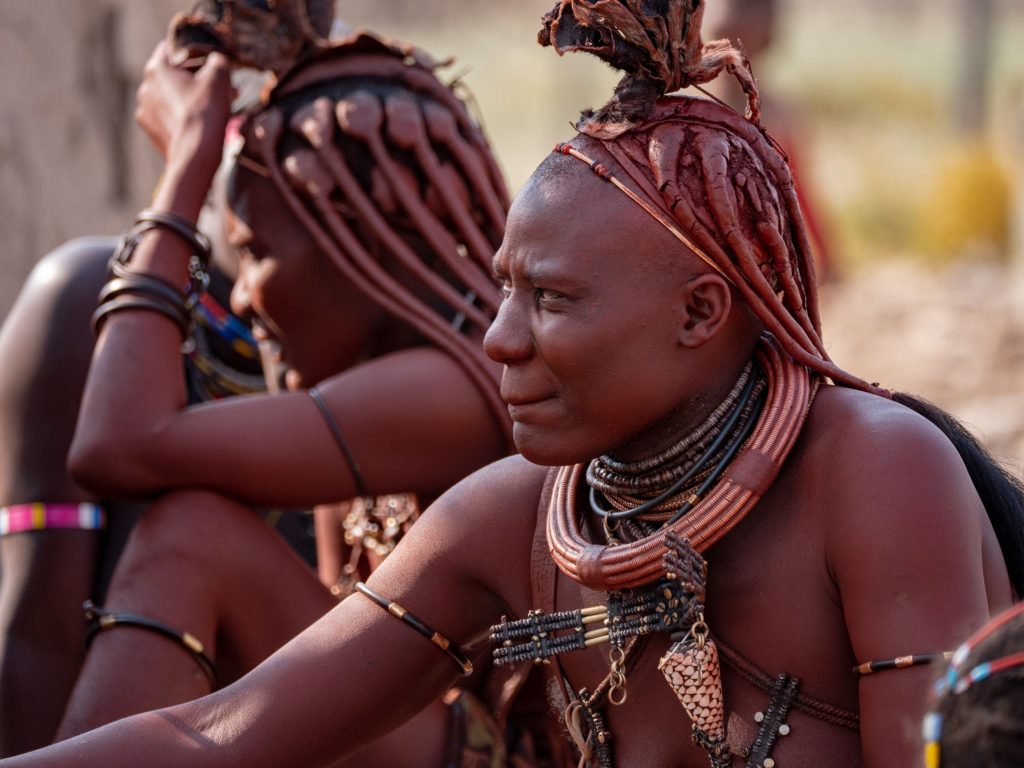
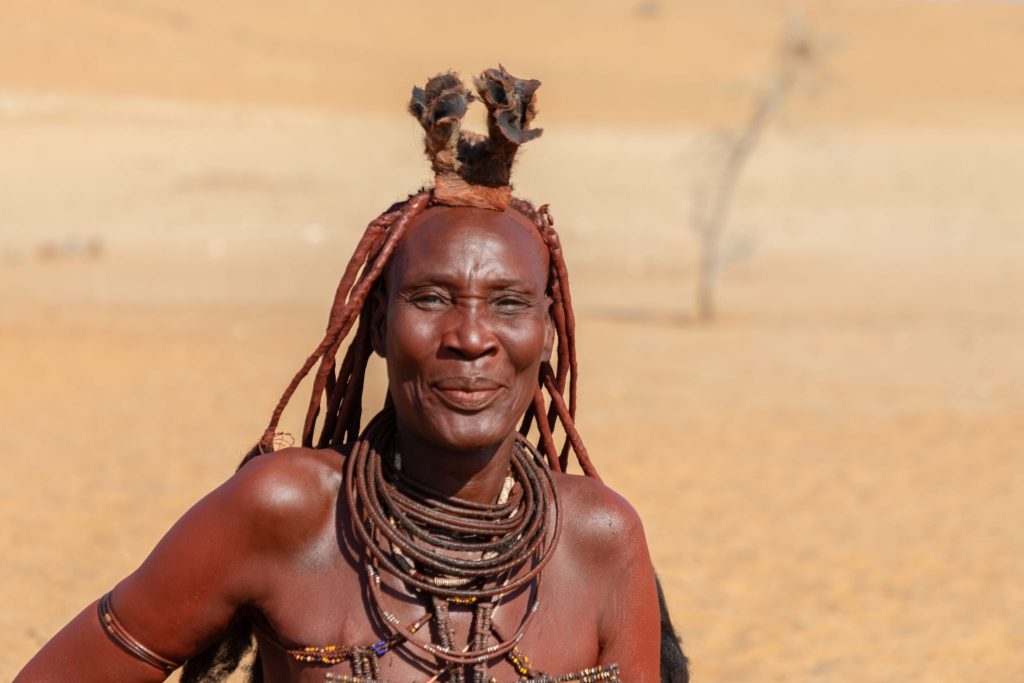
Kamanjab, Namibia – December 11, 2008. Otjikandero Himba Orphan Village. The project serves to help the people continue their ways without succumbing to the modern lifestyle, as some of the profit goes to their protection. Himba woman wearing traditional clothing and hairstyle indicating age and social status. Orange skin is due to otjize, a desirable aesthetic beauty cosmetic.
THE ETHNOBOTANY AND CHEMISTRY OF OTJIZE
COMPOSITION AND PREPARATION
The striking orange-red hue of Himba skin and hair is achieved through the daily application of otjize—a sophisticated organic cosmetic compound crafted from:
Butterfat: Extracted from cow’s milk and clarified over gentle heat.
Red Ochre (Omuhiva): Mined from local mineral deposits, consisting primarily of hydrated iron(III) oxide.
Aromatic Resins: Harvested from the omuzimba shrub and other endemic aromatic plants, imparting a distinct, pleasant woody fragrance.
The preparation of otjize is a communal ritual performed by women every morning. Chunks of red ochre stone are rubbed against a hard grinding stone (ngombe) until reduced to a fine crimson powder, which is then thoroughly kneaded into warm butterfat along with crushed aromatic resin stones.
FUNCTIONAL AND THERMO-REGULATORY BENEFITS
While popular culture views otjize purely through the lens of aesthetic tradition, scientific and anthropological research documents its critical functional utility in an extreme desert environment:
1. Solar and UV Protection: The dense layer of butterfat mixed with iron oxide acts as a physical barrier against intense ultraviolet radiation, preventing severe sunburn, skin desiccation, and premature aging caused by the Saharan-grade sun of northern Namibia.
2. Insect Repellent: The addition of aromatic plant resins functions as an effective natural repellent against mosquitoes, ticks, and biting flies, significantly reducing the incidence of vector-borne illnesses.
3. Hygiene and Water Conservation: In a region where water is exceptionally scarce and precious, bathing with water is a luxury reserved for special occasions. Otjize absorbs bodily perspiration and impurities, which are then scraped away with a specialized metal or bone scraper, maintaining skin hygiene without wasting scarce water resources.
HAIRSTYLES AS SEMIOTIC MARKERS OF STATUS AND LIFE STAGES
AGE-GRADE CODING THROUGH HAIR ARCHITECTUREHimba hairstyles function as a complex visual language, communicating an individual’s age, gender, marital status, and social standing within the clan at a single glance. Ethnographic surveys catalog several distinct hairstyle classifications:Infants and Toddlers: Both boys and girls wear their hair shaved close to the scalp, leaving only a small central tuft or braid.Young Girls (Epara): As girls grow, hair is braided into two thick plaits (ondato) that hang forward on either side of the face. The angle and positioning of these braids indicate whether a girl has reached puberty.Unmarried Adolescents: Young women approaching marriageable age wear elaborate dreadlock-like extensions made from animal hair, wool, and mud, braided tightly and allowed to cascade forward over the face to shield their gaze from prospective suitors until courtship rituals permit eye contact.Married Women (Eembe): Upon marriage, women undergo a profound ceremonial transformation. They receive an elaborate headdress constructed from sheepskin saturated with otjize, featuring numerous braided dreadlocks (errindi) extending outward, symbolizing maturity, fertility, and marital stability.Matured Men: Unmarried men wear a single braid (ora), which hangs down the back of the head. Married men wear a cloth cap or turban (omurungu) beneath which their hair is gathered into a distinctive topknot, signifying head-of-household status.
INDIGENOUS KNOWLEDGE SYSTEMS AND ETHNO-MEDICINEPHARMACOPOEIA OF THE ARID SAVANNAHIsolated from modern pharmaceutical networks, the Himba possess an extraordinary repository of botanical and ecological knowledge, utilizing over 80 endemic plant species for medicinal, veterinary, and ritual purposes. Ethnobotanical studies conducted in Kaokoland have documented treatments for a wide array of ailments:Gastrointestinal Disorders: Decoctions brewed from the roots of Commiphora species are administered to combat dysentery and severe abdominal parasites.Wound Healing and Antiseptics: Resins extracted from Boscia albitrunca (Shepherd’s tree) and various acacia species are pulverized and applied topically to lacerations, burns, and snakebites to prevent bacterial infection and accelerate tissue regeneration.Malaria Prophylaxis: Specialized bark infusions are consumed during the rainy season to reduce fever symptoms and bolster immune response against malaria-carrying mosquitoes.VETERINARY ETHNO-SCIENCEGiven that livestock constitute the absolute pillar of Himba survival, their veterinary knowledge is remarkably advanced. Herders diagnose livestock pathologies by observing subtle behavioral changes, dung consistency, and coat texture. They employ herbal washes made from bitter-tasting shrubs to treat tick infestations, hoof rot (foot-rot), and anthrax outbreaks among cattle, demonstrating an empirical understanding of disease transmission long before Western veterinary science penetrated the Kunene interior.
MUSICAL TRADITIONS, ORAL HISTORY, AND MYTHOLOGYTHE COSMOLOGY OF SONG (OMAJENDA)Himba culture is rich in oral literature, poetry, and polyphonic vocal music. Without a written script, their history, genealogies, moral codes, and mythological origins are preserved entirely through song and epic narrative poetry chanted during rituals, births, weddings, and funerals.Their musical instrumentation includes single-stringed bows (ohiva), hand-carved wooden drums (ondanda), and percussion rattles made from dried seed pods. Group singing features intricate overlapping pentatonic harmonies, often led by elder women who hold the spiritual memory of the clan.
CREATION MYTHOLOGY: MUKURU AND KAMURUAccording to Himba theological tradition, the supreme creator god is Mukuru, who dwells in the heavens and holds ultimate power over rain, fertility, and life. However, Mukuru is viewed as a distant, transcendent deity.
Direct communion with the divine is mediated through ancestral spirits (omururu). When an elder passes away, their spirit joins the collective ancestral realm, residing near the sacred fire (okuruwo). It is believed that ancestors actively monitor the daily conduct of living descendants, rewarding righteous behavior, communal harmony, and meticulous care of cattle with health and rain, while punishing social deviance or neglect of traditional rites with drought and cattle disease.
SOCIO-ECONOMIC THREATS AND MODERN CHALLENGESCLIMATE CHANGE AND DESERTIFICATION
In recent decades, the traditional pastoral lifestyle of the Himba has faced severe systemic threats. The primary ecological crisis is accelerating climate change, manifested through prolonged, multi-year droughts in southern Africa. Erratic rainfall patterns have drastically reduced pasture regeneration, leading to massive livestock mortality rates. Between 2018 and 2024, successive droughts decimated up to 40% of pastoral herds in parts of the Kunene Region, forcing many families into severe economic distress and food insecurity.ENCROACHING TOURISM, COMMERCIALIZATION, AND ACCULTURATIONWith the expansion of regional tourism, the Himba have increasingly become subjects of global fascination. While tourism injects vital cash revenue into local economies through the sale of handcrafted iron jewelry, woodcarvings, and entrance fees to cultural villages near towns like Opuwo, it introduces complex sociological challenges:Commodification of Culture: Anthropologists warn against the “human zoo” phenomenon, where sacred traditions and daily rituals are performed as commercial spectacles for tourists armed with cameras, potentially eroding their authentic cultural significance.Urban Migration and Marginalization: Impoverished youths drawn to regional centers like Opuwo face stark cultural dislocation, unemployment, and alcoholism, struggling to bridge the chasm between traditional pastoralism and modern cash economies.
COMPARATIVE ETHNOGRAPHIC PROFILE OF SOUTHERN AFRICAN PASTORALISTSTo contextualize the Himba within the broader anthropological landscape of southern Africa, consider the following comparative matrix detailing subsistence strategies, kinship structures, and bodily ornamentation across neighboring indigenous groups:
| Indigenous Group | Geographic Region | ||||
| OvaHimba | Kunene Region, Namibia / Angola | ||||
| San (Ju/’hoansi) | |||||
CONCLUSION: PRESERVING A FRAGILE HERITAGEThe Himba of Namibia are far more than a picturesque photographic motif; they represent an extraordinary triumph of human adaptation, resilience, and cultural persistence in one of the planet’s harshest environments. Their intricate architecture of dual-descent kinship, sacred spatial geometry, botanical pharmacopoeia, and semiotic bodily ornamentation reflects a profound, holistic philosophy of existence that harmonizes humanity with nature and ancestry.As modernization, climate volatility, and global tourism continue to accelerate across the Kunene Region, the greatest challenge facing the Himba is navigating the delicate boundary between preserving their ancestral integrity and adapting to an interconnected world. Documenting these lesser-known academic and ethnographic realities ensures that their rich cultural legacy is understood not merely as a relic of the past, but as a living, dynamic testament to human diversity
