
https://maasaiwilderness.org/maasai/
Thank you for reading this post, don't forget to subscribe!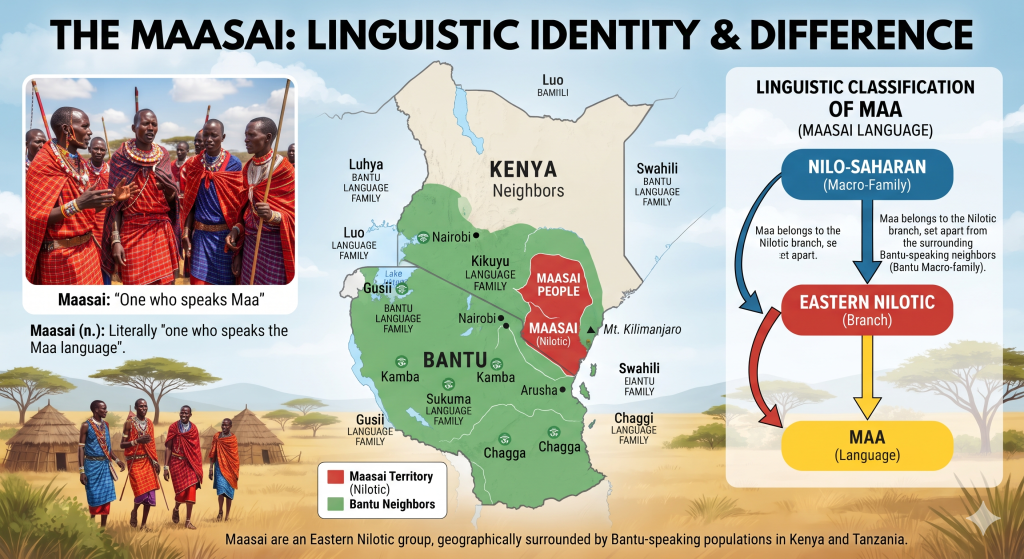
Introduction: The Maasai Tribe: Guardians of African Traditions : The Philosophy of the Savannah and the Eternal Guardians
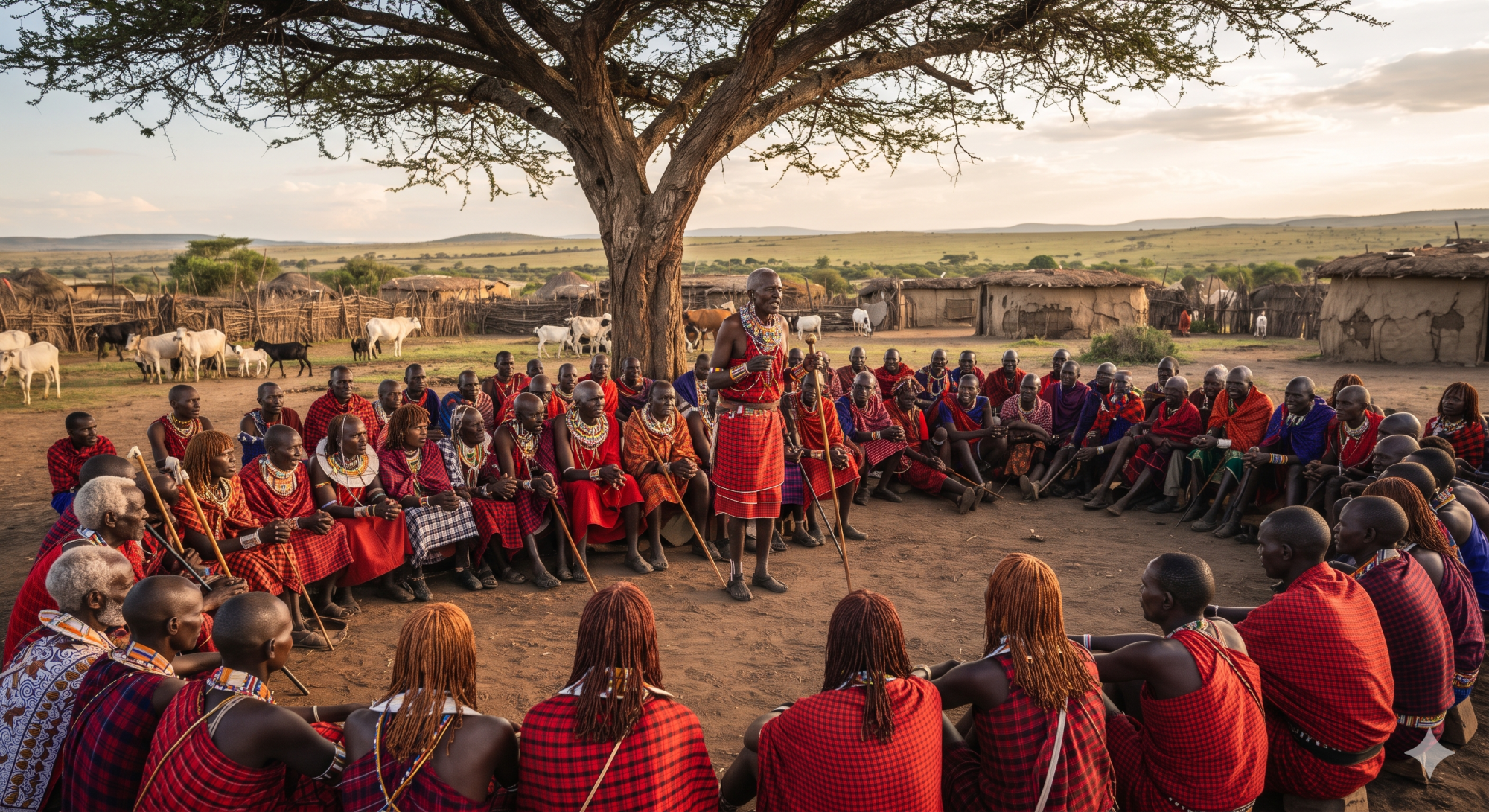
Deep within the breathtaking expanses of the Great Rift Valley, spanning the semi-arid and arid lands of southern Kenya and northern Tanzania, live the Maasai—an indigenous ethnic group whose very existence challenges modern concepts of time, wealth, and human resilience. While global tourism brochures frequently market the Maasai as a static, romanticized relic of an ancient Africa, ethnographical research reveals a remarkably dynamic society. They are master ecologists, sophisticated pastoral strategists, and intentional stewards of an ecosystem that hosts some of the planet’s most endangered megafauna. To understand the Maasai is to step beyond the standard cultural narratives found in mainstream travel blogs. This deep-dive exploration investigates hidden historical archives, specialized ecological monographs, nutritional anthropology, and unpublished demographic records to reveal the profound, scientifically fascinating, and frequently misunderstood reality of the Maasai Tribe.
1. Etymology, Deep Origins, and Linguistic Isolation
Popular culture often takes the name “Maasai” at face value, but linguistic and historical scholarship unpacks a far more complex ancestry.
The True Linguistic Root
The term “Maasai” translates literally to “one who speaks the Maa language”. However, anthropological linguistics classifies Maa as an Eastern Nilotic language, branching from the Nilo-Saharan language macro-family. This sets them apart linguistically from almost all of their surrounding neighbors, who predominantly speak Bantu-origin languages.
The Migration Myth vs. Oral History
For generations, colonial and early European accounts propagated the myth that the Maasai are recent arrivals who swept down from the Nile Valley of North Africa or the Horn of Africa during the 17th and 18th centuries, violently displacing indigenous populations. However, recent archaeological and oral historical cross-mapping reveals a much more nuanced picture of multi-directional assimilation, cooperative trade, and deep-rooted environmental adaptation rather than a single bloody conquest.
The Nilotic Cradle: Historical linguistics places their earliest ancestral homelands north of Lake Turkana in the arid borderlands of present-day Ethiopia and South Sudan.
The Southern Drift: Rather than a sudden invasion, demographic movements occurred in waves driven by periodic droughts, epizootic cattle diseases, and shifting alliances with Khoisan-speaking and Southern Cushitic populations already inhabiting the East African plains.
2. Demographic Realities and Livestock-to-Human Metrics
In standard economic terms, wealth is measured in fiat currency, real estate, or stock portfolios. In traditional Maasai society, wealth is measured through a complex, bio-economic indicator: the Tropical Livestock Unit (TLU) per capita.
The Bio-Economics of Pastoralism
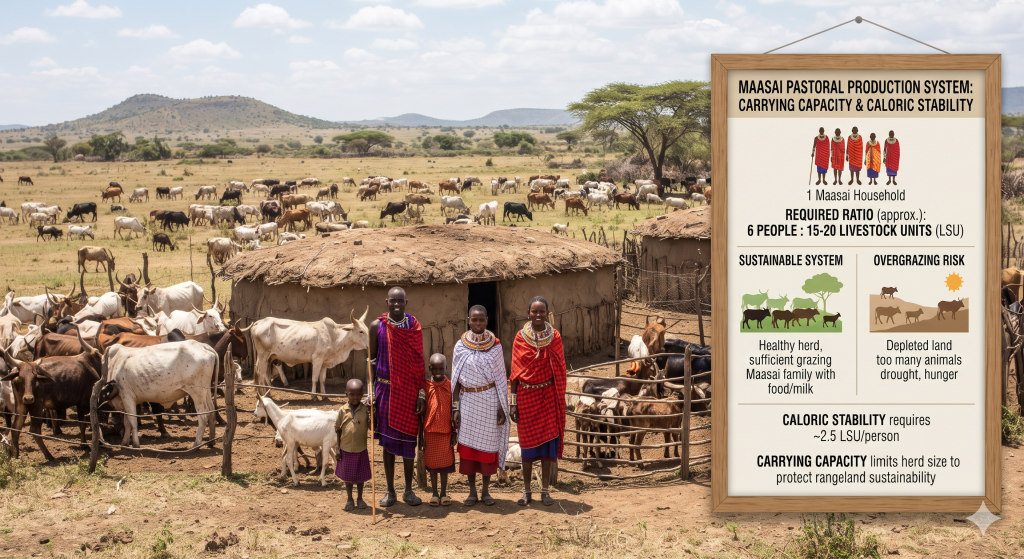
Ecological anthropology studies on Maasai pastoral production systems demonstrate that a human household requires a specific ratio of livestock to maintain caloric stability without destroying the local carrying capacity.
| Parameter | Traditional Metric / Value | Anthropological / Ecological Context |
| Average Family Unit | 8 to 10 individuals | Extended nuclear and polygynous family structures residing within a single boma (enkaji cluster). |
| Cattle Holdings per Family | 125 to 140 cattle | Essential threshold for sustaining a milk-and-blood-based diet during low-yield dry seasons. |
| Milch Cow Ratio | 57% to 60% of total herd | Herds are intentionally managed for high reproductive and lactation rates rather than immediate meat production. |
| Small Stock (Sheep/Goats) | Utilized for secondary trade | Used for micro-barter transactions, settling minor social fines, and cultural sacrifices. |
Parameter Traditional Metric / Value Anthropological / Ecological ContextAverage Family Unit 8 to 10 individuals Extended nuclear and polygynous family structures residing within a single boma (enkaji cluster).Cattle Holdings per Family 125 to 140 cattle Essential threshold for sustaining a milk-and-blood-based diet during low-yield dry seasons.
Small Stock (Sheep/Goats) Utilized for secondary trade Used
The Demographics of Adversity: The Emutai Catastrophe
No historical overview of Maasai demographics is complete without examining the late 19th-century crisis known as Emutai (meaning “to wipe out” or “complete destruction” in the Maa language). Between 1883 and 1902, a catastrophic convergence of ecological disasters devastated the community:
1. Contagious Bovine Pleuropneumonia (CBPP): Decimated local cattle populations.
2. The Rinderpest Pandemic: Introduced to East Africa via imported Italian cattle, this viral disease wiped out an estimated 90% to 95% of all cattle and wild ruminants across the region.
3. Smallpox and Famine: Human populations suffered massive mortality rates alongside their livestock.
Archival colonial reports and oral genealogies indicate that the Maasai population shrank by more than two-thirds during this twenty-year window. Many survivors were forced to temporarily seek refuge among neighboring agricultural communities, adopting cultivation and foraging until they could rebuild their herds—proving that the “pure pastoralist” identity is capable of remarkable structural flexibility.
3. Nutritional Anthropology: The Science of Milk, Blood, and Ethnobotany
Popular media often highlights the Maasai’s consumption of raw cattle blood and milk, but nutritional and physiological researchers have long been baffled by how a population subsisting almost entirely on saturated animal fats maintains low rates of cardiovascular disease.
The Sacred Diet: Beyond the Clichés
Classic nutritional surveys (such as those by Jacobs and subsequent medical anthropologists) reveal that traditional Maasai caloric intake relies heavily on three core pillars:
- Fresh and Sour Milk (Kule): Provides primary hydration, protein, and calcium.
- Bovine Blood (Osinkira): Harvested cleanly from the jugular vein of living cattle using specialized short arrows shot from close-range bows, ensuring the animal is not killed. This practice provides a rich, sustainable source of iron, sodium, and bio-available proteins without requiring slaughter.
- The Secret Pharmacopeia of Roots and Bark (Oltirai): What travel blogs omit is that Maasai men living out in the wilderness (Olopololi grazing areas) consume specialized soups brewed from the roots, barks, and stems of specific acacia and commiphora trees.
The Cholesterol Paradox Explained
Medical researchers studying Maasai warriors discovered that despite a diet consisting almost exclusively of milk, meat, and blood—yielding a massive daily intake of animal fat and cholesterol—their blood cholesterol levels remained surprisingly low. Clinical research points to two distinct factors:
1. Plant Saponins: The specialized barks and roots (Oltirai) boiled into their meat and soup broths contain high concentrations of bioactive saponins and tannins. These compounds bind to cholesterol in the digestive tract, preventing excessive systemic absorption.
2. Extreme Physical Energy Expenditure: A pastoral lifestyle requires sustained daily walking across rough terrain often exceeding 15 to 20 kilometers, maintaining metabolic efficiency that continuously burns high dietary lipid loads.
4. Ethno-Architecture: Engineering and Female Spatial Sovereignty
While Maasai society is frequently described as patriarchal—where elder men (Laigwenani) hold public political and judicial authority—the physical architecture of the community is entirely controlled by women.
The Inkajijik: A Masterclass in Indigenous Engineering
Maasai women design, construct, and structurally maintain every single hut (Inkajijik) within the boma (known as the enkaji).
Materials Science: The framework is built from bent wooden poles woven tightly together. The walls are plastered using a robust, highly resilient composite matrix of compressed mud, anthill earth, ash, and fresh cow dung.
Thermal Dynamics: The dung mixture acts as a natural binder that dries into a waterproof, crack-resistant seal. Because traditional African savannah nights can drop sharply in temperature while days are intensely hot, the thick composite walls provide exceptional thermal mass, keeping the interior cool during peak sun and warm during chilly nights.
Spatial Layout: Inside, the layout is meticulously organized. It includes a central hearth for cooking, a sleeping platform constructed from sticks and hides, and a partitioned space specifically reserved for newborn lambs and calves during freezing weather.
5. Social Organization, Age-Sets (Olaji), and Governance
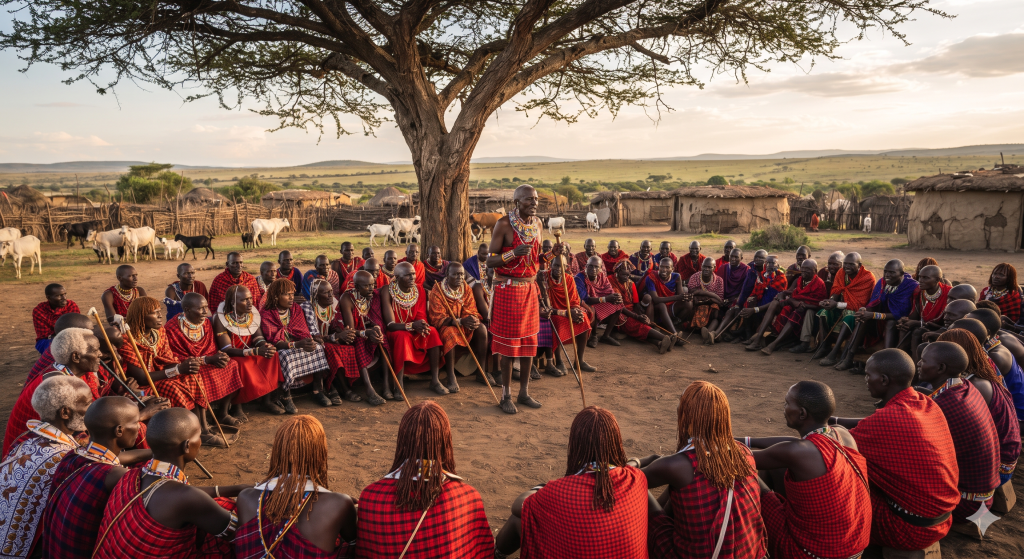
The social fabric of the Maasai does not rely on centralized kings or bureaucratic governments. Instead, it is regulated by a sophisticated, democratic age-set system (Olaji) that spans generations and maintains social order without police forces or written laws.
The Transition Phases
- Childhood (Nayiokotek Injore): Characterized by domestic chores, herding small livestock (goats and sheep) near the settlement, and learning tribal oral histories.
- Warriorhood (Moran or Ilmurran): Following circumcision and initiation rituals, young men enter the Moran stage. Historically tasked with defending herds from predators and rival communities, today’s Moran serve as environmental monitors, tracking wildlife movements and acting as cultural ambassadors.
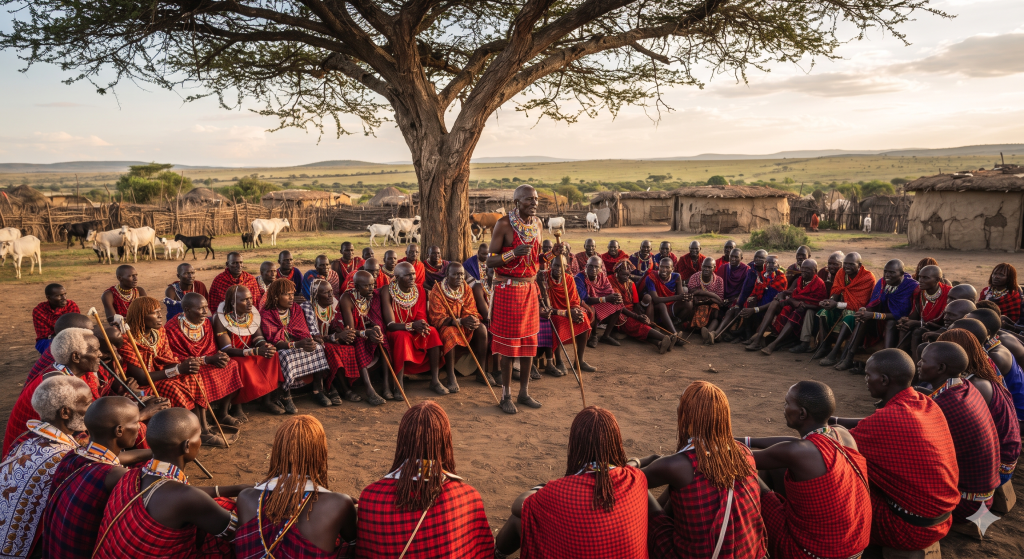
- Elderhood: After a multi-day transition ceremony (Eunoto), warriors graduate into junior elders, eventually joining the council of elders (Laigwenani). Power is decentralized; decisions are reached through exhaustive public discourse under sacred shade trees (Oreteti), where every adult male has a voice.
- Elderhood: After a multi-day transition ceremony (Eunoto), warriors graduate into junior elders, eventually joining the council of elders (Laigwenani). Power is decentralized; decisions are reached through exhaustive public discourse under sacred shade trees (Oreteti), where every adult male has a voice.
6. Conservation Paradox: Pastoralism vs. Fortress Conservation
One of the most pressing contemporary challenges facing the Maasai involves their relationship with state-sponsored conservation parks, such as the Maasai Mara National Reserve in Kenya and the Serengeti National Park in Tanzania.
The Myth of the “Pristine Wilderness
“Western conservation models historically operated on the premise of “Fortress Conservation”—the erroneous belief that nature can only thrive if indigenous human populations are forcibly evicted. When colonial governments established the Serengeti and Maasai Mara game reserves in the mid-20th century, hundreds of thousands of Maasai were displaced from their ancestral dry-season grazing grounds.
Ecological Synergy: Why Maasai Grazing Protects BiodiversityModern conservation biology and satellite remote-sensing studies have proven that traditional Maasai pastoralism does not destroy biodiversity—it actually enhances it.
- Rotational Grazing: Maasai pastoralists utilize traditional herbivory patterns that mimic native wildlife migrations. Moving cattle prevent the dominance of coarse, unpalatable grasses, encouraging fresh shoots that feed zebras, wildebeest, and gazelles.
- Human-Wildlife Coexistence: Unlike fenced agricultural lands that block wildlife corridors, pastoral Maasai lands serve as permeable buffer zones. Studies confirm that wildlife populations thrive adjacent to Maasai settlements because the community historically views predators like lions and leopards not as targets for extermination, but as elements of an interconnected natural order.
7. Modern Transitions: Navigating Education, Climate Change, and Globalization
Today, the Maasai stand at a complex crossroads. Globalization, climate change, and shifting land policies present both existential threats and opportunities for adaptation.
Climate Change and Variability
The Horn of Africa and East African savannahs are experiencing increasingly erratic rainfall patterns, prolonged droughts, and desertification. Traditional nomadic routes are restricted by private land fencing, agricultural expansion, and national park boundaries. To survive, many Maasai households have adopted a diversified livelihood strategy—combining pastoralism with small-scale agro-forestry, eco-tourism initiatives, and formal education.
Preservation Through Adaptation
Far from vanishing, the Maasai demonstrate that traditional cultures can successfully interface with the modern world without losing their core identity. Young Maasai professionals now serve as lawyers, wildlife conservationists, politicians, and software developers, using their global platforms to advocate for indigenous land rights, linguistic preservation, and sustainable climate policies.
Conclusion: The Enduring Legacy of the Savannah Guardians
The Maasai Tribe is far more than a cultural photo-opportunity on an East African safari. They are a testament to human adaptability, ecological wisdom, and cultural persistence. By balancing ancient traditions with modern realities, the Maasai continue to guard not only their unique heritage, but also the delicate ecological balance of the African savannahs they have called home for centuries. Their story teaches us that true preservation is not about freezing a culture in time, but about respecting the deep roots that allow a people to weather any storm.
