
The Forgotten Foresters: Exploring the Heritage, Culture, and Everyday Struggles of the Nagesia Tribe
High on the forested plateaus and across the undulating valleys where Chhattisgarh, Jharkhand, Odisha, and West Bengal meet, red clay roads wind through dense sal and mahua groves with Nagesia Tribe. In these remote highlands dwell the Nagesia—a community whose collective memory is written into forest paths, sacred groves, and traditional terraced fields rather than mainstream history books. Often categorized officially under the broader rubric of the Kisan tribe, the Nagesia possess an autonomous, deeply textured cultural identity shaped by an intimate bond with the central Indian biosphere.
Thank you for reading this post, don't forget to subscribe!To walk into a traditional Nagesia hamlet (tola) during the early dawn is to encounter a rhythm of existence that feels both ancient and precarious. The sound of women sweeping earthen courtyards with hand-bound grass brooms, the pungent warmth of morning woodsmoke rising from hand-laid tile roofs, and the distant ringing of cattle bells create an impression of bucolic calm. Beneath this calm lies an extraordinary history of ecological mastery, complex spiritual endurance, and an ongoing fight against economic marginalization, displacement, and cultural erasure.
Understanding the Nagesia requires looking past broad administrative labels like Scheduled Tribe and engaging directly with the lived experiences of real people: their ancestral roots, oral mythologies, village governance, culinary knowledge, and the systemic challenges they navigate every day.
Ancestral Roots: Who Are the Nagesia?
The Nagesia, also referred to by surrounding communities as Kisan (meaning “cultivator”), predominantly inhabit the Chota Nagpur Plateau and its adjoining hill ranges. Their settlements are concentrated across several districts:
- Chhattisgarh: Surguja, Balrampur, Jashpur, and Raigarh
- Jharkhand: Gumla, Simdega, Latehar, and Palamu
- Odisha: Sundargarh and Sambalpur
- West Bengal: Scattered pockets along the southwestern fringe bordering Jharkhand
Historically, ethnographic classifications conflated the Nagesia with larger neighboring Munda or Oraon populations. While they share geographic terrain and linguistic borrowings with their neighbors, the Nagesia maintain a distinct ethnic consciousness.
The Myth of the Serpent Ancestor The Three Sub-Divisions: Sinduria, Dhuria, and Telia
Oral traditions among village elders trace their lineage back to the Nag (serpent). In their foundational cosmology, the serpent is not a creature of danger or malice; it represents fertility, subterranean vitality, and the guardian spirit of moisture and soil. According to one widely recited folktale, an ancestral matriarch was rescued and guided through an impassable primeval wilderness by a divine serpent king. In gratitude and enduring alliance, her descendants assumed the name Nagesia, honoring a covenant that forbids them from deliberately harming snakes within their dwelling perimeter.
Intra-tribal structure is traditionally partitioned into three distinct sub-groups, each distinguished by ritual practice, historical caste interaction, and wedding ceremony customs:
- Sinduria: Considered the socially preeminent branch, the Sinduria use sindur (vermilion) during marriage ceremonies. They adopted certain regional Hindu ritual markers earlier than their peers, which fostered internal stratification.
- Dhuria: In contrast to the Sinduria, the Dhuria historically rejected manufactured pigments, instead employing dhul (sacred earth or dust) from the village threshold to seal the marital bond. Their identity is fiercely rooted in agrarian soil and raw ecological intimacy.
- Telia: The Telia traditionally use mustard or mahua oil (tel) during sanctification rituals and matrimonial rites, maintaining subtle dietary and ceremonial variances.
While modern education and market-town mobility have softened some of these historical demarcations, the triad remains a vital cultural marker during lineage worship, marital arrangements, and commemorative festivals.
The Geography of Survival: Highland Hamlets and the Forest Sphere
The physical landscape inhabited by the Nagesia is characterized by pat regions—elevated, flat-topped tablelands dissected by rapid seasonal streams and thick deciduous canopies. This topography historically served as both a sanctuary and an obstacle.
| Land Classification | Elevation / Terrain | Soil Profile | Primary Function for the Nagesia |
| Dhab / Pat | High plateaus (800–1,100 m) | Lateritic, red gravelly loam | Grazing, millets, rainfed pulses, and minor forest gathering |
| Tanr | Uplands and sloping ridges | Sandy, nutrient-poor, rocky | Drought-resistant crops: kodo, kutki, mustard, pulses |
| Don | Terraced valley bottoms | Clayey, alluvium-rich, high moisture | Wet rice cultivation (dhan), communal water reservoirs |
These hamlets rarely feature dense, clustered settlements. Instead, they sprawl across the landscape. Homesteads are built within walking distance of agricultural terraces (don) and upland plots (tanr). A typical traditional dwelling is constructed with thick wattle-and-daub walls reinforced with chopped straw, plastered with smooth cow dung, and topped with sloping timber frames bearing sun-baked clay tiles (khapra).
The home is designed for thermal balance, retaining cool air during dry-season heat waves and keeping inside temperatures steady during highland winters. It is built to store seed stocks safely, shelter small livestock within an integrated pen (khol), and provide a dedicated sacred corner (bhitar) where the spirits of ancestors (Muan) reside.
The surrounding forest is an extension of the homestead. The sal tree (Shorea robusta) provides timber for house posts, leaves for biodegradable plates, resin for incense, and canopy cover for medicinal herbs. The mahua tree (Madhuca longifolia) serves as a foundational seasonal resource: its dried blossoms provide nourishment during lean spring months, while its pressed seeds yield cooking oil.
Kinship, Family, and Social Organization
Kinship among the Nagesia is organized around patrilineal exogamous clans known as gotras or killis. These clans often carry totemic associations linked to regional fauna, birds, trees, or geographical features.
The Totemic Clan Structure
A clan member never intentionally kills, consumes, or fells their totem. If a clan’s totem is a specific waterfowl or wild grass, encountering that animal or plant dead demands a symbolic period of respect. Totemic identification serves three key purposes:
- It reinforces ecological kinship, creating a lived connection between human lineage and forest biodiversity.
- It regulates marriage alliances, as intra-clan marriage (sagotra) is strictly taboo and considered a violation of ancestral law.
- It establishes a mutual-aid network; a Nagesia traveler arriving in an unfamiliar village can seek shelter and food from any household sharing their totem.
Marriage and Alliances
Monogamy is the operational standard within the community. Marriages are traditionally arranged through negotiations led by family elders and a respected mediator (agua). Unlike dowry-driven mainstream systems, the traditional Nagesia framework centered on the payment of a symbolic bride price (suk or bari), consisting of cattle, grains, and handmade garments given to the bride’s family. This practice acknowledged the economic loss of a working daughter to her natal family and affirmed her value within the labor network.
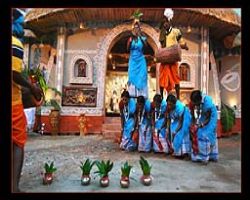
Other recognized marriage forms show the community’s adaptive flexibility:
- Dhuku (Living Together by Choice): A long-standing practice where a couple lives together, raises children, and shares economic duties without an immediate formal wedding ceremony. Formalization often occurs decades later—sometimes alongside the weddings of their adult children—when the family can afford the celebratory feast for the village council.
- Ghar-Jiya (Service Marriage): If a family lacks male heirs or requires farming labor, a prospective groom may reside in the bride’s home, contributing agricultural labor for a negotiated term of years before settling independently.
- Levirate and Sororate: Widow remarriage (sagai) and the union of a widower with his deceased wife’s younger sister are socially accepted, designed to keep dependent children within the collective kinship circle.
Village Governance: The Parha and Traditional Councils
Before formal Panchayati Raj systems expanded into tribal hinterlands, Nagesia villages relied on a dual-track leadership structure that balanced civic and spiritual matters:
- The Baiga or Pahan: The spiritual custodian. The Baiga conducts seasonal rituals, communes with earth deities, pacifies forest energies, and purifies areas affected by taboos.
- The Mahto or Mukhia: The administrative and judicial head. The Mahto convenes the council of elders to resolve boundary disputes, family divisions, property arguments, and breaches of customary law.
- The Parha Council: A confederated regional forum composed of leaders from five, seven, or twelve contiguous villages. The Parha handles complex cross-hamlet disputes, appeals over ostracism (chheka), and collective negotiations with external authorities.
Spiritual World: Sacred Groves, Deities, and Seasonal Rhythms
The Nagesia religious worldview is animistic, nature-based, and intertwined with their agrarian work. While historical contact with neighboring Hindu traditions led to the inclusion of figures like Mahadev and Parvati, the heart of everyday worship rests in local soil spirits, lineage ghosts, and forest guardians.
The Sacred Geography of the Sarna
Every authentic Nagesia settlement maintains a Sarna (or Jaherthan)—a protected copse of climax forest trees (predominantly ancient sal) located on the village perimeter.
The Ecological Ethic of the Sarna:
The Sarna is not merely a symbolic shrine; it is a sacred biosphere where modern human intervention is strictly forbidden. No branch may be lopped, no green wood harvested, and no soil overturned. The Sarna preserves an undisturbed baseline of original regional vegetation, acting as a natural micro-reserve, a windbreak, a bird sanctuary, and a living seed repository of endemic plants.
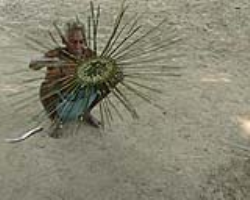
Within the Sarna dwells Gaon-Deoti or Chala Pachho, the mother guardian of village welfare. Before any agricultural activity begins—whether clearing land, sowing the first seeds, or harvesting—the Baiga offers hand-ground rice flour, clarified butter, and livestock libations within the Sarna, petitioning the earth for rain and crop health.
Major Festivals and Cultural Celebrations
The Nagesia calendar tracks seasonal transitions. Celebrations mark real biological and agricultural events rather than abstract theological dates.
| Sarhul | Sarhul | Sohrai |
| Spring (March-April) | Monsoon (August-Sept) | Winter (Oct-Nov) |
| Sal blossoms open | Vitality of young crops | Post-harvest cattle |
| Gathering season starts Youth dance | Sisterhood gratitude | Wall paintings |
- Sarhul (Baha Parab)
Celebrated in the spring (Phalgun–Chaitra) when the sal trees burst into fragrant white-yellow blossoms, Sarhul honors the marriage between the Earth (Dharati) and the Sun (Suraj). No Nagesia will bring newly emerged forest produce, edible flowers, or tender bamboo shoots into their cooking pot until Sarhul is completed.
During the festival, the Baiga examines water levels in earthen pots left overnight at the Sarna to forecast the timing and strength of the coming monsoon. Twigs of flowering sal are distributed to every household and pinned above door lintels to invite peace and protect against crop disease.
- Karma Puja
Held during the monsoon month of Bhadra, Karma centers on the sacred kadamba or karam tree (Nauclea parvifolia). Young men cut three central branches from the forest and bring them into the center of the village dancing ground (akhra).
The festival honors agricultural vitality, strength, and mutual care between brothers and sisters. Dressed in handwoven cotton garments accented with peacock plumes and brass jewelry, young villagers dance around the Karam branches in undulating circles, accompanied by the syncopated rhythms of the mandar (clay body drum) and nagada (kettledrum).
- Sohrai / Bandna
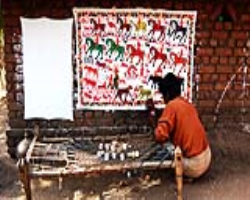
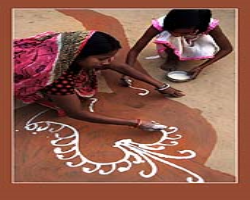
Following the autumn harvest, attention shifts to working livestock. Bullocks and buffaloes, essential partners in highland farming, are bathed in forest streams, their horns rubbed with oil and painted with natural pigments, and their necks draped with woven marigold garlands. Cattle sheds are purified with smoking incense, and homes are adorned with hand-painted mud friezes depicting deer, birds, and undulating forest trees.
Material Culture: Architecture, Diet, and Art
The material possessions of a traditional Nagesia family reflect long-term adaptation to highland life: simple, durable, zero-waste, and sourced from surrounding plants and soils.
Dietary Traditions and Indigenous Foraging
Food among the Nagesia is directly tied to seasonal availability. While polished white rice has increasingly entered the diet through public distribution shops, traditional staples center on hardy, nutrient-dense upland grains:
[ Spring ] ————> Mahua Flowers, Tender Bamboo Shoots (Karil), Sal Seeds
[ Monsoon ] ———–> Forest Mushrooms (Rugda/Puttu), Wild Greens (Bhatua, Katai)
[ Autumn / Winter ] —> Red Rice, Kodo-Kutki Millets, Horse Gram (Kulthi), Mustard
- Millets: Kodo (Paspalum scrobiculatum) and Kutki (Panicum sumatrense) are cultivated on rocky slopes. Cooked into thick porridges (pej), they provide sustained energy for long workdays in the fields.
- Wild Edibles: The Nagesia harvest dozens of uncultivated greens (saag), such as koenar, chakora, and munga. During the early monsoon, wild subterranean puffball mushrooms, known locally as rugda or puttu, are foraged from the bases of sal roots. Rich in plant protein, they are a prized seasonal food.
- Preserved Greens and Roots: Wild tubers (geethi, kanda) are dug up during times of food scarcity. Women dry surplus mahua flowers, tender bamboo shoots (karil), and wild greens to store for lean summer months.
- Indigenous Fermentation: Handia—a low-alcohol, nourishing rice beverage brewed with an herbal fermentation starter ball (ranu) containing up to twenty wild roots—remains central to social and ritual life. Handia is consumed during hard agricultural labor to replace electrolytes and is shared during community celebrations.
Traditional Tools and Craftsmanship
Nagesia men and women are skilled bamboo weavers and woodworkers. Common handmade household items include:
- Supa: A woven bamboo winnowing tray calibrated to separate chaff from grain using wind currents.
- Dauri and Tukni: Deep storage baskets and carrying baskets woven from split hill bamboo (Bambusa tulda), sealed with mud and cow dung to keep out pests.
- Khumri: A waterproof conical hat-cum-cloak made of split bamboo and dry gudhul leaves, worn by farmers working open paddy fields during heavy monsoon downpours.
- Traditional Traps: Complex bamboo funnels (kumni) set into running field bunds to catch small freshwater fish and crabs during field flooding.
The Crucible of Modern Crises: Daily Struggles of the Nagesia
Behind the community’s rich cultural life lies an acute socioeconomic reality. Despite their knowledge of local ecology and their role as stewards of forest regions, the Nagesia face systemic marginalization that affects their health, food security, and long-term autonomy.
Systemic Pressures on the Nagesia
| Forest Access | Land Fragility | Economic Vulnerability |
| Reserve laws | Poor irrigation | Distress migration to brick |
| Loss of minor | Low crop yields | kilns and construction sites |
| forest produce | Debt traps | Intermediaries taking margin |
- Forest Rights, Conservation Policies, and Land Alienation
For generations, the Nagesia managed highland environments through informal customary boundaries. The modernization of forestry laws, establishment of protected wildlife corridors, and growth of commercial plantations have fundamentally disrupted this relationship.
The Bureaucratic Forest Barrier
With the historical enforcement of the Indian Forest Act (1927) and subsequent conservation measures, traditional commons (nistar lands) were designated as Reserve Forests or Protected Sanctuaries. Communities that had gathered fuel, medicinal roots, and construction bamboo for centuries found their daily activities reclassified as trespassing or illicit extraction.
The Scheduled Tribes and Other Traditional Forest Dwellers (Recognition of Forest Rights) Act, 2006 (FRA) promised a historic correction to this exclusion by granting legal individual forest rights (IFR) and community forest rights (CFR). On the ground, progress has faced significant hurdles:
- High Claim Rejections: Forest rights committees frequently reject Nagesia claims due to a lack of documentary evidence, surveying delays, or administrative red tape.
- Incomplete Community Rights: While some individual cultivating families have obtained conditional pattas (land titles), Community Forest Resource Rights—which give the village council the legal right to protect, manage, and regenerate forests—are rarely recognized.
- Loss of Grazing Lands: Compulsory afforestation programs often prioritize commercial timber, like teak or eucalyptus, over diverse mixed forests. These monoculture plantations choke out understory grazing herbs, stripping Nagesia livestock of natural foraging grounds.
Land Alienation and Indebtedness
Although protective legislation exists to prevent the transfer of tribal land to non-tribal buyers, informal alienation persists. Highland fields often lack irrigation, leaving families vulnerable when seasonal rains fail. A medical emergency, wedding expense, or funeral feast frequently forces a household to turn to informal moneylenders (mahajans).
Operating outside formal banking systems, these moneylenders charge high monthly interest rates. When cash cannot clear the balance, the family’s best lowland rice terraces are transferred through informal leases (usufructuary mortgage), leaving the family landless in practice while remaining the nominal titleholders on official registries.
Economic Realities: Rainfed Agriculture and Seasonal Distress Migration
The economic baseline of the Nagesia remains precarious. Unlike farmers in river plains with canal networks and tube wells, highland agriculture depends almost entirely on the four-month Indian monsoon.
The Agrarian Bottleneck
- Topographic Drainage: High-plateau soils do not retain surface water easily. Without check-dams, contour trenches, and lift-irrigation systems, monsoon rainfall drains rapidly into lower gorges.
- Access to Inputs: Marginal farmers cannot easily afford certified seed variants, balanced fertilizers, or modern cold-storage facilities.
- Climate Instability: The growing unpredictability of the monsoon—marked by delayed starts, extended mid-season dry spells, and intense downpours—regularly damages both sensitive young rice seedlings and highland millet crops.
The Distress Migration Cycle
Once the paddy harvest is brought home in November, economic activity in the villages slows down. With no secondary winter harvest (rabi) possible on dry fields, a large share of the working-age population is swept into annual distress migration.
Trucks and private contractors arrive in the hamlets, offering cash advances to families facing debt. Young couples, sometimes taking their youngest children with them, travel to distant labor markets:
- Brick Kilns: Operating across Uttar Pradesh, West Bengal, and Bihar, where families work 14- to 16-hour days molding clay into raw bricks.
- Urban Construction Sites: Working as day laborers in rapidly expanding cities like Delhi, Raipur, and Surat.
- Commercial Agriculture: Seasonal harvesting work across Punjab, Haryana, or Andhra Pradesh.
This seasonal migration disrupts community life. Villages are left populated mainly by the elderly and young school-age children. Living conditions in the brick kilns are precarious: temporary plastic-sheet shanties, no clean drinking water, no sanitation, and hazardous working environments. Children miss continuous schooling, locking the next generation into the same cycle of low-wage migrant labor.
Access to Healthcare and the Education Deficit
The human development indicators in Nagesia-dominated administrative blocks highlight persistent gaps in public service delivery.
Healthcare Realities: Between Traditional Wisdom and Distant Clinics
The Nagesia possess extensive ethnobotanical knowledge. Village medicine specialists (Sirhas or Gunias) can identify wild roots, bark compounds, and plants to treat fever, snakebites, skin ailments, digestive problems, and joint pain.
This local botanical knowledge provides primary care for everyday ailments, but it cannot replace critical medical infrastructure during emergency health crises:
- Malaria and Waterborne Illness: Highland forests are endemic zones for falciparum malaria, dysentery, and seasonal hepatitis. Hand-pump wells often tap iron-heavy aquifers or become contaminated during heavy rain.
- Maternal Health and Malnutrition: Home births remain common across remote hamlets because reaching an institutional Primary Health Centre (PHC) requires walking kilometers over broken tracks or carrying patients on rope cots to a motorable road. Chronic anemia among women and acute stunting among children remain persistent concerns.
- The Accessibility Deficit: Sub-centers are often unstaffed or lack basic diagnostic tools and life-saving antivenom. Community Health Centres (CHCs) may sit 30 to 50 kilometers away. Transportation costs and lost daily wages lead families to delay hospital visits until an illness becomes critical.
Education: The Linguistic and Structural Divide
While formal school enrollment has increased through welfare programs and midday meal provisions, real educational outcomes face systemic obstacles:
- Language Barrier in Early Childhood: Nagesia children grow up speaking their mother tongue—Sadri or a regional ancestral dialect. When they enter the classroom, the medium of instruction is standard state Hindi or Odia. This linguistic gap alienates young learners, who struggle to master reading and writing in an unfamiliar language without bilingual transition programs.
- Teacher Absenteeism and Infrastructure: Primary schools in remote hilly hamlets frequently operate with a single teacher across all grades, or suffer from long-term staff vacancies. Classrooms often lack reliable electricity, functional toilets for girls, and library materials.
- The Gender Gap: While boys are increasingly encouraged to complete secondary school, girls in rural households shoulder substantial domestic and agricultural responsibilities: gathering firewood, herding livestock, caring for younger siblings, and cooking. As a result, female dropout rates rise sharply between primary and middle school.
The Path Forward: Rights, Sovereignty, and the Future of the Nagesia
Securing a stable, self-determined future for the Nagesia community does not require turning them into museum relics, nor does it mean forcing them to abandon their heritage to survive in exploitative urban labor markets. A meaningful path forward requires structural reform, community rights, and economic autonomy.
- Community Forest Governance
The administrative framework must pivot from bureaucratic obstruction to genuine community-led forestry under the Forest Rights Act. Granting full Community Forest Resource (CFR) rights gives Nagesia Gram Sabhas legal power to manage, harvest, protect, and regenerate their forest commons.
Coupling this legal security with local value-addition infrastructure can transform local incomes:
- Processing mahua into certified shelf-stable products, organic syrups, and food-grade extracts locally, bypassing predatory middlemen.
- Forming village-level cooperatives for sustainable harvesting of wild lac, chironji, harra, and bahera.
- Establishing fair-value cold storage and direct community-run market stalls in regional hubs.
- Decentralized Water Harvesting and Regenerative Farming
The solution to seasonal distress migration lies in capturing highland rainfall. State programs and civil society initiatives should prioritize low-cost, decentralized water infrastructure:
- Earthen Check-Dams and Loose Boulder Structures: Slowing runoff in gullies to recharge the water table.
- Contour Trenches and Farm Ponds (The “30-40 Model”): Capturing rainwater directly on sloping fields, turning single-crop rainfed land into productive, multi-season acreage.
- Revitalizing Traditional Millets: Establishing state procurement programs that purchase native kodo and kutki at supportive prices for inclusion in public distribution systems and school meal programs. This rewards sustainable farming while expanding local markets.
- Culturally Rooted Healthcare and Education
- Mother-Tongue Early Education: Implementing multilingual curricula in early childhood centers (Anganwadis) and primary schools, using Sadri-speaking teachers and locally contextualized learning materials.
- Mobile Highland Health Clinics: Deploying fully equipped mobile medical vans with malaria diagnostic kits, rapid treatments, prenatal support, and polyvalent antivenom to visit weekly market villages (haats).
- Empowering the Traditional Council: Ensuring Gram Sabhas have meaningful, binding authority over local development programs, mining permissions, and public resource distribution, as intended by the Provisions of the Panchayats (Extension to Scheduled Areas) Act (PESA).
Voices from the Margins: A Call for Dignity and Recognition
The story of the Nagesia tribe is not a simple tragedy, nor is it a romanticized pastoral myth. It is the real-world account of an Indian indigenous community that has protected its identity, its ancestral forests, and its cultural cohesion through centuries of change.
Their social fabric is rooted in traditions modern society often lacks: a deep balance with surrounding ecology, an egalitarian ethos that shares community labor, and an ability to find joy in drumbeats and seasonal blossoms even in the face of poverty.
Preserving this heritage requires more than passive sympathy. It demands land security, fair economic access, educational resources, and institutional respect for their rights as original inhabitants of the land. Only when the Nagesia can make their own choices—safeguarding their sacred groves while enjoying accessible healthcare, modern clean water, and self-directed education—can this community claim the dignified, secure future they have earned over generations.
